Molecular geometryChapter 6.5
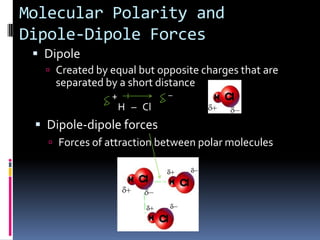
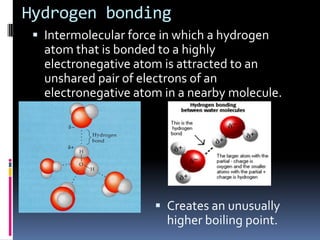
ObjectivesExplain VSEPR theoryPredict the shapes of molecules or polyatomic ions using VSEPR theoryExplain how the shapes of molecules are accounted for by the hybridization theoryDescribe dipole-dipole forces, hydrogen bonding, induced dipoles, and London dispersion forcesExplain what determines molecular polarity
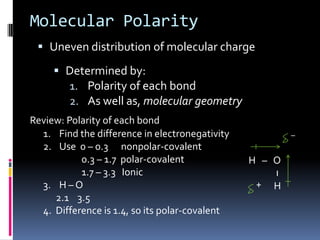
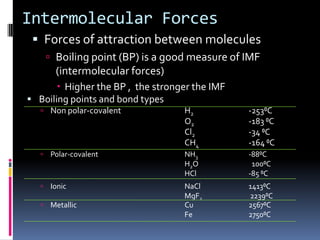
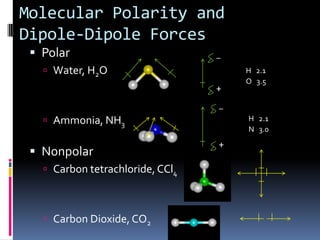
Molecular PolarityUneven distribution of molecular chargeDetermined by:Polarity of each bondAs well as, molecular geometryReview: Polarity of each bondFind the difference in electronegativityUse  0 – 0.3      nonpolar-covalent	   0.3 – 1.7  polar-covalent		   1.7 – 3.3   IonicH – O      2.1    3.54.  Difference is 1.4, so its polar-covalent_H   –   O            H  +
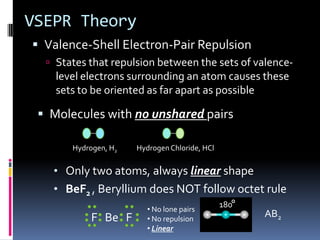
VSEPR TheoryValence-Shell Electron-Pair RepulsionStates that repulsion between the sets of valence-level electrons surrounding an atom causes these sets to be oriented as far apart as possibleMolecules with no unshared pairs
Only two atoms, always linear shape
BeF2, Beryllium does NOT follow octet rule	Hydrogen, H2Hydrogen Chloride, HCl180 No lone pairs
 No repulsion
LinearAB2F   Be   F
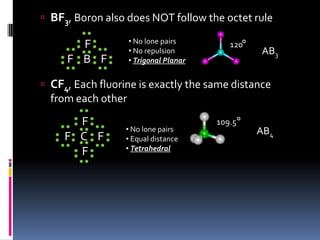
BF3, Boron also does NOT follow the octet rule        F   F    B    F No lone pairs
 No repulsion
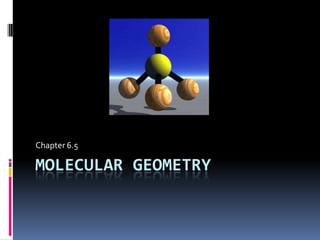
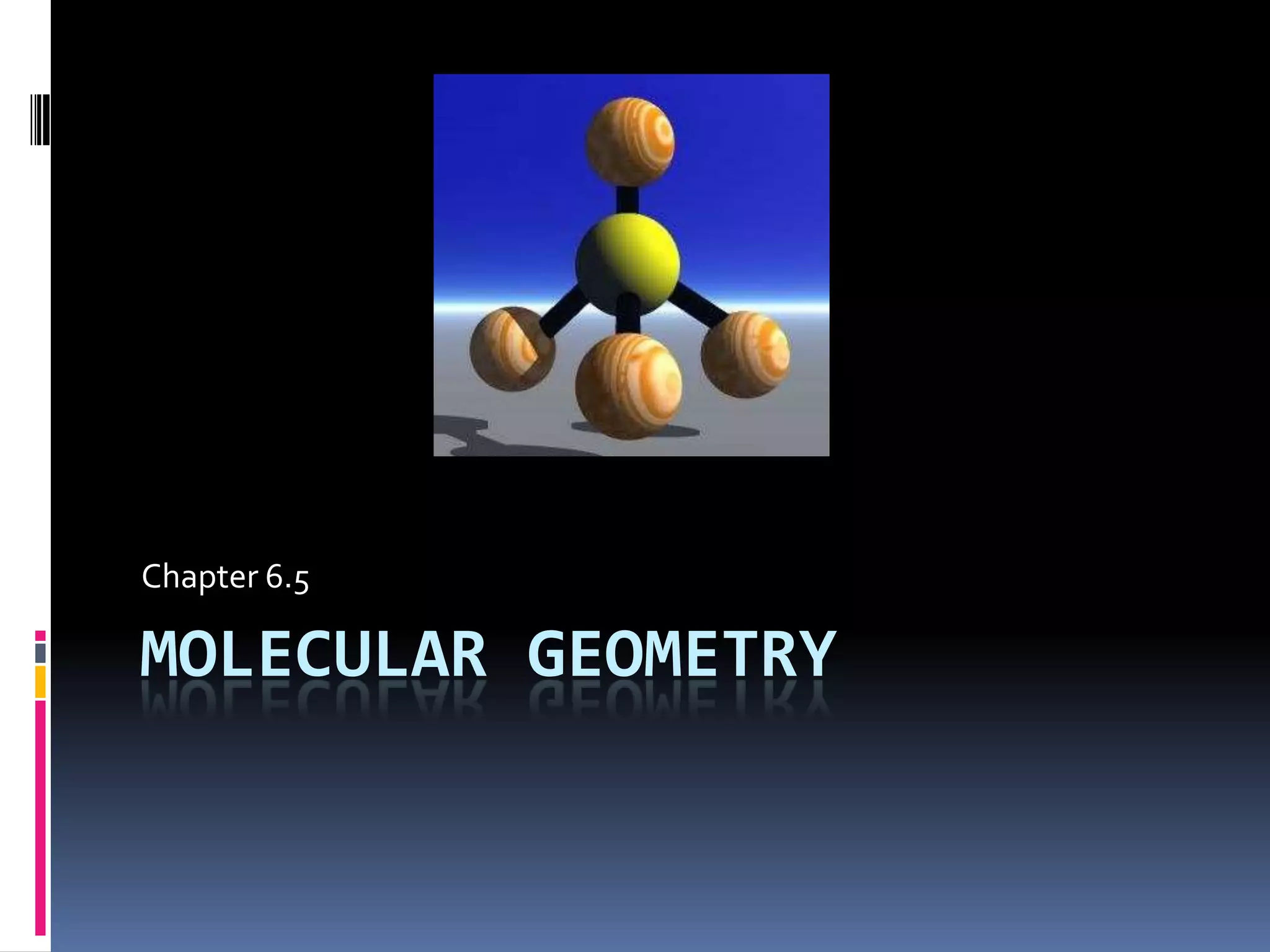
Trigonal Planar120AB3CF4, Each fluorine is exactly the same distance from each other       F   F    C    F       F109.5 No lone pairs
 Equal distance
TetrahedralAB4
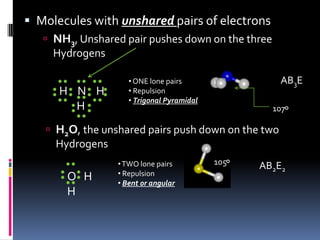
Molecules with unshared pairs of electrons
NH3, Unshared pair pushes down on the three HydrogensH    N    H       HAB3E ONE lone pairs
 Repulsion

Chapter 6.5 : Molecular Geometry