Chapter 5.3Electron Configurations and Periodic properties
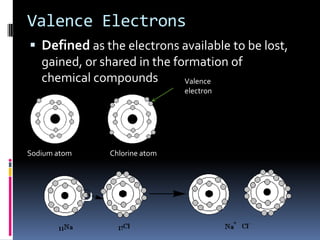
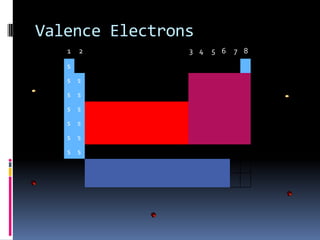
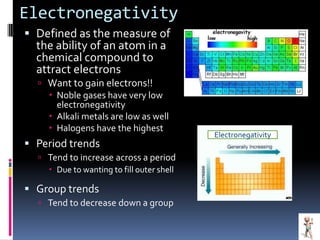
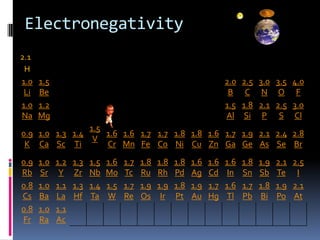
Objectives:Define atomic radii and ionic radii, ionization energy, electron affinity, and electronegativity.Compare periodic trends for these properties and state reasons for variations.Define valence electrons, and state how many are present in atoms of each main-group element. Compare the these same properties of d-block elements with those of the main-group elements
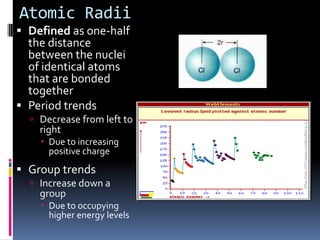
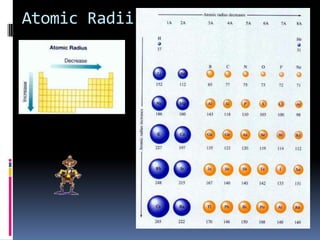
Atomic RadiiDefined as one-half the distance between the nuclei of identical atoms that are bonded togetherPeriod trendsDecrease from left to rightDue to increasing positive chargeGroup trends
Increase down a group
Due to occupying higher energy levelsAtomic Radii
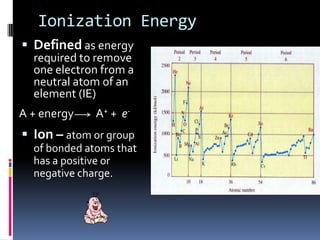
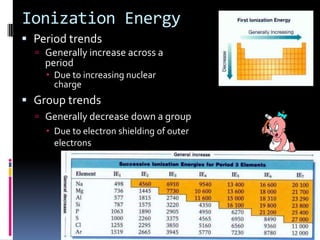
Ionization EnergyDefined as energy required to remove one electron from a neutral atom of an element (IE)A + energy         A+ +  e-Ion – atom or group of bonded atoms that has a positive or negative charge.Ionization EnergyPeriod trendsGenerally increase across a periodDue to increasing nuclear chargeGroup trends
Generally decrease down a group
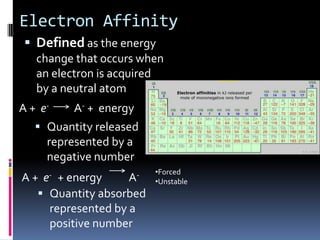
Due to electron shielding of outer electronsElectron AffinityDefined as the energy change that occurs when an electron is acquired by a neutral atomA +e-               A- +  energy Quantity released represented by a negative number
Forced
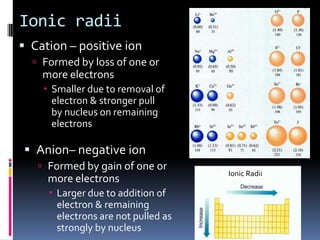
UnstableA +e-   + energyA-Quantity absorbed represented by a positive numberIonic radiiCation – positive ionFormed by loss of one or more electronsSmaller due to removal of electron & stronger pull by nucleus on remaining electronsAnion– negative ion
Formed by gain of one or more electrons
Larger due to addition of electron & remaining electrons are not pulled as strongly by nucleusIonic Radii

Chapter 5.3 : Electron Configuration and the Periodic Table

  • 1.
    Chapter 5.3Electron Configurationsand Periodic properties
  • 2.
    Objectives:Define atomic radiiand ionic radii, ionization energy, electron affinity, and electronegativity.Compare periodic trends for these properties and state reasons for variations.Define valence electrons, and state how many are present in atoms of each main-group element. Compare the these same properties of d-block elements with those of the main-group elements
  • 3.
    Atomic RadiiDefined asone-half the distance between the nuclei of identical atoms that are bonded togetherPeriod trendsDecrease from left to rightDue to increasing positive chargeGroup trends
  • 4.
  • 5.
    Due to occupyinghigher energy levelsAtomic Radii
  • 6.
    Ionization EnergyDefined asenergy required to remove one electron from a neutral atom of an element (IE)A + energy A+ + e-Ion – atom or group of bonded atoms that has a positive or negative charge.Ionization EnergyPeriod trendsGenerally increase across a periodDue to increasing nuclear chargeGroup trends
  • 7.
  • 8.
    Due to electronshielding of outer electronsElectron AffinityDefined as the energy change that occurs when an electron is acquired by a neutral atomA +e- A- + energy Quantity released represented by a negative number
  • 9.
  • 10.
    UnstableA +e- + energyA-Quantity absorbed represented by a positive numberIonic radiiCation – positive ionFormed by loss of one or more electronsSmaller due to removal of electron & stronger pull by nucleus on remaining electronsAnion– negative ion
  • 11.
    Formed by gainof one or more electrons
  • 12.
    Larger due toaddition of electron & remaining electrons are not pulled as strongly by nucleusIonic Radii