What Is Carbon ?


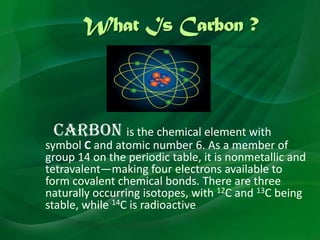
 CARBON is the chemical element with
symbol C and atomic number 6. As a member of
group 14 on the periodic table, it is nonmetallic and
tetravalent—making four electrons available to
form covalent chemical bonds. There are three
naturally occurring isotopes, with 12C and 13C being
stable, while 14C is radioactive
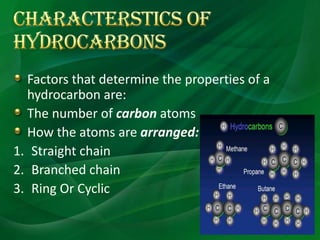
Factors that determine the properties of a
  hydrocarbon are:
  The number of carbon atoms
  How the atoms are arranged:
1. Straight chain
2. Branched chain
3. Ring Or Cyclic
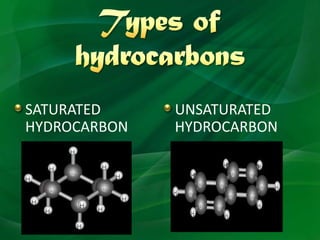
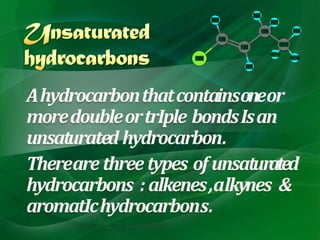
SATURATED     UNSATURATED
HYDROCARBON   HYDROCARBON
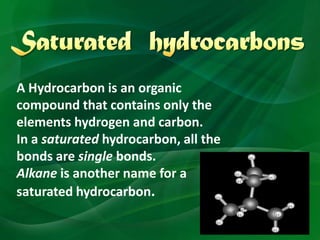
A Hydrocarbon is an organic
compound that contains only the
elements hydrogen and carbon.
In a saturated hydrocarbon, all the
bonds are single bonds.
Alkane is another name for a
saturated hydrocarbon.
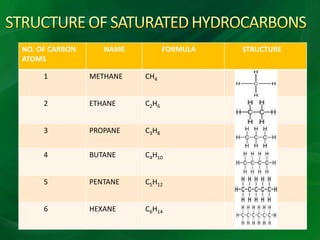
NO. OF CARBON      NAME          FORMULA   STRUCTURE
ATOMS

     1          METHANE   CH4


     2          ETHANE    C2H6


     3          PROPANE   C3H8


     4          BUTANE    C4H10


     5          PENTANE   C5H12


     6          HEXANE    C6H14
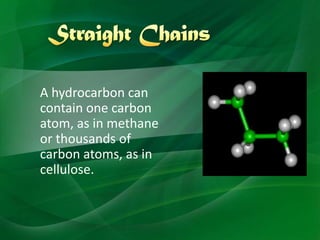
A hydrocarbon can
contain one carbon
atom, as in methane
or thousands of
carbon atoms, as in
cellulose.
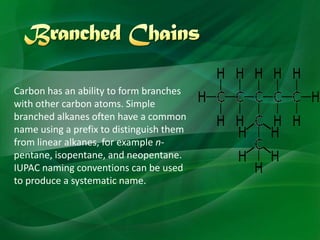
Carbon has an ability to form branches
with other carbon atoms. Simple
branched alkanes often have a common
name using a prefix to distinguish them
from linear alkanes, for example n-
pentane, isopentane, and neopentane.
IUPAC naming conventions can be used
to produce a systematic name.
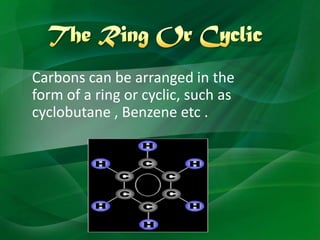
Carbons can be arranged in the
form of a ring or cyclic, such as
cyclobutane , Benzene etc .
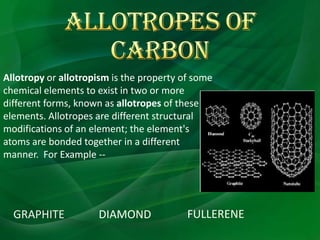
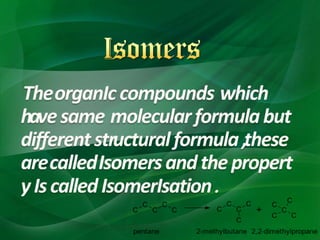
Allotropy or allotropism is the property of some
chemical elements to exist in two or more
different forms, known as allotropes of these
elements. Allotropes are different structural
modifications of an element; the element's
atoms are bonded together in a different
manner. For Example --


  GRAPHITE           DIAMOND              FULLERENE
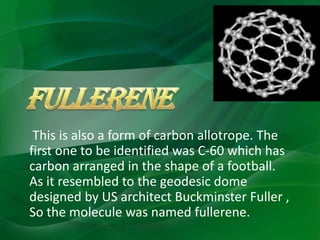
This is also a form of carbon allotrope. The
first one to be identified was C-60 which has
carbon arranged in the shape of a football.
As it resembled to the geodesic dome
designed by US architect Buckminster Fuller ,
So the molecule was named fullerene.
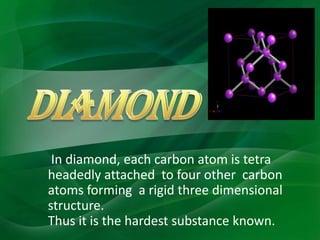
In diamond, each carbon atom is tetra
headedly attached to four other carbon
atoms forming a rigid three dimensional
structure.
Thus it is the hardest substance known.
In organic chemistry, functional groups
are specific groups of atoms within
molecules that are responsible for the
characteristic chemical reactions of those
molecules. The same functional group will
undergo the same or similar chemical
reaction(s) regardless of the size of the
molecule it is a part of.
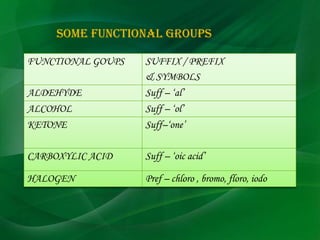
SOME FUNCTIONAL GROUPS

FUNCTIONAL GOUPS   SUFFIX / PREFIX
                   & SYMBOLS
ALDEHYDE           Suff – ‘al’
ALCOHOL            Suff – ‘ol’
KETONE             Suff–‘one’

CARBOXYLIC ACID    Suff – ‘oic acid’

HALOGEN            Pref – chloro , bromo, floro, iodo
Carbon and its compounds

Carbon and its compounds

  • 2.
    What Is Carbon? CARBON is the chemical element with symbol C and atomic number 6. As a member of group 14 on the periodic table, it is nonmetallic and tetravalent—making four electrons available to form covalent chemical bonds. There are three naturally occurring isotopes, with 12C and 13C being stable, while 14C is radioactive
  • 3.
    Factors that determinethe properties of a hydrocarbon are: The number of carbon atoms How the atoms are arranged: 1. Straight chain 2. Branched chain 3. Ring Or Cyclic
  • 4.
    SATURATED UNSATURATED HYDROCARBON HYDROCARBON
  • 5.
    A Hydrocarbon isan organic compound that contains only the elements hydrogen and carbon. In a saturated hydrocarbon, all the bonds are single bonds. Alkane is another name for a saturated hydrocarbon.
  • 7.
    NO. OF CARBON NAME FORMULA STRUCTURE ATOMS 1 METHANE CH4 2 ETHANE C2H6 3 PROPANE C3H8 4 BUTANE C4H10 5 PENTANE C5H12 6 HEXANE C6H14
  • 8.
    A hydrocarbon can containone carbon atom, as in methane or thousands of carbon atoms, as in cellulose.
  • 9.
    Carbon has anability to form branches with other carbon atoms. Simple branched alkanes often have a common name using a prefix to distinguish them from linear alkanes, for example n- pentane, isopentane, and neopentane. IUPAC naming conventions can be used to produce a systematic name.
  • 10.
    Carbons can bearranged in the form of a ring or cyclic, such as cyclobutane , Benzene etc .
  • 11.
    Allotropy or allotropismis the property of some chemical elements to exist in two or more different forms, known as allotropes of these elements. Allotropes are different structural modifications of an element; the element's atoms are bonded together in a different manner. For Example -- GRAPHITE DIAMOND FULLERENE
  • 13.
    This is alsoa form of carbon allotrope. The first one to be identified was C-60 which has carbon arranged in the shape of a football. As it resembled to the geodesic dome designed by US architect Buckminster Fuller , So the molecule was named fullerene.
  • 14.
    In diamond, eachcarbon atom is tetra headedly attached to four other carbon atoms forming a rigid three dimensional structure. Thus it is the hardest substance known.
  • 16.
    In organic chemistry,functional groups are specific groups of atoms within molecules that are responsible for the characteristic chemical reactions of those molecules. The same functional group will undergo the same or similar chemical reaction(s) regardless of the size of the molecule it is a part of.
  • 17.
    SOME FUNCTIONAL GROUPS FUNCTIONALGOUPS SUFFIX / PREFIX & SYMBOLS ALDEHYDE Suff – ‘al’ ALCOHOL Suff – ‘ol’ KETONE Suff–‘one’ CARBOXYLIC ACID Suff – ‘oic acid’ HALOGEN Pref – chloro , bromo, floro, iodo