CHROMOSOMAL ABNORMALITIES


PRESENTED BY:DR. BISWAJEETA SAHA(PGT,1ST YR),
MODERATOR-DR.A.K.ADHYA(ASST. PROF),DEPT OF
PATHOLOGY,KIMS,BBSR
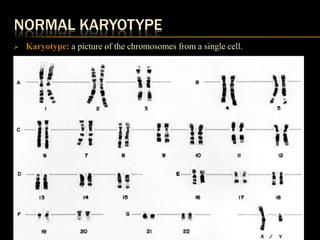
NORMAL KARYOTYPE
   Karyotype: a picture of the chromosomes from a single cell.
International system for
human cytogenetic
nomenclature.


eg- Xp21.2


Eg-47,XY,+21
NUMERICAL ABNORMALITIES

   Euploid-any exact multiple of haploid

   Aneuploidy-chromosome compliment that is not an exact mutiple of 23
        Nondisjunction

        Anaphase lag


   Mosaicism-mitotic error in early development give rise to 2 /more population
    of cells with different chromosomal complement in some individual
             EG-45X/47XXX mosaic
STRUCTURAL ABNORMALITIES
   Deletions-loss of a portion of chromosome


                 Eg-46,XY,del(16)(p11.2p13.1)
RING CHROMOSOME


          Eg-46,XY,r(16)
   Insertion
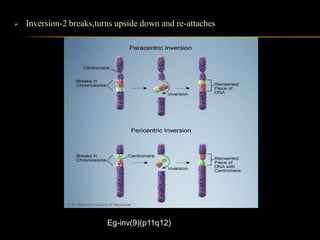
   Inversion-2 breaks,turns upside down and re-attaches


                          Eg-inv(9)(p11q12)
   Isochromosome-one arm is lost,other arm is reduplicated
   Translocation-one segment transferred to another.


                  Eg-46,XY,t(2:5)(p12;q14)
CLINICAL
ABNORMALITIES
SPONTANEOUS ABORTIONS


   1 in 200 live born children is chromosomally abnormal


   95% of chromosomally abnormal conceptus are aborted spontaneously


   Abortion mostly occurs in 1st trimester
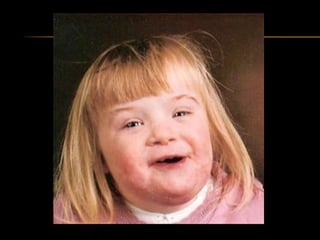
DOWN SYNDROME


   Incidence-1 in 700

   95% have trisomy 21,chromosome no 47

   1% cases are mosaics.-mitotic nondisjunction

   4% cases-extra chromosomal material derives from presence of robertsonian

    translocationof long arm of chromosome 21 to acrocentric chromosome.

   10 to 20 fold increased risk of deveoping leukemia
CHROMOSOME 22q11.2 DELETION SYNDROME
   Small deletion of band q11.2 on long arm of chromosome 22.
   1 in 4000 births
   Congenital heart defects ,palatal abnormalities, facial dysmorphism,
    developmental delay,T-cell immunodeficiency and hypocalcemia
   High risk for schizophrenia and bipolar disorder
TRISOMY 18
   Incidence 1/8000

   Overlaps with trisomy 13

   Sever Mental retardation

   >90% dead in 1st year

   Small face with prominant occiput

   Small sternum and pelvis

   Flexion deformity of the finger

   VSD and horseshoe kidney
TRISOMY 13(PATAU SYNDROME)

   Severe developmetal retardation

   Incidence 1/20000

   90% dead in the 1st year

   Midline brain defect

   Malformed ear

   Micropthalmos and coloboma

   Scalp defect
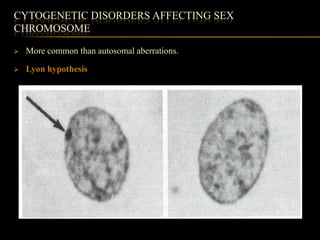
CYTOGENETIC DISORDERS AFFECTING SEX
CHROMOSOME

   More common than autosomal aberrations.

   Lyon hypothesis
TURNER SYNDROME
   Complete or partial monosomy of X chromosome
   Hypogonadism in phenotypic females
   1 in 2000 live born females
   57% missing an entire X chromosome-45,X karyotype
   14% have structural abnormalities of X chromosome
   29% are mosaics
   Structural abnormalities are-
   Deletion of small arm-isochromosome of long arm-46,X,i(X)(q10)
   Deletion of portion of both long and short arms-ring chromosome-46,X,r,(X)
   Deletion of portion of short or long arm-46X,del(Xq)
   Mosaic patterns-
   45,X/46,XX
   45,X/46,XY
   45,X/47XXX
   45,X/46,X,i(X),(q10)
   Female, short stature, primary amenorrhea, sterility, spares hair and
    underdeveloped breast

   Neonatal: wide spaced nipple, lymphedema , shield chest,
KLINEFELTER SYNDROME
   Male hypogonadism occur when there are 2 /more X chromosome and one
    /more Y chromosome.

   1 in 660 live male births

   Eunuchoid body habitus,abnormally long legs,small atrpohic testis,lack of
    secondary male characteristics

   Increased incidence of type 2 diabetes,metabolic syndrome

   Higher risk of breast cancer,extragonadal germ cell tumor and autoimmune
    diseases

   47,XXY-90% cases

   15% cases are mosaics
HERMAPHRODITISM
   GENETIC SEX

   PHENOTYPIC SEX

   PSEUDOHERMAPHRODITISM

   TRUE HERMAPHRODITISM

   FEMALE PSEUDOHERMAPHRODITISM-excessive and innapropriate
    exposure to androgenic steroids during early gestation

   MALE PSEUDOHERMAPHRODITISM-extremely heterogenous.most
    common –defective virilization of male embryo(complete androgen
    insensitivity syndrome)
KARYOTYPING


   3 main methods to identify chromosomes

   G BANDING-------giemsa

   Q BANDING-------quinacrine

   R BANDING-------reverse
SUBCLASSIFICATIONS OF BANDING METHODS
ISCN            1985


   3 letter code to describe banding techniques.

   Ist letter---type of banding

   2nd letter—general technique

   3rd letter—the stain


   Eg-QFQ------Q band by flourescence using quinacrine
G BANDING

   System of dark and light bands throughout the euchromatin part of
    chromosome

   Staining technique where chromosomes are treated with trypsin then with
    giemsa stain

   Needs metaphase

   Culture cells until sufficient mitotic activity

   Add colchicine to arrest in metaphase
TERMS AND DEFINITIONS OF VARIOUS ABERRATIONS OF
CHROMOSOMES


   Ring( r)

   Dicentric(d)                          Hyperdiploid (h)

   Chromosome gap (sg)                   Chromatid deletion (td)

   Fragment (f)                          Acentric fragment (af)

   Translocation (t)                     Triradial (tr)

   Quadriradial (qr)

   Complex rearrangement (cr)

   Polyploid (pp) or endoreduplication
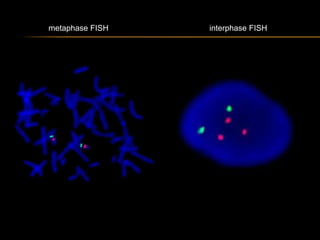
FLOURESCENT IN SITU HYBRIDISATION(FISH)
   Fluorescence in situ hybridization (FISH) uses fluorescent molecules to ―paint‖
    genes or chromosomes.


   This technique is for gene mapping, identification of chromosomal
    abnormalities


   FISH involves the use of short sequences of single-stranded DNA (probes)
    which are labeled with fluorescent tags, to hybridize, or bind, to the
    complementary DNA to see the location of those sequences of DNA under the
    fluorescent microscope.
metaphase FISH   interphase FISH
ADVANTAGES OF FISH

   Rapid


   High efficiency of hybridization and detection


   Lots of cells can be analyzed


   Cells do not have to be replicating
SPECTRAL KARYOTYPING
   Chromosomal and subchromosomal painting probes that make use
    of sorted or microdissected chromosomes
Mixtures of fluorophores used to separately label chromosome-specific probes


These are mixed and hybridized en masse


 Interpreted via spectral interferometer


Tremendously useful in detecting insertions and translocations,


especially in cancers.
THANK YOU

Chromosomal abnormalities

  • 1.
    CHROMOSOMAL ABNORMALITIES PRESENTED BY:DR.BISWAJEETA SAHA(PGT,1ST YR), MODERATOR-DR.A.K.ADHYA(ASST. PROF),DEPT OF PATHOLOGY,KIMS,BBSR
  • 2.
    NORMAL KARYOTYPE  Karyotype: a picture of the chromosomes from a single cell.
  • 3.
    International system for humancytogenetic nomenclature. eg- Xp21.2 Eg-47,XY,+21
  • 4.
    NUMERICAL ABNORMALITIES  Euploid-any exact multiple of haploid  Aneuploidy-chromosome compliment that is not an exact mutiple of 23  Nondisjunction  Anaphase lag  Mosaicism-mitotic error in early development give rise to 2 /more population of cells with different chromosomal complement in some individual  EG-45X/47XXX mosaic
  • 6.
    STRUCTURAL ABNORMALITIES  Deletions-loss of a portion of chromosome Eg-46,XY,del(16)(p11.2p13.1)
  • 7.
    RING CHROMOSOME Eg-46,XY,r(16)
  • 8.
    Insertion
  • 9.
    Inversion-2 breaks,turns upside down and re-attaches Eg-inv(9)(p11q12)
  • 10.
    Isochromosome-one arm is lost,other arm is reduplicated
  • 11.
    Translocation-one segment transferred to another. Eg-46,XY,t(2:5)(p12;q14)
  • 13.
  • 14.
    SPONTANEOUS ABORTIONS  1 in 200 live born children is chromosomally abnormal  95% of chromosomally abnormal conceptus are aborted spontaneously  Abortion mostly occurs in 1st trimester
  • 15.
    DOWN SYNDROME  Incidence-1 in 700  95% have trisomy 21,chromosome no 47  1% cases are mosaics.-mitotic nondisjunction  4% cases-extra chromosomal material derives from presence of robertsonian translocationof long arm of chromosome 21 to acrocentric chromosome.  10 to 20 fold increased risk of deveoping leukemia
  • 18.
    CHROMOSOME 22q11.2 DELETIONSYNDROME  Small deletion of band q11.2 on long arm of chromosome 22.  1 in 4000 births  Congenital heart defects ,palatal abnormalities, facial dysmorphism, developmental delay,T-cell immunodeficiency and hypocalcemia  High risk for schizophrenia and bipolar disorder
  • 19.
    TRISOMY 18  Incidence 1/8000  Overlaps with trisomy 13  Sever Mental retardation  >90% dead in 1st year  Small face with prominant occiput  Small sternum and pelvis  Flexion deformity of the finger  VSD and horseshoe kidney
  • 21.
    TRISOMY 13(PATAU SYNDROME)  Severe developmetal retardation  Incidence 1/20000  90% dead in the 1st year  Midline brain defect  Malformed ear  Micropthalmos and coloboma  Scalp defect
  • 24.
    CYTOGENETIC DISORDERS AFFECTINGSEX CHROMOSOME  More common than autosomal aberrations.  Lyon hypothesis
  • 25.
    TURNER SYNDROME  Complete or partial monosomy of X chromosome  Hypogonadism in phenotypic females  1 in 2000 live born females  57% missing an entire X chromosome-45,X karyotype  14% have structural abnormalities of X chromosome  29% are mosaics  Structural abnormalities are-  Deletion of small arm-isochromosome of long arm-46,X,i(X)(q10)  Deletion of portion of both long and short arms-ring chromosome-46,X,r,(X)  Deletion of portion of short or long arm-46X,del(Xq)  Mosaic patterns-  45,X/46,XX  45,X/46,XY  45,X/47XXX  45,X/46,X,i(X),(q10)
  • 26.
    Female, short stature, primary amenorrhea, sterility, spares hair and underdeveloped breast  Neonatal: wide spaced nipple, lymphedema , shield chest,
  • 27.
    KLINEFELTER SYNDROME  Male hypogonadism occur when there are 2 /more X chromosome and one /more Y chromosome.  1 in 660 live male births  Eunuchoid body habitus,abnormally long legs,small atrpohic testis,lack of secondary male characteristics  Increased incidence of type 2 diabetes,metabolic syndrome  Higher risk of breast cancer,extragonadal germ cell tumor and autoimmune diseases  47,XXY-90% cases  15% cases are mosaics
  • 29.
    HERMAPHRODITISM  GENETIC SEX  PHENOTYPIC SEX  PSEUDOHERMAPHRODITISM  TRUE HERMAPHRODITISM  FEMALE PSEUDOHERMAPHRODITISM-excessive and innapropriate exposure to androgenic steroids during early gestation  MALE PSEUDOHERMAPHRODITISM-extremely heterogenous.most common –defective virilization of male embryo(complete androgen insensitivity syndrome)
  • 30.
    KARYOTYPING  3 main methods to identify chromosomes  G BANDING-------giemsa  Q BANDING-------quinacrine  R BANDING-------reverse
  • 31.
    SUBCLASSIFICATIONS OF BANDINGMETHODS ISCN 1985  3 letter code to describe banding techniques.  Ist letter---type of banding  2nd letter—general technique  3rd letter—the stain  Eg-QFQ------Q band by flourescence using quinacrine
  • 32.
    G BANDING  System of dark and light bands throughout the euchromatin part of chromosome  Staining technique where chromosomes are treated with trypsin then with giemsa stain  Needs metaphase  Culture cells until sufficient mitotic activity  Add colchicine to arrest in metaphase
  • 34.
    TERMS AND DEFINITIONSOF VARIOUS ABERRATIONS OF CHROMOSOMES  Ring( r)  Dicentric(d) Hyperdiploid (h)  Chromosome gap (sg) Chromatid deletion (td)  Fragment (f) Acentric fragment (af)  Translocation (t) Triradial (tr)  Quadriradial (qr)  Complex rearrangement (cr)  Polyploid (pp) or endoreduplication
  • 35.
    FLOURESCENT IN SITUHYBRIDISATION(FISH)  Fluorescence in situ hybridization (FISH) uses fluorescent molecules to ―paint‖ genes or chromosomes.  This technique is for gene mapping, identification of chromosomal abnormalities  FISH involves the use of short sequences of single-stranded DNA (probes) which are labeled with fluorescent tags, to hybridize, or bind, to the complementary DNA to see the location of those sequences of DNA under the fluorescent microscope.
  • 36.
    metaphase FISH interphase FISH
  • 38.
    ADVANTAGES OF FISH  Rapid  High efficiency of hybridization and detection  Lots of cells can be analyzed  Cells do not have to be replicating
  • 39.
    SPECTRAL KARYOTYPING  Chromosomal and subchromosomal painting probes that make use of sorted or microdissected chromosomes
  • 41.
    Mixtures of fluorophoresused to separately label chromosome-specific probes These are mixed and hybridized en masse  Interpreted via spectral interferometer Tremendously useful in detecting insertions and translocations, especially in cancers.
  • 42.