Chromosomal Disorders
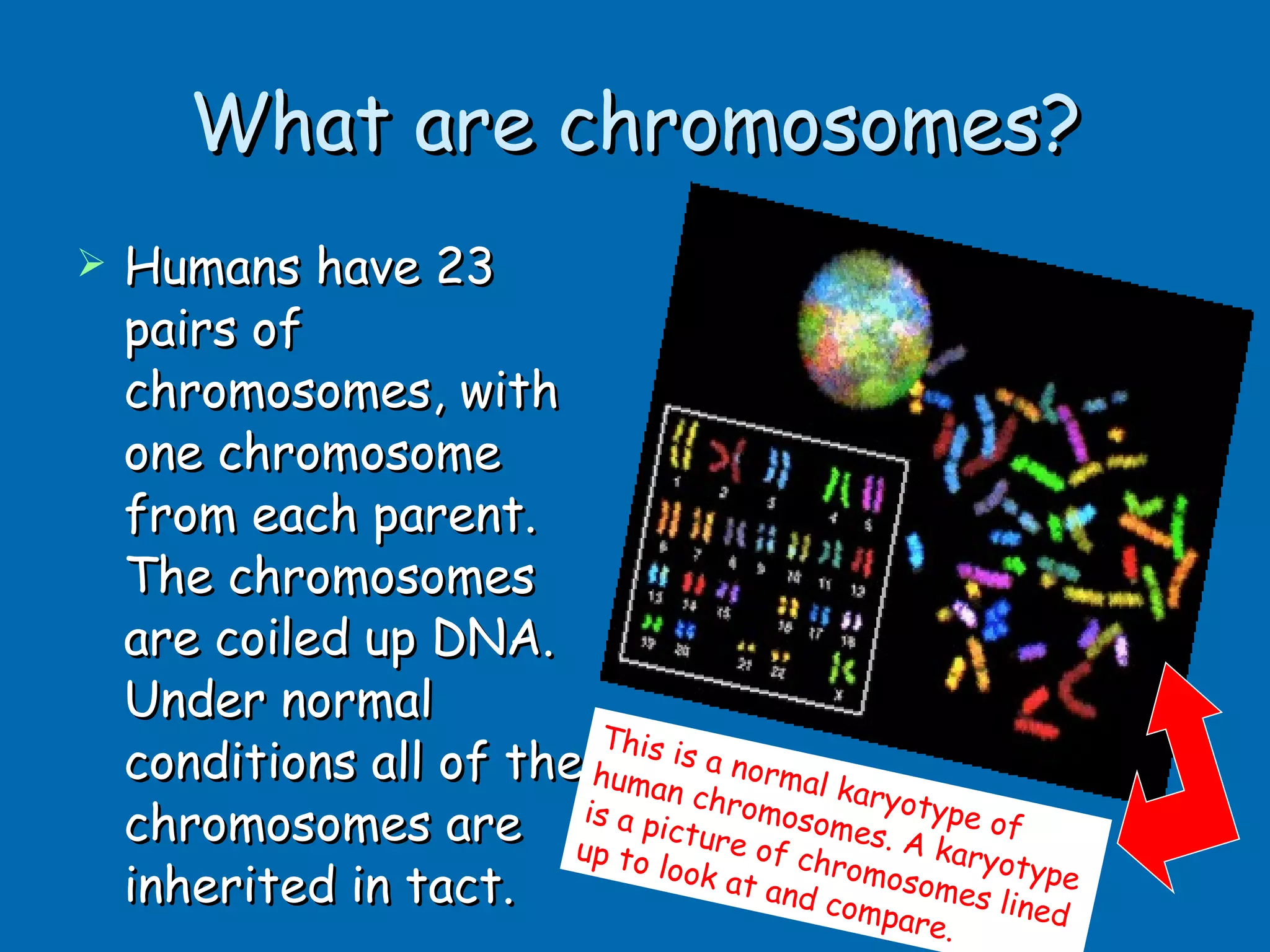
What are chromosomes? Humans have 23 pairs of chromosomes, with one chromosome from each parent. The chromosomes are coiled up DNA. Under normal conditions all of the chromosomes are inherited in tact.  This is a normal karyotype of human chromosomes. A karyotype is a picture of chromosomes lined up to look at and compare.
Chromosomal Disorders Chromosomal deletion : when cells go through meiosis, portions of the chromosome are lost. Chromosomal inversion : when cells go through meiosis, parts of the chromosome are flipped. Chromosomal translocation : when cells go through meiosis, parts of the chromosomes stick together and switch. Chromosomal non-disjunction : when cells go through meiosis the chromosomes don’t separate correctly and either too many or not enough are passed on.
Single Chromosome Disorders Deletion Genetic material is missing 2. Duplication Genetic material is present twice 3. Inversion Genetic material is “flipped”
Two Chromosome Disorders ( Both types are called “translocation”) Insertion Genetic material is  added  from another chromosome Translocation Material is  swapped  with another chromosome
Down Syndrome:   Trisomy Down Syndrome 1 in 1,250 births 47 chromosomes XY or XX #21 Trisomy  Nondisjunction 1 in 31,000 births 46 chromosomes XY=97%   XX=3% #14/21 Translocation
Down Syndrome Short, broad hands  Stubby fingers Rough skin Impotency in males Mentally retarded Small round face Protruding tongue Short lifespan VSD
Turners  Syndrome 1 in 5,000 births 45 chromosomes X only #23 Monosomy Nondisjunction 96-98% do not survive to birth No menstruation No breast development Narrow hips Broad shoulders and neck
Klinefelter  Syndrome 1 in 1,100 births Scarce beard Longer fingers and arms Sterile Delicate skin Low mental ability Normal lifespan 47 chromosomes XXY only #23 Trisomy  Nondisjunction
Cri-Du-Chat Syndrome 1 in 216,000 births 46 chromosomes #5 Deletion of lower  arm Symptoms: Moon-shaped face Heart disease Mentally retarded Malformed larynx Normal lifespan
Aniridia-Wilms Tumor Syndrome 1 in 50,000,000 births 46 chromosomes XY or XX #11 Deletion of upper arm Symptoms:  Mentally retarded Growth retarded Blindness Tumors on kidneys Short lifespan
Thirteen Q Deletion  Syndrome 1 in 500,000 births 46 chromosomes XY or XX #13 Deletion of lower arm Mentally retarded Deformed face No thumbs Heart disease Short lifespan
Prader-Willi Syndrome 1 in 5,000,000 births 46 chromosomes XY=97%  XX=3% #15 Deletion of lower arm Small bird-like head Mentally retarded Respiratory problems Obesity Short lifespan
Eighteen Q Deletion Syndrome 1 in 10,000,000 births 46 chromosomes XY or XX #18 Deletion of lower arm Mentally retarded Heart disease Abnormal hands and feet Large eyes Large ears Normal lifespan
Burkitt Lymphoma Translocation of the  Myc  gene on chromosome 8 Normal Myc genes control cell growth and division Translocated  Myc  genes don’t function properly Leads to cancer of the lymph nodes
Cat-Eye Syndrome 1 in 1,000,000 births 46 chromosomes XY or XX #22 Deletion of bottom arm Fused fingers and toes Mentally retarded Small jaw Heart problems Normal lifespan
Patau’s Trisomy Syndrome 1 in 14,000 births 47 chromosomes XY or XX #13 Trisomy  Nondisjunction Small head Small or missing eyes Heart defects Extra fingers Abnormal genitalia Mentally retarded Cleft palate Most die a few weeks after birth
Four-Ring Syndrome 1 in 10,000,000 births 46 chromosomes XY or XX #4 Inversion Cleft palate Club feet Testes don’t descend Short lifespan
Jacob’s Syndrome 1 in 1,800 births 47 chromosomes XYY only #23 Trisomy  Nondisjunction ? Normal physically Normal mentally Increase in testosterone More aggressive Normal lifespan
Triple X Syndrome Normal physically Sometimes taller Normal mentally Inc. risk of retardation Fertile
Other Types of Inherited Genetic Disorder…
Tay-Sachs Multiple kinds of mutation on Chromosome 15
Tay-Sachs incidence rate of infantile Tay-Sachs=  Ashkenazi Jewish groups, French Canadian & Cajun:  1 in 30 are carriers other groups:  1 in 300 are carriers accumulation of lipids in brain brain malfunction; death by age 5
Sex-linked:  X chromosome Duchenne Muscular Dystrophy 1 boy in every 3,000 progressive weakening of muscles and loss of coordination more common in males
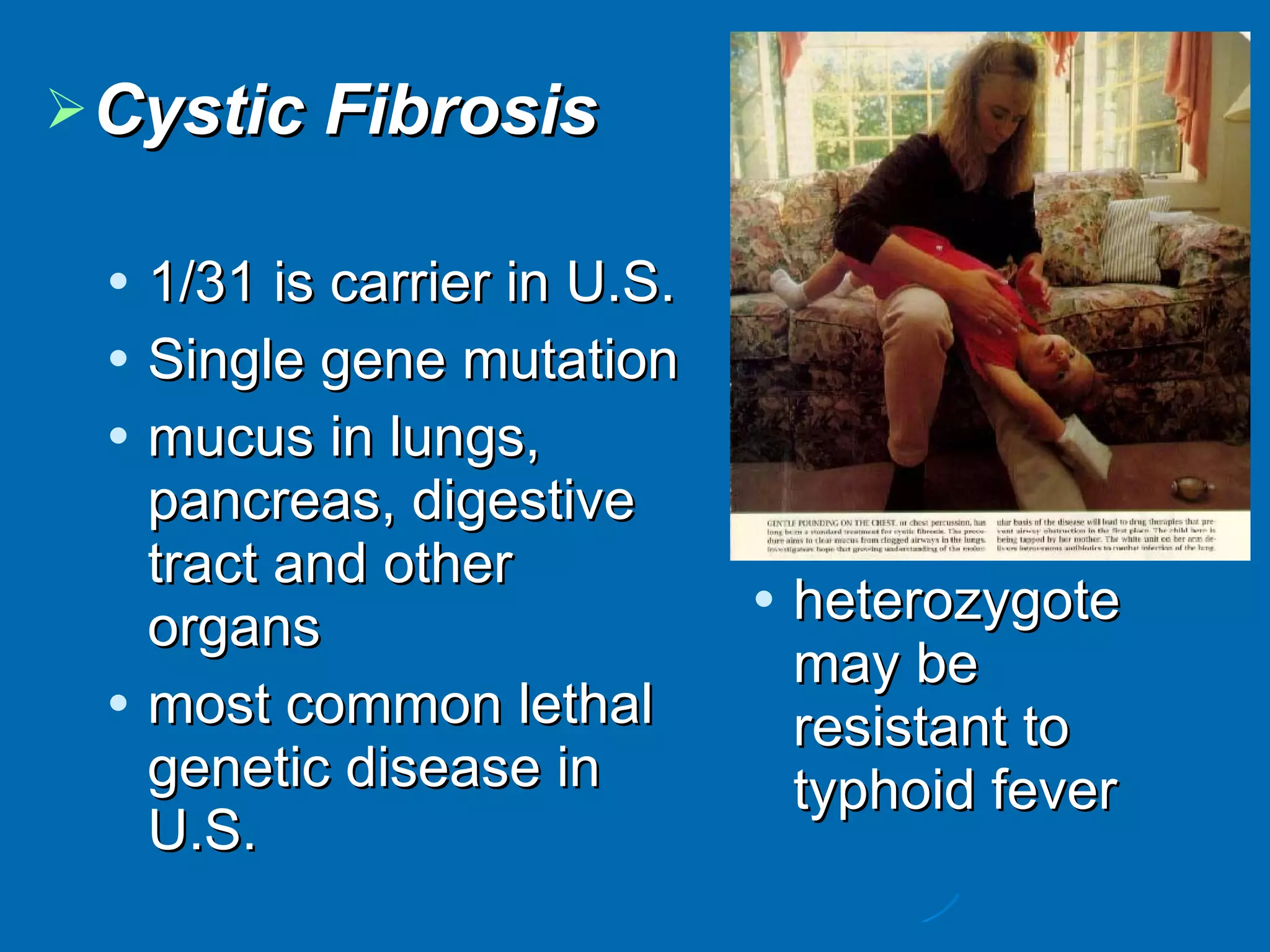
Cystic Fibrosis 1/31 is carrier in U.S. Single gene mutation mucus in lungs, pancreas, digestive tract and other organs most common lethal genetic disease in U.S. heterozygote may be resistant to typhoid fever
Autosomal Dominant Huntington’s incidence: 1/10,000 in U.S. nervous system degenerates late onset may not show symptoms until past reproductive age

Biochem chromosomal disorders

  • 1.
  • 2.
    What are chromosomes?Humans have 23 pairs of chromosomes, with one chromosome from each parent. The chromosomes are coiled up DNA. Under normal conditions all of the chromosomes are inherited in tact. This is a normal karyotype of human chromosomes. A karyotype is a picture of chromosomes lined up to look at and compare.
  • 3.
    Chromosomal Disorders Chromosomaldeletion : when cells go through meiosis, portions of the chromosome are lost. Chromosomal inversion : when cells go through meiosis, parts of the chromosome are flipped. Chromosomal translocation : when cells go through meiosis, parts of the chromosomes stick together and switch. Chromosomal non-disjunction : when cells go through meiosis the chromosomes don’t separate correctly and either too many or not enough are passed on.
  • 4.
    Single Chromosome DisordersDeletion Genetic material is missing 2. Duplication Genetic material is present twice 3. Inversion Genetic material is “flipped”
  • 5.
    Two Chromosome Disorders( Both types are called “translocation”) Insertion Genetic material is added from another chromosome Translocation Material is swapped with another chromosome
  • 6.
    Down Syndrome: Trisomy Down Syndrome 1 in 1,250 births 47 chromosomes XY or XX #21 Trisomy Nondisjunction 1 in 31,000 births 46 chromosomes XY=97% XX=3% #14/21 Translocation
  • 7.
    Down Syndrome Short,broad hands Stubby fingers Rough skin Impotency in males Mentally retarded Small round face Protruding tongue Short lifespan VSD
  • 8.
    Turners Syndrome1 in 5,000 births 45 chromosomes X only #23 Monosomy Nondisjunction 96-98% do not survive to birth No menstruation No breast development Narrow hips Broad shoulders and neck
  • 9.
    Klinefelter Syndrome1 in 1,100 births Scarce beard Longer fingers and arms Sterile Delicate skin Low mental ability Normal lifespan 47 chromosomes XXY only #23 Trisomy Nondisjunction
  • 10.
    Cri-Du-Chat Syndrome 1in 216,000 births 46 chromosomes #5 Deletion of lower arm Symptoms: Moon-shaped face Heart disease Mentally retarded Malformed larynx Normal lifespan
  • 11.
    Aniridia-Wilms Tumor Syndrome1 in 50,000,000 births 46 chromosomes XY or XX #11 Deletion of upper arm Symptoms: Mentally retarded Growth retarded Blindness Tumors on kidneys Short lifespan
  • 12.
    Thirteen Q Deletion Syndrome 1 in 500,000 births 46 chromosomes XY or XX #13 Deletion of lower arm Mentally retarded Deformed face No thumbs Heart disease Short lifespan
  • 13.
    Prader-Willi Syndrome 1in 5,000,000 births 46 chromosomes XY=97% XX=3% #15 Deletion of lower arm Small bird-like head Mentally retarded Respiratory problems Obesity Short lifespan
  • 14.
    Eighteen Q DeletionSyndrome 1 in 10,000,000 births 46 chromosomes XY or XX #18 Deletion of lower arm Mentally retarded Heart disease Abnormal hands and feet Large eyes Large ears Normal lifespan
  • 15.
    Burkitt Lymphoma Translocationof the Myc gene on chromosome 8 Normal Myc genes control cell growth and division Translocated Myc genes don’t function properly Leads to cancer of the lymph nodes
  • 16.
    Cat-Eye Syndrome 1in 1,000,000 births 46 chromosomes XY or XX #22 Deletion of bottom arm Fused fingers and toes Mentally retarded Small jaw Heart problems Normal lifespan
  • 17.
    Patau’s Trisomy Syndrome1 in 14,000 births 47 chromosomes XY or XX #13 Trisomy Nondisjunction Small head Small or missing eyes Heart defects Extra fingers Abnormal genitalia Mentally retarded Cleft palate Most die a few weeks after birth
  • 18.
    Four-Ring Syndrome 1in 10,000,000 births 46 chromosomes XY or XX #4 Inversion Cleft palate Club feet Testes don’t descend Short lifespan
  • 19.
    Jacob’s Syndrome 1in 1,800 births 47 chromosomes XYY only #23 Trisomy Nondisjunction ? Normal physically Normal mentally Increase in testosterone More aggressive Normal lifespan
  • 20.
    Triple X SyndromeNormal physically Sometimes taller Normal mentally Inc. risk of retardation Fertile
  • 21.
    Other Types ofInherited Genetic Disorder…
  • 22.
    Tay-Sachs Multiple kindsof mutation on Chromosome 15
  • 23.
    Tay-Sachs incidence rateof infantile Tay-Sachs= Ashkenazi Jewish groups, French Canadian & Cajun: 1 in 30 are carriers other groups: 1 in 300 are carriers accumulation of lipids in brain brain malfunction; death by age 5
  • 24.
    Sex-linked: Xchromosome Duchenne Muscular Dystrophy 1 boy in every 3,000 progressive weakening of muscles and loss of coordination more common in males
  • 25.
    Cystic Fibrosis 1/31is carrier in U.S. Single gene mutation mucus in lungs, pancreas, digestive tract and other organs most common lethal genetic disease in U.S. heterozygote may be resistant to typhoid fever
  • 26.
    Autosomal Dominant Huntington’sincidence: 1/10,000 in U.S. nervous system degenerates late onset may not show symptoms until past reproductive age