Patterns of Inheritance
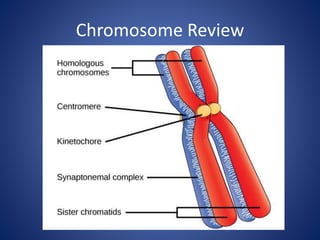
Chromosome Review
Genetics 
• Study of the patterns of inheritance 
• Mendelian Genetics 
– Gregor Mendel 
– Pea plant experiments 
• Grow easily 
• Distinguishable characteristics 
– Round/Wrinkly, Yellow/Green, Tall/Short 
• Can control mating
Terminology 
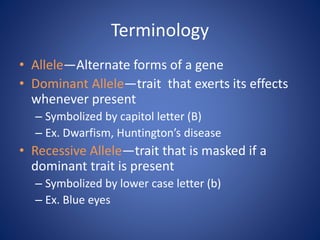
• Allele—Alternate forms of a gene 
• Dominant Allele—trait that exerts its effects 
whenever present 
– Symbolized by capitol letter (B) 
– Ex. Dwarfism, Huntington’s disease 
• Recessive Allele—trait that is masked if a 
dominant trait is present 
– Symbolized by lower case letter (b) 
– Ex. Blue eyes
Terminology 
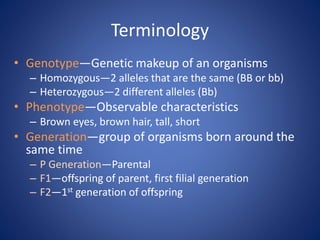
• Genotype—Genetic makeup of an organisms 
– Homozygous—2 alleles that are the same (BB or bb) 
– Heterozygous—2 different alleles (Bb) 
• Phenotype—Observable characteristics 
– Brown eyes, brown hair, tall, short 
• Generation—group of organisms born around the 
same time 
– P Generation—Parental 
– F1—offspring of parent, first filial generation 
– F2—1st generation of offspring
Genetic Terminology 
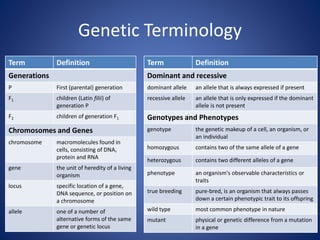
Term Definition 
Generations 
P First (parental) generation 
F1 children (Latin filii) of 
generation P 
F2 children of generation F1 
Chromosomes and Genes 
chromosome macromolecules found in 
cells, consisting of DNA, 
protein and RNA 
gene the unit of heredity of a living 
organism 
locus specific location of a gene, 
DNA sequence, or position on 
a chromosome 
allele one of a number of 
alternative forms of the same 
gene or genetic locus 
Term Definition 
Dominant and recessive 
dominant allele an allele that is always expressed if present 
recessive allele an allele that is only expressed if the dominant 
allele is not present 
Genotypes and Phenotypes 
genotype the genetic makeup of a cell, an organism, or 
an individual 
homozygous contains two of the same allele of a gene 
heterozygous contains two different alleles of a gene 
phenotype an organism's observable characteristics or 
traits 
true breeding pure-bred, is an organism that always passes 
down a certain phenotypic trait to its offspring 
wild type most common phenotype in nature 
mutant physical or genetic difference from a mutation 
in a gene
Tracking Inheritance 
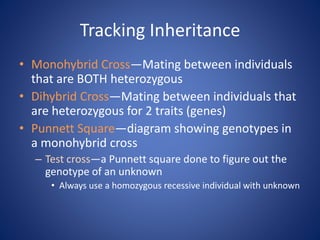
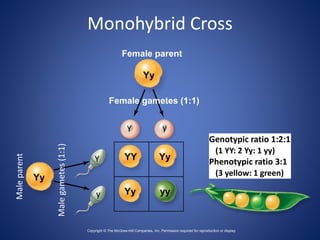
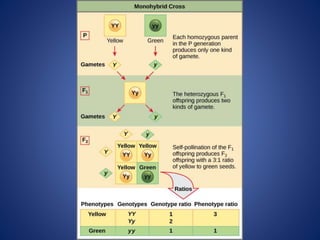
• Monohybrid Cross—Mating between individuals 
that are BOTH heterozygous 
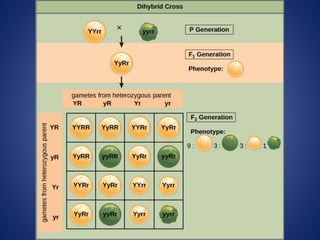
• Dihybrid Cross—Mating between individuals that 
are heterozygous for 2 traits (genes) 
• Punnett Square—diagram showing genotypes in 
a monohybrid cross 
– Test cross—a Punnett square done to figure out the 
genotype of an unknown 
• Always use a homozygous recessive individual with unknown
Male parent 
Female parent 
Yy 
Yy 
Female gametes (1:1) 
Y y 
Y 
y 
YY 
Yy 
Yy yy 
Genotypic ratio 1:2:1 
(1 YY: 2 Yy: 1 yy) 
Phenotypic ratio 3:1 
(3 yellow: 1 green) 
Copyright © The McGraw-Hill Companies, Inc. Permission required for reproduction or display. 
Male gametes (1:1) 
Monohybrid Cross
If plant is homozygous dominant (YY): 
y y 
Y 
y 
Y 
Male gametes 
y 
Y 
y 
y 
Male gametes 
y 
YY 
Female gametes 
Yy Yellow seeds (Yy): 100% chance 
Yy 
Yy 
Yy 
yy 
If plant is heterozygous (Yy): 
Yy 
Female gametes 
Yellow seeds (Yy): 50% chance 
Green seeds (yy): 50% chance 
Yy yy 
Yy yy
Law of Segregation 
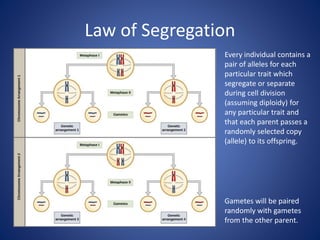
• Two alleles of each gene are packed into 
separate gametes 
– Alleles move apart during meiosis 
– Occurs during meiosis 1—Metaphase 
• Homologous chromosome move to opposite ends of 
poles
Law of Segregation 
Every individual contains a 
pair of alleles for each 
particular trait which 
segregate or separate 
during cell division 
(assuming diploidy) for 
any particular trait and 
that each parent passes a 
randomly selected copy 
(allele) to its offspring. 
Gametes will be paired 
randomly with gametes 
from the other parent.
Example 
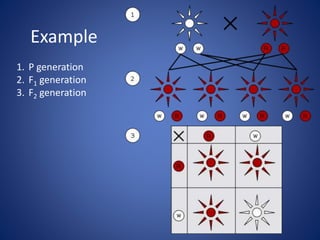
1. P generation 
2. F1 generation 
3. F2 generation
Genetics Problem 
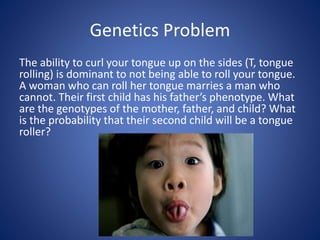
The ability to curl your tongue up on the sides (T, tongue 
rolling) is dominant to not being able to roll your tongue. 
A woman who can roll her tongue marries a man who 
cannot. Their first child has his father’s phenotype. What 
are the genotypes of the mother, father, and child? What 
is the probability that their second child will be a tongue 
roller?
Law of Independent Assortment 
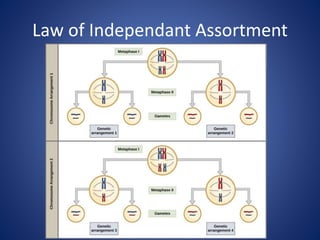
• The segregation of alleles of one gene does 
not influence the alleles for another gene 
– Alleles are RANDOMLY packaged in gametes 
• Since we have SO MANY genes, can’t keep 
doing punnett square. 
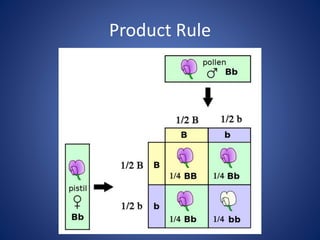
– Use Product Rule—The chance that 2 
independent events will both occur = the product 
of individual chances that each event will occur
Product Rule
Law of Independant Assortment
Law of Independent Assortment and 
Dihybrid Crosses 
About 70% of Americans perceive a bitter taste from the 
chemical phenylthiocarbamide (PTC). The ability to taste 
this chemical results from a dominant allele (T) and not 
being able to taste PTC is the result of having two 
recessive alleles (t). Albinism is also a single locus trait 
with normal pigment being dominant (A) and the lack of 
pigment being recessive (a). A normally pigmented 
woman who cannot taste PTC has a father who is an 
albino taster. She marries a homozygous, normally 
pigmented man who is a taster but who has a mother 
that does not taste PTC. What percentage of the children 
will be albinos? What percentage of the children will be 
non-taster of PTC?
Recessive Disorders 
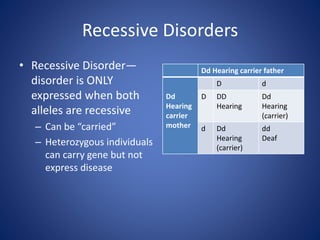
• Recessive Disorder— 
disorder is ONLY 
expressed when both 
alleles are recessive 
– Can be “carried” 
– Heterozygous individuals 
can carry gene but not 
express disease 
Dd Hearing carrier father 
Dd 
Hearing 
carrier 
mother 
D d 
D DD 
Hearing 
Dd 
Hearing 
(carrier) 
d Dd 
Hearing 
(carrier) 
dd 
Deaf
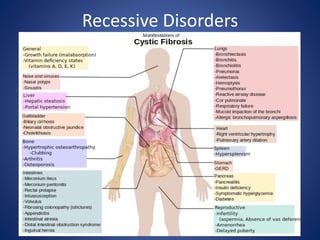
Recessive Disorders
Dominant Disorders 
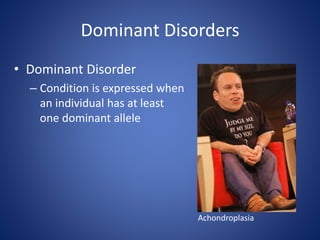
• Dominant Disorder 
– Condition is expressed when 
an individual has at least 
one dominant allele 
Achondroplasia
Autosomal Disorders 
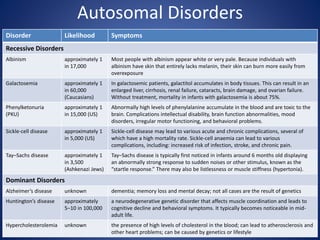
Disorder Likelihood Symptoms 
Recessive Disorders 
Albinism approximately 1 
in 17,000 
Most people with albinism appear white or very pale. Because individuals with 
albinism have skin that entirely lacks melanin, their skin can burn more easily from 
overexposure 
Galactosemia approximately 1 
in 60,000 
(Caucasians) 
In galactosemic patients, galactitol accumulates in body tissues. This can result in an 
enlarged liver, cirrhosis, renal failure, cataracts, brain damage, and ovarian failure. 
Without treatment, mortality in infants with galactosemia is about 75%. 
Phenylketonuria 
(PKU) 
approximately 1 
in 15,000 (US) 
Abnormally high levels of phenylalanine accumulate in the blood and are toxic to the 
brain. Complications intellectual disability, brain function abnormalities, mood 
disorders, irregular motor functioning, and behavioral problems. 
Sickle-cell disease approximately 1 
in 5,000 (US) 
Sickle-cell disease may lead to various acute and chronic complications, several of 
which have a high mortality rate. Sickle-cell anaemia can lead to various 
complications, including: increased risk of infection, stroke, and chronic pain. 
Tay–Sachs disease approximately 1 
in 3,500 
(Ashkenazi Jews) 
Tay–Sachs disease is typically first noticed in infants around 6 months old displaying 
an abnormally strong response to sudden noises or other stimulus, known as the 
“startle response.” There may also be listlessness or muscle stiffness (hypertonia). 
Dominant Disorders 
Alzheimer’s disease unknown dementia; memory loss and mental decay; not all cases are the result of genetics 
Huntington’s disease approximately 
5–10 in 100,000 
a neurodegenerative genetic disorder that affects muscle coordination and leads to 
cognitive decline and behavioral symptoms. It typically becomes noticeable in mid-adult 
life. 
Hypercholesterolemia unknown the presence of high levels of cholesterol in the blood; can lead to atherosclerosis and 
other heart problems; can be caused by genetics or lifestyle
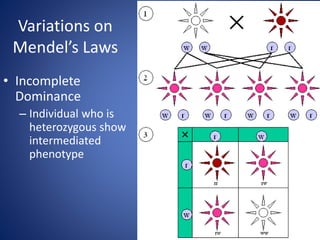
Variations on 
Mendel’s Laws 
• Incomplete 
Dominance 
– Individual who is 
heterozygous show 
intermediated 
phenotype
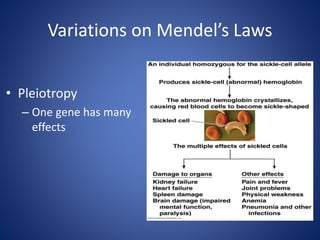
Variations on Mendel’s Laws 
• Pleiotropy 
– One gene has many 
effects
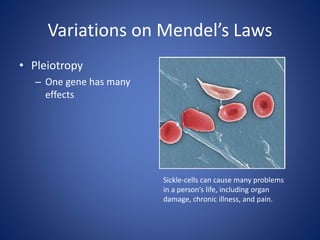
Variations on Mendel’s Laws 
• Pleiotropy 
– One gene has many 
effects 
Sickle-cells can cause many problems 
in a person’s life, including organ 
damage, chronic illness, and pain.
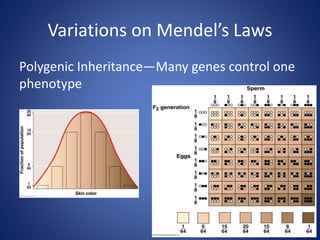
Variations on Mendel’s Laws 
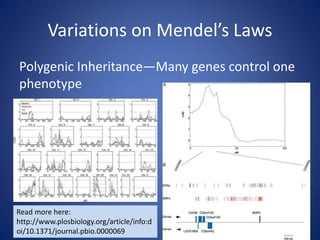
Polygenic Inheritance—Many genes control one 
phenotype
Variations on Mendel’s Laws 
Polygenic Inheritance—Many genes control one 
phenotype 
Read more here: 
http://www.plosbiology.org/article/info:d 
oi/10.1371/journal.pbio.0000069
Sex Linked Genes 
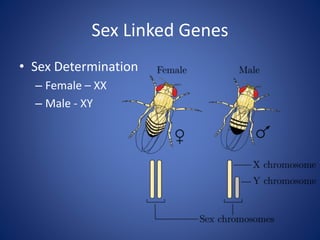
• Sex Determination 
– Female – XX 
– Male - XY
Sex Linked Genes 
• Can be carried on either X or Y chromosome 
– More common on X chromosome 
• Affect more males than females 
Female Male 
XAXa XAY
Sex Chromosomes and Sex Linked 
Genes 
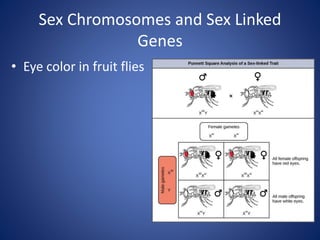
• Eye color in fruit flies
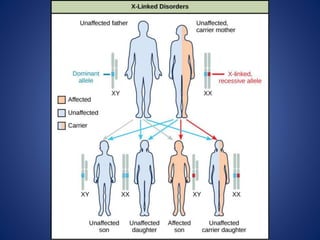
X-Linked Disorders 
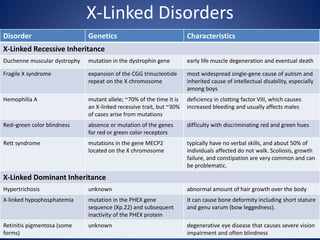
Disorder Genetics Characteristics 
X-Linked Recessive Inheritance 
Duchenne muscular dystrophy mutation in the dystrophin gene early life muscle degeneration and eventual death 
Fragile X syndrome expansion of the CGG trinucleotide 
repeat on the X chromosome 
most widespread single-gene cause of autism and 
inherited cause of intellectual disability, especially 
among boys 
Hemophilia A mutant allele; ~70% of the time it is 
an X-linked recessive trait, but ~30% 
of cases arise from mutations 
deficiency in clotting factor VIII, which causes 
increased bleeding and usually affects males 
Red–green color blindness absence or mutation of the genes 
for red or green color receptors 
difficulty with discriminating red and green hues 
Rett syndrome mutations in the gene MECP2 
located on the X chromosome 
typically have no verbal skills, and about 50% of 
individuals affected do not walk. Scoliosis, growth 
failure, and constipation are very common and can 
be problematic. 
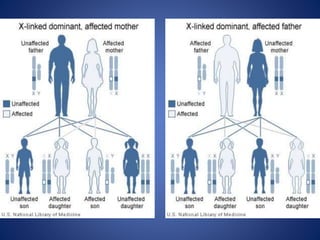
X-Linked Dominant Inheritance 
Hypertrichosis unknown abnormal amount of hair growth over the body 
X-linked hypophosphatemia mutation in the PHEX gene 
sequence (Xp.22) and subsequent 
inactivity of the PHEX protein 
It can cause bone deformity including short stature 
and genu varum (bow leggedness). 
Retinitis pigmentosa (some 
forms) 
unknown degenerative eye disease that causes severe vision 
impairment and often blindness

10. patterns of inheritance

  • 1.
  • 2.
  • 3.
    Genetics • Studyof the patterns of inheritance • Mendelian Genetics – Gregor Mendel – Pea plant experiments • Grow easily • Distinguishable characteristics – Round/Wrinkly, Yellow/Green, Tall/Short • Can control mating
  • 4.
    Terminology • Allele—Alternateforms of a gene • Dominant Allele—trait that exerts its effects whenever present – Symbolized by capitol letter (B) – Ex. Dwarfism, Huntington’s disease • Recessive Allele—trait that is masked if a dominant trait is present – Symbolized by lower case letter (b) – Ex. Blue eyes
  • 5.
    Terminology • Genotype—Geneticmakeup of an organisms – Homozygous—2 alleles that are the same (BB or bb) – Heterozygous—2 different alleles (Bb) • Phenotype—Observable characteristics – Brown eyes, brown hair, tall, short • Generation—group of organisms born around the same time – P Generation—Parental – F1—offspring of parent, first filial generation – F2—1st generation of offspring
  • 6.
    Genetic Terminology TermDefinition Generations P First (parental) generation F1 children (Latin filii) of generation P F2 children of generation F1 Chromosomes and Genes chromosome macromolecules found in cells, consisting of DNA, protein and RNA gene the unit of heredity of a living organism locus specific location of a gene, DNA sequence, or position on a chromosome allele one of a number of alternative forms of the same gene or genetic locus Term Definition Dominant and recessive dominant allele an allele that is always expressed if present recessive allele an allele that is only expressed if the dominant allele is not present Genotypes and Phenotypes genotype the genetic makeup of a cell, an organism, or an individual homozygous contains two of the same allele of a gene heterozygous contains two different alleles of a gene phenotype an organism's observable characteristics or traits true breeding pure-bred, is an organism that always passes down a certain phenotypic trait to its offspring wild type most common phenotype in nature mutant physical or genetic difference from a mutation in a gene
  • 7.
    Tracking Inheritance •Monohybrid Cross—Mating between individuals that are BOTH heterozygous • Dihybrid Cross—Mating between individuals that are heterozygous for 2 traits (genes) • Punnett Square—diagram showing genotypes in a monohybrid cross – Test cross—a Punnett square done to figure out the genotype of an unknown • Always use a homozygous recessive individual with unknown
  • 8.
    Male parent Femaleparent Yy Yy Female gametes (1:1) Y y Y y YY Yy Yy yy Genotypic ratio 1:2:1 (1 YY: 2 Yy: 1 yy) Phenotypic ratio 3:1 (3 yellow: 1 green) Copyright © The McGraw-Hill Companies, Inc. Permission required for reproduction or display. Male gametes (1:1) Monohybrid Cross
  • 9.
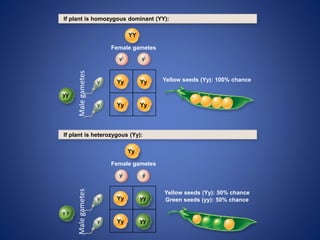
    If plant ishomozygous dominant (YY): y y Y y Y Male gametes y Y y y Male gametes y YY Female gametes Yy Yellow seeds (Yy): 100% chance Yy Yy Yy yy If plant is heterozygous (Yy): Yy Female gametes Yellow seeds (Yy): 50% chance Green seeds (yy): 50% chance Yy yy Yy yy
  • 11.
    Law of Segregation • Two alleles of each gene are packed into separate gametes – Alleles move apart during meiosis – Occurs during meiosis 1—Metaphase • Homologous chromosome move to opposite ends of poles
  • 12.
    Law of Segregation Every individual contains a pair of alleles for each particular trait which segregate or separate during cell division (assuming diploidy) for any particular trait and that each parent passes a randomly selected copy (allele) to its offspring. Gametes will be paired randomly with gametes from the other parent.
  • 13.
    Example 1. Pgeneration 2. F1 generation 3. F2 generation
  • 14.
    Genetics Problem Theability to curl your tongue up on the sides (T, tongue rolling) is dominant to not being able to roll your tongue. A woman who can roll her tongue marries a man who cannot. Their first child has his father’s phenotype. What are the genotypes of the mother, father, and child? What is the probability that their second child will be a tongue roller?
  • 15.
    Law of IndependentAssortment • The segregation of alleles of one gene does not influence the alleles for another gene – Alleles are RANDOMLY packaged in gametes • Since we have SO MANY genes, can’t keep doing punnett square. – Use Product Rule—The chance that 2 independent events will both occur = the product of individual chances that each event will occur
  • 16.
  • 17.
  • 19.
    Law of IndependentAssortment and Dihybrid Crosses About 70% of Americans perceive a bitter taste from the chemical phenylthiocarbamide (PTC). The ability to taste this chemical results from a dominant allele (T) and not being able to taste PTC is the result of having two recessive alleles (t). Albinism is also a single locus trait with normal pigment being dominant (A) and the lack of pigment being recessive (a). A normally pigmented woman who cannot taste PTC has a father who is an albino taster. She marries a homozygous, normally pigmented man who is a taster but who has a mother that does not taste PTC. What percentage of the children will be albinos? What percentage of the children will be non-taster of PTC?
  • 20.
    Recessive Disorders •Recessive Disorder— disorder is ONLY expressed when both alleles are recessive – Can be “carried” – Heterozygous individuals can carry gene but not express disease Dd Hearing carrier father Dd Hearing carrier mother D d D DD Hearing Dd Hearing (carrier) d Dd Hearing (carrier) dd Deaf
  • 21.
  • 22.
    Dominant Disorders •Dominant Disorder – Condition is expressed when an individual has at least one dominant allele Achondroplasia
  • 23.
    Autosomal Disorders DisorderLikelihood Symptoms Recessive Disorders Albinism approximately 1 in 17,000 Most people with albinism appear white or very pale. Because individuals with albinism have skin that entirely lacks melanin, their skin can burn more easily from overexposure Galactosemia approximately 1 in 60,000 (Caucasians) In galactosemic patients, galactitol accumulates in body tissues. This can result in an enlarged liver, cirrhosis, renal failure, cataracts, brain damage, and ovarian failure. Without treatment, mortality in infants with galactosemia is about 75%. Phenylketonuria (PKU) approximately 1 in 15,000 (US) Abnormally high levels of phenylalanine accumulate in the blood and are toxic to the brain. Complications intellectual disability, brain function abnormalities, mood disorders, irregular motor functioning, and behavioral problems. Sickle-cell disease approximately 1 in 5,000 (US) Sickle-cell disease may lead to various acute and chronic complications, several of which have a high mortality rate. Sickle-cell anaemia can lead to various complications, including: increased risk of infection, stroke, and chronic pain. Tay–Sachs disease approximately 1 in 3,500 (Ashkenazi Jews) Tay–Sachs disease is typically first noticed in infants around 6 months old displaying an abnormally strong response to sudden noises or other stimulus, known as the “startle response.” There may also be listlessness or muscle stiffness (hypertonia). Dominant Disorders Alzheimer’s disease unknown dementia; memory loss and mental decay; not all cases are the result of genetics Huntington’s disease approximately 5–10 in 100,000 a neurodegenerative genetic disorder that affects muscle coordination and leads to cognitive decline and behavioral symptoms. It typically becomes noticeable in mid-adult life. Hypercholesterolemia unknown the presence of high levels of cholesterol in the blood; can lead to atherosclerosis and other heart problems; can be caused by genetics or lifestyle
  • 24.
    Variations on Mendel’sLaws • Incomplete Dominance – Individual who is heterozygous show intermediated phenotype
  • 25.
    Variations on Mendel’sLaws • Pleiotropy – One gene has many effects
  • 26.
    Variations on Mendel’sLaws • Pleiotropy – One gene has many effects Sickle-cells can cause many problems in a person’s life, including organ damage, chronic illness, and pain.
  • 27.
    Variations on Mendel’sLaws Polygenic Inheritance—Many genes control one phenotype
  • 28.
    Variations on Mendel’sLaws Polygenic Inheritance—Many genes control one phenotype Read more here: http://www.plosbiology.org/article/info:d oi/10.1371/journal.pbio.0000069
  • 29.
    Sex Linked Genes • Sex Determination – Female – XX – Male - XY
  • 30.
    Sex Linked Genes • Can be carried on either X or Y chromosome – More common on X chromosome • Affect more males than females Female Male XAXa XAY
  • 31.
    Sex Chromosomes andSex Linked Genes • Eye color in fruit flies
  • 34.
    X-Linked Disorders DisorderGenetics Characteristics X-Linked Recessive Inheritance Duchenne muscular dystrophy mutation in the dystrophin gene early life muscle degeneration and eventual death Fragile X syndrome expansion of the CGG trinucleotide repeat on the X chromosome most widespread single-gene cause of autism and inherited cause of intellectual disability, especially among boys Hemophilia A mutant allele; ~70% of the time it is an X-linked recessive trait, but ~30% of cases arise from mutations deficiency in clotting factor VIII, which causes increased bleeding and usually affects males Red–green color blindness absence or mutation of the genes for red or green color receptors difficulty with discriminating red and green hues Rett syndrome mutations in the gene MECP2 located on the X chromosome typically have no verbal skills, and about 50% of individuals affected do not walk. Scoliosis, growth failure, and constipation are very common and can be problematic. X-Linked Dominant Inheritance Hypertrichosis unknown abnormal amount of hair growth over the body X-linked hypophosphatemia mutation in the PHEX gene sequence (Xp.22) and subsequent inactivity of the PHEX protein It can cause bone deformity including short stature and genu varum (bow leggedness). Retinitis pigmentosa (some forms) unknown degenerative eye disease that causes severe vision impairment and often blindness

Editor's Notes

  • #3 Image from Boundless
  • #7 “Chromosome” http://en.wikipedia.org/wiki/Chromosome “Gene” http://en.wikipedia.org/wiki/Gene “Locus (genetics)” http://en.wikipedia.org/wiki/Locus_(genetics) “Allele” http://en.wikipedia.org/wiki/Allele “Genotype” http://en.wikipedia.org/wiki/Genotype “Zygosity” http://en.wikipedia.org/wiki/Zygosity “Phenotype” http://en.wikipedia.org/wiki/Phenotype “True breeding organism” http://en.wikipedia.org/wiki/True_breeding_organism
  • #10 REPLACE IMAGE
  • #11 Image from Boundless ****Use this slide to replace slides 8 and 9*****
  • #13 Image from Boundless “Law of Segregation” https://en.wikipedia.org/wiki/Mendelian_inheritance#Law_of_Segregation
  • #14 “Mendelian Inheritance” by Magnus Manske. Released into public domain by the copyright holder. https://en.wikipedia.org/wiki/File:Mendelian_inheritance.svg
  • #15 “Rolled Tongue Flickr” by Gideon Tsang. Licensed under a CC-BY-SA 2.5 Generic license. https://commons.wikimedia.org/wiki/File:Rolled_tongue_flikr.jpg
  • #17 Image from Boundless
  • #18 Image from Boundless
  • #19 Image from Boundless
  • #22 “Cystic Fibrosis Manifestations” by Madhero88. Released into public domain by the copyright holder. https://commons.wikimedia.org/wiki/File:Cystic_fibrosis_manifestations.svg
  • #23 “2007 Disney Weekends #4: Warwick Davis” by Official Star Wars Blog. Licensed under a CC-BY 2.0 Generic license. https://en.wikipedia.org/wiki/File:Warwick_Davis_interviewed_2.jpg
  • #24 “Albinism” http://en.wikipedia.org/wiki/Albinism “Galactosemia” http://en.wikipedia.org/wiki/Galactosemia “Phenylketonuria” http://en.wikipedia.org/wiki/Phenylketonuria “Sickle-cell disease” http://en.wikipedia.org/wiki/Sickle-cell_disease “Tay–Sachs disease” http://en.wikipedia.org/wiki/Tay%E2%80%93Sachs_disease “Alzheimer’s disease” http://en.wikipedia.org/wiki/Alzheimer%27s_disease “Huntington’s disease” http://en.wikipedia.org/wiki/Huntington%27s_disease “Hypercholesterolemia” http://en.wikipedia.org/wiki/Hypercholesterolemia
  • #25 “Mendelian Inhertiance 1 2 1” by Magnus Manske. Licensed under a CC-BY-SA 3.0 Unported license. https://en.wikipedia.org/wiki/File:Mendelian_inheritance_1_2_1.png
  • #26 REPLACE IMAGE
  • #27 Image from Open Stax
  • #28 http://en.wikipedia.org/wiki/File:Drosophila_XY_sex-determination.svgREPLACE IMAGE
  • #29 Left: “Example of Genome-wide QTL-Scan” by Syrkarsodttir U, Cazier JB, Kong A, Rolfsson O, Larsen H, et al. Licensed under a CC-BY 2.5 Generic license. http://commons.wikimedia.org/wiki/File:Example_of_a_Genome-wide_QTL-Scan_from_PLoS_Biology.jpg Right: “Example of QTL-Scan on a single Chromosome” by Syrkarsodttir U, Cazier JB, Kong A, Rolfsson O, Larsen H, et al. Licensed under a CC-BY 2.5 Generic license. http://commons.wikimedia.org/wiki/File:Example_of_QTL-Scan_on_a_single_Chromosom_from_PLoS_Biology.jpg
  • #30 “Drosphila XY sex-determination” by YassineMrabet. Licensed under a CC-BY-SA 4.0 International license. http://en.wikipedia.org/wiki/File:Drosophila_XY_sex-determination.svg
  • #32 Image from Boundless
  • #33 Image from Boundless
  • #34 Images from the US National Library of Medicine. (Public Domain). Left: http://en.wikipedia.org/wiki/File:Xlink_dominant_mother.jpg Right: http://en.wikipedia.org/wiki/File:X-link_dominant_father.jpg
  • #35 “Duchenne muscular dystrophy” http://en.wikipedia.org/wiki/Duchenne_muscular_dystrophy “Fragile X syndrome” http://en.wikipedia.org/wiki/Fragile_X_syndrome “Hemophilia A” http://en.wikipedia.org/wiki/Haemophilia_A “Red–green color blindness” http://en.wikipedia.org/wiki/Color_blindness#Red.E2.80.93green_color_blindness “Rett syndrome” http://en.wikipedia.org/wiki/Rett_syndrome “Hypertrichosis” http://en.wikipedia.org/wiki/Hypertrichosis “X-linked hypophosphatemia” http://en.wikipedia.org/wiki/X-linked_hypophosphatemia “Retinitis pigmentosa” http://en.wikipedia.org/wiki/Retinitis_pigmentosa