CHROMOSOMAL ABNORMALITIES
PRESENTED BY : BARSHA KHADKA
TABLE OF CONTENT, 4D
1. Definition
2. Detection
3. Different types
4. Different human condition due to
chromosomal abnormalities
chromosomalabnormalities ?????
• A chromosomal abnormality, anomaly,
aberration or mutation is a missing, extra, or
irregular portion of chromosomal DNA.
• Chromosomal abnormality can form an atypical
number of chromosome or a structural
abnormality in one or more chromosomes.
Detection of chromosomal abnormalities
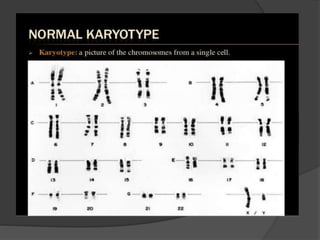
 It can be detected by studying and comparing
the affected person’s karyotype(number and
appearance of chromosomes).
 Some of the techniques of chromosomal
abnormalities detection are amniocentesis, bone
marrow sampling for screening leukemia,
chorionic villus sampling etc.
How do chromosomal abnormalities happens
???
 Usually due to error in cell division i.e.
mitosis and meiosis
Different types of chromosomal abnormalities
can be organized into two basic groups,
1] Numerical abnormalities
2] Structural abnormalities
Numerical abnormality
 Also called aneuploidy
 Abnormal number of chromosome
 Either chromosome is missing from the pair
or presence of more then two chromosome
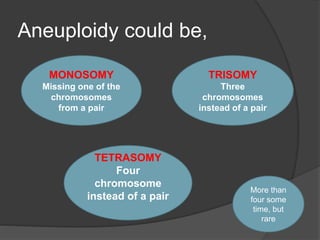
Aneuploidy could be,
MONOSOMY
Missing one of the
chromosomes
from a pair
TETRASOMY
Four
chromosome
instead of a pair
TRISOMY
Three
chromosomes
instead of a pair
More than
four some
time, but
rare
MONOSOMY
 Form of aneuploidy with the presence of
only one chromosome from a pair.
 Human condition due to monosomy;
1] Turner’s syndrome
2] Cri du chat syndrome
3] 1p36 deletion syndrome
Numerical abnormalities, monosomy
Turner’s syndrome (XO)
 Also known as 45,X or 45,XO
 Disorder affecting women
 Only X chromosome present in pair 23(sex
chromosomes)
 Frequency : 1/3300 births
 No cure for turner’s syndrome is known,
treatment is available.
Numerical abnormalities, monosomy
Cri du chat
 Also called as Chromosome 5p deletion
syndrome or 5p monosomy or partial
monosomy
 Rare chromosomal abnormality with the
frequency of 1/50,000 live birth
 More common in female
Numerical abnormalities, monosomy
1p36 deletion syndrome
 Congenital genetic disorder
 Occurs due to the deletion of outermost light
band of the short arm of chromosome 1
 Frequency : 1/5,000-10,000 birth
 Symptoms could be intellectual disability,
delayed growth, distinct facial features etc
TRISOMY
 Form of aneuploidy with the presence of three
chromosome instead of normal single pair
chromosome
 Human condition due to trisomy
1] Down syndrome
2] Klinefelter’s syndrome
3] Edward syndrome
4] Patau’s syndrome etc.
5] Triple X syndrome
Down
syndrome
Numerical abnormalities, trisomy
DOWN SYNDROME
 Also known as trisomy 21
 Known by karyotype 47,XX,+21 for female
and 47,XY,+21 for males
 Three chromosome in pair 21
 Disorder affecting both male and female
(not sex-linked)
 Frequency : 1.5/ 1000 birth
Numerical abnormalities, trisomy
KLINEFELTER’S
SYNDROME
 Also known as 47,XXY
 Disorder affecting men
 Two X chromosome and one Y chromosome
in pair 23(sex chromosome)
 Frequency : 1.4/1000 birth
Numerical abnormalities, trisomy
EDWARD SYNDROME
 Also called trisomy 18
 Represented as 47,XX,+18 for female
 Caused by the presence of all or part of
a third copy of chromosome 18
 Disorder affecting both male and female
 Frequency: 1/7000 birth
Numerical abnormalities, trisomy
PATAU SYNDROME
 Also called as trisomy 13
 Represented as 47,XX,+13 for female
 Disorder Not sex linked
 Three X chromosome in pair 13
 Frequency : 1/4000 births
Numerical abnormalities, trisomy
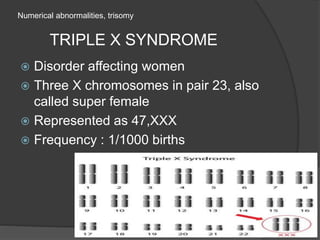
TRIPLE X SYNDROME
 Disorder affecting women
 Three X chromosomes in pair 23, also
called super female
 Represented as 47,XXX
 Frequency : 1/1000 births
TETRASOMY
 Form of aneuploidy with the presence of
four chromosome instead of normal single
pair chromosome
 Human condition due to trisomy
1] cat eye syndrome, tetrasomy 22
2] pallister-killian syndrome, tetrasomy 12p
3] 48,XXXX syndrome/tetrasomy X etc.
Cat eye syndrome, tetrasomy 22
 Rare disorder associated with the presence of an
extra chromosome fragment of short arm (p) and a
small portion of long arm (q) of chromosome 22
,resulting in total of four copies instead of normal
two copies in a cell.
 Some CES patient may have vertical colobomas,
thus name coined as cat eye syndrome
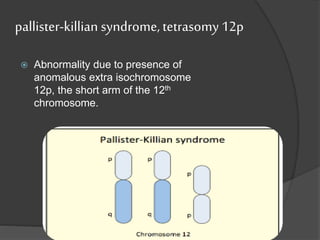
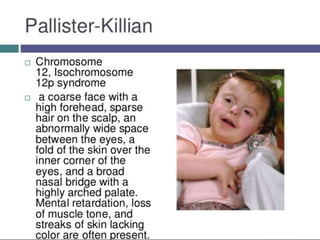
pallister-killian syndrome, tetrasomy 12p
 Abnormality due to presence of
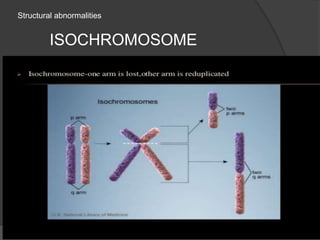
anomalous extra isochromosome
12p, the short arm of the 12th
chromosome.
TETRASOMY X / 48,xxxx
 Occurs in female only
 Presence of four X chromosome instead
of two
 When homologous X chromosome fails
to separate in the formation of the egg
or sperm, tetrasomy X may arise.
STRUCTURAL
ABNORMALITIES
 It occur when there is change in the
structure or components of the chromosome
 The change may be when,
 Part of chromosome is missing
 Part of chromosome is extra
 Part of chromosome has switched places
with another part
Several forms of structural
abnormalities
1. Deletion
2. Duplication
3. Insertion
4. Inversion
5. Translocation
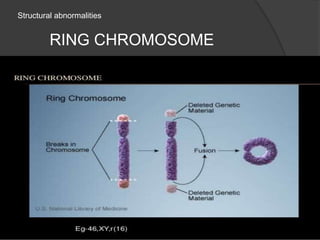
6. Ring chromosome
7. Isochromosome
Structural abnormalities
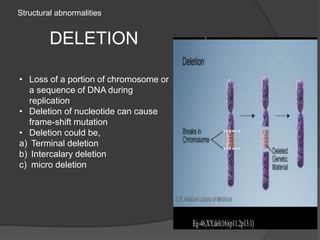
DELETION
• Loss of a portion of chromosome or
a sequence of DNA during
replication
• Deletion of nucleotide can cause
frame-shift mutation
• Deletion could be,
a) Terminal deletion
b) Intercalary deletion
c) micro deletion
Structural abnormalities
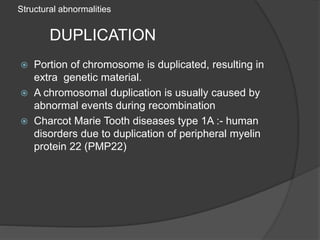
DUPLICATION
 Portion of chromosome is duplicated, resulting in
extra genetic material.
 A chromosomal duplication is usually caused by
abnormal events during recombination
 Charcot Marie Tooth diseases type 1A :- human
disorders due to duplication of peripheral myelin
protein 22 (PMP22)
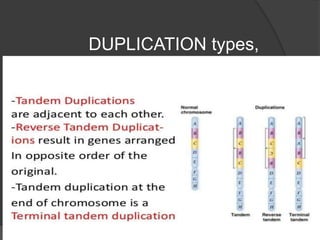
DUPLICATION types,
structural abnormalities
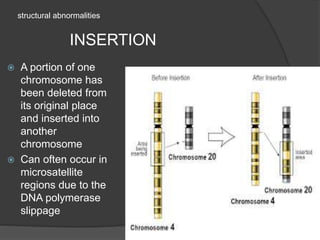
INSERTION
 A portion of one
chromosome has
been deleted from
its original place
and inserted into
another
chromosome
 Can often occur in
microsatellite
regions due to the
DNA polymerase
slippage
Structural abnormalities
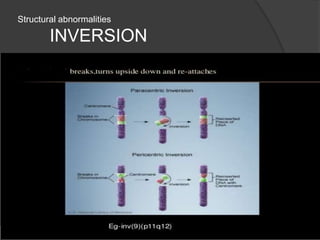
INVERSION
Structural abnormalities
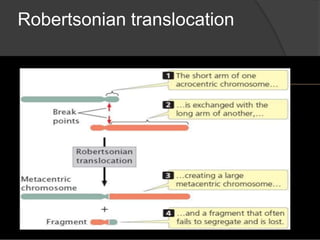
TRANSLOCATION
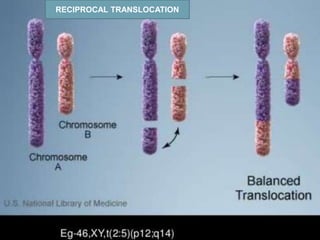
 Portion or segment of one chromosome
is exchanged
 Two types of translocation
1. Reciprocal translocation
2. Robertsonian translocation
RECIPROCAL TRANSLOCATION
Robertsonian translocation
Structural abnormalities
RING CHROMOSOME
Structural abnormalities
ISOCHROMOSOME
Facebook is not bad,
using it in a bad way
is bad.
chromosomal abnormalities

chromosomal abnormalities

  • 1.
  • 2.
    TABLE OF CONTENT,4D 1. Definition 2. Detection 3. Different types 4. Different human condition due to chromosomal abnormalities
  • 3.
    chromosomalabnormalities ????? • Achromosomal abnormality, anomaly, aberration or mutation is a missing, extra, or irregular portion of chromosomal DNA. • Chromosomal abnormality can form an atypical number of chromosome or a structural abnormality in one or more chromosomes.
  • 4.
    Detection of chromosomalabnormalities  It can be detected by studying and comparing the affected person’s karyotype(number and appearance of chromosomes).  Some of the techniques of chromosomal abnormalities detection are amniocentesis, bone marrow sampling for screening leukemia, chorionic villus sampling etc.
  • 6.
    How do chromosomalabnormalities happens ???  Usually due to error in cell division i.e. mitosis and meiosis Different types of chromosomal abnormalities can be organized into two basic groups, 1] Numerical abnormalities 2] Structural abnormalities
  • 7.
    Numerical abnormality  Alsocalled aneuploidy  Abnormal number of chromosome  Either chromosome is missing from the pair or presence of more then two chromosome
  • 8.
    Aneuploidy could be, MONOSOMY Missingone of the chromosomes from a pair TETRASOMY Four chromosome instead of a pair TRISOMY Three chromosomes instead of a pair More than four some time, but rare
  • 9.
    MONOSOMY  Form ofaneuploidy with the presence of only one chromosome from a pair.  Human condition due to monosomy; 1] Turner’s syndrome 2] Cri du chat syndrome 3] 1p36 deletion syndrome
  • 10.
    Numerical abnormalities, monosomy Turner’ssyndrome (XO)  Also known as 45,X or 45,XO  Disorder affecting women  Only X chromosome present in pair 23(sex chromosomes)  Frequency : 1/3300 births  No cure for turner’s syndrome is known, treatment is available.
  • 11.
    Numerical abnormalities, monosomy Cridu chat  Also called as Chromosome 5p deletion syndrome or 5p monosomy or partial monosomy  Rare chromosomal abnormality with the frequency of 1/50,000 live birth  More common in female
  • 12.
    Numerical abnormalities, monosomy 1p36deletion syndrome  Congenital genetic disorder  Occurs due to the deletion of outermost light band of the short arm of chromosome 1  Frequency : 1/5,000-10,000 birth  Symptoms could be intellectual disability, delayed growth, distinct facial features etc
  • 13.
    TRISOMY  Form ofaneuploidy with the presence of three chromosome instead of normal single pair chromosome  Human condition due to trisomy 1] Down syndrome 2] Klinefelter’s syndrome 3] Edward syndrome 4] Patau’s syndrome etc. 5] Triple X syndrome Down syndrome
  • 14.
    Numerical abnormalities, trisomy DOWNSYNDROME  Also known as trisomy 21  Known by karyotype 47,XX,+21 for female and 47,XY,+21 for males  Three chromosome in pair 21  Disorder affecting both male and female (not sex-linked)  Frequency : 1.5/ 1000 birth
  • 15.
    Numerical abnormalities, trisomy KLINEFELTER’S SYNDROME Also known as 47,XXY  Disorder affecting men  Two X chromosome and one Y chromosome in pair 23(sex chromosome)  Frequency : 1.4/1000 birth
  • 16.
    Numerical abnormalities, trisomy EDWARDSYNDROME  Also called trisomy 18  Represented as 47,XX,+18 for female  Caused by the presence of all or part of a third copy of chromosome 18  Disorder affecting both male and female  Frequency: 1/7000 birth
  • 17.
    Numerical abnormalities, trisomy PATAUSYNDROME  Also called as trisomy 13  Represented as 47,XX,+13 for female  Disorder Not sex linked  Three X chromosome in pair 13  Frequency : 1/4000 births
  • 18.
    Numerical abnormalities, trisomy TRIPLEX SYNDROME  Disorder affecting women  Three X chromosomes in pair 23, also called super female  Represented as 47,XXX  Frequency : 1/1000 births
  • 19.
    TETRASOMY  Form ofaneuploidy with the presence of four chromosome instead of normal single pair chromosome  Human condition due to trisomy 1] cat eye syndrome, tetrasomy 22 2] pallister-killian syndrome, tetrasomy 12p 3] 48,XXXX syndrome/tetrasomy X etc.
  • 20.
    Cat eye syndrome,tetrasomy 22  Rare disorder associated with the presence of an extra chromosome fragment of short arm (p) and a small portion of long arm (q) of chromosome 22 ,resulting in total of four copies instead of normal two copies in a cell.  Some CES patient may have vertical colobomas, thus name coined as cat eye syndrome
  • 21.
    pallister-killian syndrome, tetrasomy12p  Abnormality due to presence of anomalous extra isochromosome 12p, the short arm of the 12th chromosome.
  • 23.
    TETRASOMY X /48,xxxx  Occurs in female only  Presence of four X chromosome instead of two  When homologous X chromosome fails to separate in the formation of the egg or sperm, tetrasomy X may arise.
  • 24.
    STRUCTURAL ABNORMALITIES  It occurwhen there is change in the structure or components of the chromosome  The change may be when,  Part of chromosome is missing  Part of chromosome is extra  Part of chromosome has switched places with another part
  • 25.
    Several forms ofstructural abnormalities 1. Deletion 2. Duplication 3. Insertion 4. Inversion 5. Translocation 6. Ring chromosome 7. Isochromosome
  • 26.
    Structural abnormalities DELETION • Lossof a portion of chromosome or a sequence of DNA during replication • Deletion of nucleotide can cause frame-shift mutation • Deletion could be, a) Terminal deletion b) Intercalary deletion c) micro deletion
  • 27.
    Structural abnormalities DUPLICATION  Portionof chromosome is duplicated, resulting in extra genetic material.  A chromosomal duplication is usually caused by abnormal events during recombination  Charcot Marie Tooth diseases type 1A :- human disorders due to duplication of peripheral myelin protein 22 (PMP22)
  • 28.
  • 29.
    structural abnormalities INSERTION  Aportion of one chromosome has been deleted from its original place and inserted into another chromosome  Can often occur in microsatellite regions due to the DNA polymerase slippage
  • 30.
  • 31.
    Structural abnormalities TRANSLOCATION  Portionor segment of one chromosome is exchanged  Two types of translocation 1. Reciprocal translocation 2. Robertsonian translocation
  • 32.
  • 33.
  • 34.
  • 35.
  • 36.
    Facebook is notbad, using it in a bad way is bad.