Cytogenetics
Chromosomal Genetics
Sophie Dahoun
Service de Génétique Médicale, HUG
Geneva, Switzerland
sophie.dahoun@hcuge.ch
Training Course in Sexual and Reproductive Health Research
Geneva 2011
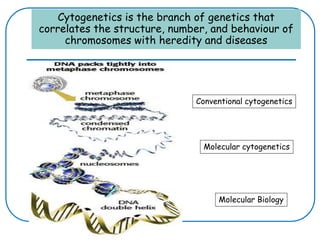
Cytogenetics is the branch of genetics that
correlates the structure, number, and behaviour of
chromosomes with heredity and diseases
Conventional cytogenetics
Molecular cytogenetics
Molecular Biology
I. Karyotype
 Definition
 Chromosomal Banding
 Resolution limits
 Nomenclature
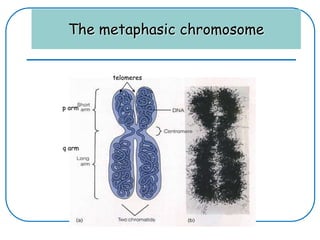
The metaphasic chromosome
p arm
q arm
telomeres
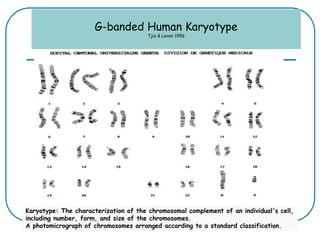
G-banded Human Karyotype
Tjio & Levan 1956
Karyotype: The characterization of the chromosomal complement of an individual's cell,
including number, form, and size of the chromosomes.
A photomicrograph of chromosomes arranged according to a standard classification.
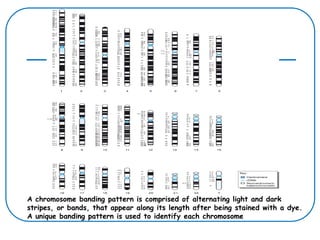
A chromosome banding pattern is comprised of alternating light and dark
stripes, or bands, that appear along its length after being stained with a dye.
A unique banding pattern is used to identify each chromosome
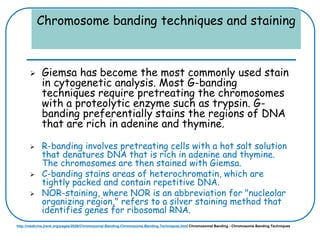
Chromosome banding techniques and staining
 Giemsa has become the most commonly used stain
in cytogenetic analysis. Most G-banding
techniques require pretreating the chromosomes
with a proteolytic enzyme such as trypsin. G-
banding preferentially stains the regions of DNA
that are rich in adenine and thymine.
 R-banding involves pretreating cells with a hot salt solution
that denatures DNA that is rich in adenine and thymine.
The chromosomes are then stained with Giemsa.
 C-banding stains areas of heterochromatin, which are
tightly packed and contain repetitive DNA.
 NOR-staining, where NOR is an abbreviation for "nucleolar
organizing region," refers to a silver staining method that
identifies genes for ribosomal RNA.
http://medicine.jrank.org/pages/2026/Chromosomal-Banding-Chromosome-Banding-Techniques.html Chromosomal Banding - Chromosome Banding Techniques
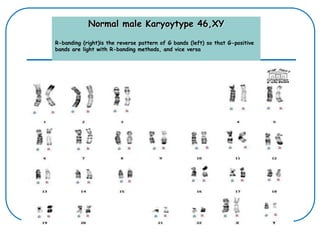
Normal male Karyoytype 46,XY
R-banding (right)is the reverse pattern of G bands (left) so that G-positive
bands are light with R-banding methods, and vice versa
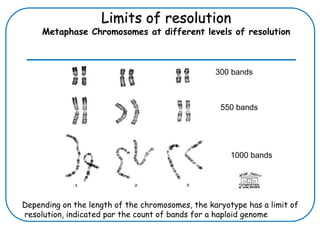
Limits of resolution
Metaphase Chromosomes at different levels of resolution
300 bands
550 bands
1000 bands
Depending on the length of the chromosomes, the karyotype has a limit of
resolution, indicated par the count of bands for a haploid genome
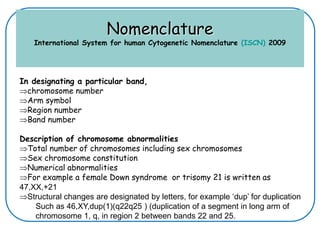
Nomenclature
International System for human Cytogenetic Nomenclature (ISCN) 2009
In designating a particular band,
chromosome number
Arm symbol
Region number
Band number
Description of chromosome abnormalities
Total number of chromosomes including sex chromosomes
Sex chromosome constitution
Numerical abnormalities
For example a female Down syndrome or trisomy 21 is written as
47,XX,+21
Structural changes are designated by letters, for example ‘dup’ for duplication
Such as 46,XY,dup(1)(q22q25 ) (duplication of a segment in long arm of
chromosome 1, q, in region 2 between bands 22 and 25.
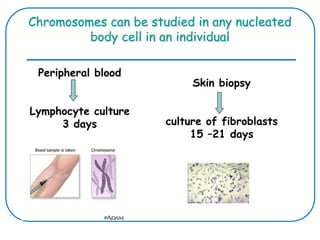
Chromosomes can be studied in any nucleated
body cell in an individual
Peripheral blood
Lymphocyte culture
3 days
Skin biopsy
culture of fibroblasts
15 –21 days
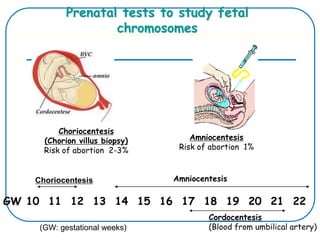
Prenatal tests to study fetal
chromosomes
Amniocentesis
Risk of abortion 1%
Choriocentesis
(Chorion villus biopsy)
Risk of abortion 2-3%
GW 10 11 12 13 14 15 16 17 18 19 20 21 22
Choriocentesis Amniocentesis
Cordocentesis
(Blood from umbilical artery)(GW: gestational weeks)
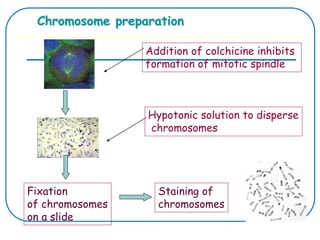
Chromosome preparation
Addition of colchicine inhibits
formation of mitotic spindle
Hypotonic solution to disperse
chromosomes
Staining of
chromosomes
Fixation
of chromosomes
on a slide
II. Chromosome abnormalities
 Statistics
 Meiosis
• Description
• Crossing over, recombination
 Errors of meiosis I
 Errors of meiosis II
 Promoted factors
Chromosome abnormalities
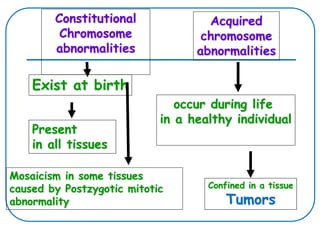
1. Constitutional : exist at birth. These are
usually present in all tissues, if present
only in some tissues, it is called mosaicism
and it means that the abnormality
occurred in the mitotic divisions that
follow zygote formation
2. Acquired: occur during the life of a
healthy individual and are confined to one
tissue as sen in tumour cells
Constitutional
Chromosome
abnormalities
Acquired
chromosome
abnormalities
Exist at birth
occur during life
in a healthy individual
Present
in all tissues
Mosaicism in some tissues
caused by Postzygotic mitotic
abnormality
Confined in a tissue
Tumors
Frequencies of chromosome
abnormalities
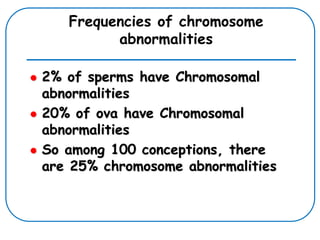
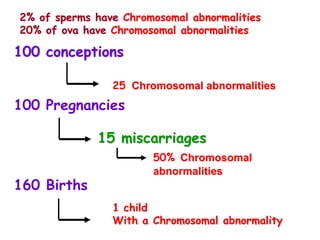
 2% of sperms have Chromosomal
abnormalities
 20% of ova have Chromosomal
abnormalities
 So among 100 conceptions, there
are 25% chromosome abnormalities
Frequencies of chromosome
abnormalities
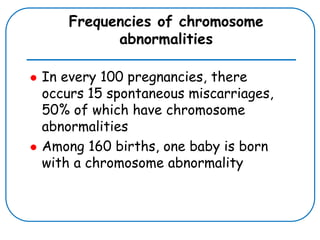
 In every 100 pregnancies, there
occurs 15 spontaneous miscarriages,
50% of which have chromosome
abnormalities
 Among 160 births, one baby is born
with a chromosome abnormality
100 conceptions
25 Chromosomal abnormalities
100 Pregnancies
15 miscarriages
50% Chromosomal
abnormalities
160 Births
1 child
With a Chromosomal abnormality
2% of sperms have Chromosomal abnormalities
20% of ova have Chromosomal abnormalities
Meiosis
 Is the process of reductional division in which a
diploid cell 2N = 46 (2 x sets of chromosomes) is
reduced to a haploid cell (N) = 23 (1 set of
chromosomes)
 It comprises MI (meiosis I) and MII (meiosis II)
 Meiosis always results in the formation of
gametes (ova and sperms)
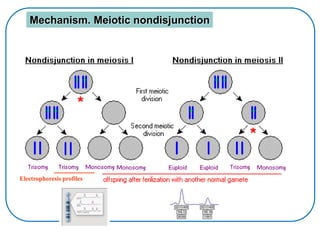
Non-disjunction in meiosis
 This is an abnormal division where one
daughter cell gets an extra chromosome
(24) and the other daughter cell gets one
chromosome less than normal (22).
 It can happen in MI or MII.
 Fertilisation with a normal gamete gives
either a trisomic zygote (24+23=47) or a
monosomic zygote (22+23=45)
Electrophoresis profiles
Mechanism. Meiotic nondisjunction
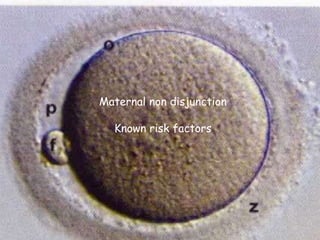
Maternal non disjunction
Known risk factors
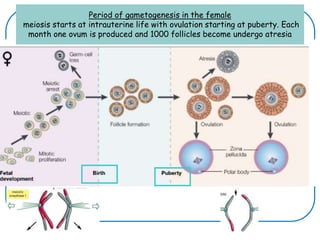
Period of gametogenesis in the female
meiosis starts at intrauterine life with ovulation starting at puberty. Each
month one ovum is produced and 1000 follicles become undergo atresia
Known predisposing causes for non-
disjunction in the female
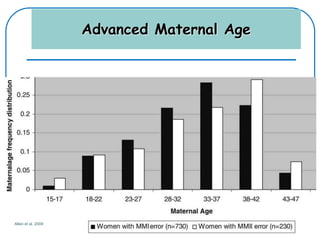
 Advanced maternal age
 Sites and rate of meiotic recombination
(crossing over or chiasma formation)
 Genetic factors
 Mosaicism with trisomic cells in ovaries
Advanced Maternal Age
Allen et al. 2009
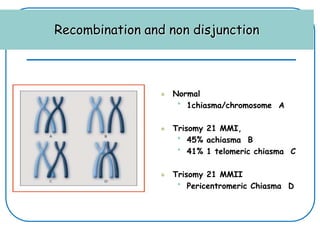
Recombination and non disjunction
 Normal
• 1chiasma/chromosome A
 Trisomy 21 MMI,
• 45% achiasma B
• 41% 1 telomeric chiasma C
 Trisomy 21 MMII
• Pericentromeric Chiasma D
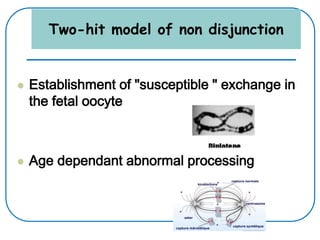
Two-hit model of non disjunction
 Establishment of "susceptible " exchange in
the fetal oocyte
 Age dependant abnormal processing
Genetic factors
 Homologous chromosomes pairing
 Assembly of the synaptonemal
complex
 Chiasmata formation
 Sister chromosome cohesion
 Spindle formation
 etc…
Vogt 2008
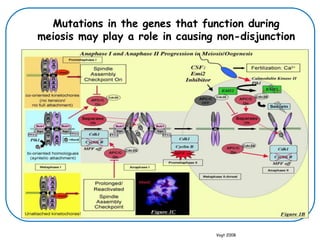
Mutations in the genes that function during
meiosis may play a role in causing non-disjunction
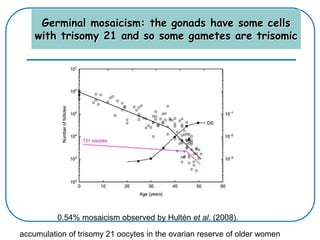
0.54% mosaicism observed by Hultén et al. (2008).
accumulation of trisomy 21 oocytes in the ovarian reserve of older women
Germinal mosaicism: the gonads have some cells
with trisomy 21 and so some gametes are trisomic
Paternal non disjunction
datas
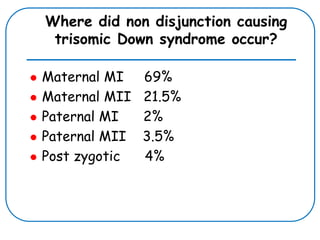
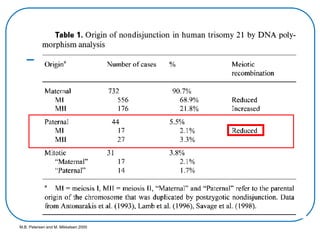
Where did non disjunction causing
trisomic Down syndrome occur?
 Maternal MI 69%
 Maternal MII 21.5%
 Paternal MI 2%
 Paternal MII 3.5%
 Post zygotic 4%
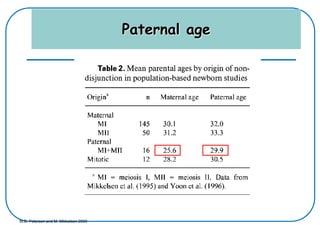
M.B. Petersen and M. Mikkelsen 2000
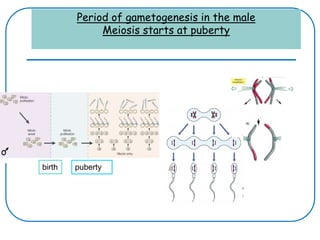
Period of gametogenesis in the male
Meiosis starts at puberty
birth puberty
M.B. Petersen and M. Mikkelsen 2000
Paternal age
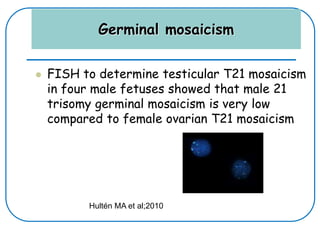
Germinal mosaicism
 FISH to determine testicular T21 mosaicism
in four male fetuses showed that male 21
trisomy germinal mosaicism is very low
compared to female ovarian T21 mosaicism
Hultén MA et al;2010
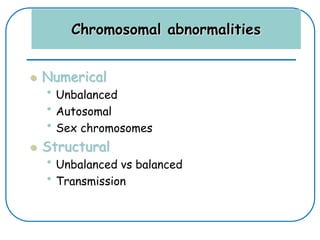
Chromosomal abnormalities
 Numerical
• Unbalanced
• Autosomal
• Sex chromosomes
 Structural
• Unbalanced vs balanced
• Transmission
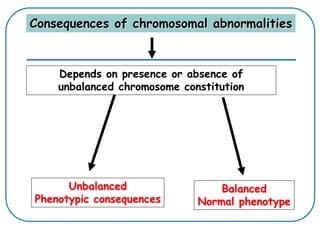
Consequences of chromosomal abnormalities
Depends on presence or absence of
unbalanced chromosome constitution
Unbalanced
Phenotypic consequences
Balanced
Normal phenotype
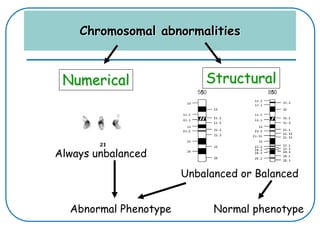
Chromosomal abnormalities
Numerical Structural
Always unbalanced
Unbalanced or Balanced
Abnormal Phenotype Normal phenotype
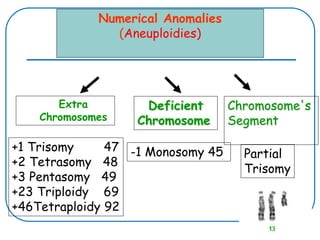
Numerical Anomalies
(Aneuploidies)
Extra
Chromosomes
+1 Trisomy 47
+2 Tetrasomy 48
+3 Pentasomy 49
+23 Triploidy 69
+46Tetraploidy 92
-1 Monosomy 45 Partial
Trisomy
Deficient
Chromosome
Chromosome's
Segment
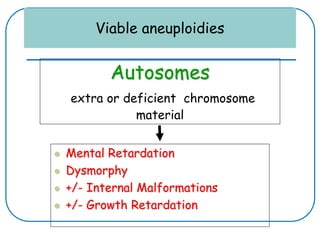
Viable aneuploidies
 Mental Retardation
 Dysmorphy
 +/- Internal Malformations
 +/- Growth Retardation
Autosomes
extra or deficient chromosome
material
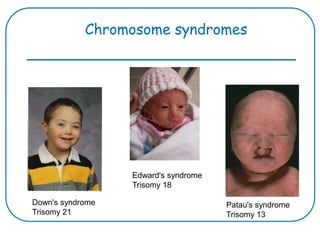
Chromosome syndromes
Down's syndrome
Trisomy 21
Edward's syndrome
Trisomy 18
Patau's syndrome
Trisomy 13
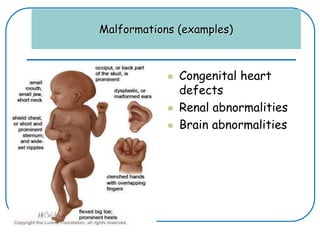
Malformations (examples)
 Congenital heart
defects
 Renal abnormalities
 Brain abnormalities
Frequency: 1/800 livebirths
In newborn: hypotonia and dysmorphic features
Down syndrome
Frequently associated malformations :
- Cardiovascular in 50% of cases
- Digestive: duodenal atresia or stenosis
Mental retardation :
- IQ around 50 at 5 years of age.
Chromosome abnormalities in Down
syndrome
 95% trisomy 21
 2.5% translocation of chromosome 21
and another acrocentric chromosome
 2.5% mosaicism
Aneuploidies of sex chromosomes
Mildly or not dysmorphic
Mild or no mental retardation
+/- height
Fertility problems
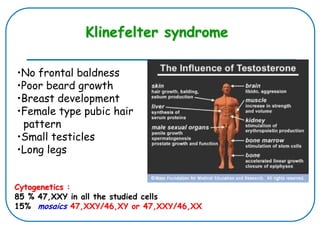
Cytogenetics :
85 % 47,XXY in all the studied cells
15% mosaics 47,XXY/46,XY or 47,XXY/46,XX
Klinefelter syndrome
•No frontal baldness
•Poor beard growth
•Breast development
•Female type pubic hair
pattern
•Small testicles
•Long legs
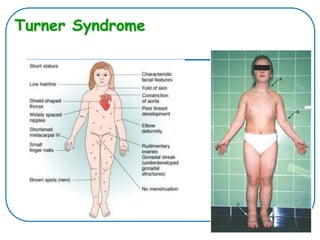
Turner Syndrome
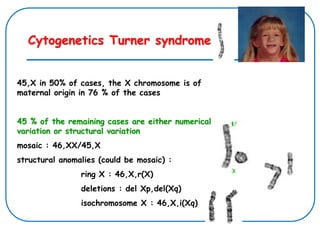
45,X in 50% of cases, the X chromosome is of
maternal origin in 76 % of the cases
45 % of the remaining cases are either numerical
variation or structural variation
mosaic : 46,XX/45,X
structural anomalies (could be mosaic) :
ring X : 46,X,r(X)
deletions : del Xp,del(Xq)
isochromosome X : 46,X,i(Xq)
Cytogenetics Turner syndrome
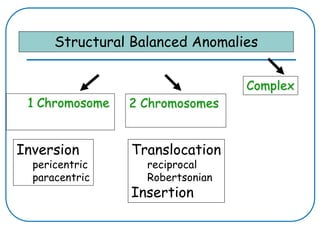
Structural Balanced Anomalies
1 Chromosome
Inversion
pericentric
paracentric
Translocation
reciprocal
Robertsonian
Insertion
2 Chromosomes
Complex
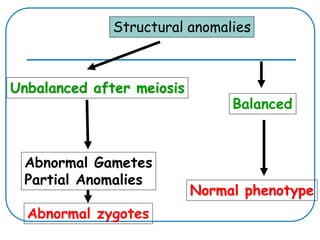
Structural anomalies
Balanced
Normal phenotype
Unbalanced after meiosis
Abnormal Gametes
Partial Anomalies
Abnormal zygotes
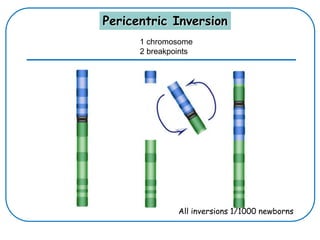
All inversions 1/1000 newborns
Pericentric Inversion
1 chromosome
2 breakpoints
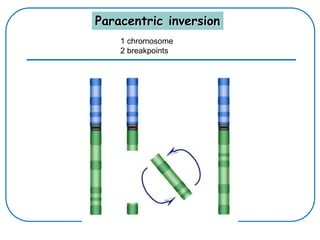
Paracentric inversion
1 chromosome
2 breakpoints
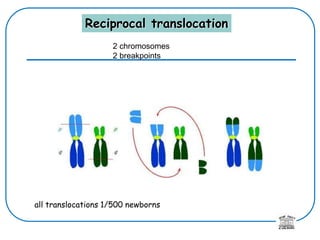
Reciprocal translocation
all translocations 1/500 newborns
2 chromosomes
2 breakpoints
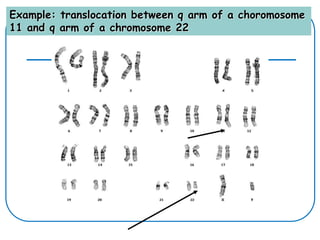
Example: translocation between q arm of a choromosome
11 and q arm of a chromosome 22
14
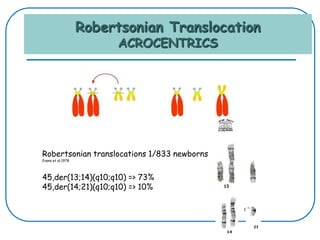
Robertsonian translocations 1/833 newborns
Evans et al.1978
45,der(13;14)(q10;q10) => 73%
45,der(14;21)(q10;q10) => 10%
Robertsonian Translocation
ACROCENTRICS
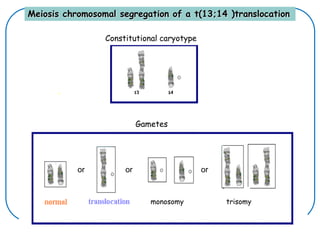
Meiosis chromosomal segregation of a t(13;14 )translocation
Constitutional caryotype
Gametes
monosomy trisomy
or or or
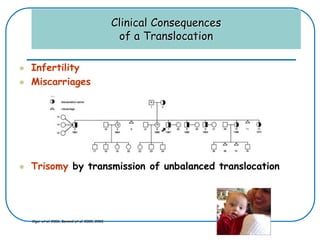
Clinical Consequences
of a Translocation
 Infertility
 Miscarriages
 Trisomy by transmission of unbalanced translocation
Ogur et al. 2006, Berend et al. 2000, 2002
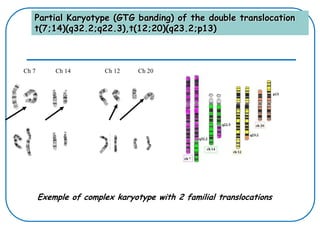
Ch 7 Ch 14 Ch 12 Ch 20
Partial Karyotype (GTG banding) of the double translocation
t(7;14)(q32.2;q22.3),t(12;20)(q23.2;p13)
Exemple of complex karyotype with 2 familial translocations
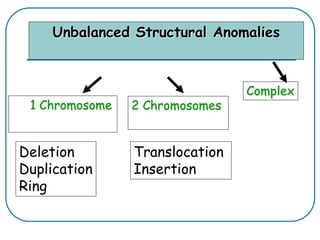
Unbalanced Structural Anomalies
1 Chromosome
Deletion
Duplication
Ring
Translocation
Insertion
2 Chromosomes
Complex
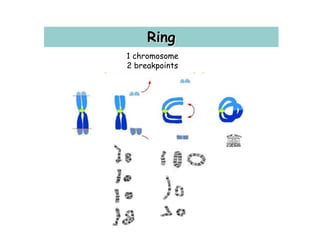
1 chromosome
2 breakpoints
Ring
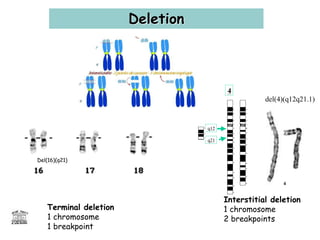
Del(16)(q21)
)
q12
q21
4
del(4)(q12q21.1)
4
Deletion
Interstitial deletion
1 chromosome
2 breakpoints
Terminal deletion
1 chromosome
1 breakpoint
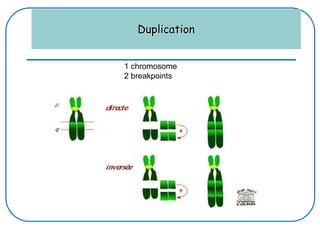
Duplication
1 chromosome
2 breakpoints
Conclusions
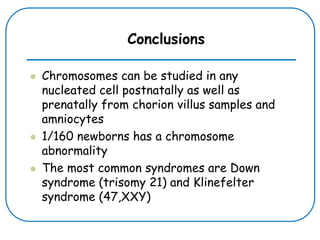
 Chromosomes can be studied in any
nucleated cell postnatally as well as
prenatally from chorion villus samples and
amniocytes
 1/160 newborns has a chromosome
abnormality
 The most common syndromes are Down
syndrome (trisomy 21) and Klinefelter
syndrome (47,XXY)

Chromosomal Genetics

  • 1.
    Cytogenetics Chromosomal Genetics Sophie Dahoun Servicede Génétique Médicale, HUG Geneva, Switzerland sophie.dahoun@hcuge.ch Training Course in Sexual and Reproductive Health Research Geneva 2011
  • 2.
    Cytogenetics is thebranch of genetics that correlates the structure, number, and behaviour of chromosomes with heredity and diseases Conventional cytogenetics Molecular cytogenetics Molecular Biology
  • 3.
    I. Karyotype  Definition Chromosomal Banding  Resolution limits  Nomenclature
  • 4.
    The metaphasic chromosome parm q arm telomeres
  • 5.
    G-banded Human Karyotype Tjio& Levan 1956 Karyotype: The characterization of the chromosomal complement of an individual's cell, including number, form, and size of the chromosomes. A photomicrograph of chromosomes arranged according to a standard classification.
  • 6.
    A chromosome bandingpattern is comprised of alternating light and dark stripes, or bands, that appear along its length after being stained with a dye. A unique banding pattern is used to identify each chromosome
  • 7.
    Chromosome banding techniquesand staining  Giemsa has become the most commonly used stain in cytogenetic analysis. Most G-banding techniques require pretreating the chromosomes with a proteolytic enzyme such as trypsin. G- banding preferentially stains the regions of DNA that are rich in adenine and thymine.  R-banding involves pretreating cells with a hot salt solution that denatures DNA that is rich in adenine and thymine. The chromosomes are then stained with Giemsa.  C-banding stains areas of heterochromatin, which are tightly packed and contain repetitive DNA.  NOR-staining, where NOR is an abbreviation for "nucleolar organizing region," refers to a silver staining method that identifies genes for ribosomal RNA. http://medicine.jrank.org/pages/2026/Chromosomal-Banding-Chromosome-Banding-Techniques.html Chromosomal Banding - Chromosome Banding Techniques
  • 8.
    Normal male Karyoytype46,XY R-banding (right)is the reverse pattern of G bands (left) so that G-positive bands are light with R-banding methods, and vice versa
  • 9.
    Limits of resolution MetaphaseChromosomes at different levels of resolution 300 bands 550 bands 1000 bands Depending on the length of the chromosomes, the karyotype has a limit of resolution, indicated par the count of bands for a haploid genome
  • 10.
    Nomenclature International System forhuman Cytogenetic Nomenclature (ISCN) 2009 In designating a particular band, chromosome number Arm symbol Region number Band number Description of chromosome abnormalities Total number of chromosomes including sex chromosomes Sex chromosome constitution Numerical abnormalities For example a female Down syndrome or trisomy 21 is written as 47,XX,+21 Structural changes are designated by letters, for example ‘dup’ for duplication Such as 46,XY,dup(1)(q22q25 ) (duplication of a segment in long arm of chromosome 1, q, in region 2 between bands 22 and 25.
  • 11.
    Chromosomes can bestudied in any nucleated body cell in an individual Peripheral blood Lymphocyte culture 3 days Skin biopsy culture of fibroblasts 15 –21 days
  • 12.
    Prenatal tests tostudy fetal chromosomes Amniocentesis Risk of abortion 1% Choriocentesis (Chorion villus biopsy) Risk of abortion 2-3% GW 10 11 12 13 14 15 16 17 18 19 20 21 22 Choriocentesis Amniocentesis Cordocentesis (Blood from umbilical artery)(GW: gestational weeks)
  • 13.
    Chromosome preparation Addition ofcolchicine inhibits formation of mitotic spindle Hypotonic solution to disperse chromosomes Staining of chromosomes Fixation of chromosomes on a slide
  • 14.
    II. Chromosome abnormalities Statistics  Meiosis • Description • Crossing over, recombination  Errors of meiosis I  Errors of meiosis II  Promoted factors
  • 15.
    Chromosome abnormalities 1. Constitutional: exist at birth. These are usually present in all tissues, if present only in some tissues, it is called mosaicism and it means that the abnormality occurred in the mitotic divisions that follow zygote formation 2. Acquired: occur during the life of a healthy individual and are confined to one tissue as sen in tumour cells
  • 16.
    Constitutional Chromosome abnormalities Acquired chromosome abnormalities Exist at birth occurduring life in a healthy individual Present in all tissues Mosaicism in some tissues caused by Postzygotic mitotic abnormality Confined in a tissue Tumors
  • 17.
    Frequencies of chromosome abnormalities 2% of sperms have Chromosomal abnormalities  20% of ova have Chromosomal abnormalities  So among 100 conceptions, there are 25% chromosome abnormalities
  • 18.
    Frequencies of chromosome abnormalities In every 100 pregnancies, there occurs 15 spontaneous miscarriages, 50% of which have chromosome abnormalities  Among 160 births, one baby is born with a chromosome abnormality
  • 19.
    100 conceptions 25 Chromosomalabnormalities 100 Pregnancies 15 miscarriages 50% Chromosomal abnormalities 160 Births 1 child With a Chromosomal abnormality 2% of sperms have Chromosomal abnormalities 20% of ova have Chromosomal abnormalities
  • 20.
    Meiosis  Is theprocess of reductional division in which a diploid cell 2N = 46 (2 x sets of chromosomes) is reduced to a haploid cell (N) = 23 (1 set of chromosomes)  It comprises MI (meiosis I) and MII (meiosis II)  Meiosis always results in the formation of gametes (ova and sperms)
  • 21.
    Non-disjunction in meiosis This is an abnormal division where one daughter cell gets an extra chromosome (24) and the other daughter cell gets one chromosome less than normal (22).  It can happen in MI or MII.  Fertilisation with a normal gamete gives either a trisomic zygote (24+23=47) or a monosomic zygote (22+23=45)
  • 22.
  • 23.
  • 24.
    Period of gametogenesisin the female meiosis starts at intrauterine life with ovulation starting at puberty. Each month one ovum is produced and 1000 follicles become undergo atresia
  • 25.
    Known predisposing causesfor non- disjunction in the female  Advanced maternal age  Sites and rate of meiotic recombination (crossing over or chiasma formation)  Genetic factors  Mosaicism with trisomic cells in ovaries
  • 26.
  • 27.
    Recombination and nondisjunction  Normal • 1chiasma/chromosome A  Trisomy 21 MMI, • 45% achiasma B • 41% 1 telomeric chiasma C  Trisomy 21 MMII • Pericentromeric Chiasma D
  • 28.
    Two-hit model ofnon disjunction  Establishment of "susceptible " exchange in the fetal oocyte  Age dependant abnormal processing
  • 29.
    Genetic factors  Homologouschromosomes pairing  Assembly of the synaptonemal complex  Chiasmata formation  Sister chromosome cohesion  Spindle formation  etc…
  • 30.
    Vogt 2008 Mutations inthe genes that function during meiosis may play a role in causing non-disjunction
  • 31.
    0.54% mosaicism observedby Hultén et al. (2008). accumulation of trisomy 21 oocytes in the ovarian reserve of older women Germinal mosaicism: the gonads have some cells with trisomy 21 and so some gametes are trisomic
  • 32.
  • 33.
    Where did nondisjunction causing trisomic Down syndrome occur?  Maternal MI 69%  Maternal MII 21.5%  Paternal MI 2%  Paternal MII 3.5%  Post zygotic 4%
  • 34.
    M.B. Petersen andM. Mikkelsen 2000
  • 35.
    Period of gametogenesisin the male Meiosis starts at puberty birth puberty
  • 36.
    M.B. Petersen andM. Mikkelsen 2000 Paternal age
  • 37.
    Germinal mosaicism  FISHto determine testicular T21 mosaicism in four male fetuses showed that male 21 trisomy germinal mosaicism is very low compared to female ovarian T21 mosaicism Hultén MA et al;2010
  • 38.
    Chromosomal abnormalities  Numerical •Unbalanced • Autosomal • Sex chromosomes  Structural • Unbalanced vs balanced • Transmission
  • 39.
    Consequences of chromosomalabnormalities Depends on presence or absence of unbalanced chromosome constitution Unbalanced Phenotypic consequences Balanced Normal phenotype
  • 40.
    Chromosomal abnormalities Numerical Structural Alwaysunbalanced Unbalanced or Balanced Abnormal Phenotype Normal phenotype
  • 41.
    Numerical Anomalies (Aneuploidies) Extra Chromosomes +1 Trisomy47 +2 Tetrasomy 48 +3 Pentasomy 49 +23 Triploidy 69 +46Tetraploidy 92 -1 Monosomy 45 Partial Trisomy Deficient Chromosome Chromosome's Segment
  • 42.
    Viable aneuploidies  MentalRetardation  Dysmorphy  +/- Internal Malformations  +/- Growth Retardation Autosomes extra or deficient chromosome material
  • 43.
    Chromosome syndromes Down's syndrome Trisomy21 Edward's syndrome Trisomy 18 Patau's syndrome Trisomy 13
  • 44.
    Malformations (examples)  Congenitalheart defects  Renal abnormalities  Brain abnormalities
  • 45.
    Frequency: 1/800 livebirths Innewborn: hypotonia and dysmorphic features Down syndrome Frequently associated malformations : - Cardiovascular in 50% of cases - Digestive: duodenal atresia or stenosis Mental retardation : - IQ around 50 at 5 years of age.
  • 46.
    Chromosome abnormalities inDown syndrome  95% trisomy 21  2.5% translocation of chromosome 21 and another acrocentric chromosome  2.5% mosaicism
  • 47.
    Aneuploidies of sexchromosomes Mildly or not dysmorphic Mild or no mental retardation +/- height Fertility problems
  • 48.
    Cytogenetics : 85 %47,XXY in all the studied cells 15% mosaics 47,XXY/46,XY or 47,XXY/46,XX Klinefelter syndrome •No frontal baldness •Poor beard growth •Breast development •Female type pubic hair pattern •Small testicles •Long legs
  • 49.
  • 50.
    45,X in 50%of cases, the X chromosome is of maternal origin in 76 % of the cases 45 % of the remaining cases are either numerical variation or structural variation mosaic : 46,XX/45,X structural anomalies (could be mosaic) : ring X : 46,X,r(X) deletions : del Xp,del(Xq) isochromosome X : 46,X,i(Xq) Cytogenetics Turner syndrome
  • 51.
    Structural Balanced Anomalies 1Chromosome Inversion pericentric paracentric Translocation reciprocal Robertsonian Insertion 2 Chromosomes Complex
  • 52.
    Structural anomalies Balanced Normal phenotype Unbalancedafter meiosis Abnormal Gametes Partial Anomalies Abnormal zygotes
  • 53.
    All inversions 1/1000newborns Pericentric Inversion 1 chromosome 2 breakpoints
  • 54.
  • 55.
    Reciprocal translocation all translocations1/500 newborns 2 chromosomes 2 breakpoints
  • 56.
    Example: translocation betweenq arm of a choromosome 11 and q arm of a chromosome 22
  • 57.
    14 Robertsonian translocations 1/833newborns Evans et al.1978 45,der(13;14)(q10;q10) => 73% 45,der(14;21)(q10;q10) => 10% Robertsonian Translocation ACROCENTRICS
  • 58.
    Meiosis chromosomal segregationof a t(13;14 )translocation Constitutional caryotype Gametes monosomy trisomy or or or
  • 59.
    Clinical Consequences of aTranslocation  Infertility  Miscarriages  Trisomy by transmission of unbalanced translocation Ogur et al. 2006, Berend et al. 2000, 2002
  • 60.
    Ch 7 Ch14 Ch 12 Ch 20 Partial Karyotype (GTG banding) of the double translocation t(7;14)(q32.2;q22.3),t(12;20)(q23.2;p13) Exemple of complex karyotype with 2 familial translocations
  • 61.
    Unbalanced Structural Anomalies 1Chromosome Deletion Duplication Ring Translocation Insertion 2 Chromosomes Complex
  • 62.
  • 63.
  • 64.
  • 65.
    Conclusions  Chromosomes canbe studied in any nucleated cell postnatally as well as prenatally from chorion villus samples and amniocytes  1/160 newborns has a chromosome abnormality  The most common syndromes are Down syndrome (trisomy 21) and Klinefelter syndrome (47,XXY)