STREPTOCOCCUS
Mrs. Jincy Ealias
M.Sc. (N)
Asst. Professor
Mr. Binu Babu
MBA, M.Sc. (N)
Asst. Professor
Streptococci is Gram-positive spherical/ovoid
cocci arranged in long chains; commonly in pairs.
• Classification of streptococci includes;
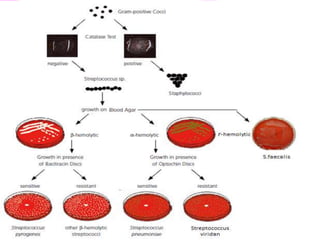
Classification system is based on hemolysis
reactions.
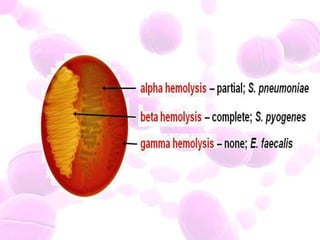
• β - hemolytic – A, B, C, D and G (S.
pyogenes)
• α - hemolytic – S. pneumoniae and viridans
• γ – hemolytic – S.faecalis
 Lancefield classification of b - hemolytic
streptococci based on presence of
carbohydrate antigen in cell wall – 17 groups
(A, B, C,….)
Human Streptococcal Pathogens
• S. Pyogenes
• S. Viridans
• S. Pneumoniae
• S. Faecalis
General Characteristics of Streptococci
• Gram-positive spherical/ovoid cocci arranged
in long chains; commonly in pairs.
• Non-spore-forming, nonmotile.
• Can form capsules
• Facultative anaerobes
• Most parasitic forms are fastidious and require
enriched media.
• Small, non pigmented colonies.
• Sensitive to drying, heat, and disinfectants.
S. Pyogenes
• Most serious streptococcal pathogen. It a parasite
and inhabits throat, nasopharynx, occasionally
skin.
Morphology
• Gram-positive
• Spherical/ovoid cocci arranged in long chains.
• Nonmotile.
• Can form capsules.
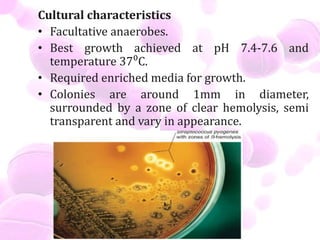
Cultural characteristics
• Facultative anaerobes.
• Best growth achieved at pH 7.4-7.6 and
temperature 37⁰C.
• Required enriched media for growth.
• Colonies are around 1mm in diameter,
surrounded by a zone of clear hemolysis, semi
transparent and vary in appearance.
Biochemical properties
• Produces many virulence factors. i.e production
of enzymes and toxins.
Virulence factors of S. Pyogenes
Enzymes:
• Streptokinase – digests fibrin clots
• Hyaluronidase – breaks down connective tissue
• DNase – hydrolyzes DNA
Toxins :
• Streptolysins (hemolysins):- streptolysin O (SLO)
and streptolysin S (SLS) – both cause cell and tissue
injury.
• Erythrogenic toxin (pyrogenic):- Induces fever and
typical red rash.
• Superantigens:- Strong monocyte and lymphocyte
stimulants; cause the release of tissue necrotic
factor.
Pathogenesis
• Humans are the only reservoir.
• In apparent carriers.(visible carriers of toxins and
enzyme)
• Transmission is through contact, droplets, food,
fomites
• Portal of entry is generally through skin or
pharynx.
• Children are predominant group affected for
cutaneous and throat infections
• Systemic infections and progressive diseases may
occur if untreated.
S. pyogenes diseases
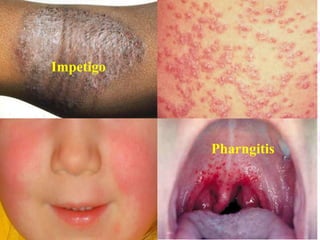
• Impetigo (pyoderma)- It is a skin infection
with superficial lesions that break and form
highly contagious crust.
• Throat infections
• Rheumatic fever – It has subclinical
pharyngitis in children; carditis with
extensive heart valve damage possible,
arthritis, chorea, fever.
• Acute glomerulonephritis – It is the
inflammation of the nephrons.
Impetigo
Pharngitis
Laboratory diagnosis
• S. pyogenes is frequently isolated from
samples such as skin, throat, sputum, urine,
and blood.
• Different methods for laboratory diagnosis
of S. pyogenes are:
Gram staining
Culture
Catalase test
Gram staining
The diagnosis is suggested by the finding
of gram positive bacteria cocci in chains in the
sample.
Culture
The organism is cultured on blood
agar with an added bacitracin antibiotic disk
to show beta-hemolytic colonies and
sensitivity (zone of inhibition around the disk)
for the antibiotic.
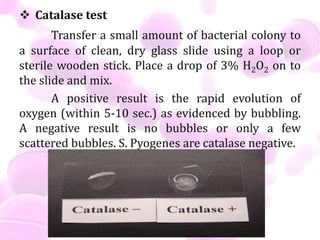
 Catalase test
Transfer a small amount of bacterial colony to
a surface of clean, dry glass slide using a loop or
sterile wooden stick. Place a drop of 3% H2O2 on to
the slide and mix.
A positive result is the rapid evolution of
oxygen (within 5-10 sec.) as evidenced by bubbling.
A negative result is no bubbles or only a few
scattered bubbles. S. Pyogenes are catalase negative.
Treatment
• S. Pyogenes infections are treated with
penicillin
• Erythromycin is recommended for
patients who are allergic to penicillin.
Prevention
• Long-term penicillin prophylaxis for people
with a history of rheumatic fever or
recurrent strep throat.
• S. Pyogenes infections are best prevented
through effective hand hygiene.
STREPTOCOCCUS PNEUMONIAE
These are commonly seen in nasopharynx of
healthy persons. It will not cause any illness itself
unless a viral infection or other factors provokes.
Morphology
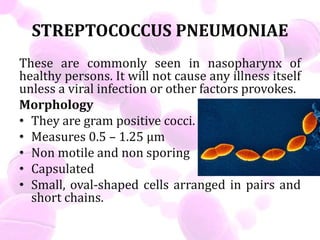
• They are gram positive cocci.
• Measures 0.5 – 1.25 µm
• Non motile and non sporing
• Capsulated
• Small, oval-shaped cells arranged in pairs and
short chains.
Cultural characteristics
• Culture requires blood or chocolate agar.
• Growth improved by 5-10% CO2.
• Facultative anaerobes.
• Best growth achieved temperature 25 - 40⁰C.
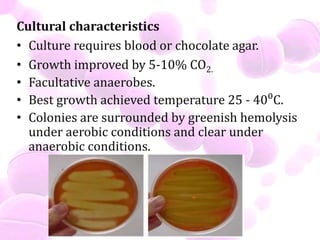
• Colonies are surrounded by greenish hemolysis
under aerobic conditions and clear under
anaerobic conditions.
Biochemical properties
• No significant toxin is produced in
pneumococci.
• Presence of some of the extra cellular products
– Haemolysin
– Immunoglobilin A1 protease
– Neuraminidase
– Hyaluronidase
• Lack catalase and peroxidases.
• Ferment glucose, lactose and sucrose with
production of acid.
Pathogenesis
• 5-50% of all people carry it as normal flora in the
nasopharynx.
• Young children, elderly, immune compromised,
those with other lung diseases or viral infections,
are at risk.
• Pneumococci multiply and induce an
inflammatory response.
• Gains access to middle ear by way of eustachian
tube.
Pneumococci diseases
• Pneumonia : infection of lung parenchyma.
• Otitis media : infection of middle ear
Laboratory diagnosis
• S. Pneumococci is frequently isolated
from samples such as sputum, blood,
wound, CSF.
• Different methods for laboratory
diagnosis of S. Pneumococci are:
Gram staining
Quellung test
Culture
Catalase test
Gram staining
The diagnosis is suggested by the finding of gram
positive bacteria cocci arranged in pairs and short chains
in the sample.
Quellung test
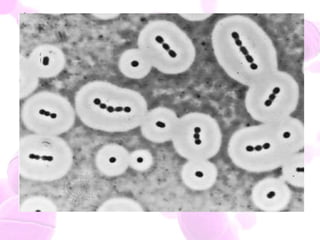
The characteristic capsule can be best detected
using the Quellung test. In this test, application of
antiserum followed by staining with India ink causes the
capsule to appear like a halo around the organism. The
capsule is also visible in smears stained with methylene
blue.
Culture
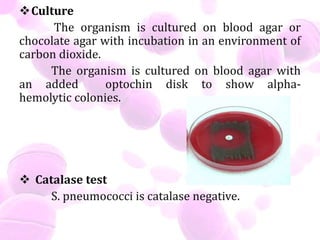
The organism is cultured on blood agar or
chocolate agar with incubation in an environment of
carbon dioxide.
The organism is cultured on blood agar with
an added optochin disk to show alpha-
hemolytic colonies.
 Catalase test
S. pneumococci is catalase negative.
Treatment and Prevention
• Traditionally treated with penicillin G
or V.
• Broad spectrum antibiotics are
recommended for patients who are
allergic to penicillin.
• Two vaccines available for high risk
individuals:
– Capsular antigen vaccine for older adults and
other high risk individuals – effective 5 years.
– Conjugate vaccine for children 2 to 23 months.
S. Viridans
• It is alpha haemolytic streptococci.
• It is oval in shape and found in short chains.
• It has six species groups (viridans group);
S. mutans, S. oralis, S. salivarus,
S. sanguis, S. milleri, S. mitis
• Found in gums and teeth, oral cavity, and also in
nasopharynx, genital tract, skin.
• Not very invasive; dental or surgical procedures
facilitate entrance.
• It causes dental caries, sepsis and endocarditis.
• Persons with preexisting heart conditions should
receive prophylactic antibiotics before surgery or
dental procedures.
S. Faecalis
• It is also known as enterococci.
• It is a Gram-positive
• Oval cocci in pairs or short chains.
• Identified in MaConkey agar. Colonies are magenta in
color and pin point.
• It can grow in the range of 10 to 45°C and survive at
temperatures of 60°C for 30 min.
• It is non-motile, facultative anaerobic microbe.
• It ferments glucose and does not produce a catalase.
• It is associated with urinary tract infections, biliary tract
infections, septicemia, endocarditis and intra abdominal
abscess.
• Aminogycosides are drug of choice.
Streptococcus
Streptococcus

Streptococcus

  • 1.
    STREPTOCOCCUS Mrs. Jincy Ealias M.Sc.(N) Asst. Professor Mr. Binu Babu MBA, M.Sc. (N) Asst. Professor
  • 2.
    Streptococci is Gram-positivespherical/ovoid cocci arranged in long chains; commonly in pairs. • Classification of streptococci includes; Classification system is based on hemolysis reactions. • β - hemolytic – A, B, C, D and G (S. pyogenes) • α - hemolytic – S. pneumoniae and viridans • γ – hemolytic – S.faecalis  Lancefield classification of b - hemolytic streptococci based on presence of carbohydrate antigen in cell wall – 17 groups (A, B, C,….)
  • 4.
    Human Streptococcal Pathogens •S. Pyogenes • S. Viridans • S. Pneumoniae • S. Faecalis
  • 5.
    General Characteristics ofStreptococci • Gram-positive spherical/ovoid cocci arranged in long chains; commonly in pairs. • Non-spore-forming, nonmotile. • Can form capsules • Facultative anaerobes • Most parasitic forms are fastidious and require enriched media. • Small, non pigmented colonies. • Sensitive to drying, heat, and disinfectants.
  • 6.
    S. Pyogenes • Mostserious streptococcal pathogen. It a parasite and inhabits throat, nasopharynx, occasionally skin. Morphology • Gram-positive • Spherical/ovoid cocci arranged in long chains. • Nonmotile. • Can form capsules.
  • 7.
    Cultural characteristics • Facultativeanaerobes. • Best growth achieved at pH 7.4-7.6 and temperature 37⁰C. • Required enriched media for growth. • Colonies are around 1mm in diameter, surrounded by a zone of clear hemolysis, semi transparent and vary in appearance.
  • 8.
    Biochemical properties • Producesmany virulence factors. i.e production of enzymes and toxins.
  • 9.
    Virulence factors ofS. Pyogenes Enzymes: • Streptokinase – digests fibrin clots • Hyaluronidase – breaks down connective tissue • DNase – hydrolyzes DNA Toxins : • Streptolysins (hemolysins):- streptolysin O (SLO) and streptolysin S (SLS) – both cause cell and tissue injury. • Erythrogenic toxin (pyrogenic):- Induces fever and typical red rash. • Superantigens:- Strong monocyte and lymphocyte stimulants; cause the release of tissue necrotic factor.
  • 10.
    Pathogenesis • Humans arethe only reservoir. • In apparent carriers.(visible carriers of toxins and enzyme) • Transmission is through contact, droplets, food, fomites • Portal of entry is generally through skin or pharynx. • Children are predominant group affected for cutaneous and throat infections • Systemic infections and progressive diseases may occur if untreated.
  • 11.
    S. pyogenes diseases •Impetigo (pyoderma)- It is a skin infection with superficial lesions that break and form highly contagious crust. • Throat infections • Rheumatic fever – It has subclinical pharyngitis in children; carditis with extensive heart valve damage possible, arthritis, chorea, fever. • Acute glomerulonephritis – It is the inflammation of the nephrons.
  • 12.
  • 13.
    Laboratory diagnosis • S.pyogenes is frequently isolated from samples such as skin, throat, sputum, urine, and blood. • Different methods for laboratory diagnosis of S. pyogenes are: Gram staining Culture Catalase test
  • 14.
    Gram staining The diagnosisis suggested by the finding of gram positive bacteria cocci in chains in the sample. Culture The organism is cultured on blood agar with an added bacitracin antibiotic disk to show beta-hemolytic colonies and sensitivity (zone of inhibition around the disk) for the antibiotic.
  • 15.
     Catalase test Transfera small amount of bacterial colony to a surface of clean, dry glass slide using a loop or sterile wooden stick. Place a drop of 3% H2O2 on to the slide and mix. A positive result is the rapid evolution of oxygen (within 5-10 sec.) as evidenced by bubbling. A negative result is no bubbles or only a few scattered bubbles. S. Pyogenes are catalase negative.
  • 16.
    Treatment • S. Pyogenesinfections are treated with penicillin • Erythromycin is recommended for patients who are allergic to penicillin.
  • 17.
    Prevention • Long-term penicillinprophylaxis for people with a history of rheumatic fever or recurrent strep throat. • S. Pyogenes infections are best prevented through effective hand hygiene.
  • 18.
    STREPTOCOCCUS PNEUMONIAE These arecommonly seen in nasopharynx of healthy persons. It will not cause any illness itself unless a viral infection or other factors provokes. Morphology • They are gram positive cocci. • Measures 0.5 – 1.25 µm • Non motile and non sporing • Capsulated • Small, oval-shaped cells arranged in pairs and short chains.
  • 19.
    Cultural characteristics • Culturerequires blood or chocolate agar. • Growth improved by 5-10% CO2. • Facultative anaerobes. • Best growth achieved temperature 25 - 40⁰C. • Colonies are surrounded by greenish hemolysis under aerobic conditions and clear under anaerobic conditions.
  • 20.
    Biochemical properties • Nosignificant toxin is produced in pneumococci. • Presence of some of the extra cellular products – Haemolysin – Immunoglobilin A1 protease – Neuraminidase – Hyaluronidase • Lack catalase and peroxidases. • Ferment glucose, lactose and sucrose with production of acid.
  • 21.
    Pathogenesis • 5-50% ofall people carry it as normal flora in the nasopharynx. • Young children, elderly, immune compromised, those with other lung diseases or viral infections, are at risk. • Pneumococci multiply and induce an inflammatory response. • Gains access to middle ear by way of eustachian tube.
  • 22.
    Pneumococci diseases • Pneumonia: infection of lung parenchyma. • Otitis media : infection of middle ear
  • 23.
    Laboratory diagnosis • S.Pneumococci is frequently isolated from samples such as sputum, blood, wound, CSF. • Different methods for laboratory diagnosis of S. Pneumococci are: Gram staining Quellung test Culture Catalase test
  • 24.
    Gram staining The diagnosisis suggested by the finding of gram positive bacteria cocci arranged in pairs and short chains in the sample. Quellung test The characteristic capsule can be best detected using the Quellung test. In this test, application of antiserum followed by staining with India ink causes the capsule to appear like a halo around the organism. The capsule is also visible in smears stained with methylene blue.
  • 25.
    Culture The organism iscultured on blood agar or chocolate agar with incubation in an environment of carbon dioxide. The organism is cultured on blood agar with an added optochin disk to show alpha- hemolytic colonies.  Catalase test S. pneumococci is catalase negative.
  • 26.
    Treatment and Prevention •Traditionally treated with penicillin G or V. • Broad spectrum antibiotics are recommended for patients who are allergic to penicillin. • Two vaccines available for high risk individuals: – Capsular antigen vaccine for older adults and other high risk individuals – effective 5 years. – Conjugate vaccine for children 2 to 23 months.
  • 27.
    S. Viridans • Itis alpha haemolytic streptococci. • It is oval in shape and found in short chains. • It has six species groups (viridans group); S. mutans, S. oralis, S. salivarus, S. sanguis, S. milleri, S. mitis • Found in gums and teeth, oral cavity, and also in nasopharynx, genital tract, skin. • Not very invasive; dental or surgical procedures facilitate entrance. • It causes dental caries, sepsis and endocarditis. • Persons with preexisting heart conditions should receive prophylactic antibiotics before surgery or dental procedures.
  • 28.
    S. Faecalis • Itis also known as enterococci. • It is a Gram-positive • Oval cocci in pairs or short chains. • Identified in MaConkey agar. Colonies are magenta in color and pin point. • It can grow in the range of 10 to 45°C and survive at temperatures of 60°C for 30 min. • It is non-motile, facultative anaerobic microbe. • It ferments glucose and does not produce a catalase. • It is associated with urinary tract infections, biliary tract infections, septicemia, endocarditis and intra abdominal abscess. • Aminogycosides are drug of choice.