ANTIMICROBIAL
SUSCEPTIBILITY
TESTING
INTRODUCTION
• Bacteria exhibit great strain variations in susceptibility to
antimicrobial agents – hence it is necessary to determine
the susceptibility of pathogenic bacteria isolated from the
clinical specimens.
Components of AST
• Bacterial inoculum size
• Growth medium
• pH
• Cation Concentration
• Blood and serum supplements
• Thymidine content
• Incubation atmosphere
• Incubation temperature
• Incubation duration
• Antimicrobial concentration tested
Antimicrobial
Susceptibility
Testing
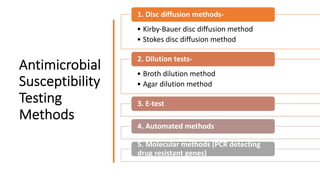
Methods
• Kirby-Bauer disc diffusion method
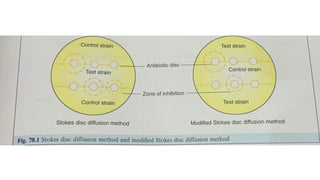
• Stokes disc diffusion method
1. Disc diffusion methods-
• Broth dilution method
• Agar dilution method
2. Dilution tests-
3. E-test
4. Automated methods
5. Molecular methods (PCR detecting
drug resistant genes)
DISC
DIFFUSION
Most widely used method.
Suitable for rapidly growing pathogenic
bacteria.
Unsuitable for slow growing bacteria.
This method uses filter paper discs
impregnated with appropriate
concentration of the antibiotic solution.
CULTURE METHOD – Lawn Culture
DISC- Filter Paper disc 6mm diameter charged
with appropriate concentration of the drug
Inoculum – 0.5 Mac Farland standard turbidity
to give semiconfluent growth after incubation
Incubated at 35-37°C
DISC DIFFUSION Media - Mueller-
Hinton agar
Modifications of MHA-
• Lysed horse blood is added to MHA to
support the growth of fastidious organisms
such as H. influenzae.
• 4% Sodium chloride (NaCl) should be added
to the medium for testing MRSA isolates.
Standard control strains - ATCC (American Type
Culture Collection)
Examples –
• Escherichia coli ATCC 25922
• Pseudomonas aeruginosa ATCC 27853
DISC
DIFFUSION –
Antibiotic
disc
• Commonly used for treatment.
• Antibiotic currently being
administered to the patient.
• Spectrum should be relevant to the
organism isolated.
First line drugs
• Restricted only to special
circumstances.
• Reserved for testing later if the
organism is found to be resistant to all
the first line antibiotics tested before.
Second line drugs
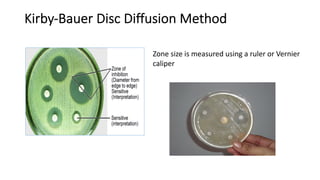
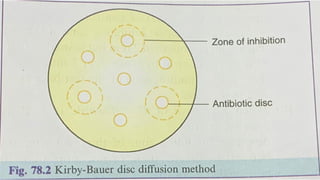
Kirby-Bauer Disc Diffusion Method
Zone size is measured using a ruler or Vernier
caliper
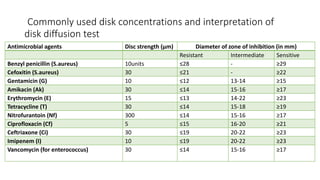
Commonly used disk concentrations and interpretation of
disk diffusion test
Antimicrobial agents Disc strength (µm) Diameter of zone of inhibition (in mm)
Resistant Intermediate Sensitive
Benzyl penicillin (S.aureus) 10units ≤28 - ≥29
Cefoxitin (S.aureus) 30 ≤21 - ≥22
Gentamicin (G) 10 ≤12 13-14 ≥15
Amikacin (Ak) 30 ≤14 15-16 ≥17
Erythromycin (E) 15 ≤13 14-22 ≥23
Tetracycline (T) 30 ≤14 15-18 ≥19
Nitrofurantoin (Nf) 300 ≤14 15-16 ≥17
Ciprofloxacin (Cf) 5 ≤15 16-20 ≥21
Ceftriaxone (Ci) 30 ≤19 20-22 ≥23
Imipenem (I) 10 ≤19 20-22 ≥23
Vancomycin (for enterococcus) 30 ≤14 15-16 ≥17
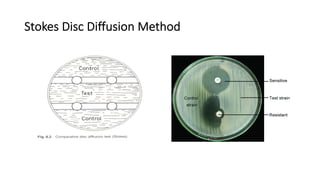
Stokes Disc Diffusion Method
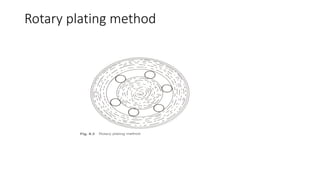
Rotary plating method
DILUTION
TEST
Dilution tests:
Broth dilution Agar dilution
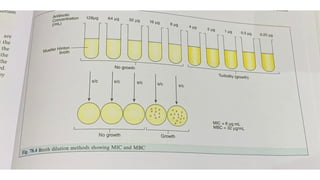
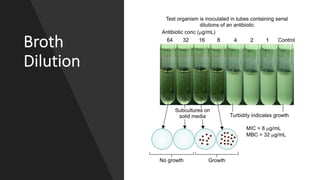
MIC (minimum inhibitory concentration) -
Lowest concentration of an antimicrobial
agent that will inhibit the visible growth of
a microorganism after overnight incubation.
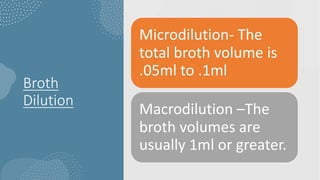
Broth
Dilution
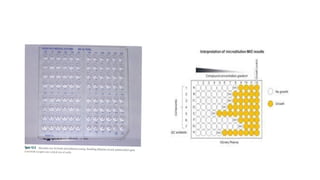
Microdilution- The
total broth volume is
.05ml to .1ml
Macrodilution –The
broth volumes are
usually 1ml or greater.
Broth
Dilution
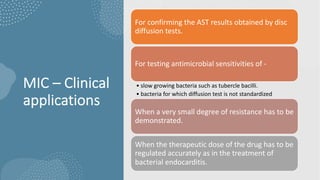
MIC – Clinical
applications
For confirming the AST results obtained by disc
diffusion tests.
For testing antimicrobial sensitivities of -
• slow growing bacteria such as tubercle bacilli.
• bacteria for which diffusion test is not standardized
When a very small degree of resistance has to be
demonstrated.
When the therapeutic dose of the drug has to be
regulated accurately as in the treatment of
bacterial endocarditis.
Agar
Dilution
Method
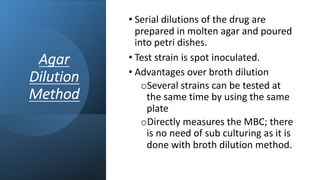
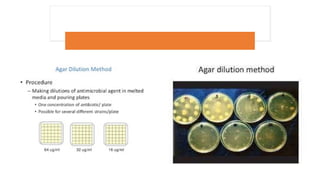
• Serial dilutions of the drug are
prepared in molten agar and poured
into petri dishes.
• Test strain is spot inoculated.
• Advantages over broth dilution
oSeveral strains can be tested at
the same time by using the same
plate
oDirectly measures the MBC; there
is no need of sub culturing as it is
done with broth dilution method.
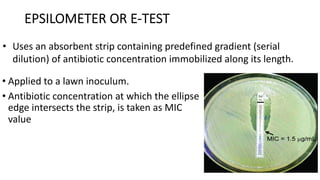
EPSILOMETER OR E-TEST
• Applied to a lawn inoculum.
• Antibiotic concentration at which the ellipse
edge intersects the strip, is taken as MIC
value
• Uses an absorbent strip containing predefined gradient (serial
dilution) of antibiotic concentration immobilized along its length.
Automated
Antimicrobial
Susceptibility
Tests
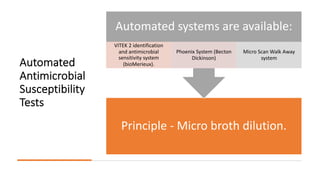
Principle - Micro broth dilution.
Automated systems are available:
VITEK 2 identification
and antimicrobial
sensitivity system
(bioMerieux).
Phoenix System (Becton
Dickinson)
Micro Scan Walk Away
system
MOLECULAR METHODS
• Polymerase chain reaction (PCR) based assays are available targeting specific drug resistant genes
• For example:-
• mecA gene for MRSA detection.
• rpo B gene in rifampicin resistance.
Thank you

Antimicrobial susceptibility testing- Microbiology

  • 1.
  • 2.
    INTRODUCTION • Bacteria exhibitgreat strain variations in susceptibility to antimicrobial agents – hence it is necessary to determine the susceptibility of pathogenic bacteria isolated from the clinical specimens.
  • 3.
    Components of AST •Bacterial inoculum size • Growth medium • pH • Cation Concentration • Blood and serum supplements • Thymidine content • Incubation atmosphere • Incubation temperature • Incubation duration • Antimicrobial concentration tested
  • 4.
    Antimicrobial Susceptibility Testing Methods • Kirby-Bauer discdiffusion method • Stokes disc diffusion method 1. Disc diffusion methods- • Broth dilution method • Agar dilution method 2. Dilution tests- 3. E-test 4. Automated methods 5. Molecular methods (PCR detecting drug resistant genes)
  • 5.
    DISC DIFFUSION Most widely usedmethod. Suitable for rapidly growing pathogenic bacteria. Unsuitable for slow growing bacteria. This method uses filter paper discs impregnated with appropriate concentration of the antibiotic solution.
  • 6.
    CULTURE METHOD –Lawn Culture DISC- Filter Paper disc 6mm diameter charged with appropriate concentration of the drug Inoculum – 0.5 Mac Farland standard turbidity to give semiconfluent growth after incubation Incubated at 35-37°C
  • 7.
    DISC DIFFUSION Media- Mueller- Hinton agar Modifications of MHA- • Lysed horse blood is added to MHA to support the growth of fastidious organisms such as H. influenzae. • 4% Sodium chloride (NaCl) should be added to the medium for testing MRSA isolates.
  • 8.
    Standard control strains- ATCC (American Type Culture Collection) Examples – • Escherichia coli ATCC 25922 • Pseudomonas aeruginosa ATCC 27853
  • 9.
    DISC DIFFUSION – Antibiotic disc • Commonlyused for treatment. • Antibiotic currently being administered to the patient. • Spectrum should be relevant to the organism isolated. First line drugs • Restricted only to special circumstances. • Reserved for testing later if the organism is found to be resistant to all the first line antibiotics tested before. Second line drugs
  • 10.
    Kirby-Bauer Disc DiffusionMethod Zone size is measured using a ruler or Vernier caliper
  • 12.
    Commonly used diskconcentrations and interpretation of disk diffusion test Antimicrobial agents Disc strength (µm) Diameter of zone of inhibition (in mm) Resistant Intermediate Sensitive Benzyl penicillin (S.aureus) 10units ≤28 - ≥29 Cefoxitin (S.aureus) 30 ≤21 - ≥22 Gentamicin (G) 10 ≤12 13-14 ≥15 Amikacin (Ak) 30 ≤14 15-16 ≥17 Erythromycin (E) 15 ≤13 14-22 ≥23 Tetracycline (T) 30 ≤14 15-18 ≥19 Nitrofurantoin (Nf) 300 ≤14 15-16 ≥17 Ciprofloxacin (Cf) 5 ≤15 16-20 ≥21 Ceftriaxone (Ci) 30 ≤19 20-22 ≥23 Imipenem (I) 10 ≤19 20-22 ≥23 Vancomycin (for enterococcus) 30 ≤14 15-16 ≥17
  • 13.
  • 15.
  • 17.
    DILUTION TEST Dilution tests: Broth dilutionAgar dilution MIC (minimum inhibitory concentration) - Lowest concentration of an antimicrobial agent that will inhibit the visible growth of a microorganism after overnight incubation.
  • 18.
    Broth Dilution Microdilution- The total brothvolume is .05ml to .1ml Macrodilution –The broth volumes are usually 1ml or greater.
  • 19.
  • 21.
    MIC – Clinical applications Forconfirming the AST results obtained by disc diffusion tests. For testing antimicrobial sensitivities of - • slow growing bacteria such as tubercle bacilli. • bacteria for which diffusion test is not standardized When a very small degree of resistance has to be demonstrated. When the therapeutic dose of the drug has to be regulated accurately as in the treatment of bacterial endocarditis.
  • 22.
    Agar Dilution Method • Serial dilutionsof the drug are prepared in molten agar and poured into petri dishes. • Test strain is spot inoculated. • Advantages over broth dilution oSeveral strains can be tested at the same time by using the same plate oDirectly measures the MBC; there is no need of sub culturing as it is done with broth dilution method.
  • 24.
    EPSILOMETER OR E-TEST •Applied to a lawn inoculum. • Antibiotic concentration at which the ellipse edge intersects the strip, is taken as MIC value • Uses an absorbent strip containing predefined gradient (serial dilution) of antibiotic concentration immobilized along its length.
  • 25.
    Automated Antimicrobial Susceptibility Tests Principle - Microbroth dilution. Automated systems are available: VITEK 2 identification and antimicrobial sensitivity system (bioMerieux). Phoenix System (Becton Dickinson) Micro Scan Walk Away system
  • 26.
    MOLECULAR METHODS • Polymerasechain reaction (PCR) based assays are available targeting specific drug resistant genes • For example:- • mecA gene for MRSA detection. • rpo B gene in rifampicin resistance.
  • 27.