CITRATE UTILIZATION TEST
SNEKHA. K
B.PHARM 2nd YEAR
• The citrate test is performed along with the other IMViC tests
to differentiate Gram-negative bacilli of the
Enterobacteriaceae family.
• It is an important test that allows the species-level
identification of the members of the Enterobacteriaceae
family.
• The citrate utilization test is a part of the IMViC test (Indole,
Methyl Red, Vogues-Proskauer, and Citrate Test) that
differentiates organisms on the basis of their ability to use
citrate as a sole source of energy.
• Bacteria such as Enterobacter aerogens, Klebsiella
pneumoniae can convert citrate to oxaloacetate and
acetate. The oxaloacetate is then metabolized to pyruvate
and CO2.
• Utilization of exogenous citrate requires the presence of
citrate transport proteins (permeases).
• Citrate = acetate + oxaloacetate
• Oxaloacetate = pyruvate + CO2
Principle of Citrate Utilization Test
• Citrate agar is used to test the ability of an organism to
utilize citrate as a source of energy.
• The agar medium contains citrate as the sole carbon
source and inorganic ammonium salts as the sole source
of nitrogen.
• Bromothymol blue is considered as a pH indicator.
• For the citrate utilization test oxygen is required and the
process is done on the slants.
• The citrate is oxidized from bacteria and is extracted with
the release of CO2 from the medium.
• Sodium from sodium citrate combines with CO2 and water,
to form an alkaline product (sodium carbonate).
• The change in the pH of the solution gives details about the
presence and absence of the test.
• Colour change of the solution to blue indicates the positive
citrate test.
• If there is no colour shift, that means there is no growth in
the medium, which indicates the absence of the citrate test.
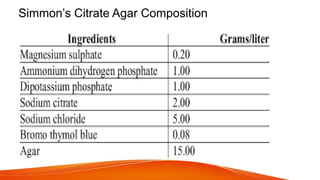
Simmon’s Citrate Agar Composition
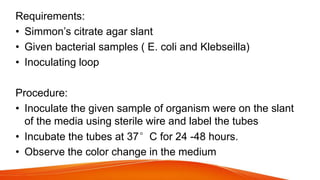
Requirements:
• Simmon’s citrate agar slant
• Given bacterial samples ( E. coli and Klebseilla)
• Inoculating loop
Procedure:
• Inoculate the given sample of organism were on the slant
of the media using sterile wire and label the tubes
• Incubate the tubes at 37°C for 24 -48 hours.
• Observe the color change in the medium
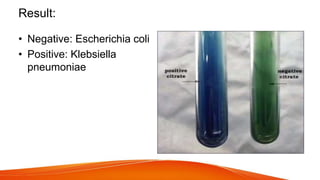
Result:
• Negative: Escherichia coli
• Positive: Klebsiella
pneumoniae
Thank you

CITRATE UTILIZATION TEST.pptx

  • 1.
  • 2.
    • The citratetest is performed along with the other IMViC tests to differentiate Gram-negative bacilli of the Enterobacteriaceae family. • It is an important test that allows the species-level identification of the members of the Enterobacteriaceae family. • The citrate utilization test is a part of the IMViC test (Indole, Methyl Red, Vogues-Proskauer, and Citrate Test) that differentiates organisms on the basis of their ability to use citrate as a sole source of energy.
  • 3.
    • Bacteria suchas Enterobacter aerogens, Klebsiella pneumoniae can convert citrate to oxaloacetate and acetate. The oxaloacetate is then metabolized to pyruvate and CO2. • Utilization of exogenous citrate requires the presence of citrate transport proteins (permeases). • Citrate = acetate + oxaloacetate • Oxaloacetate = pyruvate + CO2
  • 5.
    Principle of CitrateUtilization Test • Citrate agar is used to test the ability of an organism to utilize citrate as a source of energy. • The agar medium contains citrate as the sole carbon source and inorganic ammonium salts as the sole source of nitrogen. • Bromothymol blue is considered as a pH indicator. • For the citrate utilization test oxygen is required and the process is done on the slants.
  • 6.
    • The citrateis oxidized from bacteria and is extracted with the release of CO2 from the medium. • Sodium from sodium citrate combines with CO2 and water, to form an alkaline product (sodium carbonate). • The change in the pH of the solution gives details about the presence and absence of the test. • Colour change of the solution to blue indicates the positive citrate test. • If there is no colour shift, that means there is no growth in the medium, which indicates the absence of the citrate test.
  • 7.
  • 8.
    Requirements: • Simmon’s citrateagar slant • Given bacterial samples ( E. coli and Klebseilla) • Inoculating loop Procedure: • Inoculate the given sample of organism were on the slant of the media using sterile wire and label the tubes • Incubate the tubes at 37°C for 24 -48 hours. • Observe the color change in the medium
  • 9.
    Result: • Negative: Escherichiacoli • Positive: Klebsiella pneumoniae
  • 10.