VIVEKANANDHA ARTS AND
SCIENCE COLLEGE FOR WOMEN
VEERACHIPALAYAM,SANKAGIRI,SALEM
DEPARTMENT OF MICROBIOLOGY
ANTIMICROBIAL SUSCEPTIBILITY TESTING
SUBJECT : BACTERIOLOGY
SUBMITTED BY
:
K.SHANMUGAPRIYA
1'ST M.SC MICROBIOLOGY
Introduction :
Antimicrobial susceptibility
testing (AST) is a
laboratory procedure
performed by medical
technologists (clinical
laboratory scientists) to
identify which antimicrobial
regimen is specifically
effective for individual
Antibiotic Sensitivity Testing
Antibiotic sensitivity testing is carried out to determine
the appropriate antibiotic agent to be used for a
particular bacte-rial strain isolated from clinical
specimens. Antibiotic sensitiv-ity testing can be carried
out by two broad methods, as follows:
a) Disc diffusion tests
b) Dilution tests
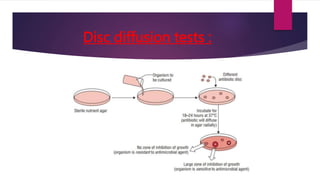
Disc diffusion tests :
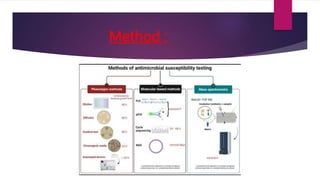
Method :
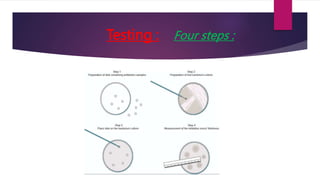
Testing : Four steps :
Types of disc diffusion tests
Disc diffusion tests are of the following
types:
a) Kirby–Bauer disc diffusion method
b) Stokes disc diffusion method
c) Primary disc diffusion test
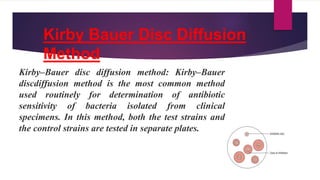
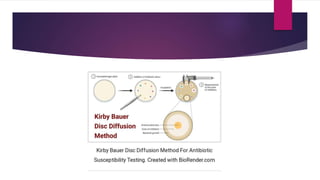
Kirby–Bauer disc diffusion method: Kirby–Bauer
discdiffusion method is the most common method
used routinely for determination of antibiotic
sensitivity of bacteria isolated from clinical
specimens. In this method, both the test strains and
the control strains are tested in separate plates.
Kirby Bauer Disc Diffusion
Method
Dilution tests :
Dilution tests are performed to determine the minimum
inhib-itory concentration (MIC) of an antimicrobial agent.
MIC is defined as the lowest concentration of an
antimicrobial agent that inhibits the growth of organisms.
Estimation of the MIC is useful to:
 Regulate the therapeutic dose of the antibiotic
accurately in the treatment of many life-threatening
situations, such as bacterial endocarditis.
Following methods are carried out
to determine the MIC:
a) Broth dilution method
b) Agar dilution method
c) Epsilometer test (E-test)
Broth dilution method
The broth dilution method is a quantitative method for
deter-mining the MIC of an antimicrobial agent that inhibits
the growth of organisms in vitro. In this method, the
antimicrobial agent is serially diluted in Mueller–Hinton
broth by doubling dilution in tubes and then a standard
suspension of the broth culture of test organism is added to
each of the antibiotic dilu-tions and control tube. This is
mixed gently and incubated at 37°C for 16–18 hours.
Agar dilution method
Agar dilution method is a quantitative method
for determining the MIC of antimicrobial
agent against the test organism.
Mueller–Hinton agar is used in this method.
Serial dilution of the antibiotic are made in
agar and poured onto Petri dishes.
Epsilometer test (E test)
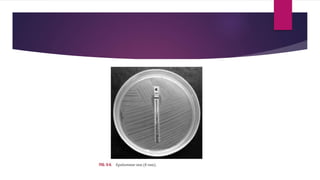
Epsilometer test (E test), based on the principle of disc
diffu-sion, is an automated system for measuring MIC of
a bacterial isolate. In this method, an absorbent plastic
strip with a con-tinuous gradient of antibiotic is
immobilized on one side.
MIC interpretative scale corresponding to 15
twofold MIC dilu-tions is used on the other side.
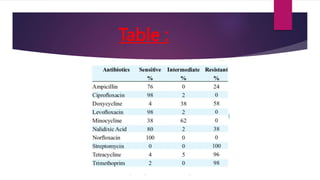
Table :
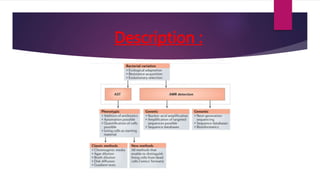
Description :
Antibiotic
discs
◍ Antibiotic discs are made from
premium quality paper towels
impregnated with antimicrobial
agents in precise concentrations.
They are clearly identified by
an acronym, comprising 1 to 3
letters, printed on each side of the
◍ The disc cartridges must be
stored in their container
between +2 and +8°C in a dry
place. The discs must be
brought to room temperature.
Any opened cartridge must be
Indications/Application
s
Antimicrobial susceptibility tests are
used to determine which specific
antibiotics a particular bacteria or
fungus is sensitive to. Most often, this
testing complements a Gram stain and
culture, the results of which are
Conclusion
Although a variety of methods exist,
the goal of in-vitro antimicrobial
susceptibility testing is the same: to
provide a reliable predictor of how a
microorganism is likely to respond
to antimicrobial therapy in the
Thank you 💐...

Antimicrobial Susceptibility Testing........... ppt...pptx

  • 1.
    VIVEKANANDHA ARTS AND SCIENCECOLLEGE FOR WOMEN VEERACHIPALAYAM,SANKAGIRI,SALEM DEPARTMENT OF MICROBIOLOGY ANTIMICROBIAL SUSCEPTIBILITY TESTING SUBJECT : BACTERIOLOGY SUBMITTED BY : K.SHANMUGAPRIYA 1'ST M.SC MICROBIOLOGY
  • 2.
    Introduction : Antimicrobial susceptibility testing(AST) is a laboratory procedure performed by medical technologists (clinical laboratory scientists) to identify which antimicrobial regimen is specifically effective for individual
  • 3.
    Antibiotic Sensitivity Testing Antibioticsensitivity testing is carried out to determine the appropriate antibiotic agent to be used for a particular bacte-rial strain isolated from clinical specimens. Antibiotic sensitiv-ity testing can be carried out by two broad methods, as follows: a) Disc diffusion tests b) Dilution tests
  • 4.
  • 5.
  • 6.
  • 7.
    Types of discdiffusion tests Disc diffusion tests are of the following types: a) Kirby–Bauer disc diffusion method b) Stokes disc diffusion method c) Primary disc diffusion test
  • 8.
    Kirby–Bauer disc diffusionmethod: Kirby–Bauer discdiffusion method is the most common method used routinely for determination of antibiotic sensitivity of bacteria isolated from clinical specimens. In this method, both the test strains and the control strains are tested in separate plates. Kirby Bauer Disc Diffusion Method
  • 10.
    Dilution tests : Dilutiontests are performed to determine the minimum inhib-itory concentration (MIC) of an antimicrobial agent. MIC is defined as the lowest concentration of an antimicrobial agent that inhibits the growth of organisms. Estimation of the MIC is useful to:  Regulate the therapeutic dose of the antibiotic accurately in the treatment of many life-threatening situations, such as bacterial endocarditis.
  • 11.
    Following methods arecarried out to determine the MIC: a) Broth dilution method b) Agar dilution method c) Epsilometer test (E-test)
  • 12.
    Broth dilution method Thebroth dilution method is a quantitative method for deter-mining the MIC of an antimicrobial agent that inhibits the growth of organisms in vitro. In this method, the antimicrobial agent is serially diluted in Mueller–Hinton broth by doubling dilution in tubes and then a standard suspension of the broth culture of test organism is added to each of the antibiotic dilu-tions and control tube. This is mixed gently and incubated at 37°C for 16–18 hours.
  • 13.
    Agar dilution method Agardilution method is a quantitative method for determining the MIC of antimicrobial agent against the test organism. Mueller–Hinton agar is used in this method. Serial dilution of the antibiotic are made in agar and poured onto Petri dishes.
  • 14.
    Epsilometer test (Etest) Epsilometer test (E test), based on the principle of disc diffu-sion, is an automated system for measuring MIC of a bacterial isolate. In this method, an absorbent plastic strip with a con-tinuous gradient of antibiotic is immobilized on one side. MIC interpretative scale corresponding to 15 twofold MIC dilu-tions is used on the other side.
  • 16.
  • 18.
  • 19.
    Antibiotic discs ◍ Antibiotic discsare made from premium quality paper towels impregnated with antimicrobial agents in precise concentrations. They are clearly identified by an acronym, comprising 1 to 3 letters, printed on each side of the
  • 20.
    ◍ The disccartridges must be stored in their container between +2 and +8°C in a dry place. The discs must be brought to room temperature. Any opened cartridge must be
  • 21.
    Indications/Application s Antimicrobial susceptibility testsare used to determine which specific antibiotics a particular bacteria or fungus is sensitive to. Most often, this testing complements a Gram stain and culture, the results of which are
  • 22.
    Conclusion Although a varietyof methods exist, the goal of in-vitro antimicrobial susceptibility testing is the same: to provide a reliable predictor of how a microorganism is likely to respond to antimicrobial therapy in the
  • 23.

Editor's Notes

  • #2 The email address is not valid. Please verify that you have entered the correct information. SUSCPTIBILITY TESTING