MRSA Detection
Dr. Samira Fattah
PhD in Medical Bacteriology
College of Health Sciences-HMU
MRSA Detection
• Methicillin Resistant Staphylococcus aureus (MRSA) is any strain of S. aureus that has
developed a multiple drug resistance to beta-lactam antibiotics.
• Beta-lactam (β-lactam) antibiotics are a broad-spectrum group that include some penams
(penicillin derivatives such as methicillin and oxacillin) and cephems such as the
cephalosporins.
• Strains unable to resist these antibiotics are classified as methicillin-susceptible S. aureus,
or MSSA.
• Methicillin resistance is due to a resistance gene mecA, which stops β-lactam antibiotics
from inactivating the enzymes (transpeptidases) critical for cell wall synthesis.
MRSA Detection
• Methicillin-resistant S. aureus are associated with serious nosocomial
infections in hospitals which lead to higher costs, longer
hospitalizations, increased mortality and limits the treatment
possibilities .
• Rapid differentiation between methicillin-resistant and methicillin-
susceptible S. aureus species is necessary to optimize treatment and
minimize costs.
• Making the correct choice of antibiotics based on the antimicrobial
susceptibility of MRSA isolates may help to reduce the resistance
problem by reducing the over-prescription of ineffective antibiotics
Screening for MRSA
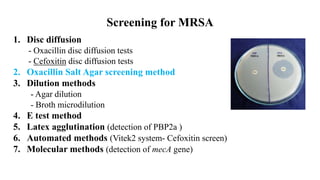
1. Disc diffusion
- Oxacillin disc diffusion tests
- Cefoxitin disc diffusion tests
2. Oxacillin Salt Agar screening method
3. Dilution methods
- Agar dilution
- Broth microdilution
4. E test method
5. Latex agglutination (detection of PBP2a )
6. Automated methods (Vitek2 system- Cefoxitin screen)
7. Molecular methods (detection of mecA gene)
Oxacillin Salt Agar Screening test
Materials:
1. Staphylococcus aureus bacteria
2. MHA with 4%NaCl
3. 6 µg/mL Oxacillin
4. Incubator
Oxacillin Salt Agar Screening test
Method:
1. Prepare 1 liter of MHA media
• Add 40 gm NaCl
• Autoclave
• After cooling to 45°C add 6mg Oxacillin
(6 µg/mL oxacillin ˟ 1000ml =6000 µg=6mg=0.006 gm )
2. Pour to plates
3. Colony suspension to obtain 0.5 McFarland turbidity.
4. Using a swab dipped in the suspension and the excess liquid expressed, spot an
area or streak an entire quadrant.
5. Incubate at 33 to 35°C for 24 hours (Testing at temperatures above 35°C may
not detect MRSA.)
Oxacillin Salt Agar Screening test
Result reading:
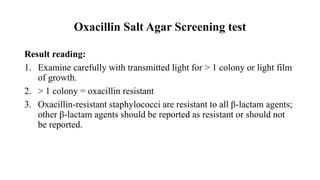
1. Examine carefully with transmitted light for > 1 colony or light film
of growth.
2. > 1 colony = oxacillin resistant
3. Oxacillin-resistant staphylococci are resistant to all β-lactam agents;
other β-lactam agents should be reported as resistant or should not
be reported.
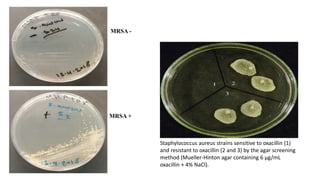
Staphylococcus aureus strains sensitive to oxacillin (1)
and resistant to oxacillin (2 and 3) by the agar screening
method (Mueller-Hinton agar containing 6 μg/mL
oxacillin + 4% NaCl).
MRSA -
MRSA +
Oxacillin Agar Screening test
Limitation of the method
When performed properly, the oxacillin agar method will detect most
mecA-positive S. aureus strains. Occasionally a heteroresistant mecA-
positive strain is not detected and may be missed , in part due to a low
frequency of resistance expression and slow growth rate.

MRSA Detection

  • 1.
    MRSA Detection Dr. SamiraFattah PhD in Medical Bacteriology College of Health Sciences-HMU
  • 2.
    MRSA Detection • MethicillinResistant Staphylococcus aureus (MRSA) is any strain of S. aureus that has developed a multiple drug resistance to beta-lactam antibiotics. • Beta-lactam (β-lactam) antibiotics are a broad-spectrum group that include some penams (penicillin derivatives such as methicillin and oxacillin) and cephems such as the cephalosporins. • Strains unable to resist these antibiotics are classified as methicillin-susceptible S. aureus, or MSSA. • Methicillin resistance is due to a resistance gene mecA, which stops β-lactam antibiotics from inactivating the enzymes (transpeptidases) critical for cell wall synthesis.
  • 3.
    MRSA Detection • Methicillin-resistantS. aureus are associated with serious nosocomial infections in hospitals which lead to higher costs, longer hospitalizations, increased mortality and limits the treatment possibilities . • Rapid differentiation between methicillin-resistant and methicillin- susceptible S. aureus species is necessary to optimize treatment and minimize costs. • Making the correct choice of antibiotics based on the antimicrobial susceptibility of MRSA isolates may help to reduce the resistance problem by reducing the over-prescription of ineffective antibiotics
  • 4.
    Screening for MRSA 1.Disc diffusion - Oxacillin disc diffusion tests - Cefoxitin disc diffusion tests 2. Oxacillin Salt Agar screening method 3. Dilution methods - Agar dilution - Broth microdilution 4. E test method 5. Latex agglutination (detection of PBP2a ) 6. Automated methods (Vitek2 system- Cefoxitin screen) 7. Molecular methods (detection of mecA gene)
  • 5.
    Oxacillin Salt AgarScreening test Materials: 1. Staphylococcus aureus bacteria 2. MHA with 4%NaCl 3. 6 µg/mL Oxacillin 4. Incubator
  • 6.
    Oxacillin Salt AgarScreening test Method: 1. Prepare 1 liter of MHA media • Add 40 gm NaCl • Autoclave • After cooling to 45°C add 6mg Oxacillin (6 µg/mL oxacillin ˟ 1000ml =6000 µg=6mg=0.006 gm ) 2. Pour to plates 3. Colony suspension to obtain 0.5 McFarland turbidity. 4. Using a swab dipped in the suspension and the excess liquid expressed, spot an area or streak an entire quadrant. 5. Incubate at 33 to 35°C for 24 hours (Testing at temperatures above 35°C may not detect MRSA.)
  • 7.
    Oxacillin Salt AgarScreening test Result reading: 1. Examine carefully with transmitted light for > 1 colony or light film of growth. 2. > 1 colony = oxacillin resistant 3. Oxacillin-resistant staphylococci are resistant to all β-lactam agents; other β-lactam agents should be reported as resistant or should not be reported.
  • 8.
    Staphylococcus aureus strainssensitive to oxacillin (1) and resistant to oxacillin (2 and 3) by the agar screening method (Mueller-Hinton agar containing 6 μg/mL oxacillin + 4% NaCl). MRSA - MRSA +
  • 9.
    Oxacillin Agar Screeningtest Limitation of the method When performed properly, the oxacillin agar method will detect most mecA-positive S. aureus strains. Occasionally a heteroresistant mecA- positive strain is not detected and may be missed , in part due to a low frequency of resistance expression and slow growth rate.