Antibiotic sensitivity Testing
Introduction
 A testdone to checkthe effectivenessof adrug againsta bacteriumandto selectthe bestdrug
that acts againstthe bacterium.
 The in vitrotestingof bacterial cultureswith antibiotictodetermine the susceptibilityof
bacteriato antibiotictherapy.
Purpose
 To guide the clinicianinselectingthe bestantibioticagentforan individual patient.
 To control the use of in clinical practice.
 To accumulate epidemiological informationonthe resistance of microorganismsof publichealth
importance withinthe community.
 To reveal the changingtrendsinthe local isolates.
 Bacteriahave the abilitytodevelopresistance followingrepeatedorsubclinical(insufficient)
doses,somore advancedantibioticsandsyntheticantibioticsare continuallyrequiredto
overcome them.
Factors Influencing Antimicrobial Susceptibility Testing
 pH
 Moisture
 Effects of Thymidine or Thymine
 Effects of Variation in Divalent Cations
 Testing strains that fail to grow satisfactorily
Methods of Antimicrobial Susceptibility Testing
Antimicrobial susceptibility testing methods are divided into types based on the principle applied in
each system. They include:
Diffusion Dilution Diffusion&Dilution
Stokes method Minimum Inhibitory Concentration E-Test method
Kirby-Bauer method i) Broth dilution
ii)AgarDilution
Disk Diffusion Method(The Kirby-Bauer Method)
Reagents for the Disk Diffusion Test
1. Müeller-Hinton Agar Medium
Of the many media available, Müeller-Hinton agar is considered to be the best for routine
susceptibility testing of nonfastidious bacteria for the following reasons:
* It shows acceptable batch-to-batch reproducibility for susceptibility testing.
* It is low in sulphonamide, trimethoprim, and tetracycline inhibitors.
* It gives satisfactory growth of most nonfastidious pathogens.
* A large bodyof dataandexperiencehasbeencollectedconcerningsusceptibility tests performed
with this medium.
AlthoughMüeller-Hintonagarisreliable generallyforsusceptibilitytesting,resultsobtained
withsome batchesmay,on occasion,varysignificantly. If abatch of mediumdoesnotsupport
adequate growthof a testorganism, zonesobtainedinadiskdiffusiontestwillusuallybe larger
than expectedandmayexceedthe acceptable qualitycontrol limits.
2. Turbidity standard for inoculum preparation
To standardizetheinoculumdensityforasusceptibilitytest,aBaSO4 turbiditystandard,equivalent
toa 0.5 McFarlandstandardoritsopticalequivalent(e.g.,latex particlesuspension),shouldbe
used.
Procedure for Performing the Disc Diffusion Test
Inoculum Preparation
Growth Method
The growth method is performed as follows
 Atleastthreetofive well-isolatedcoloniesof thesamemorphological type areselected
fromanagarplate culture. The topof eachcolonyistouchedwithaloop, andthegrowth
istransferredintoatube containing4to5 ml of a suitablebrothmedium,suchastryptic
soybroth.
 The brothcultureisincubatedat35Cuntil itachievesorexceedstheturbidityof the0.5
McFarlandstandard(usually2to6 hours)
Direct Colony Suspension Method
 Asa convenientalternativetothe growthmethod,the inoculumcanbe preparedby
makingadirectbrothorsalinesuspensionof isolatedcoloniesselectedfroma18- to
24-houragarplate (anonselectivemedium,suchasbloodagar,shouldbeused).
 The suspensionisadjustedtomatchthe 0.5McFarlandturbiditystandard,usingsaline
anda vortex mixer
 The lidmaybe leftajarfor3to5 minutes,butnomorethan15minutes,toallowfor
anyexcesssurfacemoisturetobe absorbedbeforeapplyingthe drugimpregnated
disks.
Application of Discs to Inoculated Agar Plates
 The predeterminedbatteryof antimicrobialdiscsisdispensed onto the surface of the inoculated
agar plate.
 Eachdiscmustbe presseddowntoensurecomplete contact with the agar surface. Whether the
discsare placedindividuallyorwithadispensingapparatus,theymustbedistributedevenlysothat
they are no closer than 24 mm from center to center.
 Ordinarily,nomorethan12discsshouldbe placedon one 150mmplate or more than 6 discs on a
100 mm plate.
 Because someof thedrugdiffusesalmostinstantaneously, a disc should not be relocated once it
hascome intocontactwiththeagarsurface. Instead,place a new disc in another location on the
agar.
Reading Plates and Interpreting Results
 After16to18 hoursof incubation,eachplateisexamined.
 If the plate wassatisfactorilystreaked,andthe inoculumwascorrect,the resultingzonesof
inhibitionwillbe uniformlycircularandtherewillbe aconfluentlawnof growth.
 If individualcoloniesare apparent,the inoculumwastoolightandthetestmustbe repeated.
 The diametersof the zonesof completeinhibition(asjudgedbythe unaidedeye)are measured,
includingthe diameterof thedisc.Zonesare measured tothenearestwholemillimeter,using
slidingcalipersoraruler,whichisheldonthebackof the invertedpetri plate.
 The petri plate isheldafew inchesaboveablack,nonreflectingbackgroundandilluminatedwith
reflectedlight.
 If bloodwasaddedto theagarbase (aswithstreptococci),thezonesare measuredfromthe upper
surface of the agarilluminatedwithreflectedlight,withthecoverremoved
2 Dilution Methods
Dilution susceptibility testing methods are used to determine the minimal concentration of
antimicrobial to inhibit or kill the microorganism. This can be achieved by dilution of antimicrobial in
either agar or broth media. Antimicrobials are tested in log2 serial dilutions (two fold).
Minimum Inhibitory Concentration (MIC)
 Diffusiontests widely used to determine the susceptibility of organisms isolated from clinical
specimenshave theirlimitations; when equivocal results are obtained or in prolonged serious
infectione.g.bacterialendocarditis,the quantitationof antibiotic action vis-a-vis the pathogen
needs to be more precise.
 Also the terms ‘Susceptible’ and ‘Resistant’ can have a realistic interpretation. Thus when in
doubt, the way to a precise assessment is to determine the MIC of the antibiotic to the
organisms concerned.
There are two methods of testing for MIC:
(a) Broth dilution method
(b) Agar dilution method.
Broth Dilution Method
The Broth Dilution method is a simple procedure for testing a small number of isolates, even single
isolate. It has the added advantage that the same tubes can be taken for MBC tests also:
Materials
 Sterile graduated pipettes of 10ml, 5ml, 2ml and 1ml Sterile capped 7.5 x 1.3 cm tubes /
small screw-capped bottles, Pasteur pipettes, overnight broth culture of test and control
organisms ( same as for disc diffusion tests), required antibiotic in powder form (either from
the manufacturer or standard laboratory accompanied by a statement of its activity in
mg/unit or per ml.
 Clinical preparations should not be used for reference technique. required solvent for the
antibiotic, sterile Distilled Water - 500ml and suitable nutrient broth medium.
 Trimethoprim and sulphonamide testing requires thymidine free media or addition of 4%
lysed horse blood to the media
 A suitable rack to hold 22 tubes in two rows i-e 11 tubes in each row.
Method
 Prepare stock dilutions of the antibiotic of concentrations 1000 and 100 µg/L as
required from original stock solution (10,000mg/L).
 Arrange two rows of 12 sterile 7.5 x1.3 cm capped tubes in the rack. In a sterile
30ml (universal) screw capped bottle, prepare 8ml of broth containing the
concentration of antibiotic required for the first tube in each row from the
appropriate stock solution already made.
 Mix the contents of the universal bottle using a pipette and transfer 2ml to the first
tube in each row.
 Using a fresh pipette ,add 4 ml of broth to the remaining 4 ml in the universal bottle
mix and transfer 2ml to the second tube in each row.
 Continue preparing dilutions in this way but where as many as 10 or more are
required the series should be started again half the way down.
 Place 2ml of antibiotic free broth to the last tube in each row. Inoculate one row with
one drop of an overnight broth culture of the test organism diluted approximately to
1 in 1000 in a suitable broth and the second row with the control organism of known
sensitivity similarly diluted.
 The result of the test is significantly affected by the size of the inoculum.The test
mixture should contain 106 organism/ml.
 If the broth culture used has grown poorly,it may be necessary to use this undiluted.
Incubate tubes for 18 hours at 37oC.
 Inoculate a tube containing 2ml broth with the organism and keep at +4oC in a
refrigerator overnight to be used as standard for the determination of complete
inhibition
Reading of result
 MIC is expressed as the lowest dilution, which inhibited growth judged by lack of
turbidity in the tube.
 Because very faint turbidity may be given by the inoculum itself, the inoculated tube kept
in the refrigerator overnight may be used as the standard for the determination of
complete inhibition.
 Standard strain of known MIC value run with the test is used as the control to check the
reagents and conditions
Dilution and Diffusion
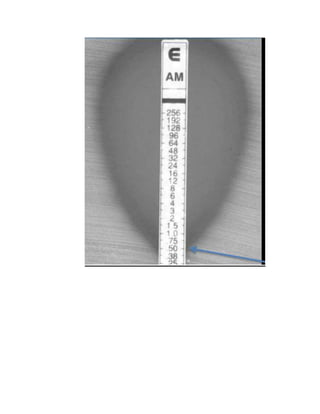
 E test also known as the epsilometer test is an ‘exponential gradient’ testing methodology
where ‘E’ in E test refers to the Greek symbol epsilon ().
 The E test(AB Biodisk) which is a quantitative method for antimicrobial susceptibility
testing applies both the dilution of antibiotic and diffusion of antibiotic into the medium..
 A predefined stable antimicrobial gradient is present on a thin inert carrier strip. When
this E test strip is applied onto an inoculated agar plate, there is an immediate release of
the drug.
 Following incubation a symmetrical inhibition ellipse is produced.
 The intersection of the inhibitory zone edge and the calibrated carrier strip indicates the
MIC value over a wide concentration range (>10 dilutions) with inherent precision and
accuracy.
 E test can be used to determine MIC for fastidious organisms like S. pneumoniae,
ß-hemolytic streptococci, N.gonorrhoeae, Haemophilus sp. and anaerobes.
 It can also be used for Nonfermenting Gram Negative bacilli (NFGNB) for eg-
Pseudomonas sp. and Burkholderia pseudomallei.
 In conclusion E test is a simple, accurate and reliable method to determine the MIC for a
wide spectrum of infectious agents.
Antibiotic sensitivity testing

Antibiotic sensitivity testing

  • 1.
    Antibiotic sensitivity Testing Introduction A testdone to checkthe effectivenessof adrug againsta bacteriumandto selectthe bestdrug that acts againstthe bacterium.  The in vitrotestingof bacterial cultureswith antibiotictodetermine the susceptibilityof bacteriato antibiotictherapy. Purpose  To guide the clinicianinselectingthe bestantibioticagentforan individual patient.  To control the use of in clinical practice.  To accumulate epidemiological informationonthe resistance of microorganismsof publichealth importance withinthe community.  To reveal the changingtrendsinthe local isolates.  Bacteriahave the abilitytodevelopresistance followingrepeatedorsubclinical(insufficient) doses,somore advancedantibioticsandsyntheticantibioticsare continuallyrequiredto overcome them. Factors Influencing Antimicrobial Susceptibility Testing  pH  Moisture  Effects of Thymidine or Thymine  Effects of Variation in Divalent Cations  Testing strains that fail to grow satisfactorily
  • 2.
    Methods of AntimicrobialSusceptibility Testing Antimicrobial susceptibility testing methods are divided into types based on the principle applied in each system. They include: Diffusion Dilution Diffusion&Dilution Stokes method Minimum Inhibitory Concentration E-Test method Kirby-Bauer method i) Broth dilution ii)AgarDilution Disk Diffusion Method(The Kirby-Bauer Method) Reagents for the Disk Diffusion Test 1. Müeller-Hinton Agar Medium Of the many media available, Müeller-Hinton agar is considered to be the best for routine susceptibility testing of nonfastidious bacteria for the following reasons: * It shows acceptable batch-to-batch reproducibility for susceptibility testing. * It is low in sulphonamide, trimethoprim, and tetracycline inhibitors. * It gives satisfactory growth of most nonfastidious pathogens. * A large bodyof dataandexperiencehasbeencollectedconcerningsusceptibility tests performed with this medium. AlthoughMüeller-Hintonagarisreliable generallyforsusceptibilitytesting,resultsobtained withsome batchesmay,on occasion,varysignificantly. If abatch of mediumdoesnotsupport adequate growthof a testorganism, zonesobtainedinadiskdiffusiontestwillusuallybe larger than expectedandmayexceedthe acceptable qualitycontrol limits.
  • 3.
    2. Turbidity standardfor inoculum preparation To standardizetheinoculumdensityforasusceptibilitytest,aBaSO4 turbiditystandard,equivalent toa 0.5 McFarlandstandardoritsopticalequivalent(e.g.,latex particlesuspension),shouldbe used. Procedure for Performing the Disc Diffusion Test Inoculum Preparation Growth Method The growth method is performed as follows  Atleastthreetofive well-isolatedcoloniesof thesamemorphological type areselected fromanagarplate culture. The topof eachcolonyistouchedwithaloop, andthegrowth istransferredintoatube containing4to5 ml of a suitablebrothmedium,suchastryptic soybroth.  The brothcultureisincubatedat35Cuntil itachievesorexceedstheturbidityof the0.5 McFarlandstandard(usually2to6 hours) Direct Colony Suspension Method  Asa convenientalternativetothe growthmethod,the inoculumcanbe preparedby makingadirectbrothorsalinesuspensionof isolatedcoloniesselectedfroma18- to 24-houragarplate (anonselectivemedium,suchasbloodagar,shouldbeused).  The suspensionisadjustedtomatchthe 0.5McFarlandturbiditystandard,usingsaline anda vortex mixer  The lidmaybe leftajarfor3to5 minutes,butnomorethan15minutes,toallowfor anyexcesssurfacemoisturetobe absorbedbeforeapplyingthe drugimpregnated disks. Application of Discs to Inoculated Agar Plates  The predeterminedbatteryof antimicrobialdiscsisdispensed onto the surface of the inoculated agar plate.  Eachdiscmustbe presseddowntoensurecomplete contact with the agar surface. Whether the discsare placedindividuallyorwithadispensingapparatus,theymustbedistributedevenlysothat they are no closer than 24 mm from center to center.  Ordinarily,nomorethan12discsshouldbe placedon one 150mmplate or more than 6 discs on a 100 mm plate.
  • 4.
     Because someofthedrugdiffusesalmostinstantaneously, a disc should not be relocated once it hascome intocontactwiththeagarsurface. Instead,place a new disc in another location on the agar. Reading Plates and Interpreting Results  After16to18 hoursof incubation,eachplateisexamined.  If the plate wassatisfactorilystreaked,andthe inoculumwascorrect,the resultingzonesof inhibitionwillbe uniformlycircularandtherewillbe aconfluentlawnof growth.  If individualcoloniesare apparent,the inoculumwastoolightandthetestmustbe repeated.  The diametersof the zonesof completeinhibition(asjudgedbythe unaidedeye)are measured, includingthe diameterof thedisc.Zonesare measured tothenearestwholemillimeter,using slidingcalipersoraruler,whichisheldonthebackof the invertedpetri plate.  The petri plate isheldafew inchesaboveablack,nonreflectingbackgroundandilluminatedwith reflectedlight.  If bloodwasaddedto theagarbase (aswithstreptococci),thezonesare measuredfromthe upper surface of the agarilluminatedwithreflectedlight,withthecoverremoved
  • 5.
    2 Dilution Methods Dilutionsusceptibility testing methods are used to determine the minimal concentration of antimicrobial to inhibit or kill the microorganism. This can be achieved by dilution of antimicrobial in either agar or broth media. Antimicrobials are tested in log2 serial dilutions (two fold). Minimum Inhibitory Concentration (MIC)  Diffusiontests widely used to determine the susceptibility of organisms isolated from clinical specimenshave theirlimitations; when equivocal results are obtained or in prolonged serious infectione.g.bacterialendocarditis,the quantitationof antibiotic action vis-a-vis the pathogen needs to be more precise.  Also the terms ‘Susceptible’ and ‘Resistant’ can have a realistic interpretation. Thus when in doubt, the way to a precise assessment is to determine the MIC of the antibiotic to the organisms concerned. There are two methods of testing for MIC: (a) Broth dilution method (b) Agar dilution method. Broth Dilution Method The Broth Dilution method is a simple procedure for testing a small number of isolates, even single isolate. It has the added advantage that the same tubes can be taken for MBC tests also: Materials  Sterile graduated pipettes of 10ml, 5ml, 2ml and 1ml Sterile capped 7.5 x 1.3 cm tubes / small screw-capped bottles, Pasteur pipettes, overnight broth culture of test and control organisms ( same as for disc diffusion tests), required antibiotic in powder form (either from the manufacturer or standard laboratory accompanied by a statement of its activity in mg/unit or per ml.
  • 6.
     Clinical preparationsshould not be used for reference technique. required solvent for the antibiotic, sterile Distilled Water - 500ml and suitable nutrient broth medium.  Trimethoprim and sulphonamide testing requires thymidine free media or addition of 4% lysed horse blood to the media  A suitable rack to hold 22 tubes in two rows i-e 11 tubes in each row. Method  Prepare stock dilutions of the antibiotic of concentrations 1000 and 100 µg/L as required from original stock solution (10,000mg/L).  Arrange two rows of 12 sterile 7.5 x1.3 cm capped tubes in the rack. In a sterile 30ml (universal) screw capped bottle, prepare 8ml of broth containing the concentration of antibiotic required for the first tube in each row from the appropriate stock solution already made.  Mix the contents of the universal bottle using a pipette and transfer 2ml to the first tube in each row.  Using a fresh pipette ,add 4 ml of broth to the remaining 4 ml in the universal bottle mix and transfer 2ml to the second tube in each row.  Continue preparing dilutions in this way but where as many as 10 or more are required the series should be started again half the way down.  Place 2ml of antibiotic free broth to the last tube in each row. Inoculate one row with one drop of an overnight broth culture of the test organism diluted approximately to 1 in 1000 in a suitable broth and the second row with the control organism of known sensitivity similarly diluted.  The result of the test is significantly affected by the size of the inoculum.The test mixture should contain 106 organism/ml.  If the broth culture used has grown poorly,it may be necessary to use this undiluted. Incubate tubes for 18 hours at 37oC.  Inoculate a tube containing 2ml broth with the organism and keep at +4oC in a refrigerator overnight to be used as standard for the determination of complete inhibition
  • 7.
    Reading of result MIC is expressed as the lowest dilution, which inhibited growth judged by lack of turbidity in the tube.  Because very faint turbidity may be given by the inoculum itself, the inoculated tube kept in the refrigerator overnight may be used as the standard for the determination of complete inhibition.  Standard strain of known MIC value run with the test is used as the control to check the reagents and conditions
  • 8.
    Dilution and Diffusion E test also known as the epsilometer test is an ‘exponential gradient’ testing methodology where ‘E’ in E test refers to the Greek symbol epsilon ().  The E test(AB Biodisk) which is a quantitative method for antimicrobial susceptibility testing applies both the dilution of antibiotic and diffusion of antibiotic into the medium..  A predefined stable antimicrobial gradient is present on a thin inert carrier strip. When this E test strip is applied onto an inoculated agar plate, there is an immediate release of the drug.  Following incubation a symmetrical inhibition ellipse is produced.  The intersection of the inhibitory zone edge and the calibrated carrier strip indicates the MIC value over a wide concentration range (>10 dilutions) with inherent precision and accuracy.  E test can be used to determine MIC for fastidious organisms like S. pneumoniae, ß-hemolytic streptococci, N.gonorrhoeae, Haemophilus sp. and anaerobes.  It can also be used for Nonfermenting Gram Negative bacilli (NFGNB) for eg- Pseudomonas sp. and Burkholderia pseudomallei.  In conclusion E test is a simple, accurate and reliable method to determine the MIC for a wide spectrum of infectious agents.