Microbial
Pathogenicity
MICROBIOLOGY
Terminologies
Terminology Explanation
Saprophytes Free-living microbes that live on dead or decaying organic matter. They are
usually found in soil and water and are generally unable to invade the living
host.
Parasites Microbes that live on a living host, derive nutrition from the host and also
cause harm to the host. They are of two types- microparasites (bacteria,
viruses, fungi and protozoa) and macroparasites (helminths).
Commensals Harmless microbes that harbour on a living host as normal flora of the host
without causing any injury to the host
Terminologies
TERMINOLOGY EXPLANATION
Pathogens Microbes capable of causing disease. Represents
only a very small proportion of the microbial
world.
Opportunistic
pathogens
Causes disease only in immunocompromised
people.
Terminologies
Terminology Explanation
Infection Process in which a pathogenic organism enters, establishes itself,
multiplies and invades the normal anatomical barrier of the host;
resulting in disease.
Infectious disease When infection becomes apparent results in clinical
manifestation.
Terminologies
Terminology Explanation
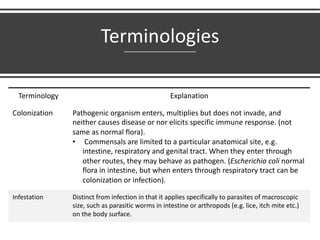
Colonization Pathogenic organism enters, multiplies but does not invade, and
neither causes disease or nor elicits specific immune response. (not
same as normal flora).
• Commensals are limited to a particular anatomical site, e.g.
intestine, respiratory and genital tract. When they enter through
other routes, they may behave as pathogen. (Escherichia coli normal
flora in intestine, but when enters through respiratory tract can be
colonization or infection).
Infestation Distinct from infection in that it applies specifically to parasites of macroscopic
size, such as parasitic worms in intestine or arthropods (e.g. lice, itch mite etc.)
on the body surface.
Classification of infections
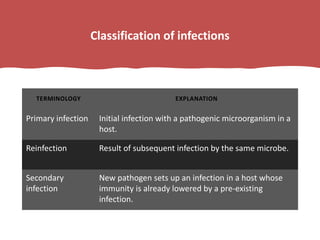
TERMINOLOGY EXPLANATION
Primary infection Initial infection with a pathogenic microorganism in a
host.
Reinfection Result of subsequent infection by the same microbe.
Secondary
infection
New pathogen sets up an infection in a host whose
immunity is already lowered by a pre-existing
infection.
Classification of infections
Terminology Explanation
Focal infection (or
focal sepsis)
Indicates a condition where, due to infection at localised sites
(such as in the appendix or tonsils), generalised effects are
produced.
Cross-infections When in a patient already suffering from a disease a new
infection sets up from another host or another external source.
Classification of infections
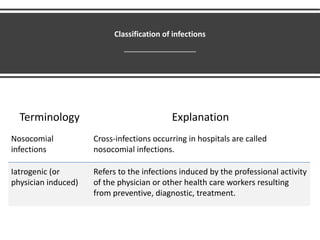
Terminology Explanation
Nosocomial
infections
Cross-infections occurring in hospitals are called
nosocomial infections.
Iatrogenic (or
physician induced)
Refers to the infections induced by the professional activity
of the physician or other health care workers resulting
from preventive, diagnostic, treatment.
Classification of infections
Terminology Explanation
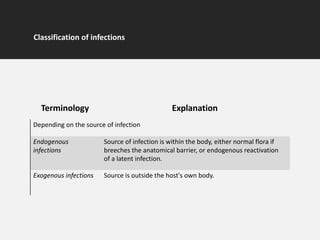
Depending on the source of infection
Endogenous
infections
Source of infection is within the body, either normal flora if
breeches the anatomical barrier, or endogenous reactivation
of a latent infection.
Exogenous infections Source is outside the host's own body.
Classification of infections
Terminology Explanation
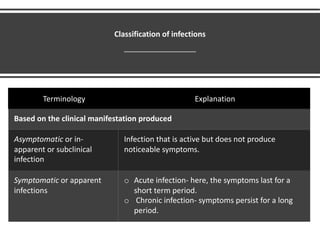
Based on the clinical manifestation produced
Asymptomatic or in-
apparent or subclinical
infection
Infection that is active but does not produce
noticeable symptoms.
Symptomatic or apparent
infections
o Acute infection- here, the symptoms last for a
short term period.
o Chronic infection- symptoms persist for a long
period.
Classification
of infections
Terminology Explanation
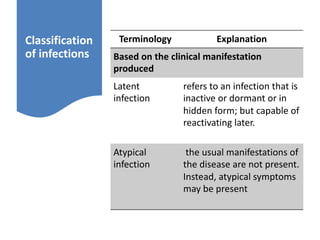
Based on the clinical manifestation
produced
Latent
infection
refers to an infection that is
inactive or dormant or in
hidden form; but capable of
reactivating later.
Atypical
infection
the usual manifestations of
the disease are not present.
Instead, atypical symptoms
may be present
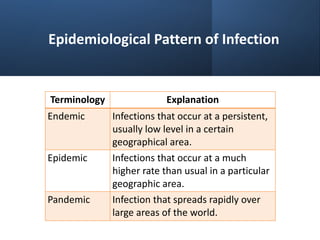
Epidemiological Pattern of Infection
Terminology Explanation
Endemic Infections that occur at a persistent,
usually low level in a certain
geographical area.
Epidemic Infections that occur at a much
higher rate than usual in a particular
geographic area.
Pandemic Infection that spreads rapidly over
large areas of the world.
SOURCES AND RESERVOIR OF INFECTION
• Not always synonymous.
• Source- refers to the person, animal, or object from which a
microorganism is transmitted to the host.
• Reservoir - natural habitat in which the organism lives,
multiplies.
• Eg-
a) Tetanus- the reservoir and source are same, i.e. the soil
b) In typhoid fever, the reservoir may be a case or carrier,
but the source of infection is usually contaminated food
& water.
SOURCES OF INFECTION
HUMANS
• Carrier – harbours the pathogen
• Healthy carrier – harbours the
pathogen, but never suffered from
the disease
• Convalescent carrier – recovered
from disease and continues to
harbour the pathogen
SOURCES OF INFECTION
• Incubatory carriers - Person shed the organism during the
incubation period of disease (usually occurs in the last few days
of incubation period) e.g. measles, mumps, polio, diphtheria,
pertussis, hepatitis B, influenza, etc
SOURCES OF INFECTION
HUMANS
• Temporary carrier – less than six months
• Chronic carrier – several years
• Contact carrier – acquires pathogen from patient
• Paradoxical carrier – acquires pathogen from
another carrier
SOURCES OF INFECTION
ANIMALS
• Reservoir host – maintain the parasite in nature
• Zoonoses – diseases transmitted from animals to
human beings
SOURCES OF
INFECTION
• Possible sources of infection (*Tetanus bacilli occur in
the feces of these animals)
Non living reservoirs
• Soil and inanimate matter can also act as
reservoir/source of infection.
• Example soil may harbour the agents of
tetanus, anthrax and some intestinal
helminths.
MODE OF TRANSMISSION
o Contact
oInhalation
oAirborne
oIngestion
oInoculation
oTransmission of Blood borne infections
oVector borne (mechanical or biological)
oVertical transmission
MECHANISM
OF
MICROBIAL
PATHOGENICITY
• 'Pathogenicity‘ - refer to the
ability of a microbial species to
produce disease.
• ‘Virulence' - relative degree of
pathogenesis (tissue damage),
which may vary between
different strains of the same
organism depending upon the
expression of the virulence
factors.
Exaltation- Enhancement of virulence is known as exaltation,
which can be induced experimentally by serial passage into
susceptible hosts.
Attenuation - Reduction of virulence which can be achieved by
passage through unfavourable hosts, repeated cultures in
artificial media, growth in high temperature or in the presence
of weak antiseptics, desiccation or prolonged storage in
culture.
MECHANISM OF MICROBIAL
PATHOGENICITY
MECHANISM OF MICROBIAL PATHOGENICITY
• Bacterial pathogenicity depends upon the sum total of several factors
as described below:
o Route of transmission of infection
o Infective dose of the organism
o Evasion of the local defences
o Adhesion
o Adherence
o Invasion
o Toxins
o Pathogenicity islands
o Bacterial secretory system
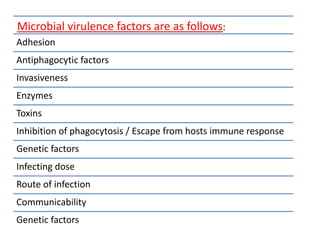
Microbial virulence factors are as follows:
Adhesion
Antiphagocytic factors
Invasiveness
Enzymes
Toxins
Inhibition of phagocytosis / Escape from hosts immune response
Genetic factors
Infecting dose
Route of infection
Communicability
Genetic factors
1) ADHESION
• If organism did not adhere, it will be swept away by
mucus and other fluids.
• They allow pathogen to adhere only to receptors on
certain host epithelial cells.
• Eg) fimbriae,pili, flagella, LPS, Glycocalyx
Adherence allows organism to
1. colonize and multiply at a rate faster
than their removal.
2. Helps in penetrating body tissues and
cells.
3. provides focus for elaboration of
enzymes and toxins, delivered directly
to host cells.
2)Antiphagocytic factors
• Capsule
• Bacterial surface antigens
• Streptococcal M- protein
à Mask the bacterial receptors from
antibacterial substances
3) INVASIVENESS
• Entry of the bacteria into the host cells by
releasing digestive enzymes that allows them to
invade tissues.
• Highly invasive – spreading & generalised
diseases.(streptococcal infections)
• Less invasive – localized disease.(staphylococcal)
• Non invasive – produce toxins at site of
localization and may cause fatal
diseases.(tetanus)
3) INVASIVENESS
• Entry of the bacteria into the host cells by
releasing digestive enzymes that allows them to
invade tissues.
• Highly invasive – spreading & generalised
diseases.(streptococcal infections)
• Less invasive – localized disease.(staphylococcal)
• Non invasive – produce toxins at site of
localization and may cause fatal
diseases.(tetanus)
4) ENZYMES
• 1. Coagulase – form a fibrin shield around
bacteria
• 2. Hyaluronidase & Collagenase – break down
collagen and allow better penetration of
microorganisms into tissues.
• 3. Beta- lactamases – hydrolyse Beta lactam ring
of penicillin and cephalosporins, thus inactivating
the antibiotic.
5) TOXINS
• Toxins produced by bacteria are classified
into two groups
1. Exotoxins
2. Endotoxins
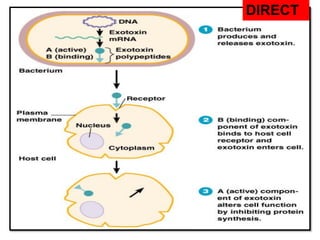
A-B toxins
Active Binding
A
Cell surface
B
1) Mechanism of action of EXOTOXIN
DIRECT
Functional
types of
exotoxins
Enterotoxins – affects GIT, eg
cholera toxin
Neurotoxins – affects
nervous system, eg tetanus
toxin
Cytotoxins – affect cells of
tissues, eg diphtheria toxin.
2) ENDOTOXINS
• Forms an integral part of the
cell wall of GNB
• Endotoxin activates the
clotting factor causing
formation of small blood
clots.
• These blood clots obstruct
capillaries, and cause
disseminated intravascular
coagulation (DIC)
• Response to endotoxin
include
• Fever
• DIC
• shock
• and even death.
Endotoxin
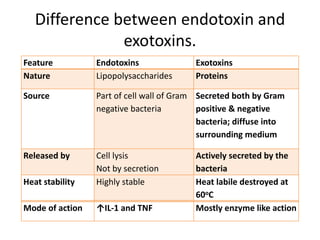
Difference between endotoxin and
exotoxins.
Feature Endotoxins Exotoxins
Nature Lipopolysaccharides Proteins
Source Part of cell wall of Gram
negative bacteria
Secreted both by Gram
positive & negative
bacteria; diffuse into
surrounding medium
Released by Cell lysis
Not by secretion
Actively secreted by the
bacteria
Heat stability Highly stable Heat labile destroyed at
60oC
Mode of action ↑IL-1 and TNF Mostly enzyme like action
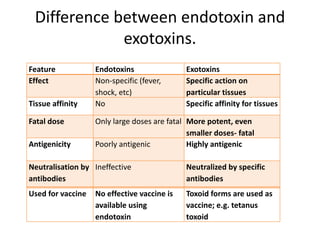
Feature Endotoxins Exotoxins
Effect Non-specific (fever,
shock, etc)
Specific action on
particular tissues
Tissue affinity No Specific affinity for tissues
Fatal dose Only large doses are fatal More potent, even
smaller doses- fatal
Antigenicity Poorly antigenic Highly antigenic
Neutralisation by
antibodies
Ineffective Neutralized by specific
antibodies
Used for vaccine No effective vaccine is
available using
endotoxin
Toxoid forms are used as
vaccine; e.g. tetanus
toxoid
Difference between endotoxin and
exotoxins.
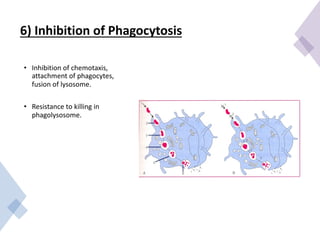
6) Inhibition of Phagocytosis
• Inhibition of chemotaxis,
attachment of phagocytes,
fusion of lysosome.
• Resistance to killing in
phagolysosome.
Escape
from
hosts
immune
response
• By antigenic variation - modify their
surface antigen and evade immune
response.
• Antibody cleavage – IgA protease
produced.
• Induction of blocking antibodies – which
bind on specific receptors on the surface
of bacteria and block access to the
effective antibacterial antibodies.
Scheme of Microbial Pathogenicity
Microbial pathogenicity

Microbial pathogenicity

  • 1.
  • 2.
    Terminologies Terminology Explanation Saprophytes Free-livingmicrobes that live on dead or decaying organic matter. They are usually found in soil and water and are generally unable to invade the living host. Parasites Microbes that live on a living host, derive nutrition from the host and also cause harm to the host. They are of two types- microparasites (bacteria, viruses, fungi and protozoa) and macroparasites (helminths). Commensals Harmless microbes that harbour on a living host as normal flora of the host without causing any injury to the host
  • 3.
    Terminologies TERMINOLOGY EXPLANATION Pathogens Microbescapable of causing disease. Represents only a very small proportion of the microbial world. Opportunistic pathogens Causes disease only in immunocompromised people.
  • 4.
    Terminologies Terminology Explanation Infection Processin which a pathogenic organism enters, establishes itself, multiplies and invades the normal anatomical barrier of the host; resulting in disease. Infectious disease When infection becomes apparent results in clinical manifestation.
  • 5.
    Terminologies Terminology Explanation Colonization Pathogenicorganism enters, multiplies but does not invade, and neither causes disease or nor elicits specific immune response. (not same as normal flora). • Commensals are limited to a particular anatomical site, e.g. intestine, respiratory and genital tract. When they enter through other routes, they may behave as pathogen. (Escherichia coli normal flora in intestine, but when enters through respiratory tract can be colonization or infection). Infestation Distinct from infection in that it applies specifically to parasites of macroscopic size, such as parasitic worms in intestine or arthropods (e.g. lice, itch mite etc.) on the body surface.
  • 6.
    Classification of infections TERMINOLOGYEXPLANATION Primary infection Initial infection with a pathogenic microorganism in a host. Reinfection Result of subsequent infection by the same microbe. Secondary infection New pathogen sets up an infection in a host whose immunity is already lowered by a pre-existing infection.
  • 7.
    Classification of infections TerminologyExplanation Focal infection (or focal sepsis) Indicates a condition where, due to infection at localised sites (such as in the appendix or tonsils), generalised effects are produced. Cross-infections When in a patient already suffering from a disease a new infection sets up from another host or another external source.
  • 8.
    Classification of infections TerminologyExplanation Nosocomial infections Cross-infections occurring in hospitals are called nosocomial infections. Iatrogenic (or physician induced) Refers to the infections induced by the professional activity of the physician or other health care workers resulting from preventive, diagnostic, treatment.
  • 9.
    Classification of infections TerminologyExplanation Depending on the source of infection Endogenous infections Source of infection is within the body, either normal flora if breeches the anatomical barrier, or endogenous reactivation of a latent infection. Exogenous infections Source is outside the host's own body.
  • 10.
    Classification of infections TerminologyExplanation Based on the clinical manifestation produced Asymptomatic or in- apparent or subclinical infection Infection that is active but does not produce noticeable symptoms. Symptomatic or apparent infections o Acute infection- here, the symptoms last for a short term period. o Chronic infection- symptoms persist for a long period.
  • 11.
    Classification of infections Terminology Explanation Basedon the clinical manifestation produced Latent infection refers to an infection that is inactive or dormant or in hidden form; but capable of reactivating later. Atypical infection the usual manifestations of the disease are not present. Instead, atypical symptoms may be present
  • 12.
    Epidemiological Pattern ofInfection Terminology Explanation Endemic Infections that occur at a persistent, usually low level in a certain geographical area. Epidemic Infections that occur at a much higher rate than usual in a particular geographic area. Pandemic Infection that spreads rapidly over large areas of the world.
  • 13.
    SOURCES AND RESERVOIROF INFECTION • Not always synonymous. • Source- refers to the person, animal, or object from which a microorganism is transmitted to the host. • Reservoir - natural habitat in which the organism lives, multiplies. • Eg- a) Tetanus- the reservoir and source are same, i.e. the soil b) In typhoid fever, the reservoir may be a case or carrier, but the source of infection is usually contaminated food & water.
  • 14.
    SOURCES OF INFECTION HUMANS •Carrier – harbours the pathogen • Healthy carrier – harbours the pathogen, but never suffered from the disease • Convalescent carrier – recovered from disease and continues to harbour the pathogen
  • 15.
    SOURCES OF INFECTION •Incubatory carriers - Person shed the organism during the incubation period of disease (usually occurs in the last few days of incubation period) e.g. measles, mumps, polio, diphtheria, pertussis, hepatitis B, influenza, etc
  • 16.
    SOURCES OF INFECTION HUMANS •Temporary carrier – less than six months • Chronic carrier – several years • Contact carrier – acquires pathogen from patient • Paradoxical carrier – acquires pathogen from another carrier
  • 17.
    SOURCES OF INFECTION ANIMALS •Reservoir host – maintain the parasite in nature • Zoonoses – diseases transmitted from animals to human beings
  • 18.
    SOURCES OF INFECTION • Possiblesources of infection (*Tetanus bacilli occur in the feces of these animals)
  • 19.
    Non living reservoirs •Soil and inanimate matter can also act as reservoir/source of infection. • Example soil may harbour the agents of tetanus, anthrax and some intestinal helminths.
  • 20.
    MODE OF TRANSMISSION oContact oInhalation oAirborne oIngestion oInoculation oTransmission of Blood borne infections oVector borne (mechanical or biological) oVertical transmission
  • 21.
    MECHANISM OF MICROBIAL PATHOGENICITY • 'Pathogenicity‘ -refer to the ability of a microbial species to produce disease. • ‘Virulence' - relative degree of pathogenesis (tissue damage), which may vary between different strains of the same organism depending upon the expression of the virulence factors.
  • 22.
    Exaltation- Enhancement ofvirulence is known as exaltation, which can be induced experimentally by serial passage into susceptible hosts. Attenuation - Reduction of virulence which can be achieved by passage through unfavourable hosts, repeated cultures in artificial media, growth in high temperature or in the presence of weak antiseptics, desiccation or prolonged storage in culture. MECHANISM OF MICROBIAL PATHOGENICITY
  • 23.
    MECHANISM OF MICROBIALPATHOGENICITY • Bacterial pathogenicity depends upon the sum total of several factors as described below: o Route of transmission of infection o Infective dose of the organism o Evasion of the local defences o Adhesion o Adherence o Invasion o Toxins o Pathogenicity islands o Bacterial secretory system
  • 24.
    Microbial virulence factorsare as follows: Adhesion Antiphagocytic factors Invasiveness Enzymes Toxins Inhibition of phagocytosis / Escape from hosts immune response Genetic factors Infecting dose Route of infection Communicability Genetic factors
  • 25.
    1) ADHESION • Iforganism did not adhere, it will be swept away by mucus and other fluids. • They allow pathogen to adhere only to receptors on certain host epithelial cells. • Eg) fimbriae,pili, flagella, LPS, Glycocalyx
  • 26.
    Adherence allows organismto 1. colonize and multiply at a rate faster than their removal. 2. Helps in penetrating body tissues and cells. 3. provides focus for elaboration of enzymes and toxins, delivered directly to host cells.
  • 27.
    2)Antiphagocytic factors • Capsule •Bacterial surface antigens • Streptococcal M- protein à Mask the bacterial receptors from antibacterial substances
  • 28.
    3) INVASIVENESS • Entryof the bacteria into the host cells by releasing digestive enzymes that allows them to invade tissues. • Highly invasive – spreading & generalised diseases.(streptococcal infections) • Less invasive – localized disease.(staphylococcal) • Non invasive – produce toxins at site of localization and may cause fatal diseases.(tetanus)
  • 29.
    3) INVASIVENESS • Entryof the bacteria into the host cells by releasing digestive enzymes that allows them to invade tissues. • Highly invasive – spreading & generalised diseases.(streptococcal infections) • Less invasive – localized disease.(staphylococcal) • Non invasive – produce toxins at site of localization and may cause fatal diseases.(tetanus)
  • 30.
    4) ENZYMES • 1.Coagulase – form a fibrin shield around bacteria • 2. Hyaluronidase & Collagenase – break down collagen and allow better penetration of microorganisms into tissues. • 3. Beta- lactamases – hydrolyse Beta lactam ring of penicillin and cephalosporins, thus inactivating the antibiotic.
  • 31.
    5) TOXINS • Toxinsproduced by bacteria are classified into two groups 1. Exotoxins 2. Endotoxins
  • 33.
    A-B toxins Active Binding A Cellsurface B 1) Mechanism of action of EXOTOXIN
  • 34.
  • 35.
    Functional types of exotoxins Enterotoxins –affects GIT, eg cholera toxin Neurotoxins – affects nervous system, eg tetanus toxin Cytotoxins – affect cells of tissues, eg diphtheria toxin.
  • 36.
    2) ENDOTOXINS • Formsan integral part of the cell wall of GNB • Endotoxin activates the clotting factor causing formation of small blood clots. • These blood clots obstruct capillaries, and cause disseminated intravascular coagulation (DIC) • Response to endotoxin include • Fever • DIC • shock • and even death.
  • 37.
  • 38.
    Difference between endotoxinand exotoxins. Feature Endotoxins Exotoxins Nature Lipopolysaccharides Proteins Source Part of cell wall of Gram negative bacteria Secreted both by Gram positive & negative bacteria; diffuse into surrounding medium Released by Cell lysis Not by secretion Actively secreted by the bacteria Heat stability Highly stable Heat labile destroyed at 60oC Mode of action ↑IL-1 and TNF Mostly enzyme like action
  • 39.
    Feature Endotoxins Exotoxins EffectNon-specific (fever, shock, etc) Specific action on particular tissues Tissue affinity No Specific affinity for tissues Fatal dose Only large doses are fatal More potent, even smaller doses- fatal Antigenicity Poorly antigenic Highly antigenic Neutralisation by antibodies Ineffective Neutralized by specific antibodies Used for vaccine No effective vaccine is available using endotoxin Toxoid forms are used as vaccine; e.g. tetanus toxoid Difference between endotoxin and exotoxins.
  • 40.
    6) Inhibition ofPhagocytosis • Inhibition of chemotaxis, attachment of phagocytes, fusion of lysosome. • Resistance to killing in phagolysosome.
  • 41.
    Escape from hosts immune response • By antigenicvariation - modify their surface antigen and evade immune response. • Antibody cleavage – IgA protease produced. • Induction of blocking antibodies – which bind on specific receptors on the surface of bacteria and block access to the effective antibacterial antibodies.
  • 42.
    Scheme of MicrobialPathogenicity