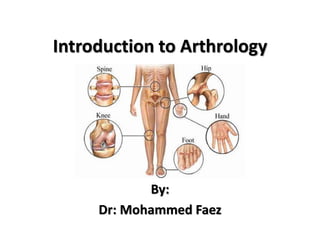
Introduction to Arthrology
By:
Dr: Mohammed Faez
Objective of The Lecture
• To know about definition of Arthrology.
• To know about classification of joints
• To master the basic structure and
movement of joints.
Arthrology
Definition:
• Greek, (arthro= joint),
(logos= science).
• Arthrology is the
scientific study of joints
, and articulations.
• Site where rigid
elements of the
skeleton meet are
called articulations.
Joints
• Joints are places of
union between two or
more skeletal elements
Classification of Joints
 Classification based
on function
 Classification based
on structure
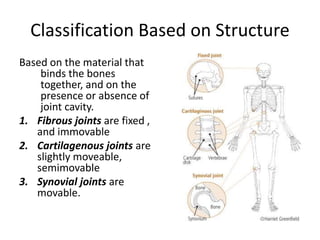
Classification Based on Structure
Based on the material that
binds the bones
together, and on the
presence or absence of
joint cavity.
1. Fibrous joints are fixed ,
and immovable
2. Cartilagenous joints are
slightly moveable,
semimovable
3. Synovial joints are
movable.
Fibrous Joints
• Bones connected by
fibrous tissue
• No joint cavity
a) Sutures
b) Syndesmoses
c) Gomphoses
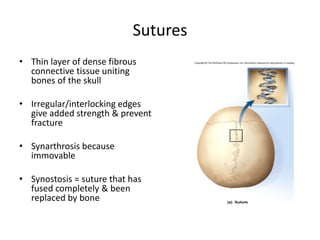
Sutures
• Thin layer of dense fibrous
connective tissue uniting
bones of the skull
• Irregular/interlocking edges
give added strength & prevent
fracture
• Synarthrosis because
immovable
• Synostosis = suture that has
fused completely & been
replaced by bone
Syndesmoses
• Greater distance between
articulating bones & more fibrous
C.T. than sutures
• Arrangements of C.T.
– bundles = ligament
– sheets = inteross. memb.
• Amphiarthrosis: limited
movement
• Examples
– Anterior tibiofibular joint
– Interosseous membranes in
forearm and leg
Gomphoses
• Dentoalveolar joints:
cone-shaped pegs in
bony socket
• Synarthrosis
• Only example = teeth in
alveolar processes of
maxillae and mandible
Cartilaginous joints
- The bones are united
by cartilage
- There is no joint cavity
A. Synchondrosis(
hyaline cartilage
unites the bones)
B. Symphyses(
fibrocartilage unites
the bones)
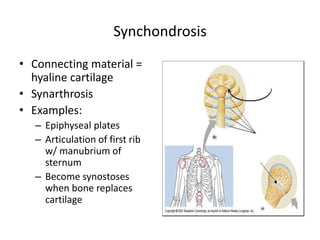
Synchondrosis
• Connecting material =
hyaline cartilage
• Synarthrosis
• Examples:
– Epiphyseal plates
– Articulation of first rib
w/ manubrium of
sternum
– Become synostoses
when bone replaces
cartilage
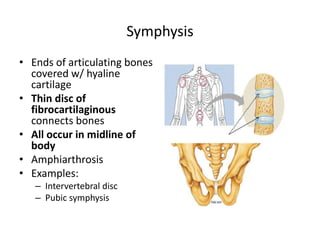
Symphysis
• Ends of articulating bones
covered w/ hyaline
cartilage
• Thin disc of
fibrocartilaginous
connects bones
• All occur in midline of
body
• Amphiarthrosis
• Examples:
– Intervertebral disc
– Pubic symphysis
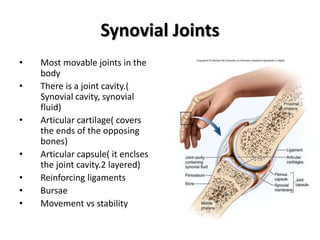
Synovial Joints
• Most movable joints in the
body
• There is a joint cavity.(
Synovial cavity, synovial
fluid)
• Articular cartilage( covers
the ends of the opposing
bones)
• Articular capsule( it enclses
the joint cavity.2 layered)
• Reinforcing ligaments
• Bursae
• Movement vs stability
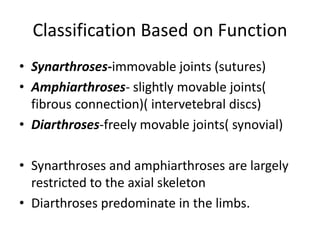
Classification Based on Function
• Synarthroses-immovable joints (sutures)
• Amphiarthroses- slightly movable joints(
fibrous connection)( intervetebral discs)
• Diarthroses-freely movable joints( synovial)
• Synarthroses and amphiarthroses are largely
restricted to the axial skeleton
• Diarthroses predominate in the limbs.
Synarthrosis
- Also called a synostosis or
syndesmosis
- is a bone to bone union
- begins as a joint where
there is a fibrous
membrane between the
two bones.
- They are sometime Fibrous
Joints or Ligamentous
- Non moveable
- Fontanelles are
examples
Amphiarthrosis
(cartilagenous joints)
- Moveable and
immoveable
- Cartilage between
two bones
- These joints allow
some movement
while still providing
protection.
Diarthrosis
(Synovial Joints)
• Allow for free movement
• Have 3 characteristics:
1) Synovial membrane: A
serous membrane that
produces synovial fluid
which reduces friction
and absorbs shock.
2) Articular cartilage
3) Capsule: Dense
connective tissue
covering the joint
Summary of Joint Classification
Structural Class Characteristics Types Mobility
Fibrous Bones united by
collagen fibers
1. Suture
2. Syndesmosis
3. gomphosis
1. Immobile
(synarthrosis)
2. Slightly moveable
(amphiarthrosis)
3. Immobile
Cartilaginous Bone ends united by
cartilage
1. Synchondrosis
(hyaline)
2. Symphysis
(fibrocartliage)
1. Immobile
2. Slightly moveable
Synovial Bone ends covered
with articular cartilage
and enclosed within a
capsule lined with a
synovial membrane
1. Plane
2. Hinge
3. Pivot
4. Condyloid
5. Saddle
6. Ball and socket
Freely moveable
(diarthrosis) which
depends on joint design
Types of Joints (Articulations)
1. Ball and Socket Joint
- Allow for the most freedom
of movement
- Triaxial movement – flexion,
extension, abduction,
adduction, circumflexion,
and rotation
Types of Joints (Articulations)
2. Hinge joint
- Uniaxial – allows movement
in only one direction. Back
and forth
- Allows only flexion and
extension in one plane
(sagittal)
- Many times the articular
surfaces will have a distinct
shape (ie: spool shaped
trochlear surface of the
humerus)
Types of Joints (Articulations)
3. Pivot joint
- Allows rotation (uniaxial)
- Rounded, pointed, or
conical surface on one bone
that fits into a ring of bone on
another.
4. Saddle joint
- Biaxial
- Allows flexion, extension,
abduction, adduction, and
circumduction.
- Surfaces are inverted
relative to each other.
Types of Joints (Articulations)
5. Condyloid joint
- Biaxial
- One bone is concave
(hollowed out
depression) and the
other is convex
(rounded or elliptical).
- Allows flexion,
extension, abduction,
and adduction.
- No rotation
Types of Joints (Articulations)
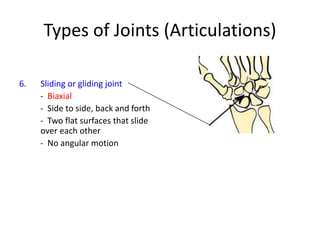
6. Sliding or gliding joint
- Biaxial
- Side to side, back and forth
- Two flat surfaces that slide
over each other
- No angular motion
Types of Joints (Articulations)
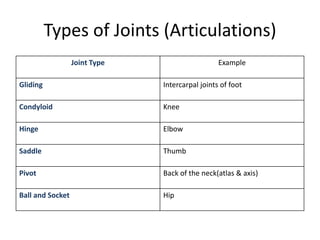
Joint Type Example
Gliding Intercarpal joints of foot
Condyloid Knee
Hinge Elbow
Saddle Thumb
Pivot Back of the neck(atlas & axis)
Ball and Socket Hip
Basic Structure & General Anatomy
• Articular capsule encloses joint cavity
– continuous with periosteum
– lined by synovial membrane
• Synovial fluid = slippery fluid; feeds cartilages
• Articular cartilage = hyaline cartilage covering the joint
surfaces
• Articular discs and menisci
– jaw, wrist, sternoclavicular and knee joints
– absorbs shock, guides bone movements and distributes forces
• Tendon attaches muscle to bone
• Ligament attaches bone to bone
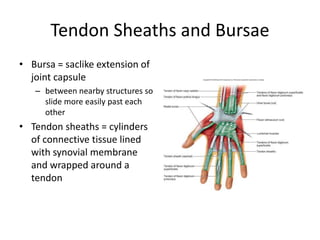
Tendon Sheaths and Bursae
• Bursa = saclike extension of
joint capsule
– between nearby structures so
slide more easily past each
other
• Tendon sheaths = cylinders
of connective tissue lined
with synovial membrane
and wrapped around a
tendon
Bursae and Tendon Sheaths
Arthrology

Arthrology

  • 1.
  • 2.
    Objective of TheLecture • To know about definition of Arthrology. • To know about classification of joints • To master the basic structure and movement of joints.
  • 3.
    Arthrology Definition: • Greek, (arthro=joint), (logos= science). • Arthrology is the scientific study of joints , and articulations. • Site where rigid elements of the skeleton meet are called articulations.
  • 4.
    Joints • Joints areplaces of union between two or more skeletal elements
  • 5.
    Classification of Joints Classification based on function  Classification based on structure
  • 6.
    Classification Based onStructure Based on the material that binds the bones together, and on the presence or absence of joint cavity. 1. Fibrous joints are fixed , and immovable 2. Cartilagenous joints are slightly moveable, semimovable 3. Synovial joints are movable.
  • 7.
    Fibrous Joints • Bonesconnected by fibrous tissue • No joint cavity a) Sutures b) Syndesmoses c) Gomphoses
  • 8.
    Sutures • Thin layerof dense fibrous connective tissue uniting bones of the skull • Irregular/interlocking edges give added strength & prevent fracture • Synarthrosis because immovable • Synostosis = suture that has fused completely & been replaced by bone
  • 9.
    Syndesmoses • Greater distancebetween articulating bones & more fibrous C.T. than sutures • Arrangements of C.T. – bundles = ligament – sheets = inteross. memb. • Amphiarthrosis: limited movement • Examples – Anterior tibiofibular joint – Interosseous membranes in forearm and leg
  • 10.
    Gomphoses • Dentoalveolar joints: cone-shapedpegs in bony socket • Synarthrosis • Only example = teeth in alveolar processes of maxillae and mandible
  • 11.
    Cartilaginous joints - Thebones are united by cartilage - There is no joint cavity A. Synchondrosis( hyaline cartilage unites the bones) B. Symphyses( fibrocartilage unites the bones)
  • 12.
    Synchondrosis • Connecting material= hyaline cartilage • Synarthrosis • Examples: – Epiphyseal plates – Articulation of first rib w/ manubrium of sternum – Become synostoses when bone replaces cartilage
  • 13.
    Symphysis • Ends ofarticulating bones covered w/ hyaline cartilage • Thin disc of fibrocartilaginous connects bones • All occur in midline of body • Amphiarthrosis • Examples: – Intervertebral disc – Pubic symphysis
  • 14.
    Synovial Joints • Mostmovable joints in the body • There is a joint cavity.( Synovial cavity, synovial fluid) • Articular cartilage( covers the ends of the opposing bones) • Articular capsule( it enclses the joint cavity.2 layered) • Reinforcing ligaments • Bursae • Movement vs stability
  • 15.
    Classification Based onFunction • Synarthroses-immovable joints (sutures) • Amphiarthroses- slightly movable joints( fibrous connection)( intervetebral discs) • Diarthroses-freely movable joints( synovial) • Synarthroses and amphiarthroses are largely restricted to the axial skeleton • Diarthroses predominate in the limbs.
  • 16.
    Synarthrosis - Also calleda synostosis or syndesmosis - is a bone to bone union - begins as a joint where there is a fibrous membrane between the two bones. - They are sometime Fibrous Joints or Ligamentous - Non moveable - Fontanelles are examples
  • 17.
    Amphiarthrosis (cartilagenous joints) - Moveableand immoveable - Cartilage between two bones - These joints allow some movement while still providing protection.
  • 18.
    Diarthrosis (Synovial Joints) • Allowfor free movement • Have 3 characteristics: 1) Synovial membrane: A serous membrane that produces synovial fluid which reduces friction and absorbs shock. 2) Articular cartilage 3) Capsule: Dense connective tissue covering the joint
  • 19.
    Summary of JointClassification Structural Class Characteristics Types Mobility Fibrous Bones united by collagen fibers 1. Suture 2. Syndesmosis 3. gomphosis 1. Immobile (synarthrosis) 2. Slightly moveable (amphiarthrosis) 3. Immobile Cartilaginous Bone ends united by cartilage 1. Synchondrosis (hyaline) 2. Symphysis (fibrocartliage) 1. Immobile 2. Slightly moveable Synovial Bone ends covered with articular cartilage and enclosed within a capsule lined with a synovial membrane 1. Plane 2. Hinge 3. Pivot 4. Condyloid 5. Saddle 6. Ball and socket Freely moveable (diarthrosis) which depends on joint design
  • 20.
    Types of Joints(Articulations) 1. Ball and Socket Joint - Allow for the most freedom of movement - Triaxial movement – flexion, extension, abduction, adduction, circumflexion, and rotation
  • 21.
    Types of Joints(Articulations) 2. Hinge joint - Uniaxial – allows movement in only one direction. Back and forth - Allows only flexion and extension in one plane (sagittal) - Many times the articular surfaces will have a distinct shape (ie: spool shaped trochlear surface of the humerus)
  • 22.
    Types of Joints(Articulations) 3. Pivot joint - Allows rotation (uniaxial) - Rounded, pointed, or conical surface on one bone that fits into a ring of bone on another. 4. Saddle joint - Biaxial - Allows flexion, extension, abduction, adduction, and circumduction. - Surfaces are inverted relative to each other.
  • 23.
    Types of Joints(Articulations) 5. Condyloid joint - Biaxial - One bone is concave (hollowed out depression) and the other is convex (rounded or elliptical). - Allows flexion, extension, abduction, and adduction. - No rotation
  • 24.
    Types of Joints(Articulations) 6. Sliding or gliding joint - Biaxial - Side to side, back and forth - Two flat surfaces that slide over each other - No angular motion
  • 25.
    Types of Joints(Articulations) Joint Type Example Gliding Intercarpal joints of foot Condyloid Knee Hinge Elbow Saddle Thumb Pivot Back of the neck(atlas & axis) Ball and Socket Hip
  • 28.
    Basic Structure &General Anatomy • Articular capsule encloses joint cavity – continuous with periosteum – lined by synovial membrane • Synovial fluid = slippery fluid; feeds cartilages • Articular cartilage = hyaline cartilage covering the joint surfaces • Articular discs and menisci – jaw, wrist, sternoclavicular and knee joints – absorbs shock, guides bone movements and distributes forces • Tendon attaches muscle to bone • Ligament attaches bone to bone
  • 29.
    Tendon Sheaths andBursae • Bursa = saclike extension of joint capsule – between nearby structures so slide more easily past each other • Tendon sheaths = cylinders of connective tissue lined with synovial membrane and wrapped around a tendon
  • 30.