Bacterial Physiology Medical Microbiology   L3 Dr. Saleh M Y OTH PhD Medical Molecular Biotechnology and Infectious Diseases 05/10/2011 MBBS-Phase II-IMS - MSU
Bacterial growth  Metabolism is the totality of an organism’s chemical processes to maintain life
Studying Bacterial Growth   Bacterial Growth - features  The Growth Curve   Bacterial Growth
NUTRITION   What are nutrients that bacteria want?  Bacterial Growth
Nutritional requirements: 1- Macroelements:  a- C, N,O, H, S, P. Required in large amounts; constitute 95% of bacterial cell dry weight,  b- K, Ca, Mg, and Fe found as ions.  Bacterial Growth
Nutritional requirements: 2- Microelements:   Mn, Zn, Co, Mo, Ni, Cu are required in trace amounts by most cells =are part of enzymes and cofactors.  3- Growth factors:  (cannot synthesize by cell); amino acids, nucleotides (purines and pyrimidines), vitamins.  Bacterial Growth
- Nutritional - Environmental - Pure culture Culture of microorganisms Culture media Dependence on oxygen - Bacterial growth in laboratory conditions Growth curve - Microbial metabolism Factors for microbial growth: Bacterial Growth
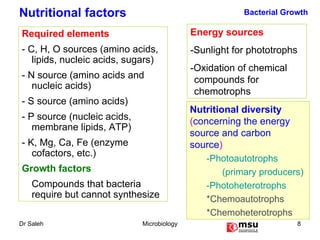
Required elements - C, H, O sources (amino acids, lipids, nucleic acids, sugars) - N source (amino acids and nucleic acids) - S source (amino acids) - P source (nucleic acids, membrane lipids, ATP) - K, Mg, Ca, Fe (enzyme cofactors, etc.) Growth factors Compounds that bacteria require but cannot synthesize Nutritional factors Energy sources -Sunlight for phototrophs -Oxidation of chemical compounds for chemotrophs Nutritional diversity  ( concerning the energy source and carbon source ) -Photoautotrophs (primary producers) -Photoheterotrophs *Chemoautotrophs *Chemoheterotrophs Bacterial Growth
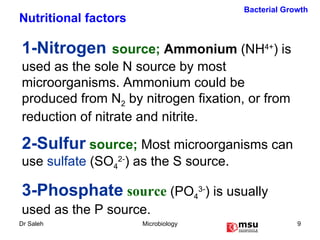
1-Nitrogen   source;  Ammonium   (NH 4+ ) is used as the sole N source by most microorganisms. Ammonium could be produced from N 2  by nitrogen fixation, or from reduction of nitrate and nitrite.   2-Sulfur  source;  Most microorganisms can use  sulfate  (SO 4 2- ) as the S source. 3-Phosphate   source  (PO 4 3- ) is usually used as the P source. Bacterial Growth Nutritional factors
4-Mineral  source;  For most microorganisms, it is necessary to provide sources of K + , Mg 2+ , Ca 2+ , Fe 2+ , Na +  and Cl - .  Many other minerals (e.g., Mn 2+  , Mo 2+ , Co 2+ , Cu 2+  and Zn 2+ ) can be provided in tap water or as contaminants of other medium ingredients. 5-Growth factors;  Compounds that bacteria require but cannot synthesize Bacterial Growth Nutritional factors
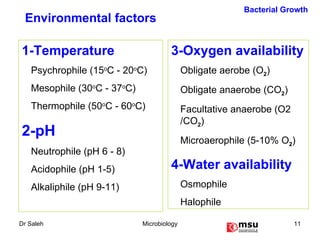
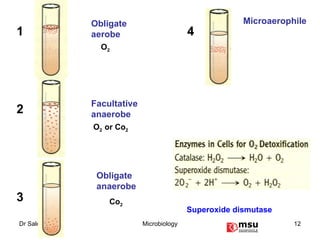
1-Temperature Psychrophile (15 o C - 20 o C) Mesophile (30 o C - 37 o C) Thermophile (50 o C - 60 o C) 2-pH Neutrophile (pH 6 - 8) Acidophile (pH 1-5) Alkaliphile (pH 9-11) Environmental factors 3-Oxygen availability Obligate aerobe (O 2 ) Obligate anaerobe (CO 2 ) Facultative anaerobe (O2 /CO 2 ) Microaerophile (5-10% O 2 ) 4-Water availability Osmophile Halophile Bacterial Growth
Obligate aerobe Facultative anaerobe Obligate anaerobe Microaerophile 1 2 3 4 O 2 O 2  or Co 2 Co 2 Superoxide dismutase
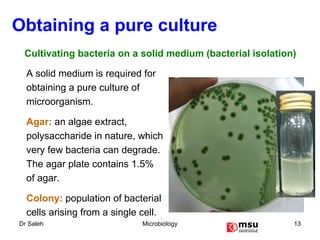
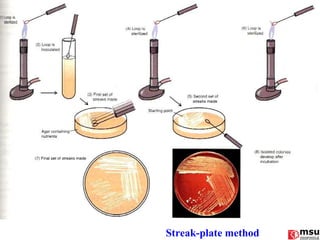
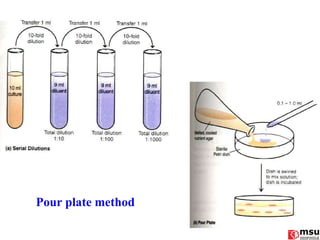
Obtaining a pure culture A solid medium is required for obtaining a pure culture of microorganism. Agar:   an algae extract, polysaccharide in nature, which very few bacteria can degrade. The agar plate contains 1.5% of agar. Colony:   population of bacterial cells arising from a single cell. Cultivating bacteria on a solid medium (bacterial isolation)
 
 
Streak-plate method
Pour plate method
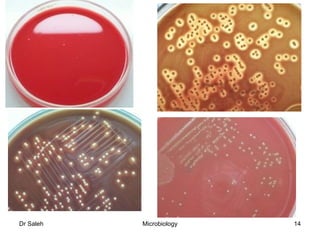
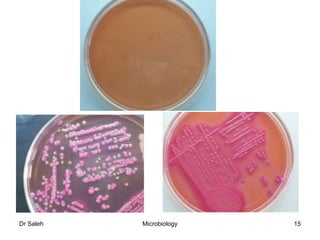
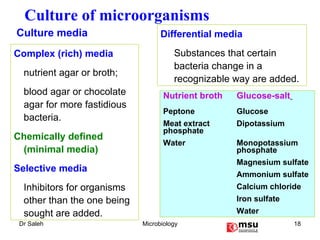
Culture of microorganisms Complex (rich) media nutrient agar or broth; blood agar or chocolate agar for more fastidious bacteria.  Chemically defined (minimal media) Selective media Inhibitors for organisms other than the one being sought are added. Culture media Differential media   Substances that certain bacteria change in a recognizable way are added. Nutrient broth Glucose-salt   Peptone Glucose Meat extract Dipotassium  phosphate Water Monopotassium phosphate Magnesium sulfate Ammonium sulfate Calcium chloride Iron sulfate Water
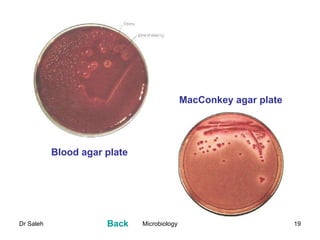
MacConkey agar plate Blood agar plate Back
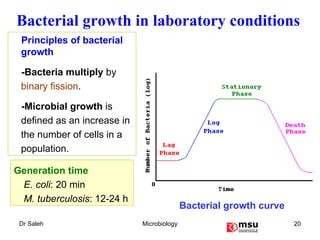
Principles of bacterial growth -Bacteria multiply  by  binary fission . -Microbial growth  is defined as an increase in the number of cells in a population. Bacterial growth curve Bacterial growth in laboratory conditions Generation time E. coli : 20 min M. tuberculosis : 12-24 h
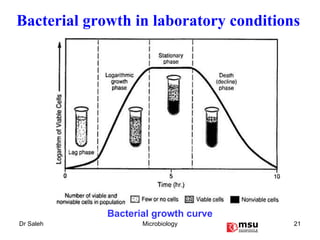
Bacterial growth curve Bacterial growth in laboratory conditions
A balance between slow loss of cells through death and the formation of new cells through growth and division. The bacteria die off rapidly, the curve turns downward, and the last cell in the population soon dies.  Bacteria synthesize macromolecules required for multiplication. The length of lag phase depends on the conditions in the original culture and the medium into which they are transferred. The doubling time is measured during this period. The bacteria are most susceptible to antibiotics during this time. Bacteria stop growing due to decrease of nutrients and O 2  supply, and accumulation of toxic metabolites.
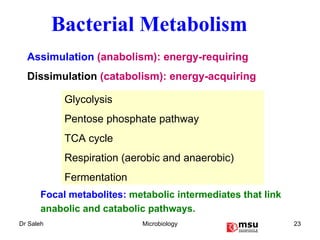
Assimulation  (anabolism): energy-requiring Dissimulation  (catabolism): energy-acquiring Bacterial Metabolism Focal metabolites:  metabolic intermediates that link anabolic and catabolic pathways. Glycolysis Pentose phosphate pathway TCA cycle Respiration (aerobic and anaerobic) Fermentation
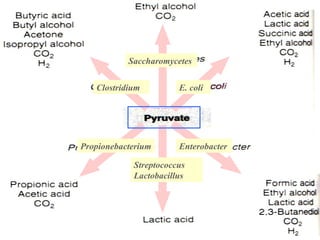
Saccharomycetes E. coli Clostridium Propionebacterium Enterobacter Streptococcus Lactobacillus
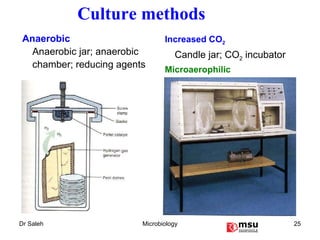
Increased CO 2   Candle jar; CO 2  incubator Microaerophilic Culture methods Anaerobic Anaerobic jar; anaerobic chamber; reducing agents
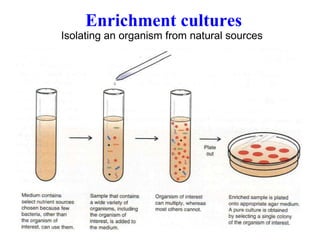
Enrichment cultures Isolating an organism from natural sources
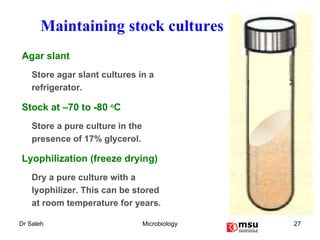
Maintaining stock cultures Agar slant Store agar slant cultures in a refrigerator. Stock at –70 to -80  o C Store a pure culture in the presence of 17% glycerol. Lyophilization (freeze drying) Dry a pure culture with a lyophilizer. This can be stored at room temperature for years.
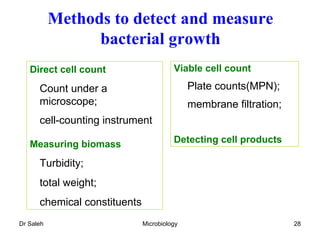
Direct cell count Count under a microscope; cell-counting instrument   Measuring biomass Turbidity; total weight; chemical constituents Viable cell count Plate counts(MPN); membrane filtration; Detecting cell products Methods to detect and measure bacterial growth
 
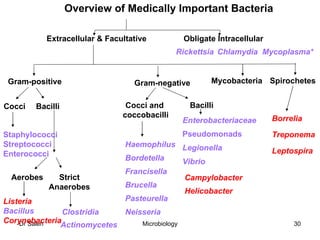
Overview of Medically Important Bacteria Rickettsia Chlamydia Mycoplasma* Clostridia Actinomycetes Obligate Intracellular Extracellular & Facultative Gram-positive Gram-negative Mycobacteria Spirochetes Cocci Bacilli Staphylococci Streptococci Enterococci Listeria Bacillus Corynebacteria Cocci and  coccobacilli Bacilli Haemophilus Bordetella Neisseria Enterobacteriaceae Pseudomonads Legionella Campylobacter Helicobacter Borrelia Leptospira Treponema Brucella Francisella Pasteurella Aerobes Strict Anaerobes Vibrio
Topics for reading: Using of Microscope and its parts Classification of Bacteria Bacterial structure Bacterial multiplication Bacterial genetic
Topics for reading: Catabolism and anabolism ATP Generation and energy conservation Fermentation
Thank you Study Questions Besides chemical nutrients, what are 4 other factors you would consider when trying to grow a bacterium for the first time? Why do you need to sterilize bacterial media? What are some ways you could do this? What would happen if you didn’t sterilize the media? What are the four phases of growth curve? What is happening in each?

Bacteriology physiology

  • 1.
    Bacterial Physiology MedicalMicrobiology L3 Dr. Saleh M Y OTH PhD Medical Molecular Biotechnology and Infectious Diseases 05/10/2011 MBBS-Phase II-IMS - MSU
  • 2.
    Bacterial growth Metabolism is the totality of an organism’s chemical processes to maintain life
  • 3.
    Studying Bacterial Growth Bacterial Growth - features The Growth Curve Bacterial Growth
  • 4.
    NUTRITION What are nutrients that bacteria want? Bacterial Growth
  • 5.
    Nutritional requirements: 1-Macroelements: a- C, N,O, H, S, P. Required in large amounts; constitute 95% of bacterial cell dry weight, b- K, Ca, Mg, and Fe found as ions. Bacterial Growth
  • 6.
    Nutritional requirements: 2-Microelements: Mn, Zn, Co, Mo, Ni, Cu are required in trace amounts by most cells =are part of enzymes and cofactors. 3- Growth factors: (cannot synthesize by cell); amino acids, nucleotides (purines and pyrimidines), vitamins. Bacterial Growth
  • 7.
    - Nutritional -Environmental - Pure culture Culture of microorganisms Culture media Dependence on oxygen - Bacterial growth in laboratory conditions Growth curve - Microbial metabolism Factors for microbial growth: Bacterial Growth
  • 8.
    Required elements -C, H, O sources (amino acids, lipids, nucleic acids, sugars) - N source (amino acids and nucleic acids) - S source (amino acids) - P source (nucleic acids, membrane lipids, ATP) - K, Mg, Ca, Fe (enzyme cofactors, etc.) Growth factors Compounds that bacteria require but cannot synthesize Nutritional factors Energy sources -Sunlight for phototrophs -Oxidation of chemical compounds for chemotrophs Nutritional diversity ( concerning the energy source and carbon source ) -Photoautotrophs (primary producers) -Photoheterotrophs *Chemoautotrophs *Chemoheterotrophs Bacterial Growth
  • 9.
    1-Nitrogen source; Ammonium (NH 4+ ) is used as the sole N source by most microorganisms. Ammonium could be produced from N 2 by nitrogen fixation, or from reduction of nitrate and nitrite. 2-Sulfur source; Most microorganisms can use sulfate (SO 4 2- ) as the S source. 3-Phosphate source (PO 4 3- ) is usually used as the P source. Bacterial Growth Nutritional factors
  • 10.
    4-Mineral source; For most microorganisms, it is necessary to provide sources of K + , Mg 2+ , Ca 2+ , Fe 2+ , Na + and Cl - . Many other minerals (e.g., Mn 2+ , Mo 2+ , Co 2+ , Cu 2+ and Zn 2+ ) can be provided in tap water or as contaminants of other medium ingredients. 5-Growth factors; Compounds that bacteria require but cannot synthesize Bacterial Growth Nutritional factors
  • 11.
    1-Temperature Psychrophile (15o C - 20 o C) Mesophile (30 o C - 37 o C) Thermophile (50 o C - 60 o C) 2-pH Neutrophile (pH 6 - 8) Acidophile (pH 1-5) Alkaliphile (pH 9-11) Environmental factors 3-Oxygen availability Obligate aerobe (O 2 ) Obligate anaerobe (CO 2 ) Facultative anaerobe (O2 /CO 2 ) Microaerophile (5-10% O 2 ) 4-Water availability Osmophile Halophile Bacterial Growth
  • 12.
    Obligate aerobe Facultativeanaerobe Obligate anaerobe Microaerophile 1 2 3 4 O 2 O 2 or Co 2 Co 2 Superoxide dismutase
  • 13.
    Obtaining a pureculture A solid medium is required for obtaining a pure culture of microorganism. Agar: an algae extract, polysaccharide in nature, which very few bacteria can degrade. The agar plate contains 1.5% of agar. Colony: population of bacterial cells arising from a single cell. Cultivating bacteria on a solid medium (bacterial isolation)
  • 14.
  • 15.
  • 16.
  • 17.
  • 18.
    Culture of microorganismsComplex (rich) media nutrient agar or broth; blood agar or chocolate agar for more fastidious bacteria. Chemically defined (minimal media) Selective media Inhibitors for organisms other than the one being sought are added. Culture media Differential media Substances that certain bacteria change in a recognizable way are added. Nutrient broth Glucose-salt Peptone Glucose Meat extract Dipotassium phosphate Water Monopotassium phosphate Magnesium sulfate Ammonium sulfate Calcium chloride Iron sulfate Water
  • 19.
    MacConkey agar plateBlood agar plate Back
  • 20.
    Principles of bacterialgrowth -Bacteria multiply by binary fission . -Microbial growth is defined as an increase in the number of cells in a population. Bacterial growth curve Bacterial growth in laboratory conditions Generation time E. coli : 20 min M. tuberculosis : 12-24 h
  • 21.
    Bacterial growth curveBacterial growth in laboratory conditions
  • 22.
    A balance betweenslow loss of cells through death and the formation of new cells through growth and division. The bacteria die off rapidly, the curve turns downward, and the last cell in the population soon dies. Bacteria synthesize macromolecules required for multiplication. The length of lag phase depends on the conditions in the original culture and the medium into which they are transferred. The doubling time is measured during this period. The bacteria are most susceptible to antibiotics during this time. Bacteria stop growing due to decrease of nutrients and O 2 supply, and accumulation of toxic metabolites.
  • 23.
    Assimulation (anabolism):energy-requiring Dissimulation (catabolism): energy-acquiring Bacterial Metabolism Focal metabolites: metabolic intermediates that link anabolic and catabolic pathways. Glycolysis Pentose phosphate pathway TCA cycle Respiration (aerobic and anaerobic) Fermentation
  • 24.
    Saccharomycetes E. coliClostridium Propionebacterium Enterobacter Streptococcus Lactobacillus
  • 25.
    Increased CO 2 Candle jar; CO 2 incubator Microaerophilic Culture methods Anaerobic Anaerobic jar; anaerobic chamber; reducing agents
  • 26.
    Enrichment cultures Isolatingan organism from natural sources
  • 27.
    Maintaining stock culturesAgar slant Store agar slant cultures in a refrigerator. Stock at –70 to -80 o C Store a pure culture in the presence of 17% glycerol. Lyophilization (freeze drying) Dry a pure culture with a lyophilizer. This can be stored at room temperature for years.
  • 28.
    Direct cell countCount under a microscope; cell-counting instrument Measuring biomass Turbidity; total weight; chemical constituents Viable cell count Plate counts(MPN); membrane filtration; Detecting cell products Methods to detect and measure bacterial growth
  • 29.
  • 30.
    Overview of MedicallyImportant Bacteria Rickettsia Chlamydia Mycoplasma* Clostridia Actinomycetes Obligate Intracellular Extracellular & Facultative Gram-positive Gram-negative Mycobacteria Spirochetes Cocci Bacilli Staphylococci Streptococci Enterococci Listeria Bacillus Corynebacteria Cocci and coccobacilli Bacilli Haemophilus Bordetella Neisseria Enterobacteriaceae Pseudomonads Legionella Campylobacter Helicobacter Borrelia Leptospira Treponema Brucella Francisella Pasteurella Aerobes Strict Anaerobes Vibrio
  • 31.
    Topics for reading:Using of Microscope and its parts Classification of Bacteria Bacterial structure Bacterial multiplication Bacterial genetic
  • 32.
    Topics for reading:Catabolism and anabolism ATP Generation and energy conservation Fermentation
  • 33.
    Thank you StudyQuestions Besides chemical nutrients, what are 4 other factors you would consider when trying to grow a bacterium for the first time? Why do you need to sterilize bacterial media? What are some ways you could do this? What would happen if you didn’t sterilize the media? What are the four phases of growth curve? What is happening in each?