Hip Bone
Dr. Atif Raza
Hip Bone:
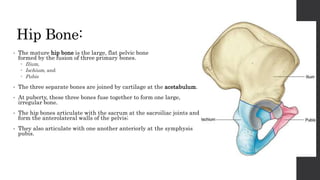
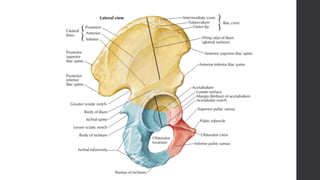
• The mature hip bone is the large, flat pelvic bone
formed by the fusion of three primary bones.
 Ilium,
 Ischium, and
 Pubis
• The three separate bones are joined by cartilage at the acetabulum.
• At puberty, these three bones fuse together to form one large,
irregular bone.
• The hip bones articulate with the sacrum at the sacroiliac joints and
form the anterolateral walls of the pelvis;
• They also articulate with one another anteriorly at the symphysis
pubis.
Ilium:
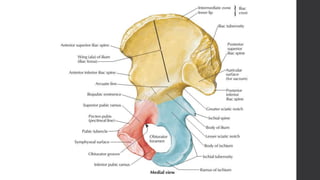
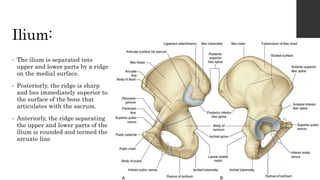
• The ilium is separated into
upper and lower parts by a ridge
on the medial surface.
• Posteriorly, the ridge is sharp
and lies immediately superior to
the surface of the bone that
articulates with the sacrum.
• Anteriorly, the ridge separating
the upper and lower parts of the
ilium is rounded and termed the
arcuate line
Ilium (Contd....)
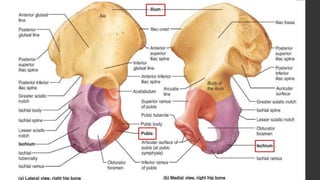
• The body of the ilium joins the pubis and ischium to form the acetabulum.
• Anteriorly, the ilium has stout anterior superior and anterior inferior iliac spines
that provide attachment for ligaments and tendons of lower limb muscles.
• Beginning at the anterior superior iliac spine (ASIS), the long curved and
thickened superior border of the ala of the ilium, the iliac crest, extends
posteriorly, terminating at the posterior superior iliac spine.
• A prominence on the external lip of the crest, the tubercle of
the iliac crest (iliac tubercle), lies 5–6 cm posterior to the ASIS. The posterior
inferior iliac spine marks the superior end of the greater sciatic notch.
• The lateral surface of the ala of the ilium has three rough curved lines—the
posterior, anterior, and inferior gluteal lines—that demarcate the proximal
attachments of the three large gluteal muscles.
• Medially, each ala has a large, smooth depression, the iliac fossa
Ischium
• The superior part of the body of the ischium fuses with the pubis and ilium,
forming the postero-inferior aspect of the acetabulum.
• The ramus of the ischium joins the inferior ramus of the pubis to form a bar
of bone, the ischiopubic ramus.
• The posterior border of the ischium forms the inferior margin of a deep
indentation called the greater sciatic notch.
• The large, triangular ischial spine at the inferior margin of this notch
provides ligamentous attachment.
• The rough bony projection at the junction of the inferior end of the body of
the ischium and its ramus is the large ischial tuberosity.
Pubis
• The pubis is divided into a flattened medially placed body and superior and
inferior rami that project laterally from the body.
• Medially, the symphysial surface of the body of the pubis articulates with
the corresponding surface of the body of the contralateral pubis by means of
the pubic symphysis.
• The anterosuperior border of the united bodies and symphysis forms the
pubic crest.
• Small projections at the lateral ends of this crest, the pubic tubercles.
• The posterior margin of the superior ramus of the pubis has a sharp raised
edge, the pecten pubis.
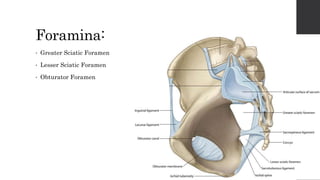
Foramina:
• Greater Sciatic Foramen
• Lesser Sciatic Foramen
• Obturator Foramen
Structures Passing Through Greater
Sciatic Foramen
• Above Piriformis:
 Superior Gluteal Vessels & nerves
• Below Piriformis: (P.I.N and P.I.N.S)
 Posterior cutaneous nerve of thigh
 Inferior gluteal vessels and nerves
 Nerve to quadratus femoris
 Pudendal nerve
 Internal pudendal vessels
 Nerve to obturator internus
 Sciatic nerve
Structures Passing Through Greater
Sciatic Foramen (PINTo)
• Pudendal Nerve
• Internal Pudendal Vessels
• Nerve to Obturator Internus
• Tendon of Obturator Internus
THANK YOU

Hip bone (Gross Anatomy)

  • 2.
  • 3.
    Hip Bone: • Themature hip bone is the large, flat pelvic bone formed by the fusion of three primary bones.  Ilium,  Ischium, and  Pubis • The three separate bones are joined by cartilage at the acetabulum. • At puberty, these three bones fuse together to form one large, irregular bone. • The hip bones articulate with the sacrum at the sacroiliac joints and form the anterolateral walls of the pelvis; • They also articulate with one another anteriorly at the symphysis pubis.
  • 7.
    Ilium: • The iliumis separated into upper and lower parts by a ridge on the medial surface. • Posteriorly, the ridge is sharp and lies immediately superior to the surface of the bone that articulates with the sacrum. • Anteriorly, the ridge separating the upper and lower parts of the ilium is rounded and termed the arcuate line
  • 8.
    Ilium (Contd....) • Thebody of the ilium joins the pubis and ischium to form the acetabulum. • Anteriorly, the ilium has stout anterior superior and anterior inferior iliac spines that provide attachment for ligaments and tendons of lower limb muscles. • Beginning at the anterior superior iliac spine (ASIS), the long curved and thickened superior border of the ala of the ilium, the iliac crest, extends posteriorly, terminating at the posterior superior iliac spine. • A prominence on the external lip of the crest, the tubercle of the iliac crest (iliac tubercle), lies 5–6 cm posterior to the ASIS. The posterior inferior iliac spine marks the superior end of the greater sciatic notch. • The lateral surface of the ala of the ilium has three rough curved lines—the posterior, anterior, and inferior gluteal lines—that demarcate the proximal attachments of the three large gluteal muscles. • Medially, each ala has a large, smooth depression, the iliac fossa
  • 9.
    Ischium • The superiorpart of the body of the ischium fuses with the pubis and ilium, forming the postero-inferior aspect of the acetabulum. • The ramus of the ischium joins the inferior ramus of the pubis to form a bar of bone, the ischiopubic ramus. • The posterior border of the ischium forms the inferior margin of a deep indentation called the greater sciatic notch. • The large, triangular ischial spine at the inferior margin of this notch provides ligamentous attachment. • The rough bony projection at the junction of the inferior end of the body of the ischium and its ramus is the large ischial tuberosity.
  • 10.
    Pubis • The pubisis divided into a flattened medially placed body and superior and inferior rami that project laterally from the body. • Medially, the symphysial surface of the body of the pubis articulates with the corresponding surface of the body of the contralateral pubis by means of the pubic symphysis. • The anterosuperior border of the united bodies and symphysis forms the pubic crest. • Small projections at the lateral ends of this crest, the pubic tubercles. • The posterior margin of the superior ramus of the pubis has a sharp raised edge, the pecten pubis.
  • 11.
    Foramina: • Greater SciaticForamen • Lesser Sciatic Foramen • Obturator Foramen
  • 12.
    Structures Passing ThroughGreater Sciatic Foramen • Above Piriformis:  Superior Gluteal Vessels & nerves • Below Piriformis: (P.I.N and P.I.N.S)  Posterior cutaneous nerve of thigh  Inferior gluteal vessels and nerves  Nerve to quadratus femoris  Pudendal nerve  Internal pudendal vessels  Nerve to obturator internus  Sciatic nerve
  • 13.
    Structures Passing ThroughGreater Sciatic Foramen (PINTo) • Pudendal Nerve • Internal Pudendal Vessels • Nerve to Obturator Internus • Tendon of Obturator Internus
  • 14.