Anatomy
Classification of Joints
NHF COLLEGE OF NURSING,MYSURU
Prepared by:
Prof.Ananda.S
Introduction:-
• A joint, also called articulation is a point of contact.
• Arthrology:-It is the scientific study of joints.
• Kinesiology:-It is the study of the motion of the human body.
• There are 230 joints in thebody
Definition
• A joint is the site at which any two or more bones articulate or
come together. Joints allow flexibility and movement of the
skeleton and allow attachment between bones.
Joint Functions
1. Hold the skeletal bones together
2. Allow the skeleton some flexibility so movement can occur
3. Make bone growth possible
Classification of Joints
• The joints are classified as :
• Functionally
• Structurally
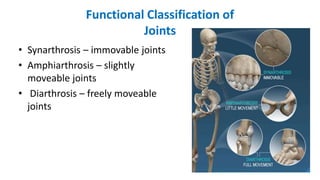
Functional Classification of
Joints
• Synarthrosis – immovable joints
• Amphiarthrosis – slightly
moveable joints
• Diarthrosis – freely moveable
joints
Synarthrosis
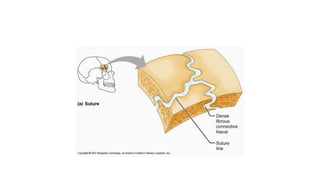
• Synarthrosis permit little or no mobility.
• Most synarthrosis joints are fibrous joints.
• Eg-cranial sutures in adult.
Amphiarthrosis :-
• Amphiarthrosis permit slight mobility.
• The two bone surfaces at the joint are both covered in hyaline
cartilage and joined by strands of fibrocartilage.
eg: secondary cartilaginous joints
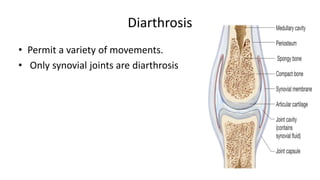
Diarthrosis
• Permit a variety of movements.
• Only synovial joints are diarthrosis
Structural classification of joints
There are three types of joints.
1.Fibrous or fixed joints or Immovable
2.Cartilaginous or Slightly moveable joints
3.Synovial or Freely moveable joints
1.Fibrous or fixed joints or Immovable
• In this type, the articulating surfaces of bones are connected
by fibrous tissue.
• There are three types of fibrous joints.
A. Sutures or sutural joints
B. Syndesmosis
C. Gomphosis
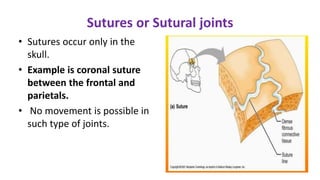
Sutures or Sutural joints
• Sutures occur only in the
skull.
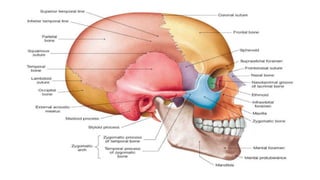
• Example is coronal suture
between the frontal and
parietals.
• No movement is possible in
such type of joints.
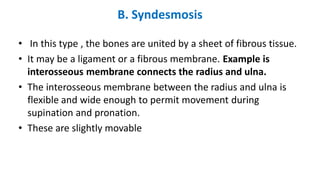
B. Syndesmosis
• In this type , the bones are united by a sheet of fibrous tissue.
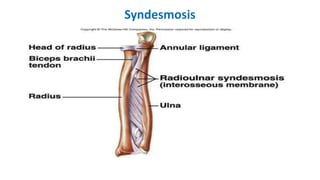
• It may be a ligament or a fibrous membrane. Example is
interosseous membrane connects the radius and ulna.
• The interosseous membrane between the radius and ulna is
flexible and wide enough to permit movement during
supination and pronation.
• These are slightly movable
Syndesmosis
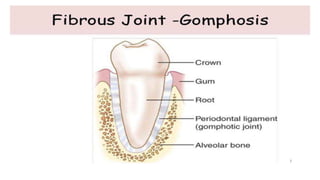
C. Gomphosis
• This is a special type of fibrous joint, between a tooth and
its socket.
• The fibrous tissue of the periodontal ligament firmly holds
the tooth in its socket.
2.Cartilaginous or Slightly moveable joints
• Here bones are united either by hyaline cartilage or by fibrous
cartilage.
• Depending on this, cartilaginous joints are classified into
primary and secondary cartilaginous joints.
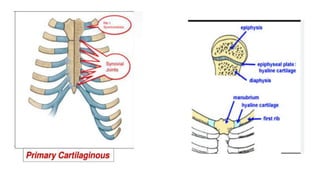
Primary cartilaginous joints
• It is also known as hyaline cartilaginous joints or
Synchondroses.
• The bones are united by hyaline.
• This type of joint is temporary , as in the development of a long
bone.
• The bones are united by a plate or a bar of hyaline cartilage.
No movement, temporary joints (ossify later),
• Example: Between the Epiphysis and the Diaphysis of a
growing bone.
• Between the First Rib and the Sternum (1st sternocostal joint)
(The rest of the sternocostal joints are synovial plane joints.)
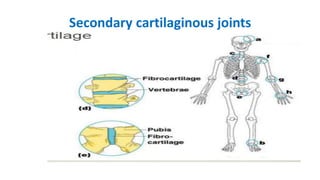
Secondary cartilaginous joints
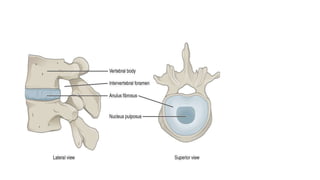
• Also known fibrocartilagenous joints or symphyses.
• Bones are united with strong fibrous tissue or fibrocartilage.
• Examples are symphysis pubis, joints between vertebral bodies
( intervertebral discs).
Secondary cartilaginous joints
3.Synovial or Freely moveable joints
• They are most common and important joints in the body.
• They normally provide free movement.
• They are called synovial joints because they are lined with a
synovial membrane and contain a lubricating fluid called
synovial fluid.
• Eg- Shoulder, hip, elbow and knee.
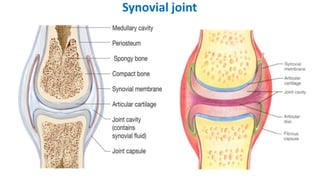
Synovial joint
Characteristic features of Synovial joint
• Articular surface:
These consist of corresponding ends of articulating bones.
• Articular cartilage:
Articular cartilage covers the articular surface of the
articulating bones. It provides a smooth gliding surface and
reduces the force of compression during weight bearing
• Synovial membrane:
It lines the fibrous capsule from inside. It secrets synovial fluid.
• Synovial fluid:
It is a clear or pale yellow, viscous alkaline fluid. It maintains
the nutrition of articular cartilage. It provides lubrication to the
joint cavity
• Joint cavity:
The joint cavity is enclosed within a fibrous capsule.
• Articular capsule:
It consists of a fibrous capsule lined by synovial membrane on
the inside. It binds the articulating bones together.
• Articular disc: It is made up of fibrocartilage.
• Ligaments: True and accessory. They maintain the stability of
the joint.
Function of S.F. Is:-
1) Provides nutrients for the structure with in the joint cavity.
2) Contain phagocytes which remove microbes
3) Act as a lubricant
4) Maintain joint stability.
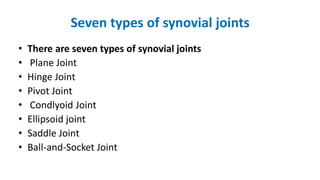
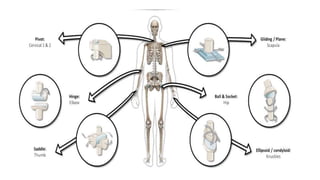
Seven types of synovial joints
• There are seven types of synovial joints
• Plane Joint
• Hinge Joint
• Pivot Joint
• Condlyoid Joint
• Ellipsoid joint
• Saddle Joint
• Ball-and-Socket Joint
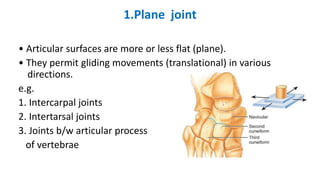
1.Plane joint
• Articular surfaces are more or less flat (plane).
• They permit gliding movements (translational) in various
directions.
e.g.
1. Intercarpal joints
2. Intertarsal joints
3. Joints b/w articular process
of vertebrae
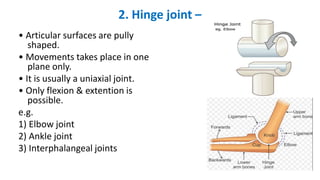
2. Hinge joint –
• Articular surfaces are pully
shaped.
• Movements takes place in one
plane only.
• It is usually a uniaxial joint.
• Only flexion & extention is
possible.
e.g.
1) Elbow joint
2) Ankle joint
3) Interphalangeal joints
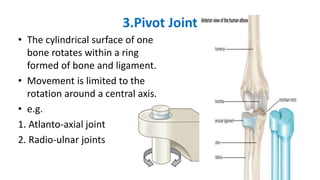
3.Pivot Joint
• The cylindrical surface of one
bone rotates within a ring
formed of bone and ligament.
• Movement is limited to the
rotation around a central axis.
• e.g.
1. Atlanto-axial joint
2. Radio-ulnar joints
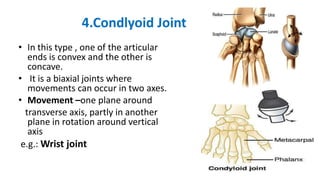
4.Condlyoid Joint
• In this type , one of the articular
ends is convex and the other is
concave.
• It is a biaxial joints where
movements can occur in two axes.
• Movement –one plane around
transverse axis, partly in another
plane in rotation around vertical
axis
e.g.: Wrist joint
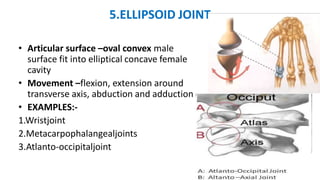
5.ELLIPSOID JOINT
• Articular surface –oval convex male
surface fit into elliptical concave female
cavity
• Movement –flexion, extension around
transverse axis, abduction and adduction
• EXAMPLES:-
1.Wristjoint
2.Metacarpophalangealjoints
3.Atlanto-occipitaljoint
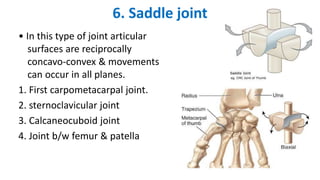
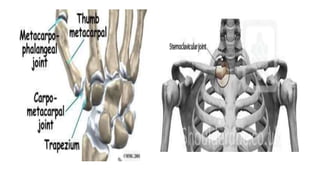
6. Saddle joint
• In this type of joint articular
surfaces are reciprocally
concavo-convex & movements
can occur in all planes.
1. First carpometacarpal joint.
2. sternoclavicular joint
3. Calcaneocuboid joint
4. Joint b/w femur & patella
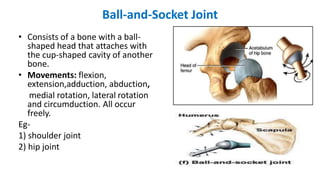
Ball-and-Socket Joint
• Consists of a bone with a ball-
shaped head that attaches with
the cup-shaped cavity of another
bone.
• Movements: flexion,
extension,adduction, abduction,
medial rotation, lateral rotation
and circumduction. All occur
freely.
Eg-
1) shoulder joint
2) hip joint
Joints of Human body
• Joints of upper limb
• Joints of the lower limb
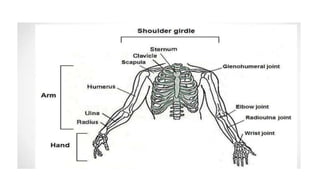
Joints of upper limb
• Acromio-clavicular joint
• Sterno-clavicular joint
• Shoulder joint
• Elbow joint
• Radio-ulnar joints
• Wrist joint
• Intercarpal and Midcarpal joints
• Carpo-metacarpal joints
• Metacarpo-phalangeal joint
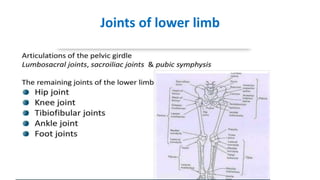
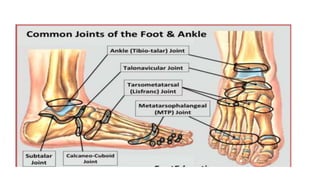
Joints of lower limb
Joints of Skull

Lec-5-Sketetal System- Joints.pdf

  • 1.
    Anatomy Classification of Joints NHFCOLLEGE OF NURSING,MYSURU Prepared by: Prof.Ananda.S
  • 2.
    Introduction:- • A joint,also called articulation is a point of contact. • Arthrology:-It is the scientific study of joints. • Kinesiology:-It is the study of the motion of the human body. • There are 230 joints in thebody
  • 3.
    Definition • A jointis the site at which any two or more bones articulate or come together. Joints allow flexibility and movement of the skeleton and allow attachment between bones.
  • 4.
    Joint Functions 1. Holdthe skeletal bones together 2. Allow the skeleton some flexibility so movement can occur 3. Make bone growth possible
  • 5.
    Classification of Joints •The joints are classified as : • Functionally • Structurally
  • 6.
    Functional Classification of Joints •Synarthrosis – immovable joints • Amphiarthrosis – slightly moveable joints • Diarthrosis – freely moveable joints
  • 7.
    Synarthrosis • Synarthrosis permitlittle or no mobility. • Most synarthrosis joints are fibrous joints. • Eg-cranial sutures in adult.
  • 9.
    Amphiarthrosis :- • Amphiarthrosispermit slight mobility. • The two bone surfaces at the joint are both covered in hyaline cartilage and joined by strands of fibrocartilage. eg: secondary cartilaginous joints
  • 11.
    Diarthrosis • Permit avariety of movements. • Only synovial joints are diarthrosis
  • 12.
    Structural classification ofjoints There are three types of joints. 1.Fibrous or fixed joints or Immovable 2.Cartilaginous or Slightly moveable joints 3.Synovial or Freely moveable joints
  • 13.
    1.Fibrous or fixedjoints or Immovable • In this type, the articulating surfaces of bones are connected by fibrous tissue. • There are three types of fibrous joints. A. Sutures or sutural joints B. Syndesmosis C. Gomphosis
  • 14.
    Sutures or Suturaljoints • Sutures occur only in the skull. • Example is coronal suture between the frontal and parietals. • No movement is possible in such type of joints.
  • 16.
    B. Syndesmosis • Inthis type , the bones are united by a sheet of fibrous tissue. • It may be a ligament or a fibrous membrane. Example is interosseous membrane connects the radius and ulna. • The interosseous membrane between the radius and ulna is flexible and wide enough to permit movement during supination and pronation. • These are slightly movable
  • 17.
  • 18.
    C. Gomphosis • Thisis a special type of fibrous joint, between a tooth and its socket. • The fibrous tissue of the periodontal ligament firmly holds the tooth in its socket.
  • 20.
    2.Cartilaginous or Slightlymoveable joints • Here bones are united either by hyaline cartilage or by fibrous cartilage. • Depending on this, cartilaginous joints are classified into primary and secondary cartilaginous joints.
  • 21.
    Primary cartilaginous joints •It is also known as hyaline cartilaginous joints or Synchondroses. • The bones are united by hyaline. • This type of joint is temporary , as in the development of a long bone. • The bones are united by a plate or a bar of hyaline cartilage. No movement, temporary joints (ossify later), • Example: Between the Epiphysis and the Diaphysis of a growing bone. • Between the First Rib and the Sternum (1st sternocostal joint) (The rest of the sternocostal joints are synovial plane joints.)
  • 23.
    Secondary cartilaginous joints •Also known fibrocartilagenous joints or symphyses. • Bones are united with strong fibrous tissue or fibrocartilage. • Examples are symphysis pubis, joints between vertebral bodies ( intervertebral discs).
  • 24.
  • 25.
    3.Synovial or Freelymoveable joints • They are most common and important joints in the body. • They normally provide free movement. • They are called synovial joints because they are lined with a synovial membrane and contain a lubricating fluid called synovial fluid. • Eg- Shoulder, hip, elbow and knee.
  • 26.
  • 27.
    Characteristic features ofSynovial joint • Articular surface: These consist of corresponding ends of articulating bones. • Articular cartilage: Articular cartilage covers the articular surface of the articulating bones. It provides a smooth gliding surface and reduces the force of compression during weight bearing
  • 28.
    • Synovial membrane: Itlines the fibrous capsule from inside. It secrets synovial fluid. • Synovial fluid: It is a clear or pale yellow, viscous alkaline fluid. It maintains the nutrition of articular cartilage. It provides lubrication to the joint cavity
  • 29.
    • Joint cavity: Thejoint cavity is enclosed within a fibrous capsule. • Articular capsule: It consists of a fibrous capsule lined by synovial membrane on the inside. It binds the articulating bones together. • Articular disc: It is made up of fibrocartilage. • Ligaments: True and accessory. They maintain the stability of the joint.
  • 30.
    Function of S.F.Is:- 1) Provides nutrients for the structure with in the joint cavity. 2) Contain phagocytes which remove microbes 3) Act as a lubricant 4) Maintain joint stability.
  • 31.
    Seven types ofsynovial joints • There are seven types of synovial joints • Plane Joint • Hinge Joint • Pivot Joint • Condlyoid Joint • Ellipsoid joint • Saddle Joint • Ball-and-Socket Joint
  • 33.
    1.Plane joint • Articularsurfaces are more or less flat (plane). • They permit gliding movements (translational) in various directions. e.g. 1. Intercarpal joints 2. Intertarsal joints 3. Joints b/w articular process of vertebrae
  • 34.
    2. Hinge joint– • Articular surfaces are pully shaped. • Movements takes place in one plane only. • It is usually a uniaxial joint. • Only flexion & extention is possible. e.g. 1) Elbow joint 2) Ankle joint 3) Interphalangeal joints
  • 35.
    3.Pivot Joint • Thecylindrical surface of one bone rotates within a ring formed of bone and ligament. • Movement is limited to the rotation around a central axis. • e.g. 1. Atlanto-axial joint 2. Radio-ulnar joints
  • 36.
    4.Condlyoid Joint • Inthis type , one of the articular ends is convex and the other is concave. • It is a biaxial joints where movements can occur in two axes. • Movement –one plane around transverse axis, partly in another plane in rotation around vertical axis e.g.: Wrist joint
  • 38.
    5.ELLIPSOID JOINT • Articularsurface –oval convex male surface fit into elliptical concave female cavity • Movement –flexion, extension around transverse axis, abduction and adduction • EXAMPLES:- 1.Wristjoint 2.Metacarpophalangealjoints 3.Atlanto-occipitaljoint
  • 39.
    6. Saddle joint •In this type of joint articular surfaces are reciprocally concavo-convex & movements can occur in all planes. 1. First carpometacarpal joint. 2. sternoclavicular joint 3. Calcaneocuboid joint 4. Joint b/w femur & patella
  • 41.
    Ball-and-Socket Joint • Consistsof a bone with a ball- shaped head that attaches with the cup-shaped cavity of another bone. • Movements: flexion, extension,adduction, abduction, medial rotation, lateral rotation and circumduction. All occur freely. Eg- 1) shoulder joint 2) hip joint
  • 42.
    Joints of Humanbody • Joints of upper limb • Joints of the lower limb
  • 43.
    Joints of upperlimb • Acromio-clavicular joint • Sterno-clavicular joint • Shoulder joint • Elbow joint • Radio-ulnar joints • Wrist joint • Intercarpal and Midcarpal joints • Carpo-metacarpal joints • Metacarpo-phalangeal joint
  • 45.
  • 47.