Angle Modulation
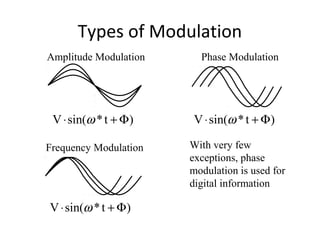
Types of Modulation
Amplitude Modulation
Frequency Modulation
Phase Modulation
With very few
exceptions, phase
modulation is used for
digital information.
)t*sin(V Φ+⋅ ω
)t*sin(V Φ+⋅ ω
)t*sin(V Φ+⋅ ω
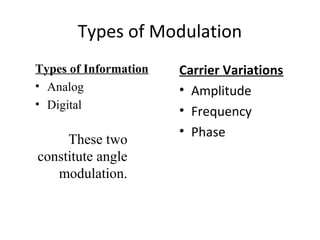
Types of Modulation
Carrier Variations
• Amplitude
• Frequency
• Phase
Types of Information
• Analog
• Digital
These two
constitute angle
modulation.
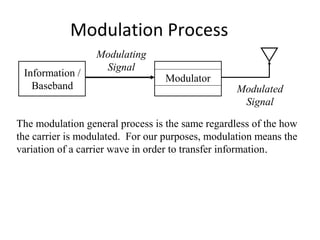
Modulation Process
Modulating
Signal
Modulator
Information /
Baseband Modulated
Signal
The modulation general process is the same regardless of the how
the carrier is modulated. For our purposes, modulation means the
variation of a carrier wave in order to transfer information..
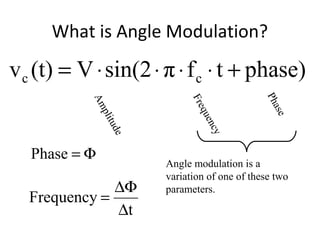
What is Angle Modulation?
phase)tfπsin(2V(t)v cc +⋅⋅⋅⋅=
Amplitude
Frequency
Phase
Angle modulation is a
variation of one of these two
parameters.
Φ=Phase
t
Frequency
∆
∆Φ
=
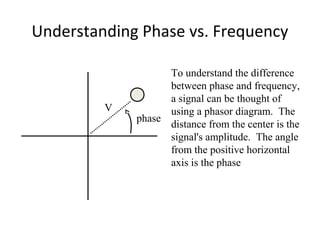
Understanding Phase vs. Frequency
phase
V
To understand the difference
between phase and frequency,
a signal can be thought of
using a phasor diagram. The
distance from the center is the
signal's amplitude. The angle
from the positive horizontal
axis is the phase.
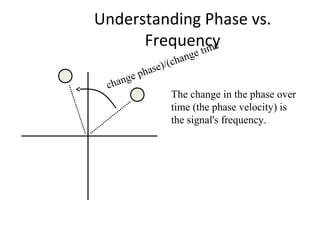
Understanding Phase vs.
Frequency
The change in the phase over
time (the phase velocity) is
the signal's frequency.
(change phase)/(change time)
Understanding Angle Modulation
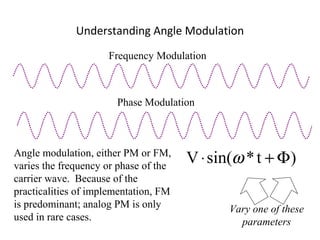
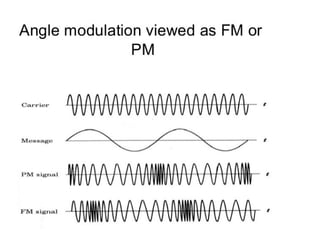
Angle modulation, either PM or FM,
varies the frequency or phase of the
carrier wave. Because of the
practicalities of implementation, FM
is predominant; analog PM is only
used in rare cases.
)t*sin(V Φ+⋅ ω
Vary one of these
parameters
Frequency Modulation
Phase Modulation
Calculating Total Power
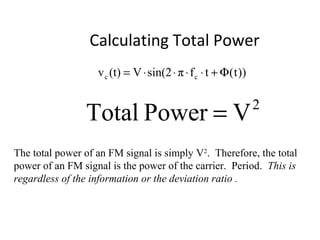
The total power of an FM signal is simply V2
. Therefore, the total
power of an FM signal is the power of the carrier. Period. This is
regardless of the information or the deviation ratio .
))t(tfπsin(2V(t)v cc Φ+⋅⋅⋅⋅=
2
VPowerTotal =
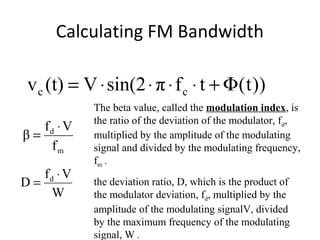
Calculating FM Bandwidth
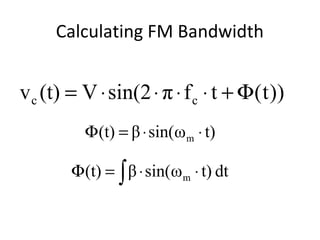
t)ωsin(β(t) m ⋅⋅=Φ
))t(tfπsin(2V(t)v cc Φ+⋅⋅⋅⋅=
Angle Modulation
For PM
∫ ⋅⋅=Φ dtt)ωsin(β(t) m
For FM
Calculating FM Bandwidth
m
d
f
Vf
β
⋅
=
))t(tfπsin(2V(t)v cc Φ+⋅⋅⋅⋅=
Angle Modulation
The beta value, called the modulation index, is
the ratio of the deviation of the modulator, fd,
multiplied by the amplitude of the modulating
signal and divided by the modulating frequency,
fm .
the deviation ratio, D, which is the product of
the modulator deviation, fd, multiplied by the
amplitude of the modulating signalV, divided
by the maximum frequency of the modulating
signal, W .
W
Vf
D d ⋅
=
Why FM and not PM?
• Broadcast analog television chrominanceBroadcast analog television chrominance
(color)(color)
• Apollo spacecraft communicationsApollo spacecraft communications
• AM stereoAM stereo
For practical implementation reasons, analog FM is easier to
generate than PM, and FM provides better performance in most
common environments. However, analog PM has been (and
continues to be) used for a few, isolated systems.

Angle modulation

  • 1.
  • 2.
    Types of Modulation AmplitudeModulation Frequency Modulation Phase Modulation With very few exceptions, phase modulation is used for digital information. )t*sin(V Φ+⋅ ω )t*sin(V Φ+⋅ ω )t*sin(V Φ+⋅ ω
  • 3.
    Types of Modulation CarrierVariations • Amplitude • Frequency • Phase Types of Information • Analog • Digital These two constitute angle modulation.
  • 4.
    Modulation Process Modulating Signal Modulator Information / BasebandModulated Signal The modulation general process is the same regardless of the how the carrier is modulated. For our purposes, modulation means the variation of a carrier wave in order to transfer information..
  • 5.
    What is AngleModulation? phase)tfπsin(2V(t)v cc +⋅⋅⋅⋅= Amplitude Frequency Phase Angle modulation is a variation of one of these two parameters. Φ=Phase t Frequency ∆ ∆Φ =
  • 6.
    Understanding Phase vs.Frequency phase V To understand the difference between phase and frequency, a signal can be thought of using a phasor diagram. The distance from the center is the signal's amplitude. The angle from the positive horizontal axis is the phase.
  • 7.
    Understanding Phase vs. Frequency Thechange in the phase over time (the phase velocity) is the signal's frequency. (change phase)/(change time)
  • 8.
    Understanding Angle Modulation Anglemodulation, either PM or FM, varies the frequency or phase of the carrier wave. Because of the practicalities of implementation, FM is predominant; analog PM is only used in rare cases. )t*sin(V Φ+⋅ ω Vary one of these parameters Frequency Modulation Phase Modulation
  • 10.
    Calculating Total Power Thetotal power of an FM signal is simply V2 . Therefore, the total power of an FM signal is the power of the carrier. Period. This is regardless of the information or the deviation ratio . ))t(tfπsin(2V(t)v cc Φ+⋅⋅⋅⋅= 2 VPowerTotal =
  • 11.
    Calculating FM Bandwidth t)ωsin(β(t)m ⋅⋅=Φ ))t(tfπsin(2V(t)v cc Φ+⋅⋅⋅⋅= Angle Modulation For PM ∫ ⋅⋅=Φ dtt)ωsin(β(t) m For FM
  • 12.
    Calculating FM Bandwidth m d f Vf β ⋅ = ))t(tfπsin(2V(t)vcc Φ+⋅⋅⋅⋅= Angle Modulation The beta value, called the modulation index, is the ratio of the deviation of the modulator, fd, multiplied by the amplitude of the modulating signal and divided by the modulating frequency, fm . the deviation ratio, D, which is the product of the modulator deviation, fd, multiplied by the amplitude of the modulating signalV, divided by the maximum frequency of the modulating signal, W . W Vf D d ⋅ =
  • 13.
    Why FM andnot PM? • Broadcast analog television chrominanceBroadcast analog television chrominance (color)(color) • Apollo spacecraft communicationsApollo spacecraft communications • AM stereoAM stereo For practical implementation reasons, analog FM is easier to generate than PM, and FM provides better performance in most common environments. However, analog PM has been (and continues to be) used for a few, isolated systems.