ANALOG COMMUNICATION SYSTEMS
By
Ms. Swati S Halunde
DEPT. of E.C.E
SITCOE, Yadrav
Modulation
It is the process of varying the characteristics of
high frequency carrier in accordance with
instantaneous values of modulating or message
or baseband signal.
(Or)
It is a frequency translation technique which
converts baseband or low frequency signal to
bandpass or high frequency signal.
Modulation is used in the transmitter.
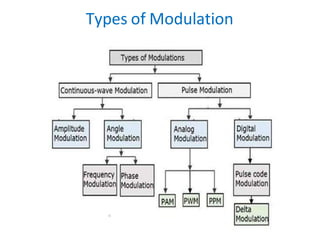
Types of Modulation
Types of Modulation
• Amplitude Modulation: Amplitude of the carrier
is varied in accordance with the instantaneous
values of modulating signal.
• Frequency Modulation: Frequency of the carrier
is varied in accordance with the instantaneous
values of modulating signal.
• Phase Modulation: Phase of the carrier is varied
in accordance with the instantaneous values of
modulating signal.
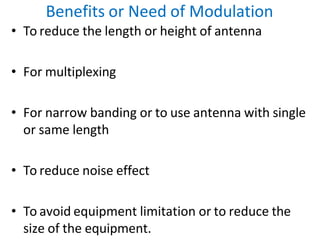
Benefits or Need of Modulation
• To reduce the length or height of antenna
• For multiplexing
• For narrow banding or to use antenna with single
or same length
• To reduce noise effect
• To avoid equipment limitation or to reduce the
size of the equipment.
Amplitude Modulation
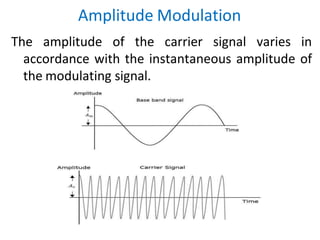
The amplitude of the carrier signal varies in
accordance with the instantaneous amplitude of
the modulating signal.
Amplitude Modulation
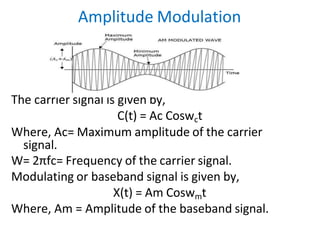
The carrier signal is given by,
C(t) = Ac Coswct
Where, Ac= Maximum amplitude of the carrier
signal.
W= 2πfc= Frequency of the carrier signal.
Modulating or baseband signal is given by,
X(t) = Am Coswmt
Where, Am = Amplitude of the baseband signal.
Amplitude Modulation
The standard equation for amplitude modulated
signal is expressed as,
S(t)= Ac Cos2πfct[1+ma(Cos2πfmt)]
Where, ma = Am/Ac = Modulation Index
Time Domain representation of AM:
S(t)=AcCos2πfct+μAc/2Cos[2πfc+2πfm]t+μAc/2Cos[2πfc-2πfm]t
I term: Carrier signal with amplitude Ac and frequency fc.
II.term: Amplitude= μAc/2, frequency= fc+fm , Upper sideband
frequency
III.term: Amplitude= μAc/2, frequency= fc-fm , Lower sideband
frequency
Amplitude Modulation
Frequency Domain representation of AM:
The time domain representation of AM wave is
given by,
S(t)= Ac Cos2πfct[1+ma(Cos2πfmt)]
Taking Fourier transform on both sides,
S(f) = Ac/2[δ(f-fc)+ δ(f+fc)] + Acma/2[M(f-fc)+ M(f+fc)]
Modulation Index
Modulation index or depth of modulation is given
by,
ma = [Amax-Amin/ Amax+Amin]= Am/Ac
Percentage of modulation index is,
%ma = [Amax-Amin/ Amax+Amin]X100= [Am/Ac ]X100
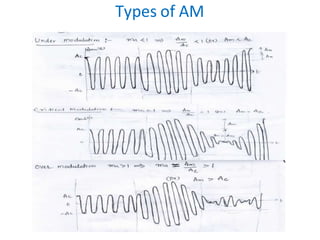
Types of AM with respect to modulation index:
• Under Modulation (ma <1)
• Critical Modulation (ma =1)
• Over Modulation (ma >1)
Types of AM
Generation of AM Wave
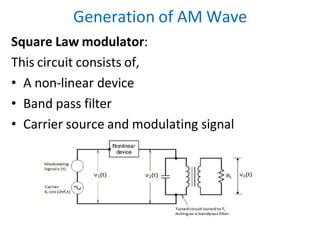
Square Law modulator:
This circuit consists of,
• A non-linear device
• Band pass filter
• Carrier source and modulating signal
Generation of AM Wave
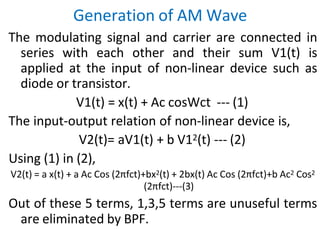
The modulating signal and carrier are connected in
series with each other and their sum V1(t) is
applied at the input of non-linear device such as
diode or transistor.
V1(t) = x(t) + Ac cosWct --- (1)
The input-output relation of non-linear device is,
V2(t)= aV1(t) + b V12(t) --- (2)
Using (1) in (2),
V2(t) = a x(t) + a Ac Cos (2πfct)+bx2(t) + 2bx(t) Ac Cos (2πfct)+b Ac2 Cos2
(2πfct)---(3)
Out of these 5 terms, 1,3,5 terms are unuseful terms
are eliminated by BPF.
Generation of AM Wave
Output of BPF is given by,
V0(t) = a Ac Cos (2πfct)+ 2bx(t) Ac Cos (2πfct)---(4)
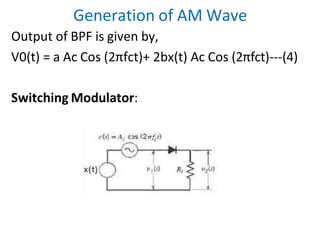
Switching Modulator:
Generation of AM Wave
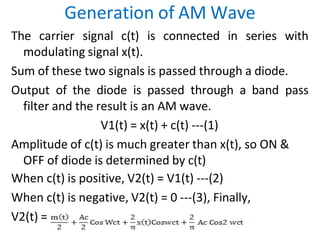
The carrier signal c(t) is connected in series with
modulating signal x(t).
Sum of these two signals is passed through a diode.
Output of the diode is passed through a band pass
filter and the result is an AM wave.
V1(t) = x(t) + c(t) ---(1)
Amplitude of c(t) is much greater than x(t), so ON &
OFF of diode is determined by c(t)
When c(t) is positive, V2(t) = V1(t) ---(2)
When c(t) is negative, V2(t) = 0 ---(3), Finally,
V2(t) =
Detection of AM Wave
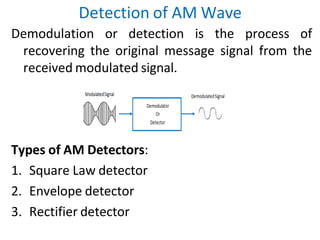
Demodulation or detection is the process of
recovering the original message signal from the
received modulated signal.
Types of AM Detectors:
1. Square Law detector
2. Envelope detector
3. Rectifier detector
Detection of AM Wave
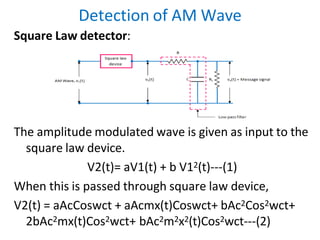
Square Law detector:
The amplitude modulated wave is given as input to the
square law device.
V2(t)= aV1(t) + b V12(t)---(1)
When this is passed through square law device,
V2(t) = aAcCoswct + aAcmx(t)Coswct+ bAc2Cos2wct+
2bAc2mx(t)Cos2wct+ bAc2m2x2(t)Cos2wct---(2)
Detection of AM Wave
In order to extract the original message signal, V2(t)
is passed through a low pass filter .
The output of LPF is,
V0(t) = mbAc2x(t) ---(3)
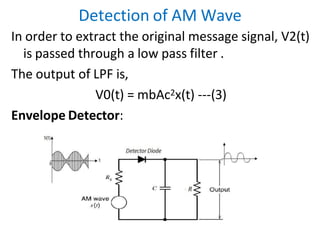
Envelope Detector:
Detection of AM Wave
• The standard AM wave is applied at the input of
detector .
• In every positive half cycle of input, diode is
forward biased which charges capacitor ‘C’.
• When capacitor charges to peak value of input
voltage, diode stops conducting.
• The capacitor discharges through ‘R’ between
positive peaks.
• This process continuous and capacitor charges
and discharges repeatedly.
Detection of AM Wave
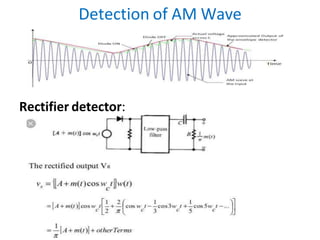
Rectifier detector:

modulation of analog communication system

  • 1.
    ANALOG COMMUNICATION SYSTEMS By Ms.Swati S Halunde DEPT. of E.C.E SITCOE, Yadrav
  • 2.
    Modulation It is theprocess of varying the characteristics of high frequency carrier in accordance with instantaneous values of modulating or message or baseband signal. (Or) It is a frequency translation technique which converts baseband or low frequency signal to bandpass or high frequency signal. Modulation is used in the transmitter.
  • 3.
  • 4.
    Types of Modulation •Amplitude Modulation: Amplitude of the carrier is varied in accordance with the instantaneous values of modulating signal. • Frequency Modulation: Frequency of the carrier is varied in accordance with the instantaneous values of modulating signal. • Phase Modulation: Phase of the carrier is varied in accordance with the instantaneous values of modulating signal.
  • 5.
    Benefits or Needof Modulation • To reduce the length or height of antenna • For multiplexing • For narrow banding or to use antenna with single or same length • To reduce noise effect • To avoid equipment limitation or to reduce the size of the equipment.
  • 6.
    Amplitude Modulation The amplitudeof the carrier signal varies in accordance with the instantaneous amplitude of the modulating signal.
  • 7.
    Amplitude Modulation The carriersignal is given by, C(t) = Ac Coswct Where, Ac= Maximum amplitude of the carrier signal. W= 2πfc= Frequency of the carrier signal. Modulating or baseband signal is given by, X(t) = Am Coswmt Where, Am = Amplitude of the baseband signal.
  • 8.
    Amplitude Modulation The standardequation for amplitude modulated signal is expressed as, S(t)= Ac Cos2πfct[1+ma(Cos2πfmt)] Where, ma = Am/Ac = Modulation Index Time Domain representation of AM: S(t)=AcCos2πfct+μAc/2Cos[2πfc+2πfm]t+μAc/2Cos[2πfc-2πfm]t I term: Carrier signal with amplitude Ac and frequency fc. II.term: Amplitude= μAc/2, frequency= fc+fm , Upper sideband frequency III.term: Amplitude= μAc/2, frequency= fc-fm , Lower sideband frequency
  • 9.
    Amplitude Modulation Frequency Domainrepresentation of AM: The time domain representation of AM wave is given by, S(t)= Ac Cos2πfct[1+ma(Cos2πfmt)] Taking Fourier transform on both sides, S(f) = Ac/2[δ(f-fc)+ δ(f+fc)] + Acma/2[M(f-fc)+ M(f+fc)]
  • 10.
    Modulation Index Modulation indexor depth of modulation is given by, ma = [Amax-Amin/ Amax+Amin]= Am/Ac Percentage of modulation index is, %ma = [Amax-Amin/ Amax+Amin]X100= [Am/Ac ]X100 Types of AM with respect to modulation index: • Under Modulation (ma <1) • Critical Modulation (ma =1) • Over Modulation (ma >1)
  • 11.
  • 12.
    Generation of AMWave Square Law modulator: This circuit consists of, • A non-linear device • Band pass filter • Carrier source and modulating signal
  • 13.
    Generation of AMWave The modulating signal and carrier are connected in series with each other and their sum V1(t) is applied at the input of non-linear device such as diode or transistor. V1(t) = x(t) + Ac cosWct --- (1) The input-output relation of non-linear device is, V2(t)= aV1(t) + b V12(t) --- (2) Using (1) in (2), V2(t) = a x(t) + a Ac Cos (2πfct)+bx2(t) + 2bx(t) Ac Cos (2πfct)+b Ac2 Cos2 (2πfct)---(3) Out of these 5 terms, 1,3,5 terms are unuseful terms are eliminated by BPF.
  • 14.
    Generation of AMWave Output of BPF is given by, V0(t) = a Ac Cos (2πfct)+ 2bx(t) Ac Cos (2πfct)---(4) Switching Modulator:
  • 15.
    Generation of AMWave The carrier signal c(t) is connected in series with modulating signal x(t). Sum of these two signals is passed through a diode. Output of the diode is passed through a band pass filter and the result is an AM wave. V1(t) = x(t) + c(t) ---(1) Amplitude of c(t) is much greater than x(t), so ON & OFF of diode is determined by c(t) When c(t) is positive, V2(t) = V1(t) ---(2) When c(t) is negative, V2(t) = 0 ---(3), Finally, V2(t) =
  • 16.
    Detection of AMWave Demodulation or detection is the process of recovering the original message signal from the received modulated signal. Types of AM Detectors: 1. Square Law detector 2. Envelope detector 3. Rectifier detector
  • 17.
    Detection of AMWave Square Law detector: The amplitude modulated wave is given as input to the square law device. V2(t)= aV1(t) + b V12(t)---(1) When this is passed through square law device, V2(t) = aAcCoswct + aAcmx(t)Coswct+ bAc2Cos2wct+ 2bAc2mx(t)Cos2wct+ bAc2m2x2(t)Cos2wct---(2)
  • 18.
    Detection of AMWave In order to extract the original message signal, V2(t) is passed through a low pass filter . The output of LPF is, V0(t) = mbAc2x(t) ---(3) Envelope Detector:
  • 19.
    Detection of AMWave • The standard AM wave is applied at the input of detector . • In every positive half cycle of input, diode is forward biased which charges capacitor ‘C’. • When capacitor charges to peak value of input voltage, diode stops conducting. • The capacitor discharges through ‘R’ between positive peaks. • This process continuous and capacitor charges and discharges repeatedly.
  • 20.
    Detection of AMWave Rectifier detector: