Contents 
 Introduction 
 History 
 Types Of Radio Receiver 
 Sensitivity and Selectivity 
 Frequency range
Introduction 
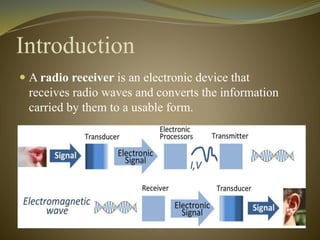
 A radio receiver is an electronic device that 
receives radio waves and converts the information 
carried by them to a usable form.
History 
 Alexander Stepanovich Popov 
 First radio receiver in 1896. 
 It was based on electromagnetic waves, 
 which were proven to exist by James Clerk Maxwell 
only a few years earlier in 1887.
Types Of Radio Receiver 
Crystal radio receiver 
Tuned radio frequency receiver 
Superheterodyne Receiver
Crystal radio 
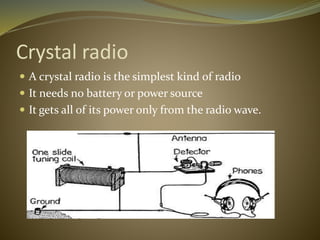
 A crystal radio is the simplest kind of radio 
 It needs no battery or power source 
 It gets all of its power only from the radio wave.
Components of Crystal Radio 
 Antenna 
 Tuner 
 Coil 
 Ground wire 
 Detector 
 Capacitor 
 Diode
Working
Tuned radio frequency receiver 
 one or more tuned radio frequency (RF) 
 individually tuned to the station's frequency
Tuned Radio Frequency Receiver 
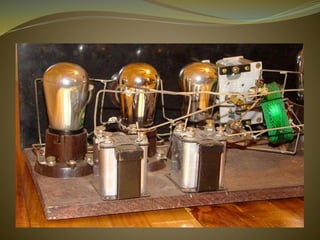
 A tuned radio frequency receiver (or TRF receiver) 
is a type of radio receiver that is usually composed of 
one or more tuned radio frequency (RF) amplifier 
stages followed by a detector (demodulator) circuit to 
extract the audio signal and an audio frequency 
amplifier. Popular in the 1920s, it could be tedious to 
operate because each stage must be individually tuned 
to the station's frequency. By the mid 1930s it was 
replaced by the superheterodyne receiver invented by 
Edwin Armstrong.
How it works 
 The classic TRF receivers of the 1920s and 30s 
consisted of three sections: 
 One or more tuned RF amplifier stages. These amplify 
the signal of the desired station to a level sufficient to 
drive the detector, while rejecting all other signals 
picked up by the antenna 
 a detector, which extracts the audio (modulation) 
signal from the radio carrier signal by rectifying it 
 optionally, but almost always included, one or more 
audio amplifier stages which increase the power of the 
audio signal.
Advantages and disadvantages 
 Disadvantage. 
 Since they used inductor and capacitor as tunning the 
element, the circuit is bulky and costly. 
 They are not suitable to amplify audio frequencies 
 If the band of the frequency is increased, design 
become complex.
Advantages and disadvantages 
Advantages 
 They amplify defined frequency. 
 Signal to noise ratio at output is good. 
 They are well suited for radio transmitters and receiver. 
 The band of frequency over which amplification is 
required can be varied.
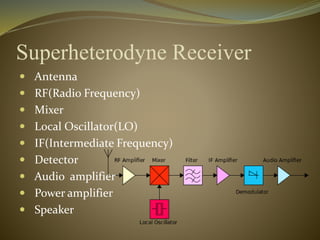
Superheterodyne Receiver 
 Antenna 
 RF(Radio Frequency) 
 Mixer 
 Local Oscillator(LO) 
 IF(Intermediate Frequency) 
 Detector 
 Audio amplifier 
 Power amplifier 
 Speaker
Architecture of 
Superheterodyne Receiver 
Antenna 
The antenna pick up all radiated signal and feeds them into 
the RF(Amplifier) .These signal are very small (usually only 
a few microvolts).
RF(Amplifier) 
 This circuit can be adjusted (tuned) to select and amplify 
any carries frequency within the AM Broad cost band . 
Only the selected frequency and its two side bands pass 
through the amplifier.(Some AM Receiver don’t have a 
Separate RF amplifier stage.)
Local Oscillator 
This circuit generates a steady sine 
wave at a frequency 455 khz above 
the selected RF
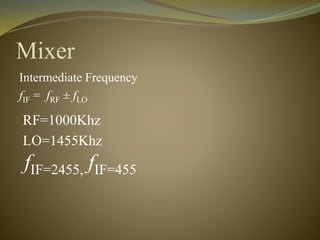
Mixer 
Intermediate Frequency 
fIF = fRF ± fLO 
RF=1000Khz 
LO=1455Khz 
fIF=2455, fIF=455
IF Amplifier 
Increase the level of the signal . 
Demodulation 
The received signal is now processed by 
the demodulator stage where the audio signal (or 
other baseband signal) is recovered and then further 
amplified. 
Audio Amplifier 
This circuit amplifies the detected audio signal and 
drive the speaker to drive sound
Sensitivity and Selectivity 
 Sensitivity 
Weak signal 
 noise 
 Selectivity 
 Band width filter 
 1% of RC Frequency
How radio waves travel. 
 Although radio waves are sometimes colloquially referred to as 
"airwaves", they do not require air or any other medium in 
which to travel and can travel through a vacuum. 
 Like light waves, radio waves travel in straight lines unless 
something reflects or refracts them. Like light waves, radio 
waves may be obstructed by obstacles, which can cast a radio 
"shadow". Although radio waves can pass through many non-conductive 
material without much loss, they do suffer some 
loss when passing through walls, floors and roofs. This loss 
depends upon the building materials used and increases at 
higher frequencies. Metal, water, ground and other electrically 
conductive materials cause large losses to radio waves passing 
through them and in some cases no usable signal may pass 
through.
Frequency range 
 A radio receiver may be designed to tune to a fixed frequency, 
 MF AM broadcast band, 535 kHz - 1605 kHz 
 General coverage MF/HF communications receiver 100 kHz - 
30 MHz 
 VHF FM broadcast band, 88 - 108 MHz 
 UHF TV broadcast band (analogue or digital) 470 - 860 MHz 
 Scanning receiver 0.5 MHz - 1300 MHz 
 GSM 900, GSM1800 or 3G mobile phone bands 
 Wireless LAN band 2400 - 2483.5 MHz
Radio receivers

Radio receivers

  • 2.
    Contents  Introduction  History  Types Of Radio Receiver  Sensitivity and Selectivity  Frequency range
  • 3.
    Introduction  Aradio receiver is an electronic device that receives radio waves and converts the information carried by them to a usable form.
  • 4.
    History  AlexanderStepanovich Popov  First radio receiver in 1896.  It was based on electromagnetic waves,  which were proven to exist by James Clerk Maxwell only a few years earlier in 1887.
  • 5.
    Types Of RadioReceiver Crystal radio receiver Tuned radio frequency receiver Superheterodyne Receiver
  • 6.
    Crystal radio A crystal radio is the simplest kind of radio  It needs no battery or power source  It gets all of its power only from the radio wave.
  • 7.
    Components of CrystalRadio  Antenna  Tuner  Coil  Ground wire  Detector  Capacitor  Diode
  • 8.
  • 9.
    Tuned radio frequencyreceiver  one or more tuned radio frequency (RF)  individually tuned to the station's frequency
  • 10.
    Tuned Radio FrequencyReceiver  A tuned radio frequency receiver (or TRF receiver) is a type of radio receiver that is usually composed of one or more tuned radio frequency (RF) amplifier stages followed by a detector (demodulator) circuit to extract the audio signal and an audio frequency amplifier. Popular in the 1920s, it could be tedious to operate because each stage must be individually tuned to the station's frequency. By the mid 1930s it was replaced by the superheterodyne receiver invented by Edwin Armstrong.
  • 12.
    How it works  The classic TRF receivers of the 1920s and 30s consisted of three sections:  One or more tuned RF amplifier stages. These amplify the signal of the desired station to a level sufficient to drive the detector, while rejecting all other signals picked up by the antenna  a detector, which extracts the audio (modulation) signal from the radio carrier signal by rectifying it  optionally, but almost always included, one or more audio amplifier stages which increase the power of the audio signal.
  • 13.
    Advantages and disadvantages  Disadvantage.  Since they used inductor and capacitor as tunning the element, the circuit is bulky and costly.  They are not suitable to amplify audio frequencies  If the band of the frequency is increased, design become complex.
  • 14.
    Advantages and disadvantages Advantages  They amplify defined frequency.  Signal to noise ratio at output is good.  They are well suited for radio transmitters and receiver.  The band of frequency over which amplification is required can be varied.
  • 15.
    Superheterodyne Receiver Antenna  RF(Radio Frequency)  Mixer  Local Oscillator(LO)  IF(Intermediate Frequency)  Detector  Audio amplifier  Power amplifier  Speaker
  • 16.
    Architecture of SuperheterodyneReceiver Antenna The antenna pick up all radiated signal and feeds them into the RF(Amplifier) .These signal are very small (usually only a few microvolts).
  • 17.
    RF(Amplifier)  Thiscircuit can be adjusted (tuned) to select and amplify any carries frequency within the AM Broad cost band . Only the selected frequency and its two side bands pass through the amplifier.(Some AM Receiver don’t have a Separate RF amplifier stage.)
  • 18.
    Local Oscillator Thiscircuit generates a steady sine wave at a frequency 455 khz above the selected RF
  • 19.
    Mixer Intermediate Frequency fIF = fRF ± fLO RF=1000Khz LO=1455Khz fIF=2455, fIF=455
  • 20.
    IF Amplifier Increasethe level of the signal . Demodulation The received signal is now processed by the demodulator stage where the audio signal (or other baseband signal) is recovered and then further amplified. Audio Amplifier This circuit amplifies the detected audio signal and drive the speaker to drive sound
  • 21.
    Sensitivity and Selectivity  Sensitivity Weak signal  noise  Selectivity  Band width filter  1% of RC Frequency
  • 22.
    How radio wavestravel.  Although radio waves are sometimes colloquially referred to as "airwaves", they do not require air or any other medium in which to travel and can travel through a vacuum.  Like light waves, radio waves travel in straight lines unless something reflects or refracts them. Like light waves, radio waves may be obstructed by obstacles, which can cast a radio "shadow". Although radio waves can pass through many non-conductive material without much loss, they do suffer some loss when passing through walls, floors and roofs. This loss depends upon the building materials used and increases at higher frequencies. Metal, water, ground and other electrically conductive materials cause large losses to radio waves passing through them and in some cases no usable signal may pass through.
  • 23.
    Frequency range A radio receiver may be designed to tune to a fixed frequency,  MF AM broadcast band, 535 kHz - 1605 kHz  General coverage MF/HF communications receiver 100 kHz - 30 MHz  VHF FM broadcast band, 88 - 108 MHz  UHF TV broadcast band (analogue or digital) 470 - 860 MHz  Scanning receiver 0.5 MHz - 1300 MHz  GSM 900, GSM1800 or 3G mobile phone bands  Wireless LAN band 2400 - 2483.5 MHz