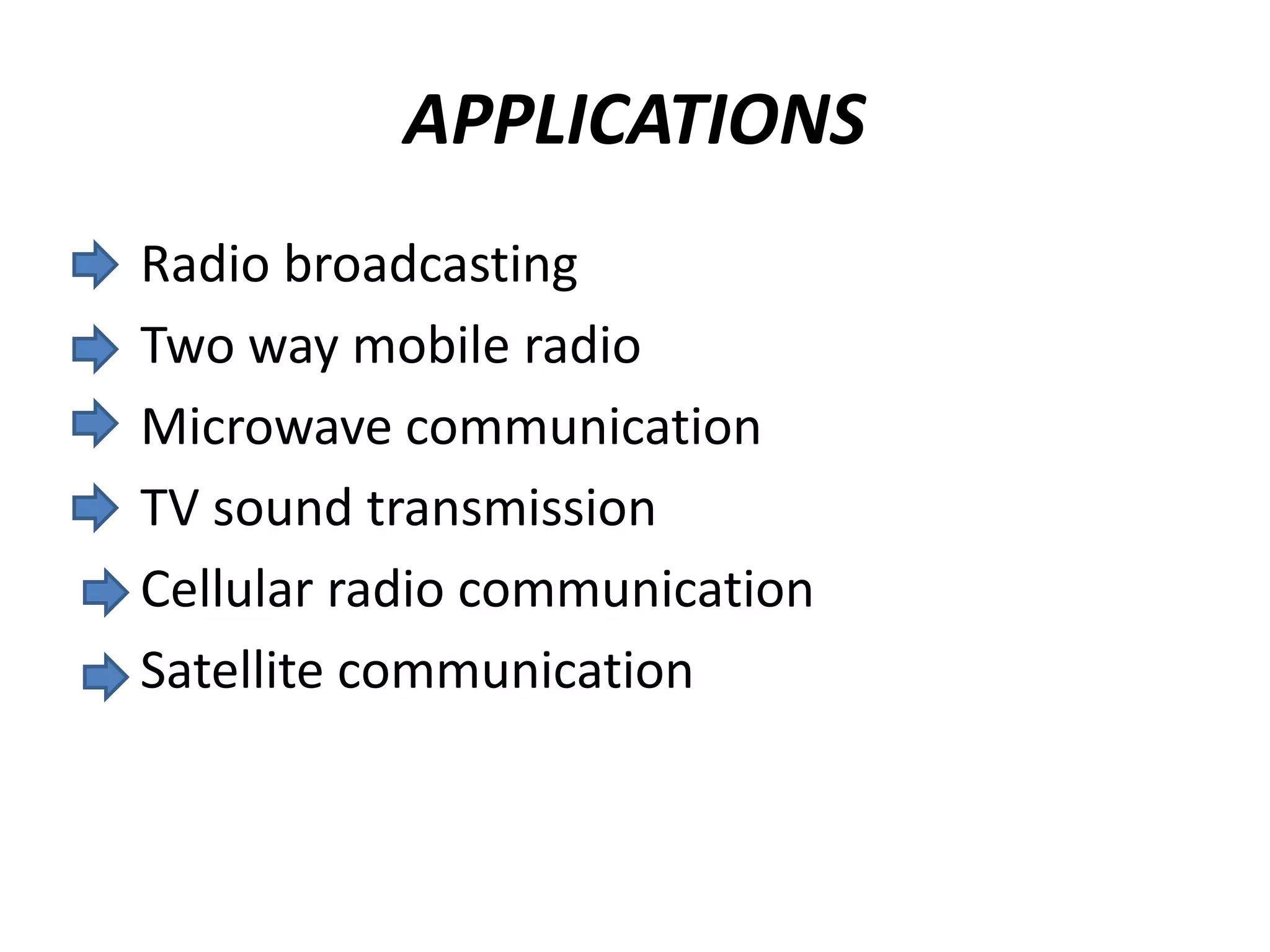
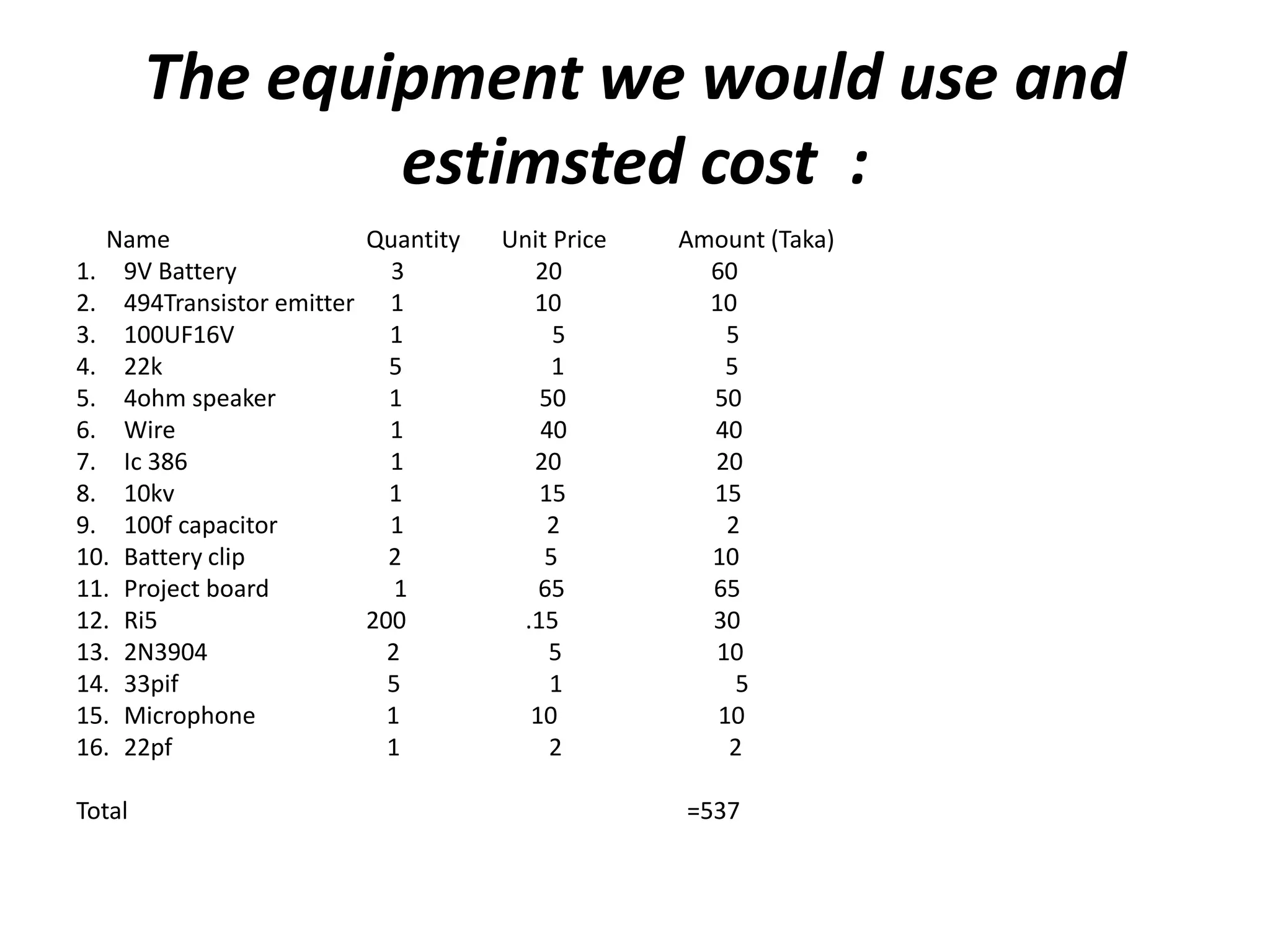
This document provides information about FM transmitters and receivers. It discusses what frequency modulation is, how it works, and the advantages it has over AM such as greater efficiency and noise reduction. It describes the components of an FM transmitter, including the crystal oscillator, phase modulator, frequency multiplier, and power amplifier. It also describes the components of an FM receiver, including the RF tuned amplifier, mixer, intermediate frequency amplifier, limiters, discriminator, de-emphasis circuit, and volume and tone controls. It discusses the applications of FM and provides an estimated bill of materials and costs for building a basic FM transmitter.
Introduction
The FM transmittersand receivers are those
devices which is used for sending and
receiving FM signal. The transmitters are
those devices which is used to send frequency
modulated wave through a band and the
receivers are the devices which received
modulated signal then after demodulation it
gives us the original signal.
What is FrequencyModulation?
When the audio signal is modulated onto the radio frequency carrier, the
new radio frequency signal moves up and down in frequency. The amount
by which the signal moves up and down is important. It is known as the
deviation and is normally quoted as the number of kilohertz deviation. As
an example the signal may have a deviation of plus and minus 3 kHz, i.e.
±3 kHz. In this case the carrier is made to move up and down by 3 kHz.
• Broadcast stations in the VHF portion of the frequency spectrum between
88.5 and 108 MHz use large values of deviation, typically ±75 kHz. This is
known as wide-band FM (WBFM). These signals are capable of supporting
high quality transmissions, but occupy a large amount of bandwidth.
Usually 200 kHz is allowed for each wide-band FM transmission. For
communications purposes less bandwidth is used. Narrow band FM
(NBFM) often uses deviation figures of around ±3 kHz.
• It is narrow band FM that is typically used for two-way radio
communication applications. Having a narrower band it is not able to
provide the high quality of the wideband transmissions, but this is not
needed for applications such as mobile radio communication.
5.
Why we douse FM communication?
• Efficiency
• The efficiency of a signal is the power in the side-bands as a fraction of the
total. In FM signals, because of the considerable side-bands produced, the
efficiency is generally high. Recall that conventional AM is limited to about
33 % efficiency to prevent distortion in the receiver when the modulation
index was greater than 1. FM has no analogous problem.
• The side-band structure is fairly complicated, but it is safe to say that the
efficiency is generally improved by making the modulation index larger (as
it should be). But if you make the modulation index larger, so make the
bandwidth larger (unlike AM) which has its disadvantages. As is typical in
engineering, a compromise between efficiency and performance is struck.
The modulation index is normally limited to a value between 1 and 5,
depending on the application.
6.
• Noise
• FMsystems are far better at rejecting noise than AM systems. Noise
generally is spread uniformly across the spectrum (the so-called white
noise, meaning wide spectrum). The amplitude of the noise varies
randomly at these frequencies. The change in amplitude can actually
modulate the signal and be picked up in the AM system. As a result, AM
systems are very sensitive to random noise. An example might be ignition
system noise in your car. Special filters need to be installed to keep the
interference out of your car radio.
• FM systems are inherently immune to random noise. In order for the noise
to interfere, it would have to modulate the frequency somehow. But the
noise is distributed uniformly in frequency and varies mostly in amplitude.
As a result, there is virtually no interference picked up in the FM receiver.
FM is sometimes called "static free, " referring to its superior immunity to
random noise.
7.
Different Type OfFM
• NARROW BAND F.M. We know that the bandwidth of an FM signal
depends upon the frequency Deviation (∆𝜔 = 𝑘𝑓. 𝑥(𝑡).if frequency
deviation is low it means 𝑘𝑓 is low then bandwidth will be narrow then
narrow band FM is formed.
• WIDEBAND FM If frequency deviation (∆𝜔 = 𝑘𝑓. 𝑥(𝑡) is high , it means
frequency sensitivity 𝑘𝑓 is high result as bandwidth will be wide hence
wide band is formed
.
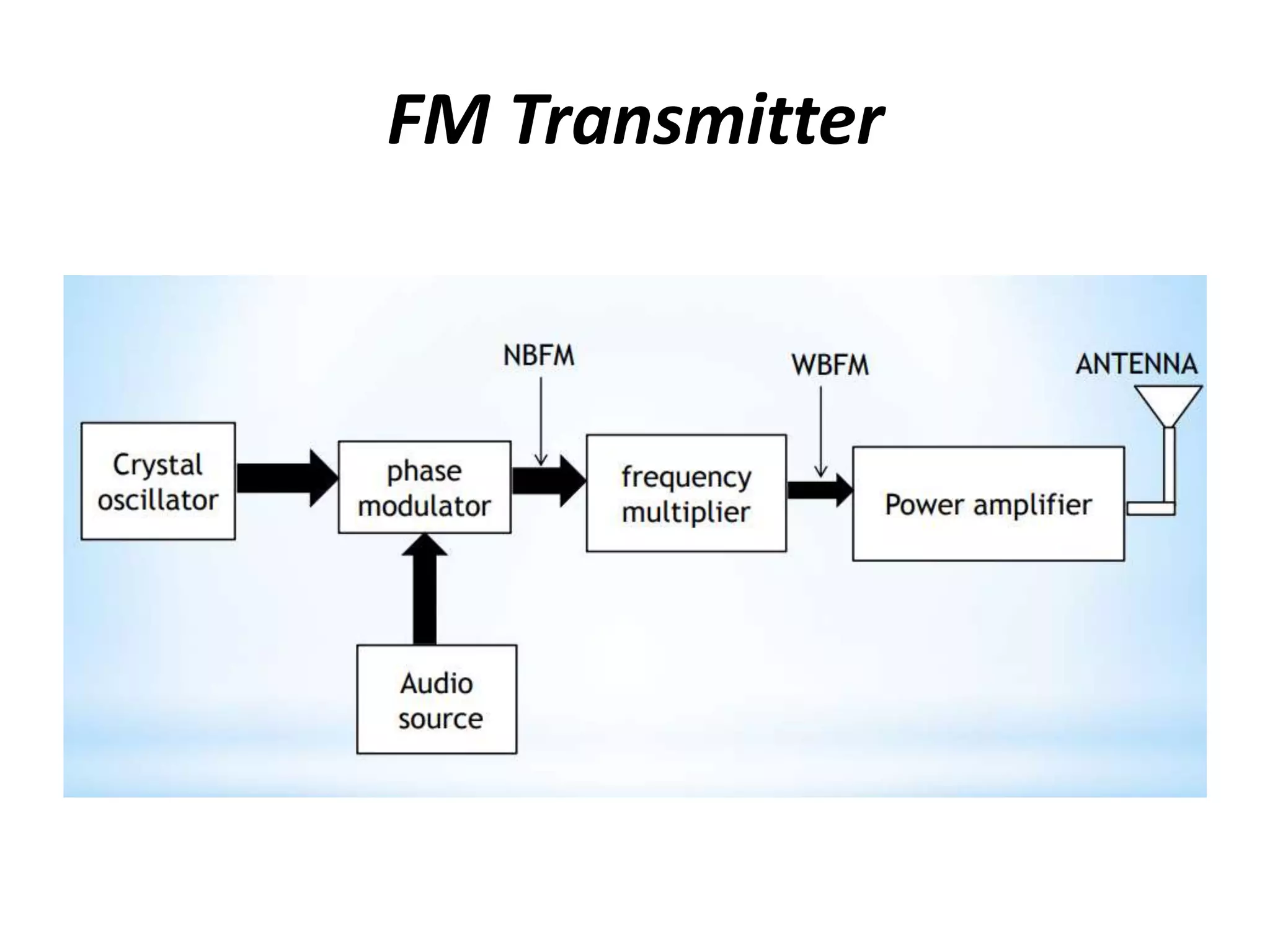
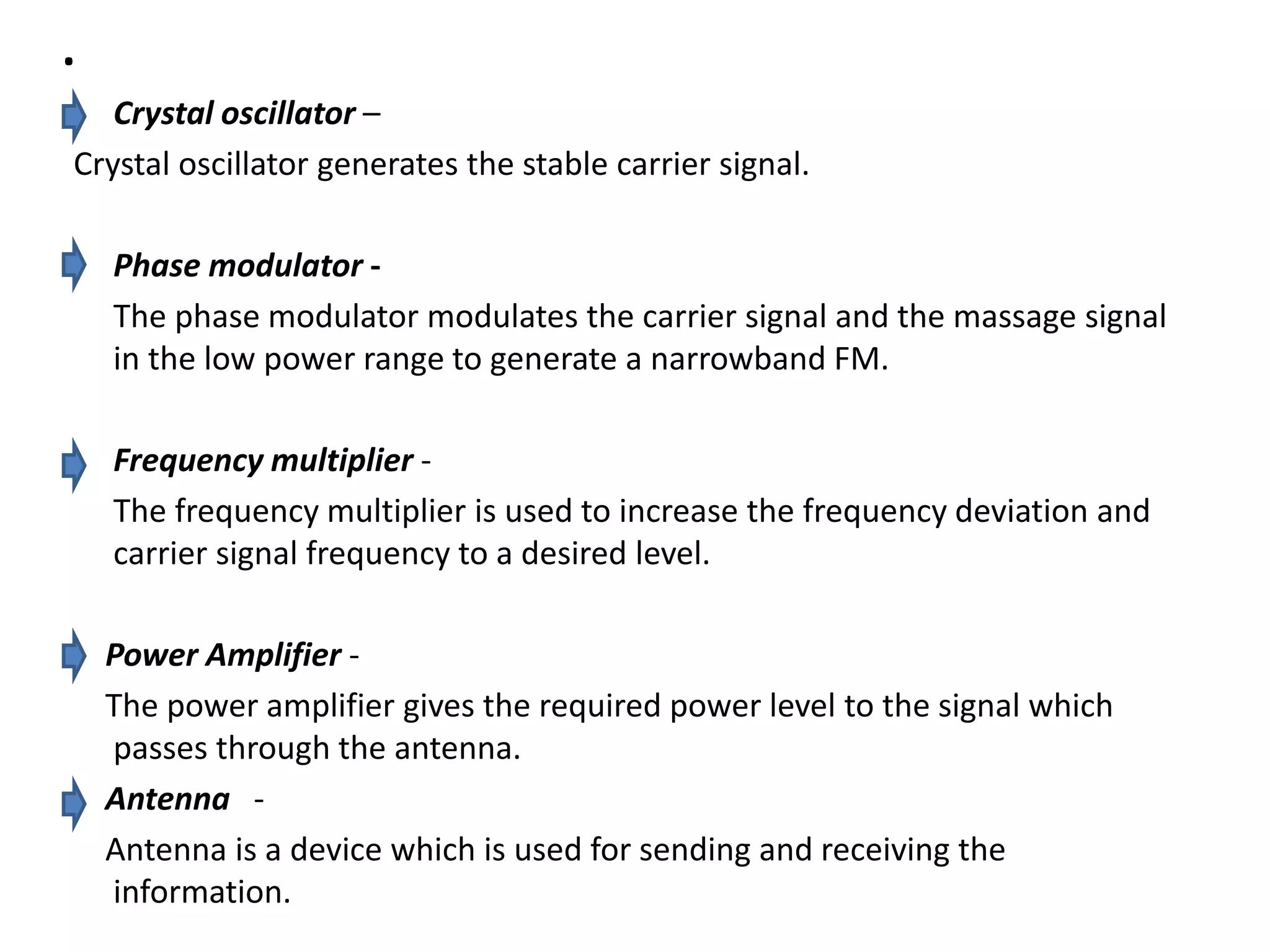
• Crystal oscillator–
Crystal oscillator generates the stable carrier signal.
• Phase modulator -
The phase modulator modulates the carrier signal and the massage signal
in the low power range to generate a narrowband FM.
Frequency multiplier -
The frequency multiplier is used to increase the frequency deviation and
carrier signal frequency to a desired level.
Power Amplifier -
The power amplifier gives the required power level to the signal which
passes through the antenna.
Antenna -
Antenna is a device which is used for sending and receiving the
information.
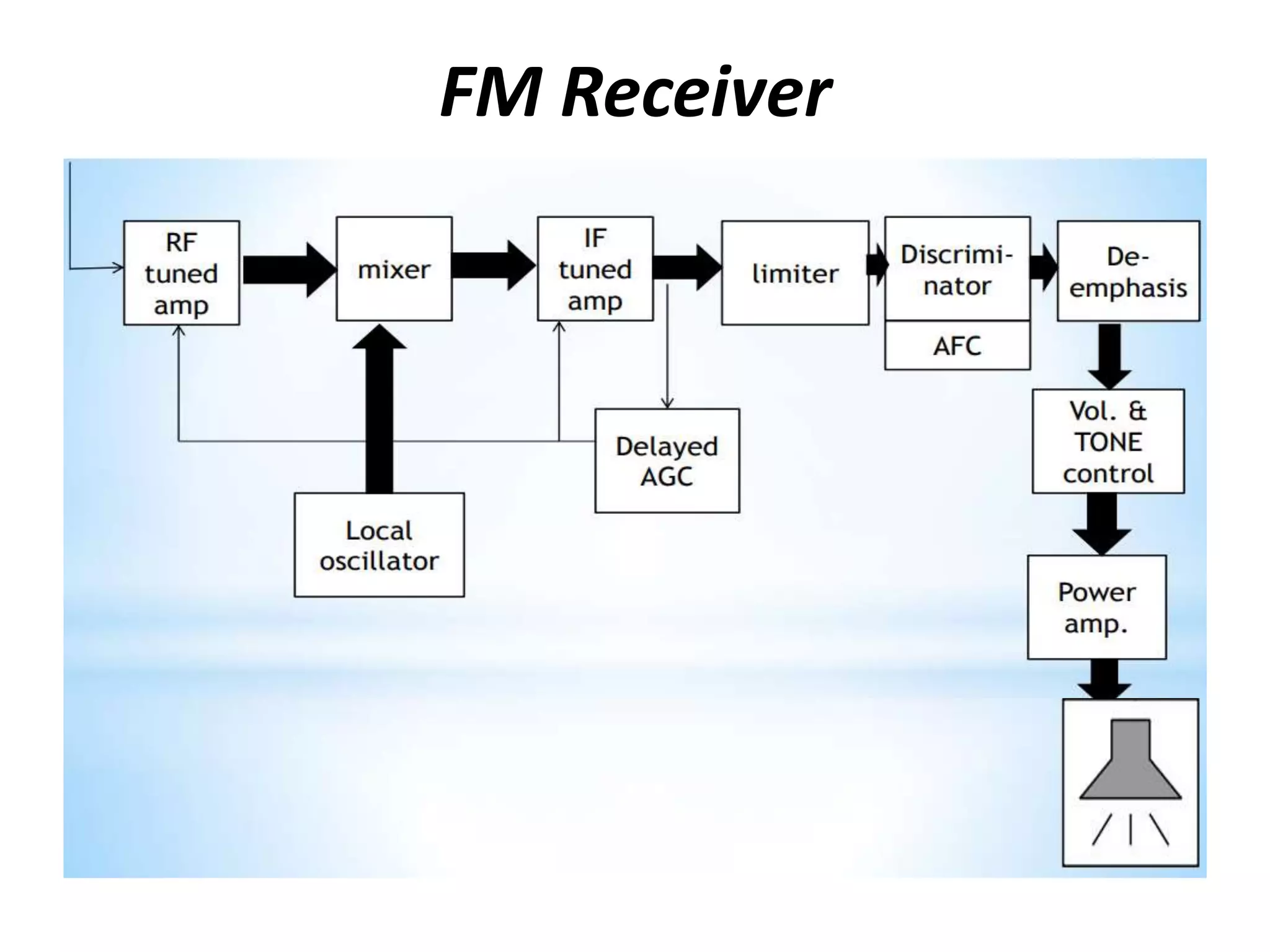
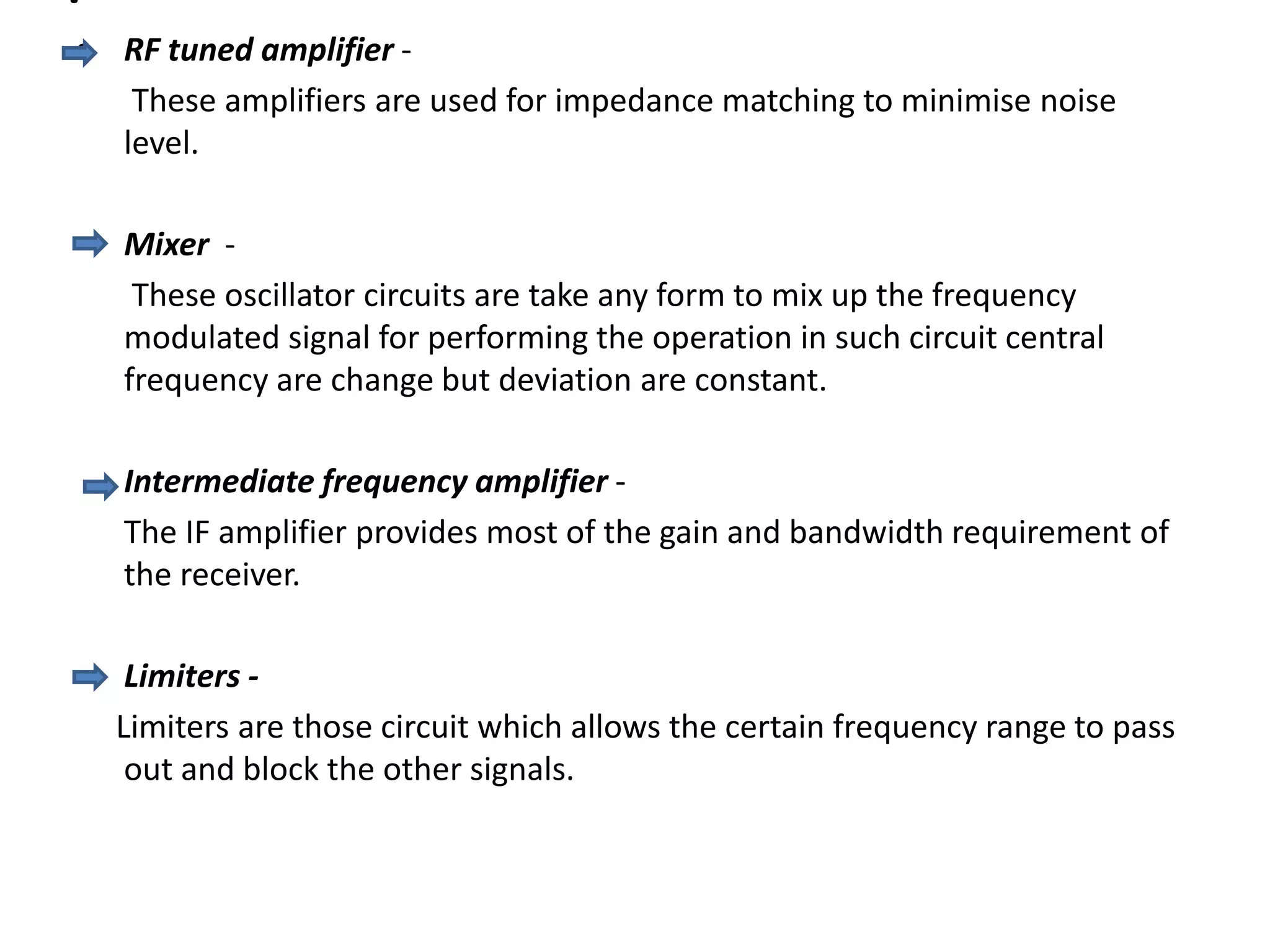
• RF tunedamplifier -
These amplifiers are used for impedance matching to minimise noise
level.
Mixer -
These oscillator circuits are take any form to mix up the frequency
modulated signal for performing the operation in such circuit central
frequency are change but deviation are constant.
Intermediate frequency amplifier -
The IF amplifier provides most of the gain and bandwidth requirement of
the receiver.
Limiters -
Limiters are those circuit which allows the certain frequency range to pass
out and block the other signals.
12.
.
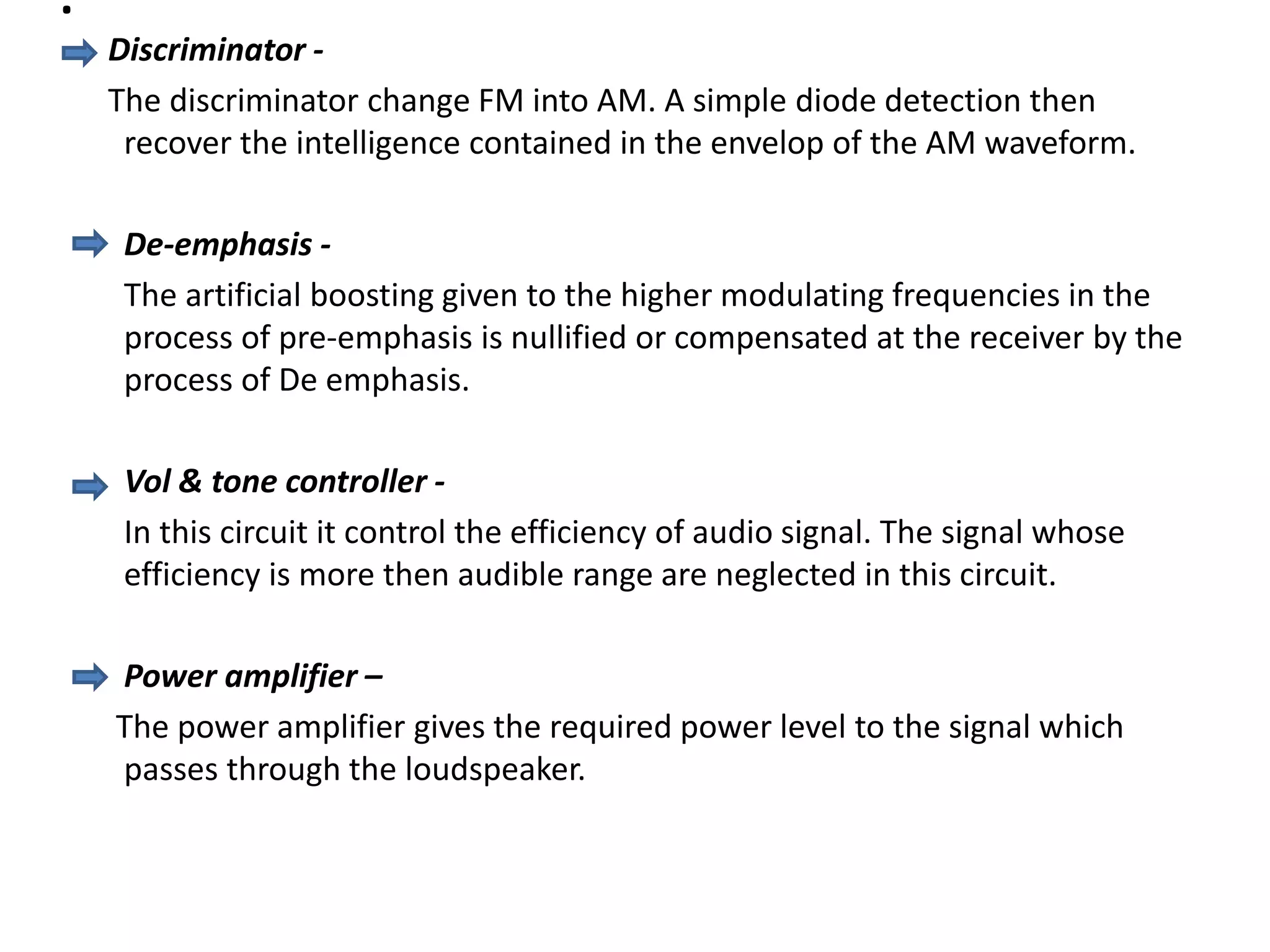
Discriminator -
The discriminatorchange FM into AM. A simple diode detection then
recover the intelligence contained in the envelop of the AM waveform.
De-emphasis -
The artificial boosting given to the higher modulating frequencies in the
process of pre-emphasis is nullified or compensated at the receiver by the
process of De emphasis.
Vol & tone controller -
In this circuit it control the efficiency of audio signal. The signal whose
efficiency is more then audible range are neglected in this circuit.
Power amplifier –
The power amplifier gives the required power level to the signal which
passes through the loudspeaker.
13.
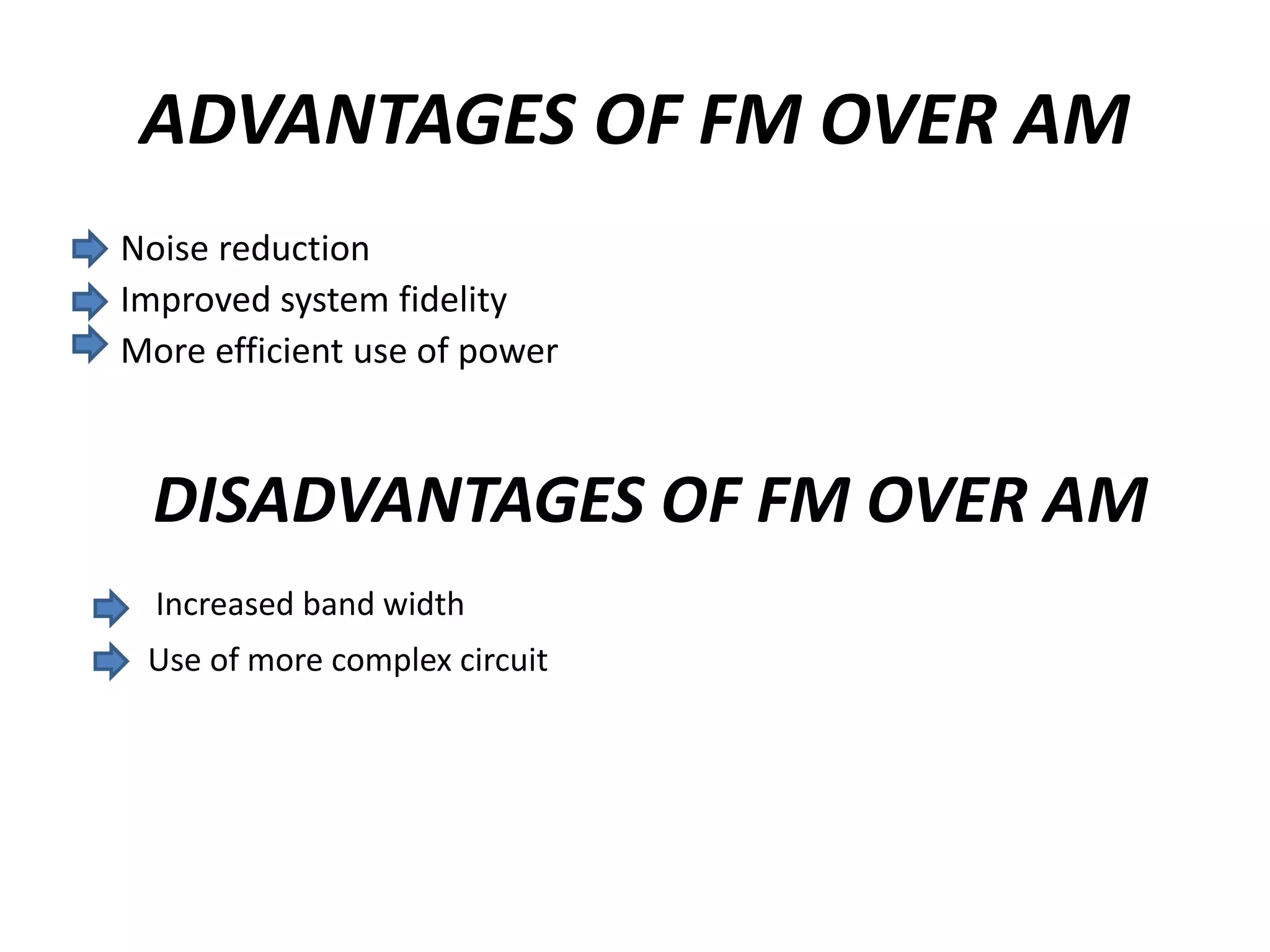
ADVANTAGES OF FMOVER AM
Noise reduction
Improved system fidelity
More efficient use of power
DISADVANTAGES OF FM OVER AM
Increased band width
Use of more complex circuit
.
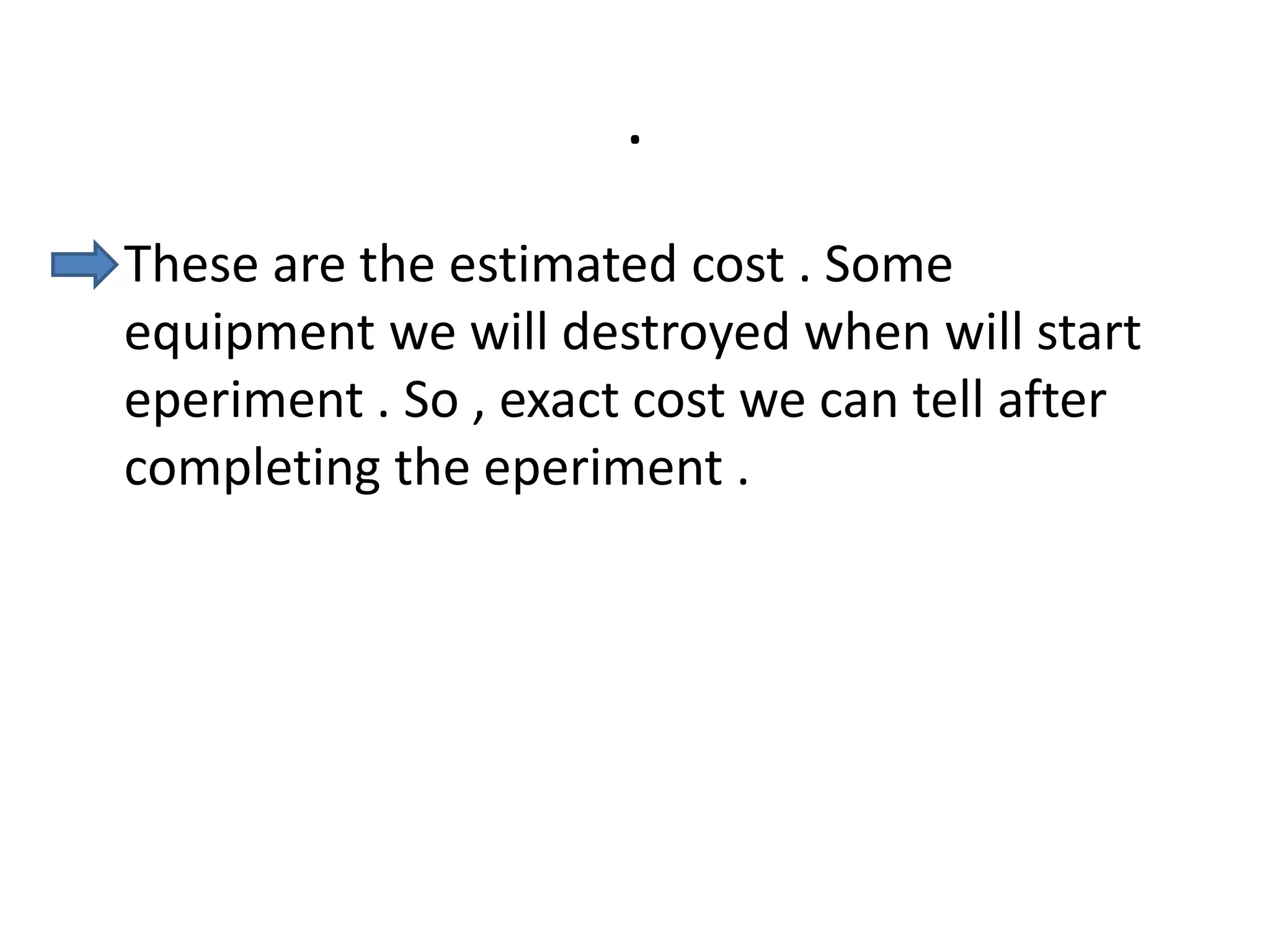
• These arethe estimated cost . Some
equipment we will destroyed when will start
eperiment . So , exact cost we can tell after
completing the eperiment .