Photodiode Working Principle,
Characteristics and
Applications
http://www.elprocus.com/
Photodiode Working Principle,
Characteristics and Applications
Introduction:
 A photodiode is a PN-junction diode that consumes light energy to
produce electric current. Sometimes it is also called as photo-detector, a light
detector, and photo-sensor. These diodes are particularly designed to work in
reverse bias condition, it means that the P-side of the photodiode is
associated with the negative terminal of the battery and n-side is connected
to the positive terminal of the battery.
http://www.elprocus.com/
Photodiode Working Principle,
Characteristics and Applications
 A photodiode is one type of light detector, used to convert the light into
current or voltage based on the mode of operation of the device.
 It comprises of optical filters, built-in lenses and also surface areas.
 These diodes have a slow response time when the surface area of the
photodiode increases.
 Photodiodes are alike to regular semiconductor diodes.
What is a Photodiode
http://www.elprocus.com/
Photodiode Working Principle,
Characteristics and Applications
What is a Photodiode
 They may be either visible to let light reach the delicate part of the device.
 Several diodes intended for use exactly as a photodiode will also use a PIN
junction somewhat than the usual PN junction.
http://www.elprocus.com/
Photodiode Working Principle,
Characteristics and Applications
What is a Photodiode
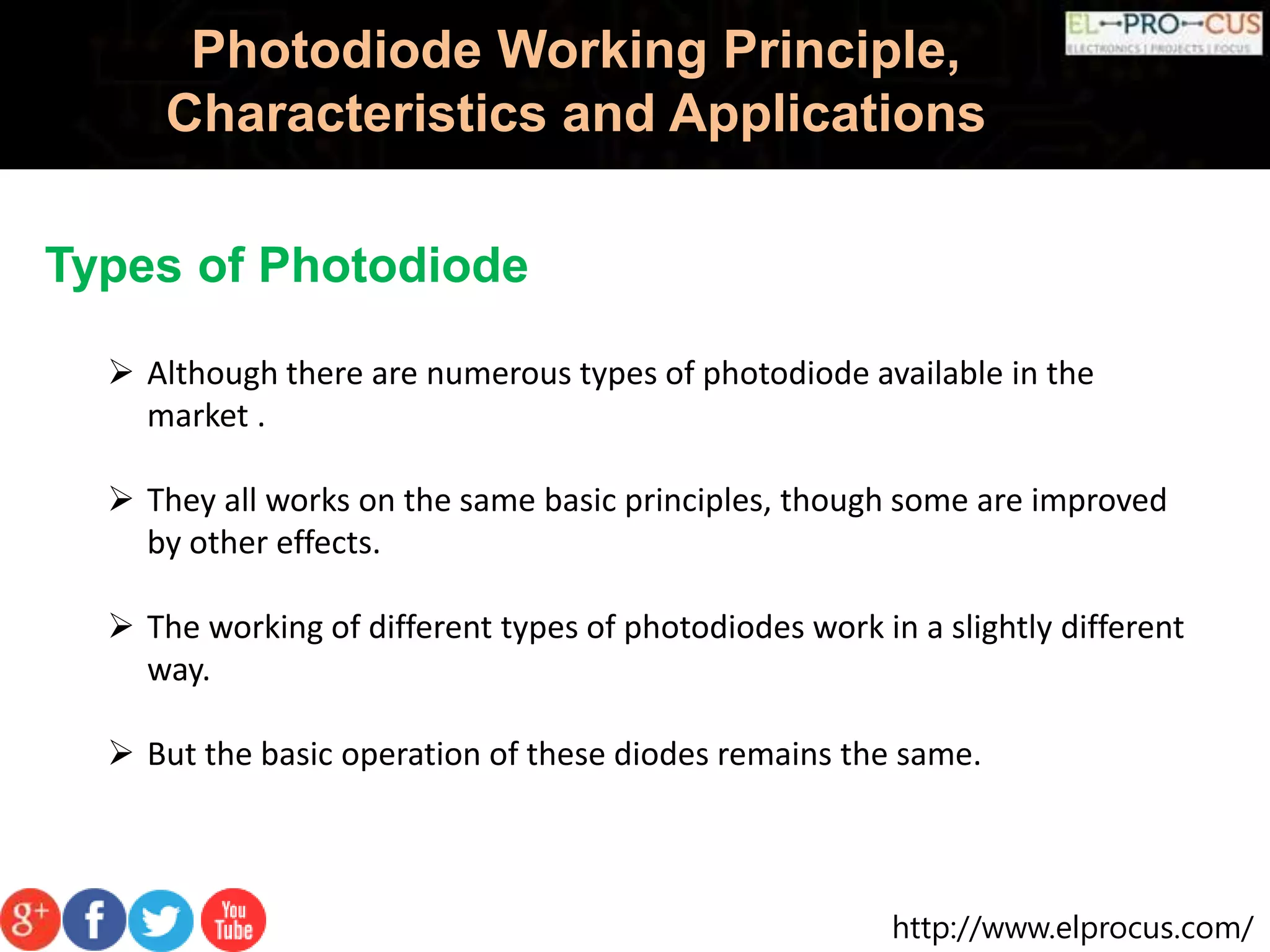
 Some photodiodes will look like a light emitting diode.
 They have two terminals coming from the end.
 The smaller end of the diode is the cathode terminal.
 While the longer end of the diode is the anode terminal.
http://www.elprocus.com/
Photodiode Working Principle,
Characteristics and Applications
What is a Photodiode
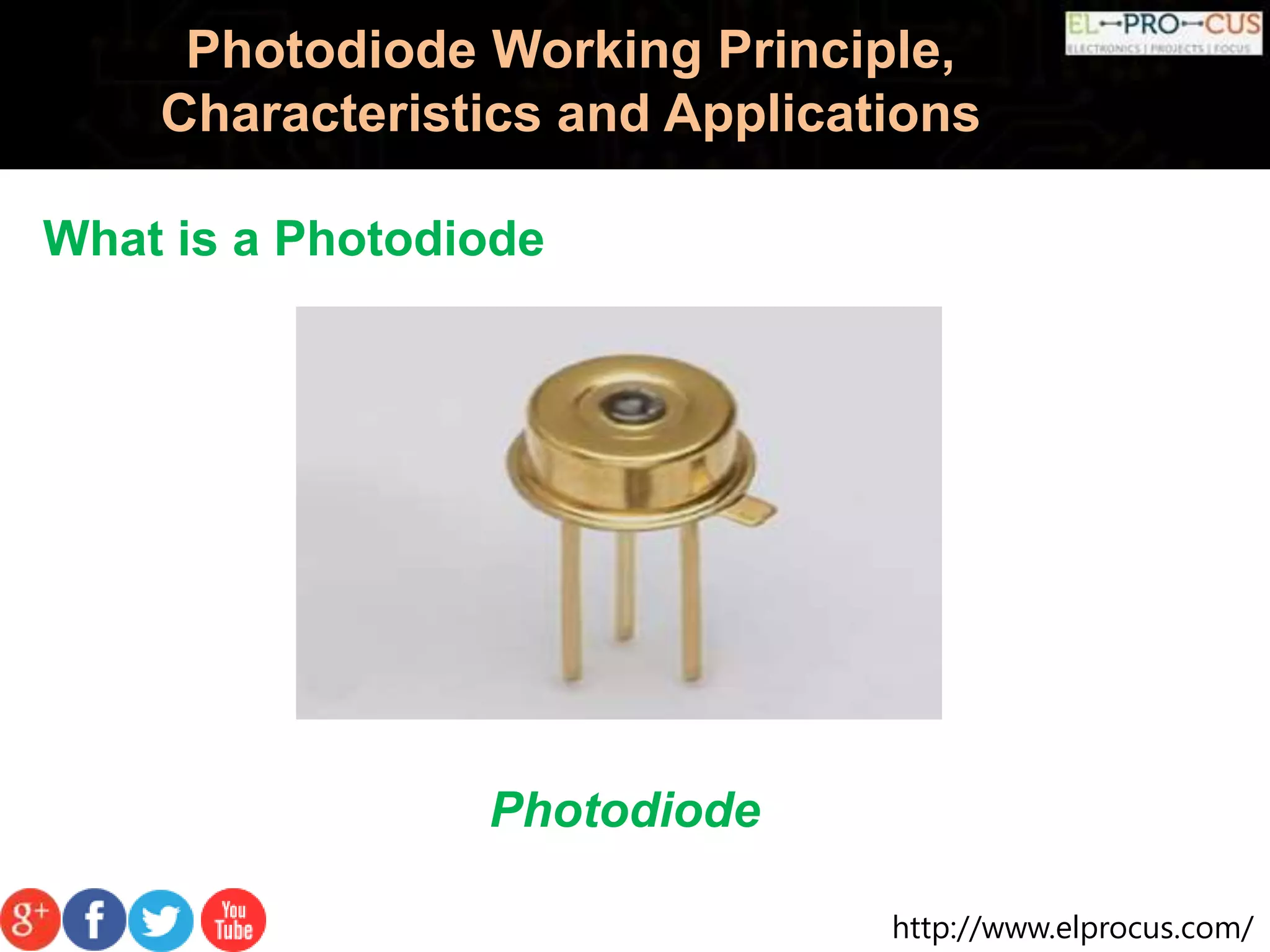
 See the following schematic diagram for the anode and cathode side.
Under forward bias condition, conventional current will flow from the
anode to the cathode, following the arrow in the diode symbol.
 Photocurrent flows in the reverse direction.
http://www.elprocus.com/
Photodiode Working Principle,
Characteristics and Applications
What is a Photodiode
Photodiode
http://www.elprocus.com/
Photodiode Working Principle,
Characteristics and Applications
Types of Photodiode
 Although there are numerous types of photodiode available in the
market .
 They all works on the same basic principles, though some are improved
by other effects.
 The working of different types of photodiodes work in a slightly different
way.
 But the basic operation of these diodes remains the same.
http://www.elprocus.com/
Photodiode Working Principle,
Characteristics and Applications
• PN Photodiode
• Schottky Photo Diode
• PIN Photodiode
• Avalanche Photodiode
Types of Photodiode
 The types of the photodiodes can be classified based on its construction
and functions as follows.
http://www.elprocus.com/
Photodiode Working Principle,
Characteristics and Applications
Types of Photodiode
 These diodes are widely used in different applications .
 where the detection of the presence of light, colour, position, intensity
is required.
http://www.elprocus.com/
Photodiode Working Principle,
Characteristics and Applications
Types of Photodiode
• The linearity of the diode is good with respect to incident light
• Noise is low.
• The response is wide spectral
• Rugged mechanically
• Light weight and compact
• Long life
 The main features of these diodes include the following.
http://www.elprocus.com/
Photodiode Working Principle,
Characteristics and Applications
 The required materials to make a photodiode and the range of
electromagnetic spectrum wavelength range includes the following
• For silicon material: The electromagnetic spectrum wavelength range
will be (190-1100) nm
• For Germanium material: The electromagnetic spectrum wavelength
range will be (400-1700) nm
• For Indium gallium arsenide material: The electromagnetic spectrum
wavelength range will be (800-2600) nm
Materials to Make a Photodiode
http://www.elprocus.com/
Photodiode Working Principle,
Characteristics and Applications
Materials to Make a Photodiode
• For Lead (II) sulfide material: The electromagnetic spectrum
wavelength range will be <1000-3500) nm
• For Mercury, cadmium Telluride material: The electromagnetic
spectrum wavelength range will be (400-14000) nm
 Because of their better band gap, Si-based photodiodes produce
lower noise than Ge-based photodiodes.
http://www.elprocus.com/
Photodiode Working Principle,
Characteristics and Applications
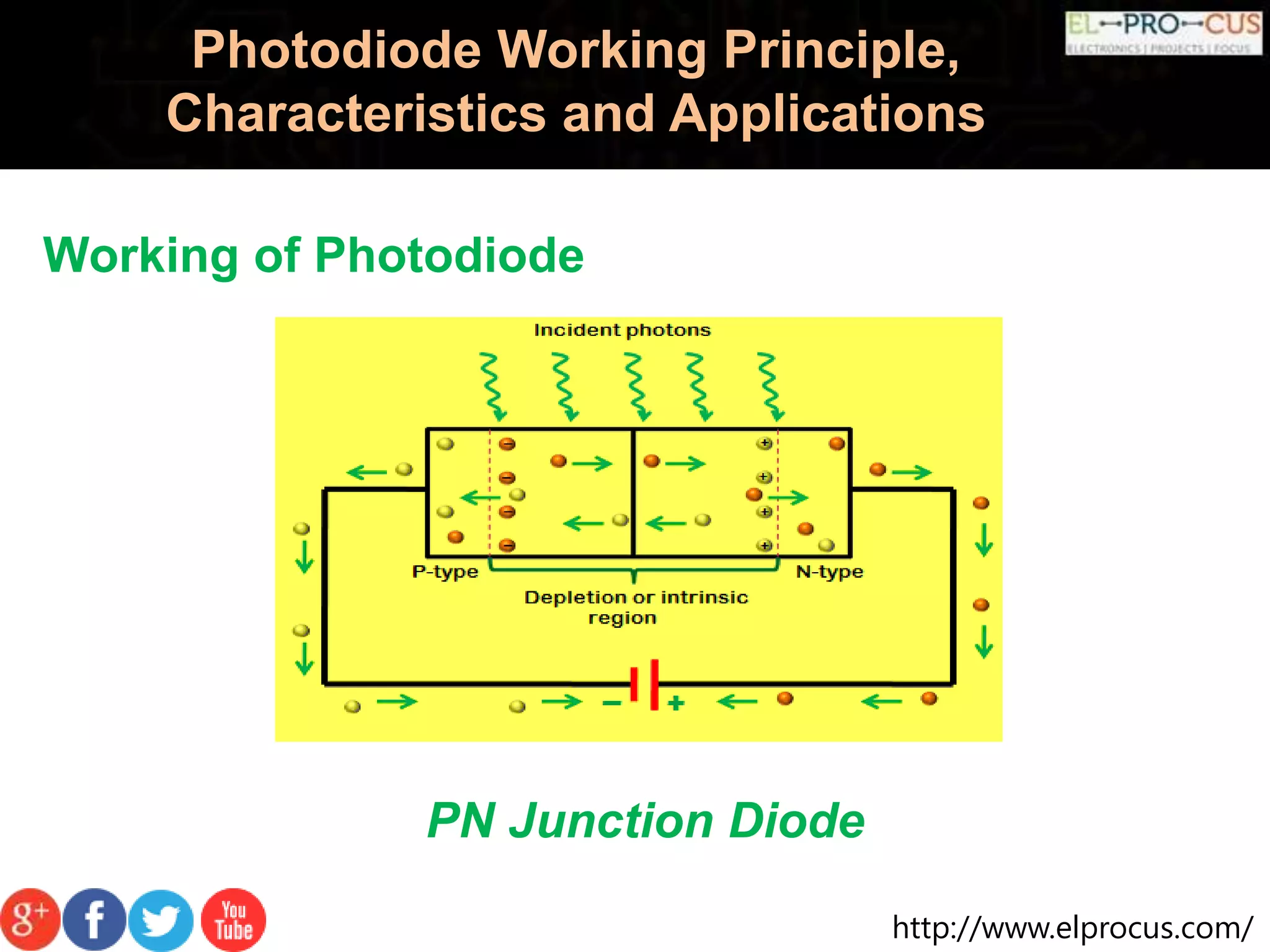
Working of Photodiode
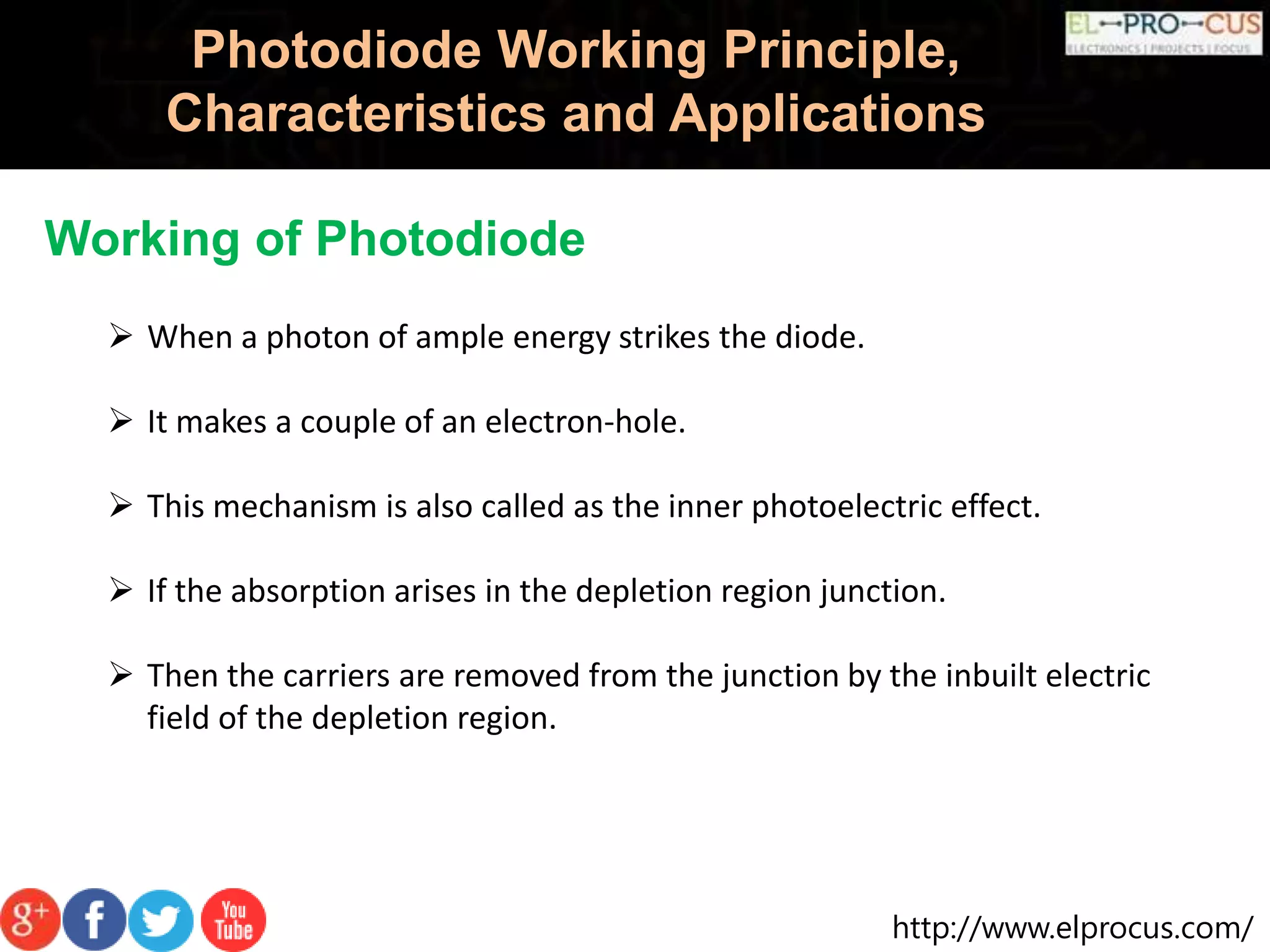
 When a photon of ample energy strikes the diode.
 It makes a couple of an electron-hole.
 This mechanism is also called as the inner photoelectric effect.
 If the absorption arises in the depletion region junction.
 Then the carriers are removed from the junction by the inbuilt electric
field of the depletion region.
http://www.elprocus.com/
Photodiode Working Principle,
Characteristics and Applications
Working of Photodiode
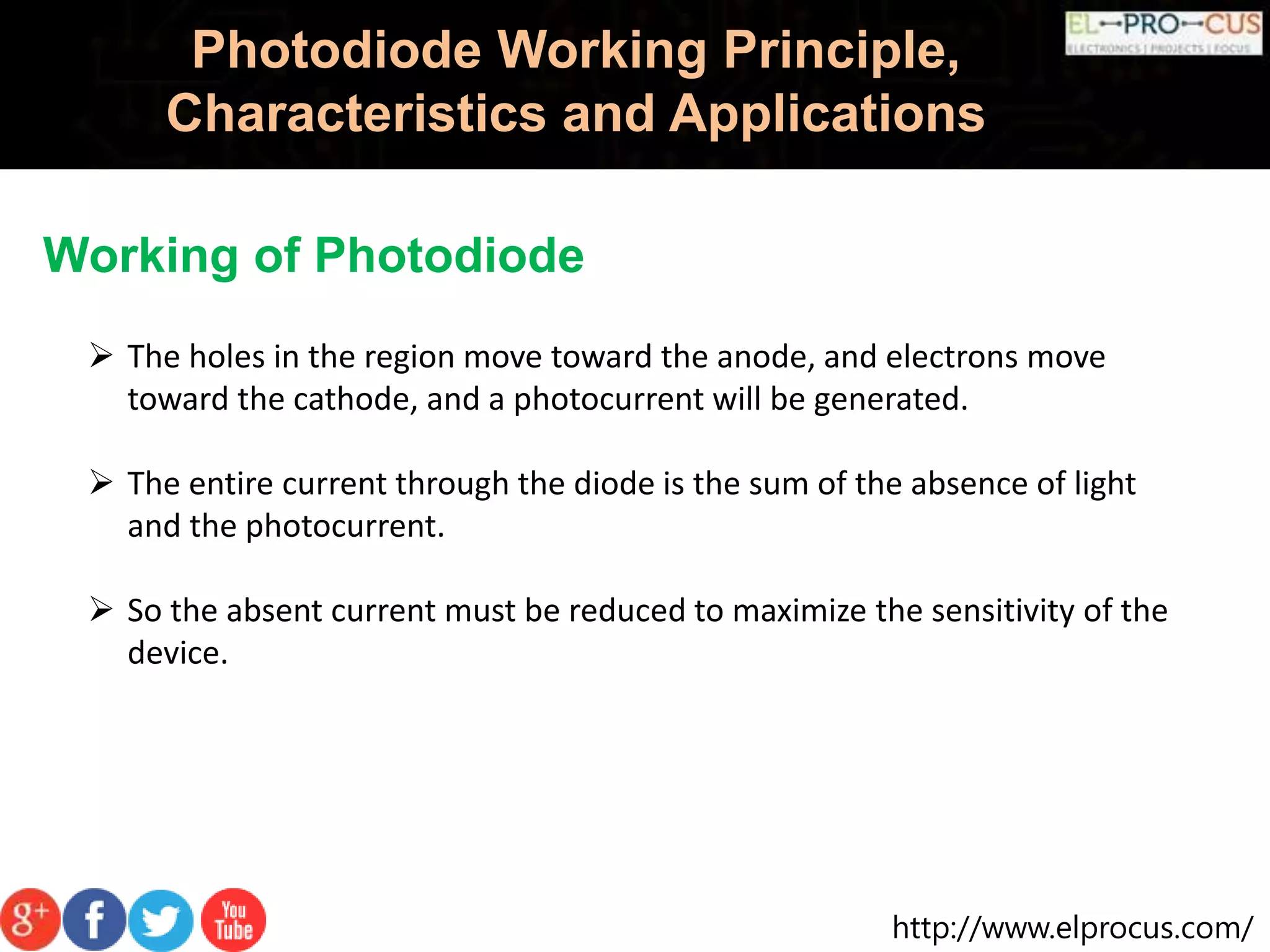
 The holes in the region move toward the anode, and electrons move
toward the cathode, and a photocurrent will be generated.
 The entire current through the diode is the sum of the absence of light
and the photocurrent.
 So the absent current must be reduced to maximize the sensitivity of the
device.
http://www.elprocus.com/
Photodiode Working Principle,
Characteristics and Applications
Working of Photodiode
PN Junction Diode
http://www.elprocus.com/
Photodiode Working Principle,
Characteristics and Applications
Modes of Operation
 The operating modes of the photodiode include three modes, namely
• Photovoltaic mode.
• Photoconductive mode.
• Avalanche diode mode.
http://www.elprocus.com/
Photodiode Working Principle,
Characteristics and Applications
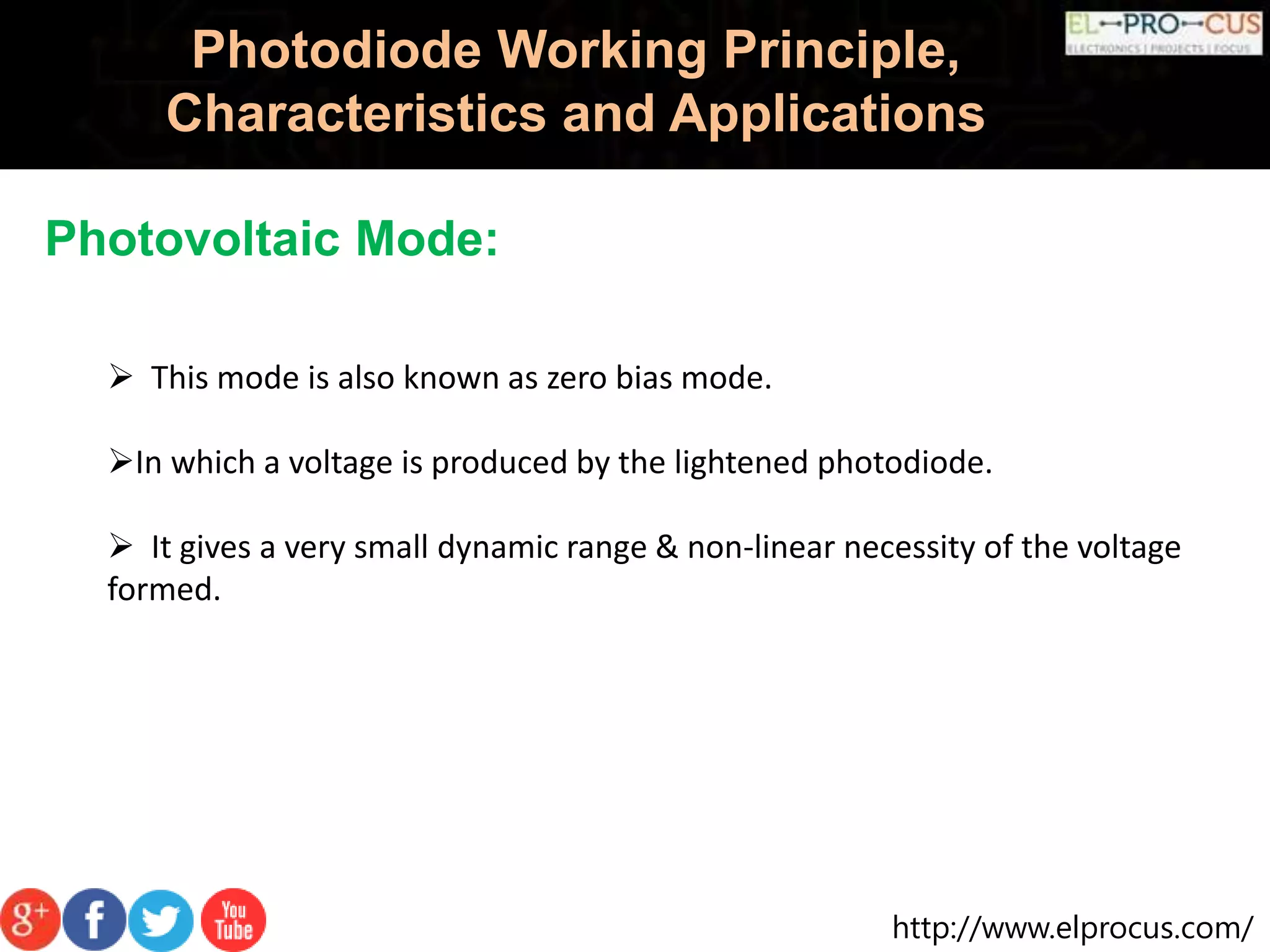
Photovoltaic Mode:
 This mode is also known as zero bias mode.
In which a voltage is produced by the lightened photodiode.
 It gives a very small dynamic range & non-linear necessity of the voltage
formed.
http://www.elprocus.com/
Photodiode Working Principle,
Characteristics and Applications
Photoconductive Mode
 The photodiode used in this photoconductive mode is more usually
reverse biased.
 The reverse voltage application will increase the depletion layer’s width.
 Which in turn decreases the response time & the junction capacitance.
 This mode is too fast and displays electronic noise.
http://www.elprocus.com/
Photodiode Working Principle,
Characteristics and Applications
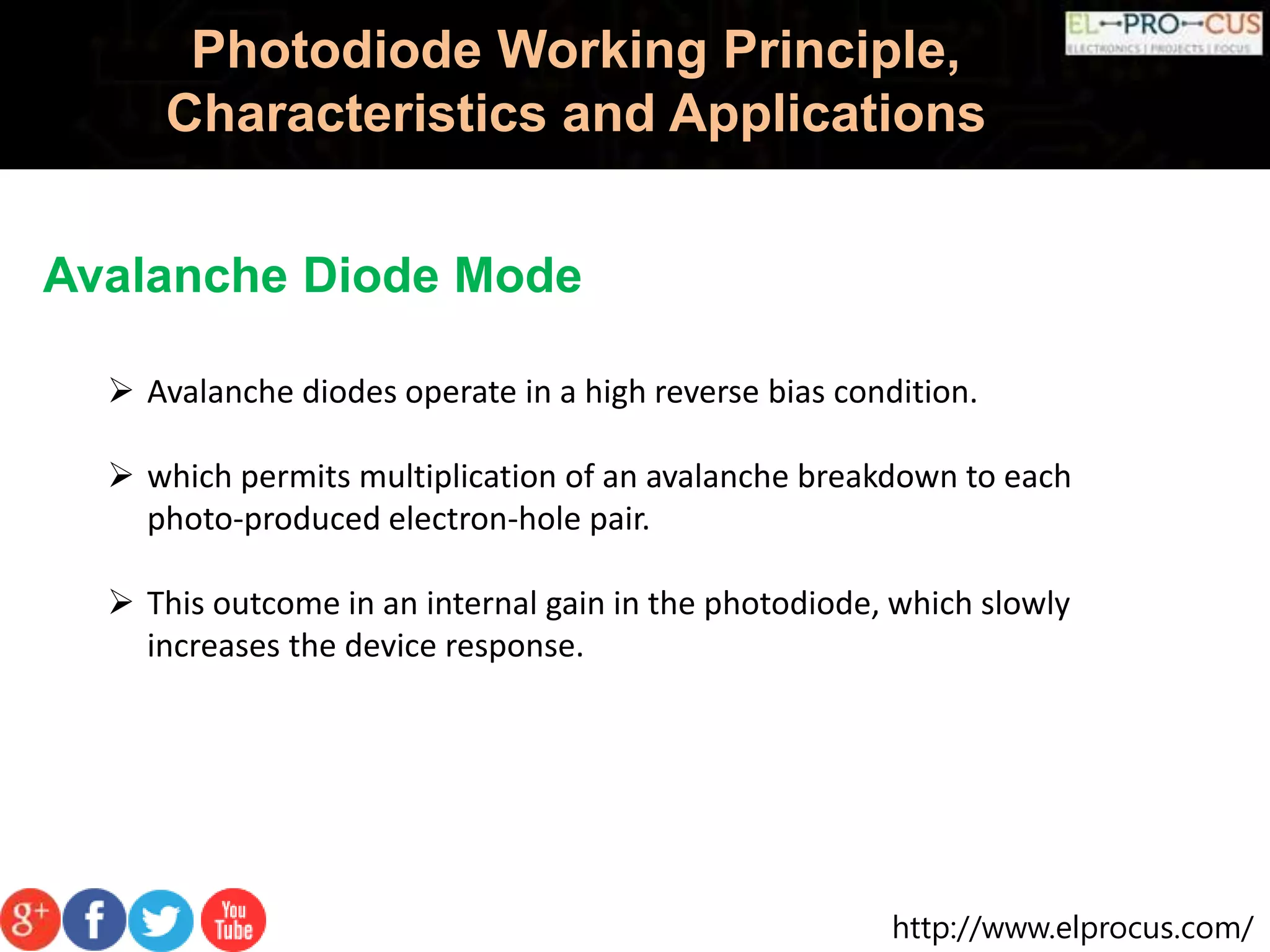
Avalanche Diode Mode
 Avalanche diodes operate in a high reverse bias condition.
 which permits multiplication of an avalanche breakdown to each
photo-produced electron-hole pair.
 This outcome in an internal gain in the photodiode, which slowly
increases the device response.
http://www.elprocus.com/
Photodiode Working Principle,
Characteristics and Applications
V-I Characteristics of Photodiode
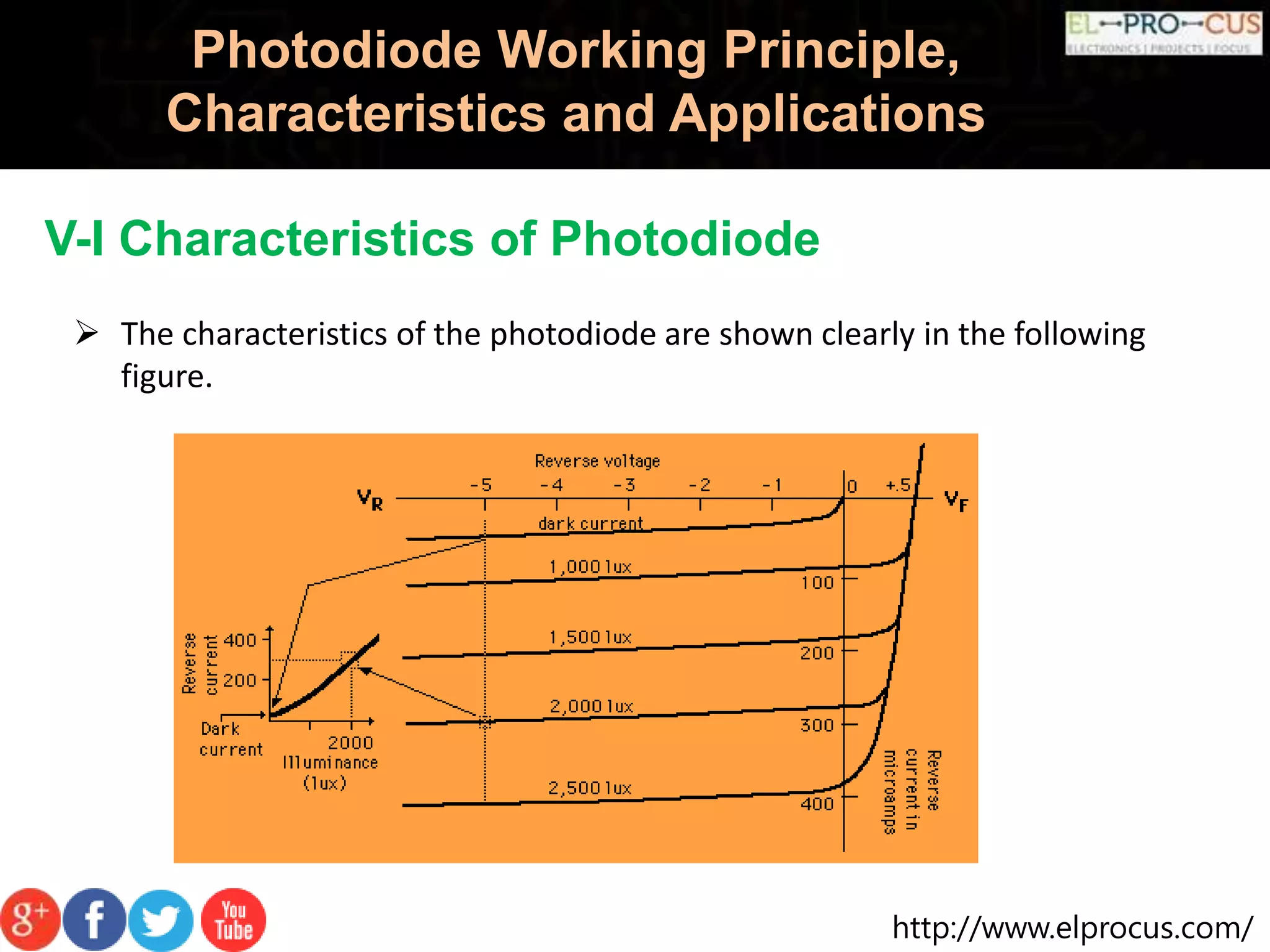
 A photodiode continually operates in a reverse bias mode.
 The photocurrent is nearly independent of reverse bias voltage which is
applied.
 For zero luminance, the photocurrent is almost zero excluding for small
dark current.
http://www.elprocus.com/
Photodiode Working Principle,
Characteristics and Applications
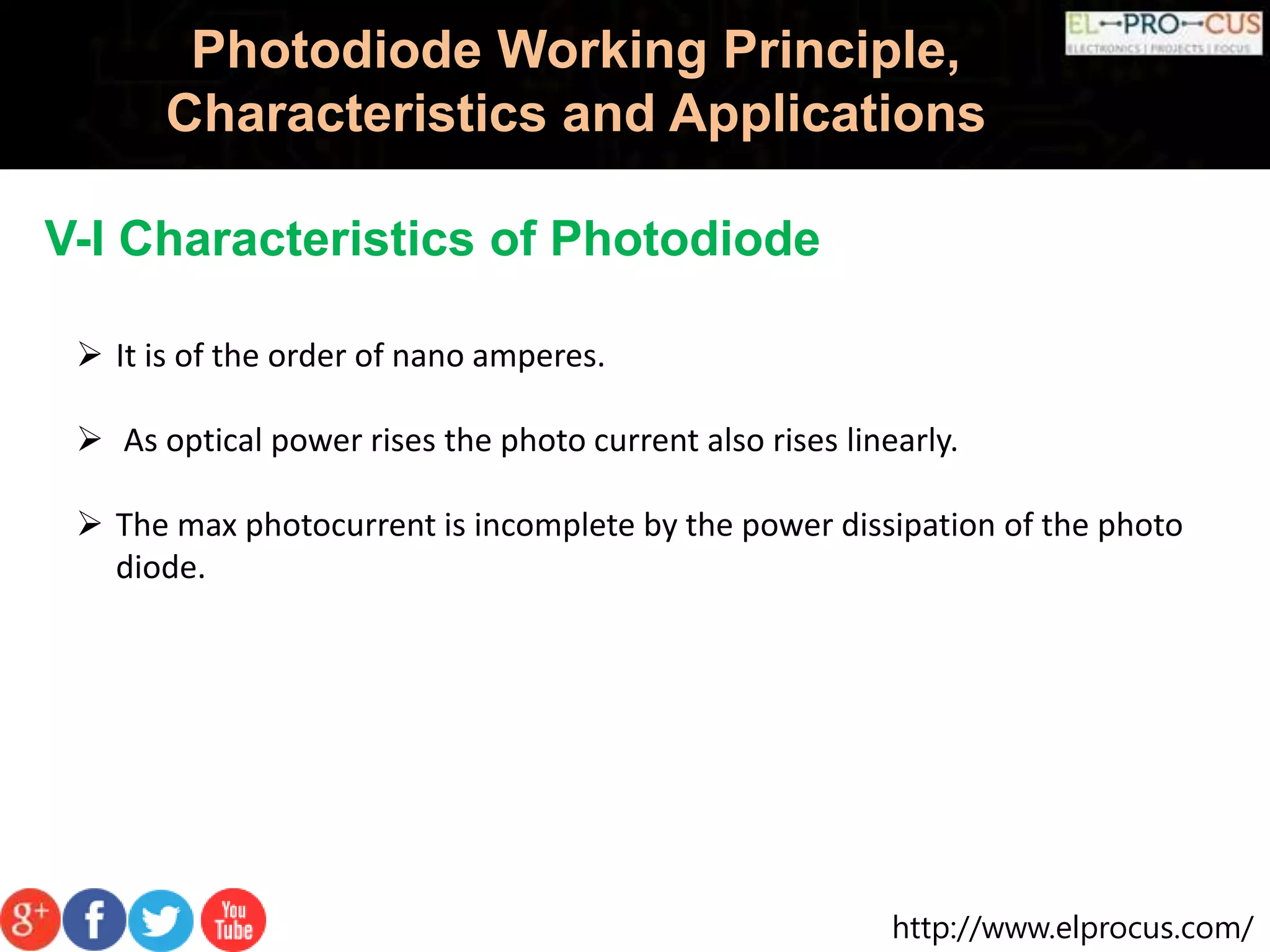
V-I Characteristics of Photodiode
 It is of the order of nano amperes.
 As optical power rises the photo current also rises linearly.
 The max photocurrent is incomplete by the power dissipation of the photo
diode.
http://www.elprocus.com/
Photodiode Working Principle,
Characteristics and Applications
V-I Characteristics of Photodiode
 The characteristics of the photodiode are shown clearly in the following
figure.
http://www.elprocus.com/
Photodiode Working Principle,
Characteristics and Applications
Applications of Photodiode
 The applications of photodiodes involve in similar applications of
photodetectors like charge-coupled devices, photoconductors, and
photomultiplier tubes.
 These diodes are used in consumer electronics devices like smoke
detectors, compact disc players, televisions and remote controls in VCRs.
 It uses in consumer devices like clock radios, camera light meters, and
street lights.
http://www.elprocus.com/
Photodiode Working Principle,
Characteristics and Applications
Applications of Photodiode
 Photoconductors are more frequently used rather than photodiodes.
 Photodiodes are frequently used for exact measurement of the intensity
of light in science & industry.
 Generally, they have an enhanced, more linear response than
photoconductors.
http://www.elprocus.com/
Photodiode Working Principle,
Characteristics and Applications
Applications of Photodiode
 Photodiodes are also widely used in numerous medical applications like
instruments to analyze samples, detectors for computed tomography and
also used in blood gas monitors.
 These diodes are much faster & more complex than normal PN junction
diodes.
 It is frequently used for lighting regulation and in optical communications.
http://www.elprocus.com/
Photodiode Working Principle,
Characteristics and Applications
 A photodiode is a kind of light detector, which involves the
conversion of light into voltage or current, based on the mode
of operation of the device. A photodiode is a semi-conductor device,
with a p-n junction and an intrinsic layer between p and n layers.
Conclusion
http://www.elprocus.com/

Photodiode working principle characteristics and applications

  • 1.
  • 2.
    http://www.elprocus.com/ Photodiode Working Principle, Characteristicsand Applications Introduction:  A photodiode is a PN-junction diode that consumes light energy to produce electric current. Sometimes it is also called as photo-detector, a light detector, and photo-sensor. These diodes are particularly designed to work in reverse bias condition, it means that the P-side of the photodiode is associated with the negative terminal of the battery and n-side is connected to the positive terminal of the battery.
  • 3.
    http://www.elprocus.com/ Photodiode Working Principle, Characteristicsand Applications  A photodiode is one type of light detector, used to convert the light into current or voltage based on the mode of operation of the device.  It comprises of optical filters, built-in lenses and also surface areas.  These diodes have a slow response time when the surface area of the photodiode increases.  Photodiodes are alike to regular semiconductor diodes. What is a Photodiode
  • 4.
    http://www.elprocus.com/ Photodiode Working Principle, Characteristicsand Applications What is a Photodiode  They may be either visible to let light reach the delicate part of the device.  Several diodes intended for use exactly as a photodiode will also use a PIN junction somewhat than the usual PN junction.
  • 5.
    http://www.elprocus.com/ Photodiode Working Principle, Characteristicsand Applications What is a Photodiode  Some photodiodes will look like a light emitting diode.  They have two terminals coming from the end.  The smaller end of the diode is the cathode terminal.  While the longer end of the diode is the anode terminal.
  • 6.
    http://www.elprocus.com/ Photodiode Working Principle, Characteristicsand Applications What is a Photodiode  See the following schematic diagram for the anode and cathode side. Under forward bias condition, conventional current will flow from the anode to the cathode, following the arrow in the diode symbol.  Photocurrent flows in the reverse direction.
  • 7.
    http://www.elprocus.com/ Photodiode Working Principle, Characteristicsand Applications What is a Photodiode Photodiode
  • 8.
    http://www.elprocus.com/ Photodiode Working Principle, Characteristicsand Applications Types of Photodiode  Although there are numerous types of photodiode available in the market .  They all works on the same basic principles, though some are improved by other effects.  The working of different types of photodiodes work in a slightly different way.  But the basic operation of these diodes remains the same.
  • 9.
    http://www.elprocus.com/ Photodiode Working Principle, Characteristicsand Applications • PN Photodiode • Schottky Photo Diode • PIN Photodiode • Avalanche Photodiode Types of Photodiode  The types of the photodiodes can be classified based on its construction and functions as follows.
  • 10.
    http://www.elprocus.com/ Photodiode Working Principle, Characteristicsand Applications Types of Photodiode  These diodes are widely used in different applications .  where the detection of the presence of light, colour, position, intensity is required.
  • 11.
    http://www.elprocus.com/ Photodiode Working Principle, Characteristicsand Applications Types of Photodiode • The linearity of the diode is good with respect to incident light • Noise is low. • The response is wide spectral • Rugged mechanically • Light weight and compact • Long life  The main features of these diodes include the following.
  • 12.
    http://www.elprocus.com/ Photodiode Working Principle, Characteristicsand Applications  The required materials to make a photodiode and the range of electromagnetic spectrum wavelength range includes the following • For silicon material: The electromagnetic spectrum wavelength range will be (190-1100) nm • For Germanium material: The electromagnetic spectrum wavelength range will be (400-1700) nm • For Indium gallium arsenide material: The electromagnetic spectrum wavelength range will be (800-2600) nm Materials to Make a Photodiode
  • 13.
    http://www.elprocus.com/ Photodiode Working Principle, Characteristicsand Applications Materials to Make a Photodiode • For Lead (II) sulfide material: The electromagnetic spectrum wavelength range will be <1000-3500) nm • For Mercury, cadmium Telluride material: The electromagnetic spectrum wavelength range will be (400-14000) nm  Because of their better band gap, Si-based photodiodes produce lower noise than Ge-based photodiodes.
  • 14.
    http://www.elprocus.com/ Photodiode Working Principle, Characteristicsand Applications Working of Photodiode  When a photon of ample energy strikes the diode.  It makes a couple of an electron-hole.  This mechanism is also called as the inner photoelectric effect.  If the absorption arises in the depletion region junction.  Then the carriers are removed from the junction by the inbuilt electric field of the depletion region.
  • 15.
    http://www.elprocus.com/ Photodiode Working Principle, Characteristicsand Applications Working of Photodiode  The holes in the region move toward the anode, and electrons move toward the cathode, and a photocurrent will be generated.  The entire current through the diode is the sum of the absence of light and the photocurrent.  So the absent current must be reduced to maximize the sensitivity of the device.
  • 16.
    http://www.elprocus.com/ Photodiode Working Principle, Characteristicsand Applications Working of Photodiode PN Junction Diode
  • 17.
    http://www.elprocus.com/ Photodiode Working Principle, Characteristicsand Applications Modes of Operation  The operating modes of the photodiode include three modes, namely • Photovoltaic mode. • Photoconductive mode. • Avalanche diode mode.
  • 18.
    http://www.elprocus.com/ Photodiode Working Principle, Characteristicsand Applications Photovoltaic Mode:  This mode is also known as zero bias mode. In which a voltage is produced by the lightened photodiode.  It gives a very small dynamic range & non-linear necessity of the voltage formed.
  • 19.
    http://www.elprocus.com/ Photodiode Working Principle, Characteristicsand Applications Photoconductive Mode  The photodiode used in this photoconductive mode is more usually reverse biased.  The reverse voltage application will increase the depletion layer’s width.  Which in turn decreases the response time & the junction capacitance.  This mode is too fast and displays electronic noise.
  • 20.
    http://www.elprocus.com/ Photodiode Working Principle, Characteristicsand Applications Avalanche Diode Mode  Avalanche diodes operate in a high reverse bias condition.  which permits multiplication of an avalanche breakdown to each photo-produced electron-hole pair.  This outcome in an internal gain in the photodiode, which slowly increases the device response.
  • 21.
    http://www.elprocus.com/ Photodiode Working Principle, Characteristicsand Applications V-I Characteristics of Photodiode  A photodiode continually operates in a reverse bias mode.  The photocurrent is nearly independent of reverse bias voltage which is applied.  For zero luminance, the photocurrent is almost zero excluding for small dark current.
  • 22.
    http://www.elprocus.com/ Photodiode Working Principle, Characteristicsand Applications V-I Characteristics of Photodiode  It is of the order of nano amperes.  As optical power rises the photo current also rises linearly.  The max photocurrent is incomplete by the power dissipation of the photo diode.
  • 23.
    http://www.elprocus.com/ Photodiode Working Principle, Characteristicsand Applications V-I Characteristics of Photodiode  The characteristics of the photodiode are shown clearly in the following figure.
  • 24.
    http://www.elprocus.com/ Photodiode Working Principle, Characteristicsand Applications Applications of Photodiode  The applications of photodiodes involve in similar applications of photodetectors like charge-coupled devices, photoconductors, and photomultiplier tubes.  These diodes are used in consumer electronics devices like smoke detectors, compact disc players, televisions and remote controls in VCRs.  It uses in consumer devices like clock radios, camera light meters, and street lights.
  • 25.
    http://www.elprocus.com/ Photodiode Working Principle, Characteristicsand Applications Applications of Photodiode  Photoconductors are more frequently used rather than photodiodes.  Photodiodes are frequently used for exact measurement of the intensity of light in science & industry.  Generally, they have an enhanced, more linear response than photoconductors.
  • 26.
    http://www.elprocus.com/ Photodiode Working Principle, Characteristicsand Applications Applications of Photodiode  Photodiodes are also widely used in numerous medical applications like instruments to analyze samples, detectors for computed tomography and also used in blood gas monitors.  These diodes are much faster & more complex than normal PN junction diodes.  It is frequently used for lighting regulation and in optical communications.
  • 27.
    http://www.elprocus.com/ Photodiode Working Principle, Characteristicsand Applications  A photodiode is a kind of light detector, which involves the conversion of light into voltage or current, based on the mode of operation of the device. A photodiode is a semi-conductor device, with a p-n junction and an intrinsic layer between p and n layers. Conclusion
  • 28.