CUÑADO, Jeaneth T.
GEQUINTO, Leah Jane P.
MANGARING, Meleria S.
cgmarts@ee12
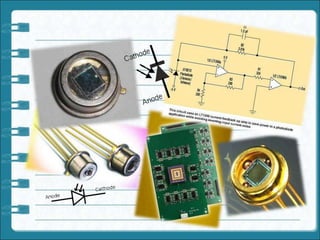
PHOTODIODE
A photodiode is a type of photodetector capable of converting light into
either current or voltage, depending upon the mode of operation. The
common, traditional solar cell used to generate electric solar power is a
large areaphotodiode.
OPERATION
• A photodiode is designed to operate
in reverse bias.
• Photoelectric effect.
• Photocurrent.
HISTORY & THEORY
• Photodiode technology developments came out of
the basic developments of the PN junction diode
that started in the 1940s in earnest. Applications
for the use of the PN junction diode were found
outside the basic use of rectifying signals.
• Photodiode technology was refined in the 1950s
and in the latter part of that decade the PIN
photodiode was developed. Light absorption in the
wide depletion area of the PIN structure was first
investigated in a paper published in 1959 by
Gartner. Although silicon has been the favoured
material for photodiodes, germanium can also be
used, and its use was first demonstrated in 1962
MATERIALS
STRUCTURE
TYPES
1.PINphotodiode
2.PNphotodiode
3.Avalanche photodiode
4.Schottky photodiode
ADVANTAGES &
DISADVANTAGES
+ Advantages for the
Photodiode detector are high
NIR sensitivity and high speed.
- Disadvantages are limited
amount of pixels and no UV
response.
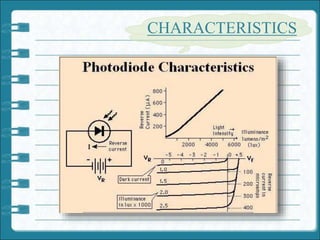
CHARACTERISTICS
Photodiodes are similar to
regular semiconductor diodes except that they
may be either exposed (to detect vacuum
UV or X-rays) or packaged with a window
or optical fiber connection to allow light to reach
the sensitive part of the device. Many diodes
designed for use specifically as a photodiode use
a PIN junction rather than a p-n junction, to
increase the speed of response.
CHARACTERISTICS
SIGNIFICANCE
• In most cases, the photodiode is used to deliver
a trigger signal to an electrical device when it is
either exposed to a UV ray or X-ray. It may also
be used to deliver the same trigger signal when
the light source is either turned off or
the photodiode is blocked from the light source.
• A function that a photodiode can perform is to
keep an electrical device operating through the
process of converting light into a power signal or
voltage.
• Photovoltaic mode and photoconductive mode
are naturally occurring reactions to the light
APPLICATIONS
• P-N photodiodes are used in similar applications
to other photodetectors, such
as photoconductors, charge-coupled devices,
and photomultiplier tubes. They may be used to
generate an output which is dependent upon the
illumination (analog; for measurement and the
like), or to change the state of circuitry (digital;
either for control and switching, or digital signal
processing)..
• Photodiodes are used in consumer
electronics devices such as compact
disc players, smoke detectors, and the
many applications either photodiodes or photoconductors may
be used. Either type of photosensor may be used for light
measurement, as in camera light meters, or to respond to light
levels,asin switchingon streetlightingafterdark
• Photosensors of all types may be used to respond to incident
light, or to a source of light which is part of the same circuit or
system. A photodiode is often combined into a single
component with an emitter of light, usually a light-emitting
diode (LED), either to detect the presence of a mechanical
obstruction to the beam (slotted optical switch), or
to couple two digital or analog circuits while maintaining
extremely high electrical isolation between them, often for
APPLICATIONS
• Photodiodes are often used for accurate
measurement of light intensity in science and
industry. They generally have a more linear
response than photoconductors.
• They are also widely used in various medical
applications, such as detectors for computed
tomography (coupled with scintillators),
instruments to analyze samples (immunoassay),
and pulse oximeters.
• PIN diodes are much faster and more sensitive
than p-n junction diodes, and hence are often
used for optical communications and in lighting
APPLICATIONS
• P-N photodiodes are not used to measure extremely low light
intensities. Instead, if high sensitivity is needed, avalanche
photodiodes, intensified charge-coupled
devices or photomultiplier tubes are used for applications such
as astronomy, spectroscopy, night vision equipment and laser
rangefinding.
APPLICATIONS
EFFECTS
Photodiodes are basically reverse biased
diodes with optical windows that allow like to
shine on the PN junction. Like any diode, the
leakage current (otherwise known as a
photodiodes 'dark' current) increases
exponentially with temperature in accordance to
William Shockley's idea diode equation. This is
known as the quantum efficiency of the
photodiode. If the quantum efficiency of a
photodiode will increase with temperature, so as
well as the thermally induced noise.
(According to
temperature…)
BreakDown Voltage:
For small active area devices, by definition breakdown voltage is
defined as the voltage at which the dark current becomes 10 A. Since
dark current increases with temperature, therefore, breakdown
voltage decreases similarly with increase in temperature.
Photodiode & LED Discription

Photodiode & LED Discription

  • 1.
    CUÑADO, Jeaneth T. GEQUINTO,Leah Jane P. MANGARING, Meleria S. cgmarts@ee12
  • 2.
    PHOTODIODE A photodiode isa type of photodetector capable of converting light into either current or voltage, depending upon the mode of operation. The common, traditional solar cell used to generate electric solar power is a large areaphotodiode. OPERATION • A photodiode is designed to operate in reverse bias. • Photoelectric effect. • Photocurrent.
  • 3.
    HISTORY & THEORY •Photodiode technology developments came out of the basic developments of the PN junction diode that started in the 1940s in earnest. Applications for the use of the PN junction diode were found outside the basic use of rectifying signals. • Photodiode technology was refined in the 1950s and in the latter part of that decade the PIN photodiode was developed. Light absorption in the wide depletion area of the PIN structure was first investigated in a paper published in 1959 by Gartner. Although silicon has been the favoured material for photodiodes, germanium can also be used, and its use was first demonstrated in 1962
  • 4.
  • 5.
    TYPES 1.PINphotodiode 2.PNphotodiode 3.Avalanche photodiode 4.Schottky photodiode ADVANTAGES& DISADVANTAGES + Advantages for the Photodiode detector are high NIR sensitivity and high speed. - Disadvantages are limited amount of pixels and no UV response.
  • 6.
    CHARACTERISTICS Photodiodes are similarto regular semiconductor diodes except that they may be either exposed (to detect vacuum UV or X-rays) or packaged with a window or optical fiber connection to allow light to reach the sensitive part of the device. Many diodes designed for use specifically as a photodiode use a PIN junction rather than a p-n junction, to increase the speed of response.
  • 7.
  • 8.
    SIGNIFICANCE • In mostcases, the photodiode is used to deliver a trigger signal to an electrical device when it is either exposed to a UV ray or X-ray. It may also be used to deliver the same trigger signal when the light source is either turned off or the photodiode is blocked from the light source. • A function that a photodiode can perform is to keep an electrical device operating through the process of converting light into a power signal or voltage. • Photovoltaic mode and photoconductive mode are naturally occurring reactions to the light
  • 9.
    APPLICATIONS • P-N photodiodesare used in similar applications to other photodetectors, such as photoconductors, charge-coupled devices, and photomultiplier tubes. They may be used to generate an output which is dependent upon the illumination (analog; for measurement and the like), or to change the state of circuitry (digital; either for control and switching, or digital signal processing).. • Photodiodes are used in consumer electronics devices such as compact disc players, smoke detectors, and the
  • 10.
    many applications eitherphotodiodes or photoconductors may be used. Either type of photosensor may be used for light measurement, as in camera light meters, or to respond to light levels,asin switchingon streetlightingafterdark • Photosensors of all types may be used to respond to incident light, or to a source of light which is part of the same circuit or system. A photodiode is often combined into a single component with an emitter of light, usually a light-emitting diode (LED), either to detect the presence of a mechanical obstruction to the beam (slotted optical switch), or to couple two digital or analog circuits while maintaining extremely high electrical isolation between them, often for APPLICATIONS
  • 11.
    • Photodiodes areoften used for accurate measurement of light intensity in science and industry. They generally have a more linear response than photoconductors. • They are also widely used in various medical applications, such as detectors for computed tomography (coupled with scintillators), instruments to analyze samples (immunoassay), and pulse oximeters. • PIN diodes are much faster and more sensitive than p-n junction diodes, and hence are often used for optical communications and in lighting APPLICATIONS
  • 12.
    • P-N photodiodesare not used to measure extremely low light intensities. Instead, if high sensitivity is needed, avalanche photodiodes, intensified charge-coupled devices or photomultiplier tubes are used for applications such as astronomy, spectroscopy, night vision equipment and laser rangefinding. APPLICATIONS
  • 13.
    EFFECTS Photodiodes are basicallyreverse biased diodes with optical windows that allow like to shine on the PN junction. Like any diode, the leakage current (otherwise known as a photodiodes 'dark' current) increases exponentially with temperature in accordance to William Shockley's idea diode equation. This is known as the quantum efficiency of the photodiode. If the quantum efficiency of a photodiode will increase with temperature, so as well as the thermally induced noise. (According to temperature…)
  • 14.
    BreakDown Voltage: For smallactive area devices, by definition breakdown voltage is defined as the voltage at which the dark current becomes 10 A. Since dark current increases with temperature, therefore, breakdown voltage decreases similarly with increase in temperature.