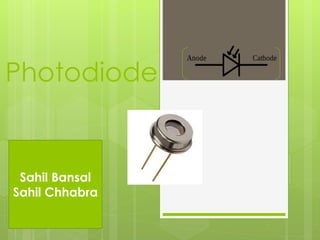
Photodiode 
Sahil Bansal 
Sahil Chhabra
•A photodiode is a type of photo detector 
capable of converting light into either current 
or voltage 
•It converts light energy into electrical energy. 
•Photodiodes are similar to regular 
semiconductor diodes except that they may 
be either exposed with a window or optical 
fibre to allow light to reach sensitive part of 
device
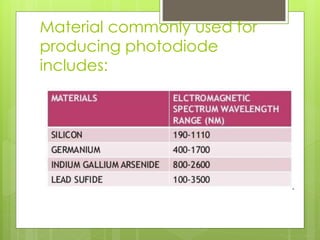
Material commonly used for 
producing photodiode 
includes:
Working of Photodiode 
 Photodiodes are of two types PN and PIN. 
 At PN junction there will be concentration 
gradient that causes electrons to diffuse 
into p-type region and holes into n-type 
region. This diffusion results in an opposing 
electric potential, often referred to as an 
Depletion region. 
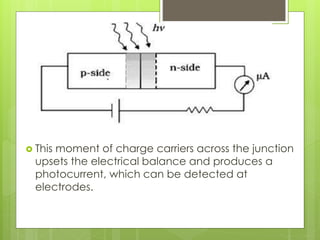
 Any photon absorbed in the depletion 
region causes moment of charge carriers
 This moment of charge carriers across the junction 
upsets the electrical balance and produces a 
photocurrent, which can be detected at 
electrodes.
Applications 
In electronic devices 
In smoke detectors 
• Light sensors 
• Used to measurer light intensity in 
science and industry
What is LED? 
LED are semiconductor p-n junctions that under forward bias conditions can emit 
radiation by electroluminescence in the UV, visible or infrared regions of the 
electromagnetic spectrum. The qaunta of light energy released is approximately 
proportional to the band gap of the semiconductor.
Applications of LEDs
Your fancy telephone, i-pod, palm pilot 
and digital camera
Getting to know LED 
Advantages of Light Emitting Diodes (LEDs) 
Longevity: 
The light emitting element in a diode is a small 
conductor chip rather than a filament which greatly 
extends the diode’s life in comparison to an 
incandescent bulb (10 000 hours life time compared 
to ~1000 hours for incandescence light bulb) 
Efficiency: 
Diodes emit almost no heat and run at very low 
ampere.
How does it work? 
P-n junction Electrical 
Contacts 
A typical LED needs a p-n junction 
There are a lot of electrons and holes at 
the junction due to excitations 
Electrons from n need to be injected to p 
to promote recombination 
Junction is biased to produce even more 
e-h and to inject electrons from n to p for 
recombination to happen 
Recombination 
produces light!!
Thank you

photodiode

  • 1.
  • 2.
    •A photodiode isa type of photo detector capable of converting light into either current or voltage •It converts light energy into electrical energy. •Photodiodes are similar to regular semiconductor diodes except that they may be either exposed with a window or optical fibre to allow light to reach sensitive part of device
  • 3.
    Material commonly usedfor producing photodiode includes:
  • 4.
    Working of Photodiode  Photodiodes are of two types PN and PIN.  At PN junction there will be concentration gradient that causes electrons to diffuse into p-type region and holes into n-type region. This diffusion results in an opposing electric potential, often referred to as an Depletion region.  Any photon absorbed in the depletion region causes moment of charge carriers
  • 5.
     This momentof charge carriers across the junction upsets the electrical balance and produces a photocurrent, which can be detected at electrodes.
  • 7.
    Applications In electronicdevices In smoke detectors • Light sensors • Used to measurer light intensity in science and industry
  • 8.
    What is LED? LED are semiconductor p-n junctions that under forward bias conditions can emit radiation by electroluminescence in the UV, visible or infrared regions of the electromagnetic spectrum. The qaunta of light energy released is approximately proportional to the band gap of the semiconductor.
  • 9.
  • 10.
    Your fancy telephone,i-pod, palm pilot and digital camera
  • 11.
    Getting to knowLED Advantages of Light Emitting Diodes (LEDs) Longevity: The light emitting element in a diode is a small conductor chip rather than a filament which greatly extends the diode’s life in comparison to an incandescent bulb (10 000 hours life time compared to ~1000 hours for incandescence light bulb) Efficiency: Diodes emit almost no heat and run at very low ampere.
  • 12.
    How does itwork? P-n junction Electrical Contacts A typical LED needs a p-n junction There are a lot of electrons and holes at the junction due to excitations Electrons from n need to be injected to p to promote recombination Junction is biased to produce even more e-h and to inject electrons from n to p for recombination to happen Recombination produces light!!
  • 13.