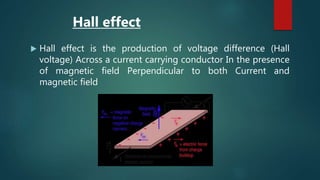
The document discusses the Hall effect, which is the production of voltage across a current-carrying conductor placed in a magnetic field perpendicular to the current. It was discovered in 1879 by Edwin Hall. Current consists of moving charged particles like electrons, which experience a Lorentz force in a magnetic field, producing a Hall voltage. The Hall effect proved that current in metals is carried by electrons and has applications in sensors for fields, position, speed and other measurements. Common uses include switches, ignition systems, and magnetic field sensors.