Tunnel diodes are heavily doped PN junction diodes that exhibit negative resistance. They were invented in 1958 by Dr. Leo Esaki and operate based on the quantum mechanical principle of tunneling. When forward biased, the current initially increases with voltage but then decreases as the voltage is further increased, demonstrating the unique property of negative resistance. Tunnel diodes find application in ultrafast switching, memory storage, satellite communication equipment, and oscillators due to their negative resistance characteristic.
Introduction
O Inventedby Dr. Leo Esaki in 1958.
O Also called Esaki diode.
O Basically, it is heavily doped PN- junction.
O These diodes are fabricated from germanium, gallium
arsenide (GaAs), and Gallium Antimonide.
O Symbol:
2.
Description
O Tunneldiode is a semi-conductor with a
special characteristic of negative resistance.
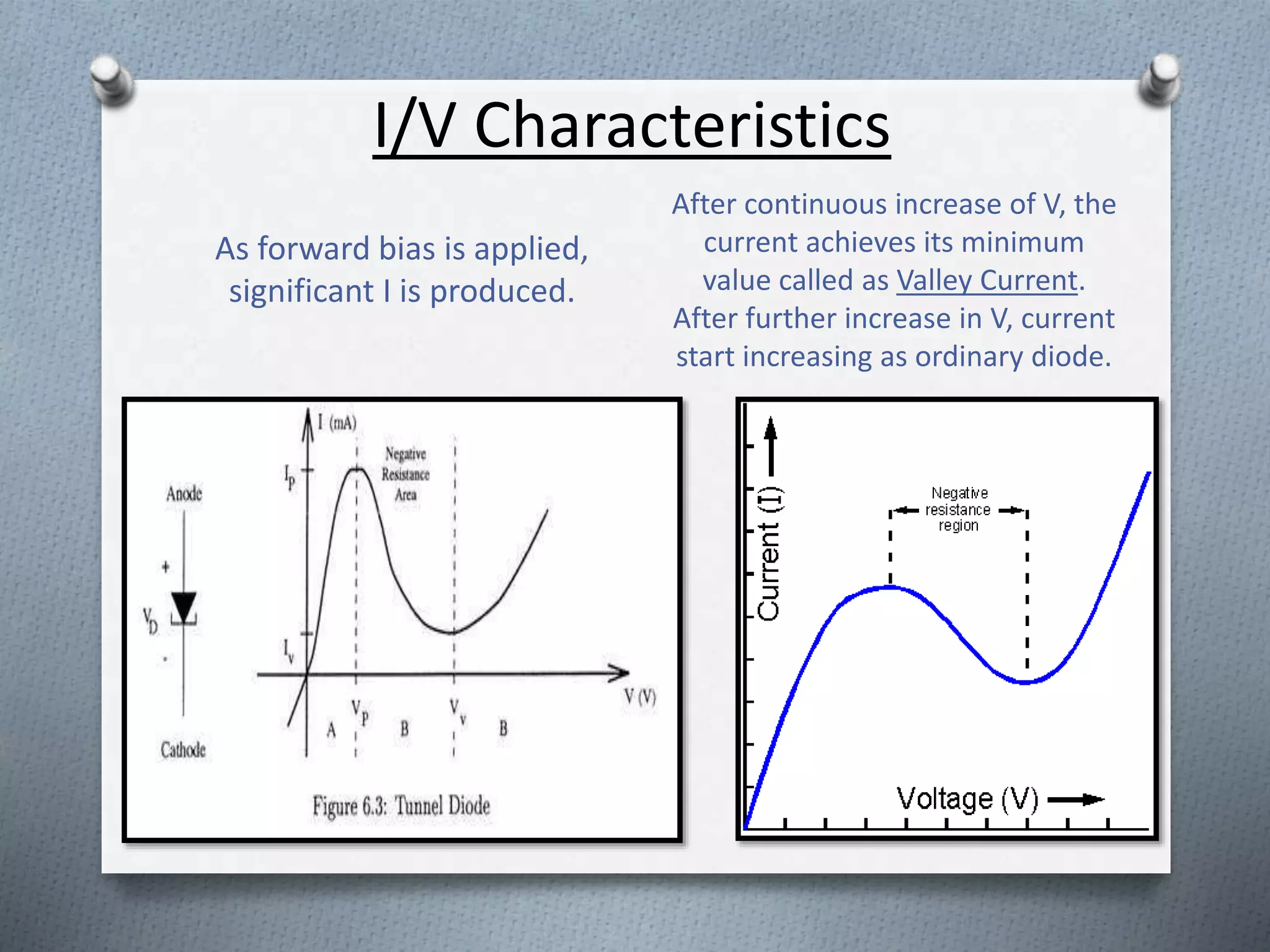
O By negative resistance, we mean that when
voltage is increased, the current through it
decreases.
O Highly doped PN- junction. Doping density of
about 1000 times greater than ordinary
junction diode.
3.
Construction
O HeavyDoping Effects:
i. Reduces the width of depletion layer to about
0.00001 mm.
ii. Produces negative resistance section in
characteristics graph of diode.
iii. Reduces the reverse breakdown voltage
to a small value approaches to zero.
iv. Small forbidden gaps in tunnel diode.
v. Allows conduction for all reverse voltages.
4.
Basic principle ofoperation:
O The operation depends upon quantum mechanics
principle known as “tunneling”.
O The movement of valence electrons from valence
energy band to conduction band with no applied
forward voltage is called “tunneling”.
O Intrinsic voltage barrier (0.3V for Ge) is reduced
which enhanced tunneling.
O Enhanced tunneling causes effective conductivity.
5.
Working:
O Ina conventional diode, forward conduction
occurs only if the forward bias is sufficient to
give charge carriers the energy necessary to
overcome the potential barrier.
O When the tunnel diode is slightly forward
biased, many carriers are able to tunnel through
narrow depletion region without acquiring that
energy.
O The carriers are able to tunnel or easily pass
because the voltage barrier is reduced due to
high doping.
6.
Working(contd.)
O ForwardBias operation:
At first voltage begin to increase,
1. Electrons tunnel through pn junction.
2. Electron and holes states become aligned.
Voltage increases further:
1. States become misaligned.
2. Current drops.
3. Shows negative resistance (V increase, I decrease).
As voltage increase yet further:
1. The diode behave as normal diode.
2. The electrons no longer tunnel through barrier.
7.
Working(contd.)
O ReverseBias Operation:
When used in reverse direction, they are called as
Back Diodes.
In this,
i. The electrons in valence band of p-side tunnel
directly towards the empty states present in the
conduction band of n-side.
ii. Thus, creating large tunneling current which
increases with application of reverse voltage.
8.
I/V Characteristics
Asforward bias is applied,
significant I is produced.
After continuous increase of V, the
current achieves its minimum
value called as Valley Current.
After further increase in V, current
start increasing as ordinary diode.
9.
I/V Characteristic(contd.)
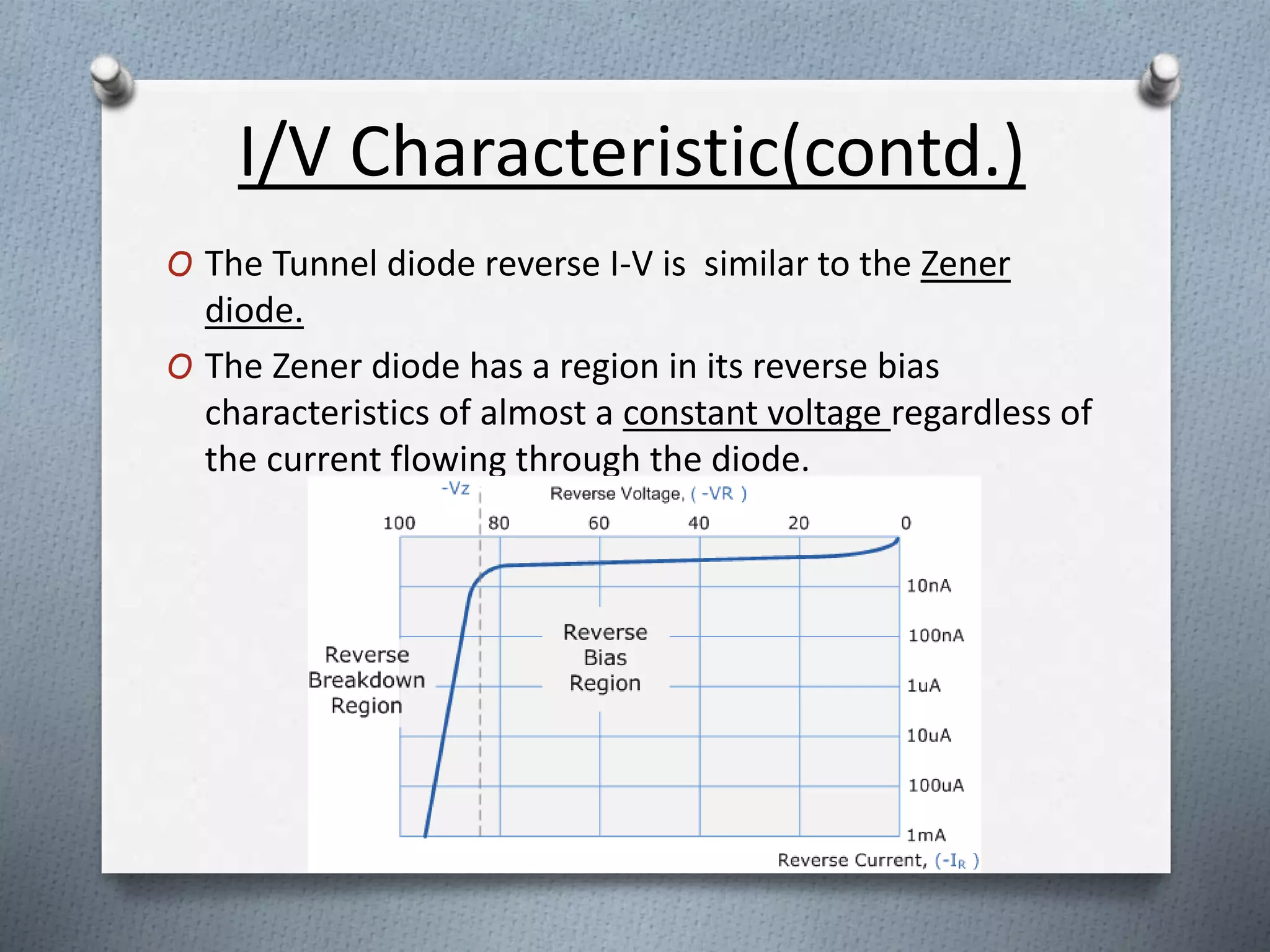
OThe Tunnel diode reverse I-V is similar to the Zener
diode.
O The Zener diode has a region in its reverse bias
characteristics of almost a constant voltage regardless of
the current flowing through the diode.
10.
Applications:
O Itis used as an ultra- high speed switch due to
tunneling (which essentially takes place at speed of
light). It has switching time of nanoseconds or
picoseconds.
O Used as logic memory storage device.
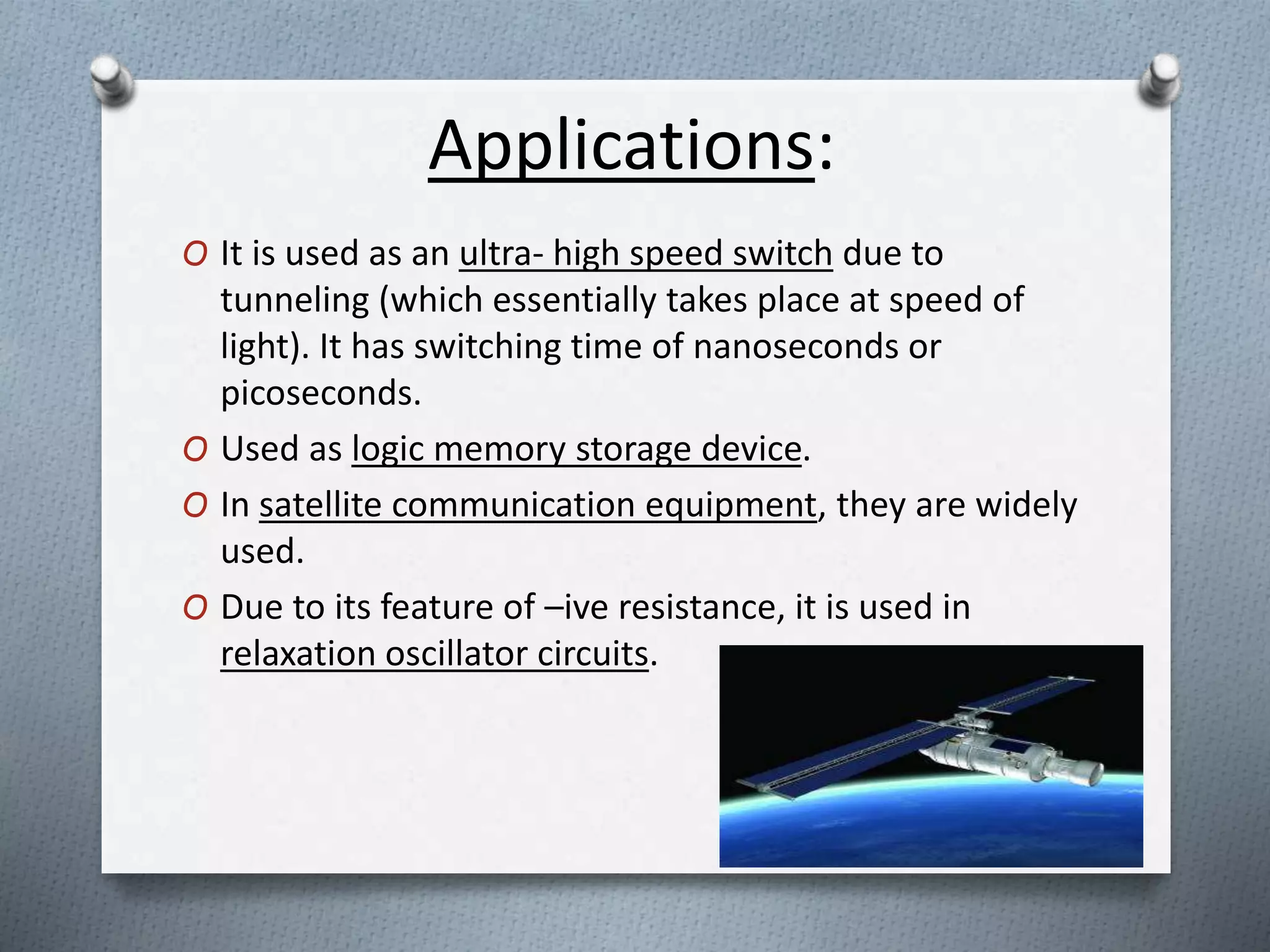
O In satellite communication equipment, they are widely
used.
O Due to its feature of –ive resistance, it is used in
relaxation oscillator circuits.
11.
Applications(contd.):
O Tunneldiodes are resistant to the effects of magnetic
fields, high temperature and radioactivity. That’s why
these can be used in modern military equipments -
NMR machines.
O Due to low power requirement, they are used in FM
receivers.