

PHOTODIODE
PRESENTED BY
AKSHARA.V.B
8/9/2019 1
8/9/2019 2
OUTLINE
S.NO TOPIC
1. INTRODUCTION
2. SYMBOL & CIRCUIT
3. COMPONENTS & CONSTRUCTION
4. OPERTION & MODES
5. TYPES
6. CHARATERISTIC
7. ADVANTAGE
8. DISADVANTAGE
9. APPLICATION
8/9/2019 3
INTRODUCTION:
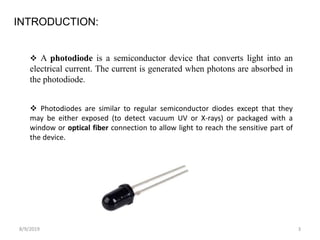
 A photodiode is a semiconductor device that converts light into an
electrical current. The current is generated when photons are absorbed in
the photodiode.
 Photodiodes are similar to regular semiconductor diodes except that they
may be either exposed (to detect vacuum UV or X-rays) or packaged with a
window or optical fiber connection to allow light to reach the sensitive part of
the device.
8/9/2019 4
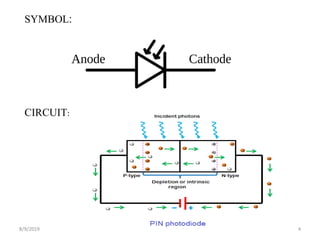
SYMBOL:
CIRCUIT:
8/9/2019 5
COMPOUNDS:
 Photodiodes are mainly made from gallium arsenide instead of silicon
because silicon creates crystal lattice vibrations called phonons when photons
are absorbed in order to create electron-hole pairs.
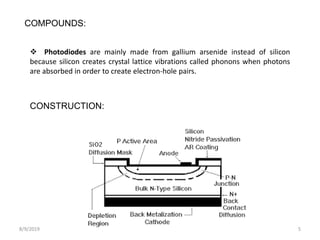
CONSTRUCTION:
8/9/2019 6
OPERATION:
 The working principle of a photodiode is, when a photon of ample
energy strikes the diode, it makes a couple of an electron-hole.
This mechanism is also called as the inner photoelectric
effect.
 If the absorption arises in the depletion region junction, then the
carriers are removed from the junction by the inbuilt electric field of the
depletion region.
 Therefore, holes in the region move toward the anode, and electrons
move toward the cathode, and a photocurrent will be generated.
The entire current through the diode is the sum of the absence of light
and the photocurrent.
8/9/2019 7
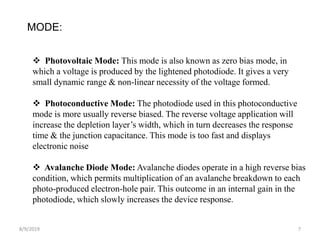
MODE:
 Photovoltaic Mode: This mode is also known as zero bias mode, in
which a voltage is produced by the lightened photodiode. It gives a very
small dynamic range & non-linear necessity of the voltage formed.
 Photoconductive Mode: The photodiode used in this photoconductive
mode is more usually reverse biased. The reverse voltage application will
increase the depletion layer’s width, which in turn decreases the response
time & the junction capacitance. This mode is too fast and displays
electronic noise
 Avalanche Diode Mode: Avalanche diodes operate in a high reverse bias
condition, which permits multiplication of an avalanche breakdown to each
photo-produced electron-hole pair. This outcome in an internal gain in the
photodiode, which slowly increases the device response.
8/9/2019 8
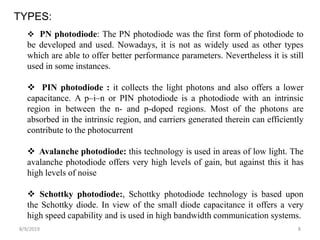
TYPES:
 PN photodiode: The PN photodiode was the first form of photodiode to
be developed and used. Nowadays, it is not as widely used as other types
which are able to offer better performance parameters. Nevertheless it is still
used in some instances.
 PIN photodiode : it collects the light photons and also offers a lower
capacitance. A p–i–n or PIN photodiode is a photodiode with an intrinsic
region in between the n- and p-doped regions. Most of the photons are
absorbed in the intrinsic region, and carriers generated therein can efficiently
contribute to the photocurrent
 Avalanche photodiode: this technology is used in areas of low light. The
avalanche photodiode offers very high levels of gain, but against this it has
high levels of noise
 Schottky photodiode:, Schottky photodiode technology is based upon
the Schottky diode. In view of the small diode capacitance it offers a very
high speed capability and is used in high bandwidth communication systems.
8/9/2019 9
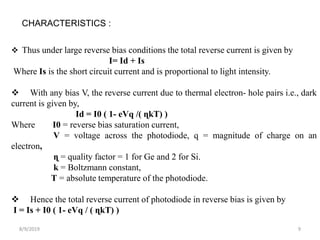
CHARACTERISTICS :
 Thus under large reverse bias conditions the total reverse current is given by
I= Id + Is
Where Is is the short circuit current and is proportional to light intensity.
 With any bias V, the reverse current due to thermal electron- hole pairs i.e., dark
current is given by,
Id = I0 ( 1- eVq /( ɳkT) )
Where I0 = reverse bias saturation current,
V = voltage across the photodiode, q = magnitude of charge on an
electron,
ɳ = quality factor = 1 for Ge and 2 for Si.
k = Boltzmann constant,
T = absolute temperature of the photodiode.
 Hence the total reverse current of photodiode in reverse bias is given by
I = Is + I0 ( 1- eVq / ( ɳkT) )
8/9/2019 10
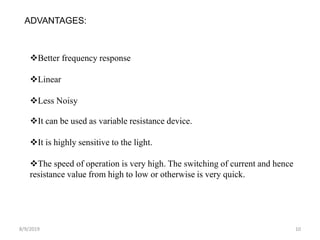
ADVANTAGES:
Better frequency response
Linear
Less Noisy
It can be used as variable resistance device.
It is highly sensitive to the light.
The speed of operation is very high. The switching of current and hence
resistance value from high to low or otherwise is very quick.
8/9/2019 11
DISADVANTAGE:
Small active area
Rapid increase in dark current and it depends on temperature.
Require amplification at low illumination level.
Photodiode characteristics are temperature dependent and have poor
temperature stability.
Current/change in current is in small and hence may not be sufficient
to drive the circuits, hence amplification is necessary in photodiode
based circuits.
8/9/2019 12
APPLICATION:
The photodiode is used in optical communication system
The photodiode is used in automotive devices.
The photodiode is used in medical devices.
It is used in solar cell panels.
The Photodiode are used in consumer electronics devices
like smoke detectors
It is used for exact measurement of the intensity of light in science &
industry.
It is used in character recognition circuit.
It is used in camera light meters, and street lights.
It is used in demodulation.
The photodiode is used in logic circuit.
It is used in photo detection circuits.

Photodiode

  • 1.
  • 2.
    8/9/2019 2 OUTLINE S.NO TOPIC 1.INTRODUCTION 2. SYMBOL & CIRCUIT 3. COMPONENTS & CONSTRUCTION 4. OPERTION & MODES 5. TYPES 6. CHARATERISTIC 7. ADVANTAGE 8. DISADVANTAGE 9. APPLICATION
  • 3.
    8/9/2019 3 INTRODUCTION:  Aphotodiode is a semiconductor device that converts light into an electrical current. The current is generated when photons are absorbed in the photodiode.  Photodiodes are similar to regular semiconductor diodes except that they may be either exposed (to detect vacuum UV or X-rays) or packaged with a window or optical fiber connection to allow light to reach the sensitive part of the device.
  • 4.
  • 5.
    8/9/2019 5 COMPOUNDS:  Photodiodesare mainly made from gallium arsenide instead of silicon because silicon creates crystal lattice vibrations called phonons when photons are absorbed in order to create electron-hole pairs. CONSTRUCTION:
  • 6.
    8/9/2019 6 OPERATION:  Theworking principle of a photodiode is, when a photon of ample energy strikes the diode, it makes a couple of an electron-hole. This mechanism is also called as the inner photoelectric effect.  If the absorption arises in the depletion region junction, then the carriers are removed from the junction by the inbuilt electric field of the depletion region.  Therefore, holes in the region move toward the anode, and electrons move toward the cathode, and a photocurrent will be generated. The entire current through the diode is the sum of the absence of light and the photocurrent.
  • 7.
    8/9/2019 7 MODE:  PhotovoltaicMode: This mode is also known as zero bias mode, in which a voltage is produced by the lightened photodiode. It gives a very small dynamic range & non-linear necessity of the voltage formed.  Photoconductive Mode: The photodiode used in this photoconductive mode is more usually reverse biased. The reverse voltage application will increase the depletion layer’s width, which in turn decreases the response time & the junction capacitance. This mode is too fast and displays electronic noise  Avalanche Diode Mode: Avalanche diodes operate in a high reverse bias condition, which permits multiplication of an avalanche breakdown to each photo-produced electron-hole pair. This outcome in an internal gain in the photodiode, which slowly increases the device response.
  • 8.
    8/9/2019 8 TYPES:  PNphotodiode: The PN photodiode was the first form of photodiode to be developed and used. Nowadays, it is not as widely used as other types which are able to offer better performance parameters. Nevertheless it is still used in some instances.  PIN photodiode : it collects the light photons and also offers a lower capacitance. A p–i–n or PIN photodiode is a photodiode with an intrinsic region in between the n- and p-doped regions. Most of the photons are absorbed in the intrinsic region, and carriers generated therein can efficiently contribute to the photocurrent  Avalanche photodiode: this technology is used in areas of low light. The avalanche photodiode offers very high levels of gain, but against this it has high levels of noise  Schottky photodiode:, Schottky photodiode technology is based upon the Schottky diode. In view of the small diode capacitance it offers a very high speed capability and is used in high bandwidth communication systems.
  • 9.
    8/9/2019 9 CHARACTERISTICS : Thus under large reverse bias conditions the total reverse current is given by I= Id + Is Where Is is the short circuit current and is proportional to light intensity.  With any bias V, the reverse current due to thermal electron- hole pairs i.e., dark current is given by, Id = I0 ( 1- eVq /( ɳkT) ) Where I0 = reverse bias saturation current, V = voltage across the photodiode, q = magnitude of charge on an electron, ɳ = quality factor = 1 for Ge and 2 for Si. k = Boltzmann constant, T = absolute temperature of the photodiode.  Hence the total reverse current of photodiode in reverse bias is given by I = Is + I0 ( 1- eVq / ( ɳkT) )
  • 10.
    8/9/2019 10 ADVANTAGES: Better frequencyresponse Linear Less Noisy It can be used as variable resistance device. It is highly sensitive to the light. The speed of operation is very high. The switching of current and hence resistance value from high to low or otherwise is very quick.
  • 11.
    8/9/2019 11 DISADVANTAGE: Small activearea Rapid increase in dark current and it depends on temperature. Require amplification at low illumination level. Photodiode characteristics are temperature dependent and have poor temperature stability. Current/change in current is in small and hence may not be sufficient to drive the circuits, hence amplification is necessary in photodiode based circuits.
  • 12.
    8/9/2019 12 APPLICATION: The photodiodeis used in optical communication system The photodiode is used in automotive devices. The photodiode is used in medical devices. It is used in solar cell panels. The Photodiode are used in consumer electronics devices like smoke detectors It is used for exact measurement of the intensity of light in science & industry. It is used in character recognition circuit. It is used in camera light meters, and street lights. It is used in demodulation. The photodiode is used in logic circuit. It is used in photo detection circuits.