Dr.S.Sethupathy,M.D.,Ph.D.,
Professor of Biochemistry,
RMMC, AU
1 Excretion of waste products
Kidney excretes metabolic waste products
such as urea, creatinine and uric acid.
2 Maintains homeostasis
Kidney maintains water and electrolyte balance
with the help of antidiuretic hormone (Water
Balance ) and renin – angiotensin –
aldosterone mechanism (Electrolyte balance)
and maintains acid base balance by
reabsorbing sodium bicarbonate .
3.Hormonal function
It produces erythropoietin which
helps in promoting erythropoiesis in
bone narrow .
It plays a role in calcium metabolism
Renal enzyme 1- alpha-hydroxylase
converts 25-hydroxy cholecalciferol to
1,25 dihydroxy cholecalcified (calcitriol)
which is highly potent in promoting
intestinal calcium absorption.
 It has two components
 1. Glomerular apparatus - the
Filtration unit
 2. Tubular system for selective
reabsorption
 The renal function tests are used to
assess glomerular and tubular
functional efficiency for which blood
and urine samples are used.
 When it is unusually more than 2500 ml / 24 hours it
is called polyuria. It can be due to
 1. Increase in water excretion
 2. Increase in solute excretion causing osmotic water
loss
 Increase in water loss due to either diminished
tubular dysfunction with decreased concentration
ability or ADH deficiency. ADH deficiency results in
diabetes insipidus. In this case urine specific gravity
will be lower.
 In case of diabetic mellitus due to glucosuria, there
will be polyuria. In this case urine specific gravity will
be higher.
When urine output is lesser then 400 ml /
24 hrs, it is called oliguria. If no urine is
passed, then it is called anuria.
Oliguria and anuria can be the result of
following:
Diminished perfusion of the kidney due to
Diminished blood volume (eg. Dehydration,
hemorrhage) or
Diminished blood flow (eg. Cardiac failure)
Renal diseases such as acute
glomerulonephritis, tubular necrosis.
Obstruction to the outflow e.g. prostate
tumor, bladder stones, renal stones etc.
 Normally it is pale yellow or amber colour
 Hematuria or hemoglobinuria produce a dark
brown colour. By microscopy, hematuria can
be detected.
 Pyuria (pale, turbid ) can be due to infection .
 Yellow colour can be due to jaundice or B
complex vitamins intake or concentrated
urine due to reduced water intake
 pH of urine
 usually acidic pH6 (4.5-8-pH )
 specific gravity
 Normally varies from 1.016 to 1.025
 Osmolality
 On average fluid intake, it ranges from
300 to 900 mosmol/kg
 Odour
 Foul smell indicates bacterial infection
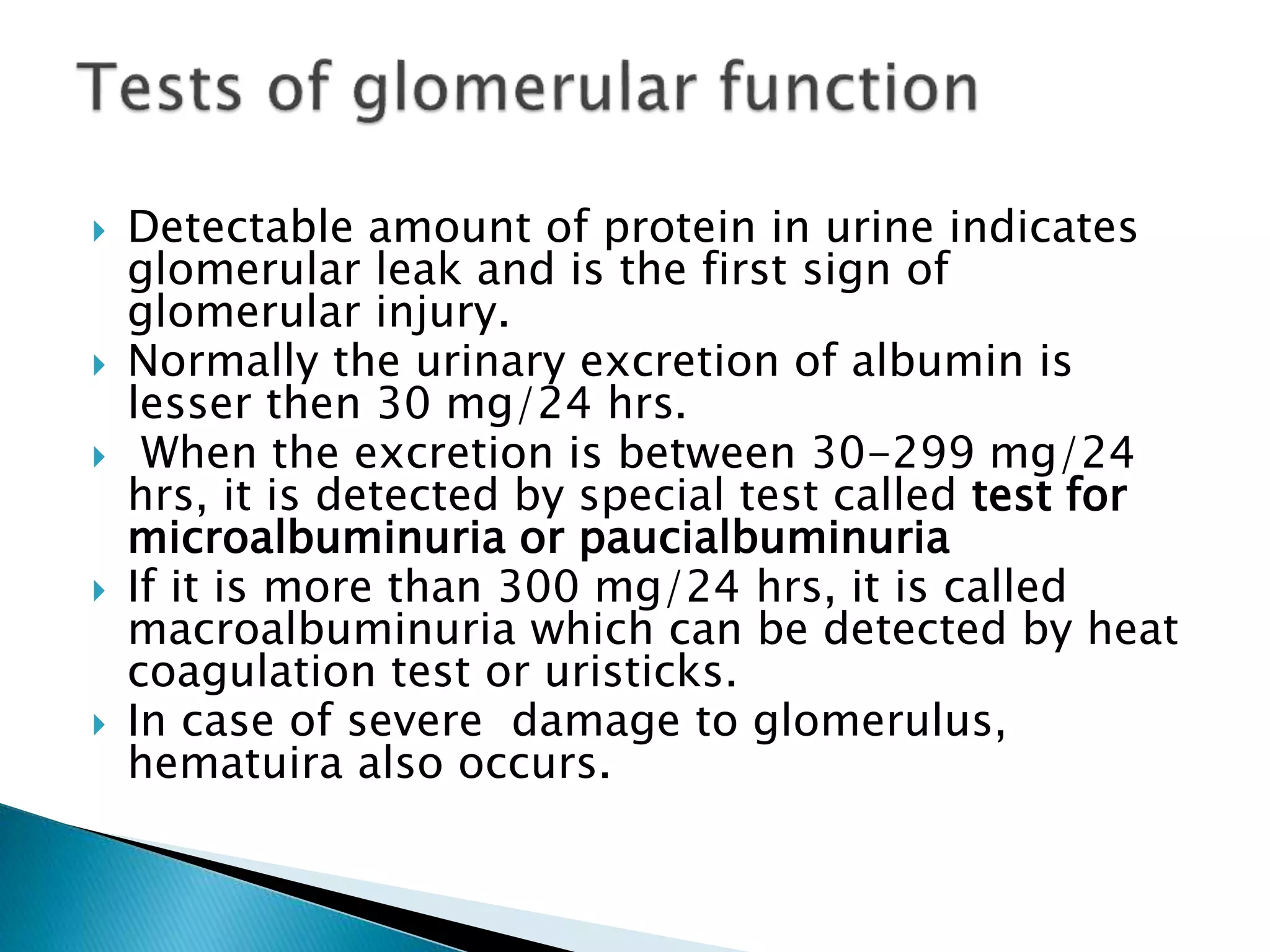
 Detectable amount of protein in urine indicates
glomerular leak and is the first sign of
glomerular injury.
 Normally the urinary excretion of albumin is
lesser then 30 mg/24 hrs.
 When the excretion is between 30-299 mg/24
hrs, it is detected by special test called test for
microalbuminuria or paucialbuminuria
 If it is more than 300 mg/24 hrs, it is called
macroalbuminuria which can be detected by heat
coagulation test or uristicks.
 In case of severe damage to glomerulus,
hematuira also occurs.
 The renal clearance of a substance is defined
as the volume of plasma from which the
substance is completely cleared by the
kidneys per unit time.
 Creatinine clearance test is based on the rate
of excretion of creatinine, a metabolic waste
product produced at a steady level.
 For this test, 24 hours urine is collected. It's
volume, the urinary creatinine concentration
and the plasma creatinine concentration were
measured.
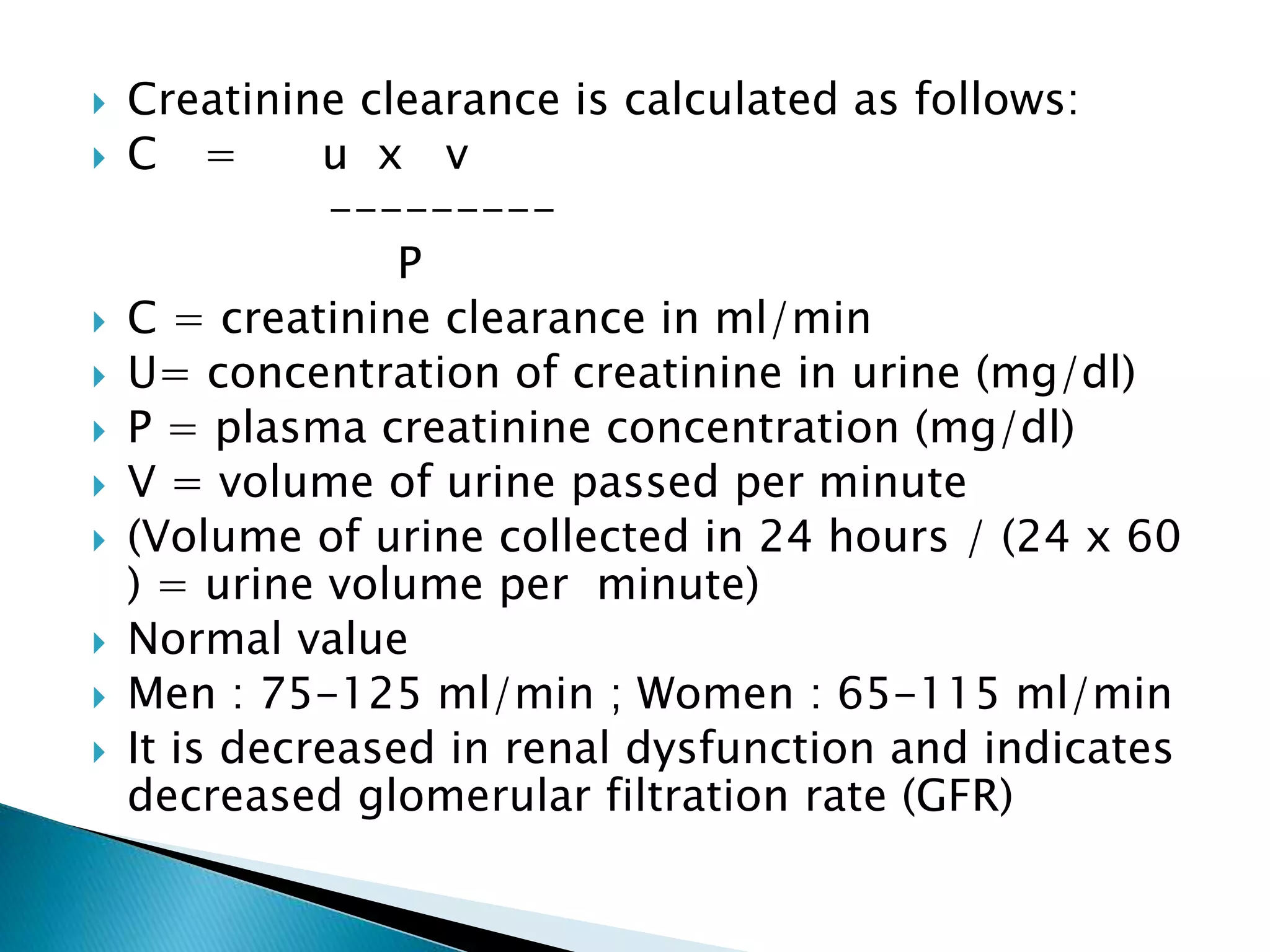
 Creatinine clearance is calculated as follows:
 C = u x v
---------
P
 C = creatinine clearance in ml/min
 U= concentration of creatinine in urine (mg/dl)
 P = plasma creatinine concentration (mg/dl)
 V = volume of urine passed per minute
 (Volume of urine collected in 24 hours / (24 x 60
) = urine volume per minute)
 Normal value
 Men : 75-125 ml/min ; Women : 65-115 ml/min
 It is decreased in renal dysfunction and indicates
decreased glomerular filtration rate (GFR)
 Inulin clearance is exogenous compound and
the blood level is maintained, It is neither
secreted nor reabsorbed. It gives true GFR.
 Clearance test is useful in the early stages of
renal disease
 In moderate impairment, blood urea, serum
creatinine are elevated. That condition is
known as azotemia or uremia
 Creatinine clearance is little higher because
some amount is secreted.
 Urea clearance is lesser because some
amount of urea is reabsorbed.
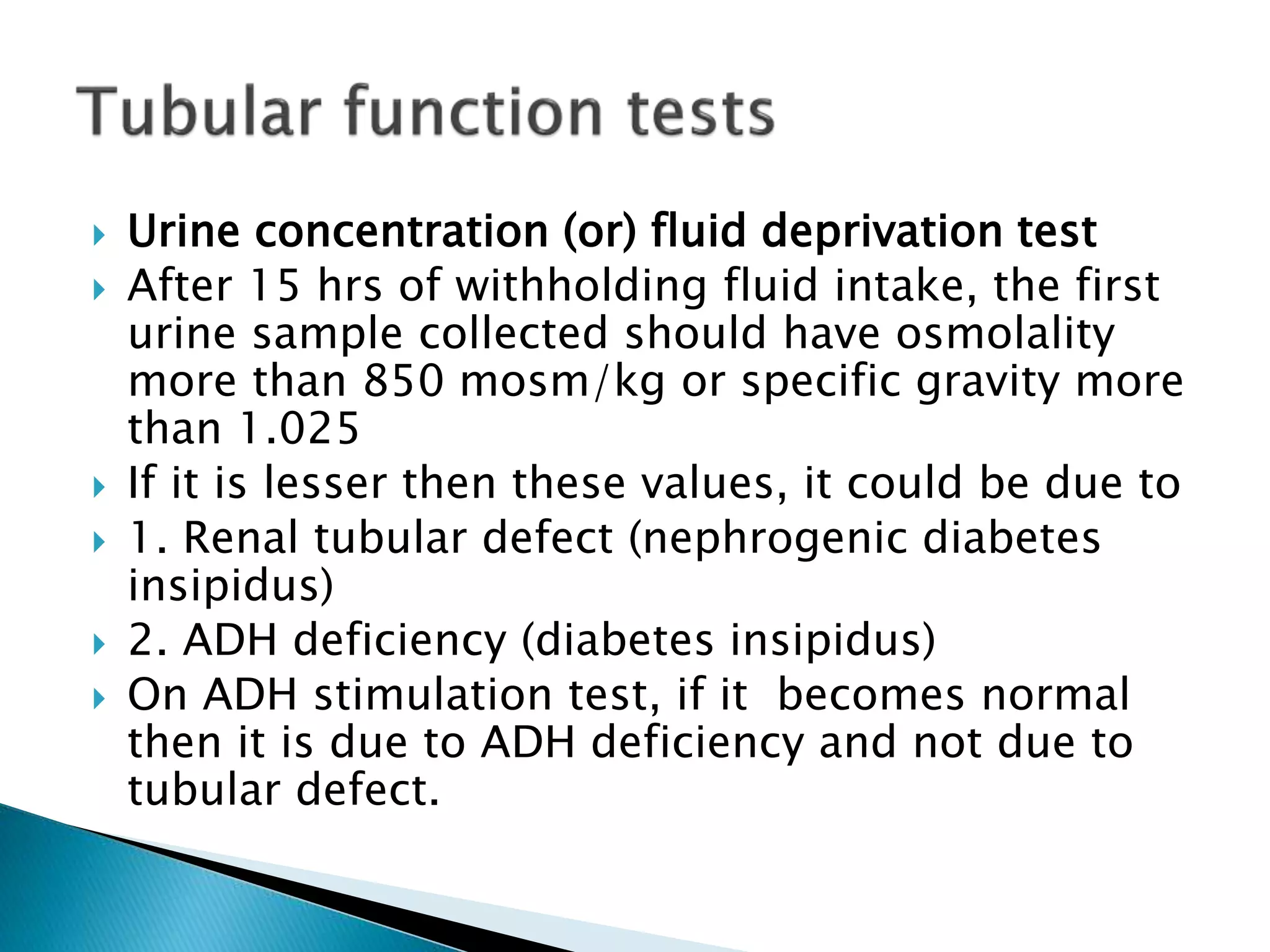
 Urine concentration (or) fluid deprivation test
 After 15 hrs of withholding fluid intake, the first
urine sample collected should have osmolality
more than 850 mosm/kg or specific gravity more
than 1.025
 If it is lesser then these values, it could be due to
 1. Renal tubular defect (nephrogenic diabetes
insipidus)
 2. ADH deficiency (diabetes insipidus)
 On ADH stimulation test, if it becomes normal
then it is due to ADH deficiency and not due to
tubular defect.
 In dilution test, after emptying the
bladder, 1200 ml of water is given.
Urinary specific gravity should fall to
1.005 or an osmolality lesser the 100
mosml/kg
 Urine specimens are collected hourly
for next four hours
 In renal tubular disease, there will be a
fixed specific gravity.
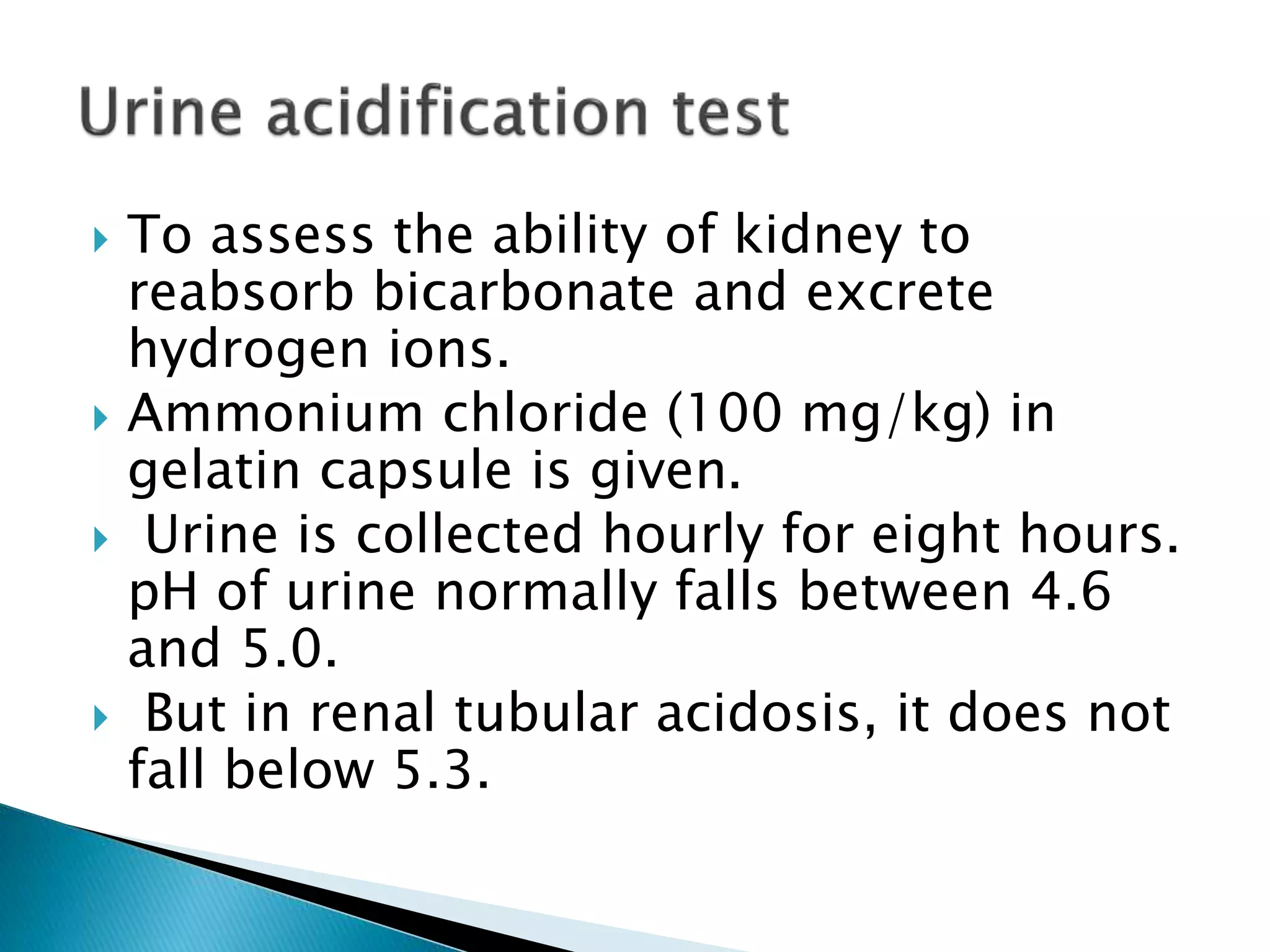
 To assess the ability of kidney to
reabsorb bicarbonate and excrete
hydrogen ions.
 Ammonium chloride (100 mg/kg) in
gelatin capsule is given.
 Urine is collected hourly for eight hours.
pH of urine normally falls between 4.6
and 5.0.
 But in renal tubular acidosis, it does not
fall below 5.3.
 Patient is given 600 ml water initially.
 Phenolsulphthalein test dye 6 mg in 1 ml
saline is given intravenously and urine
samples are collected at 15, 30, 60, 120
minutes.
 If the 15 minute urine contains 25% or more,
the test is normal.
 If it is lesser than 25%, it indicates impaired
renal excretory function.
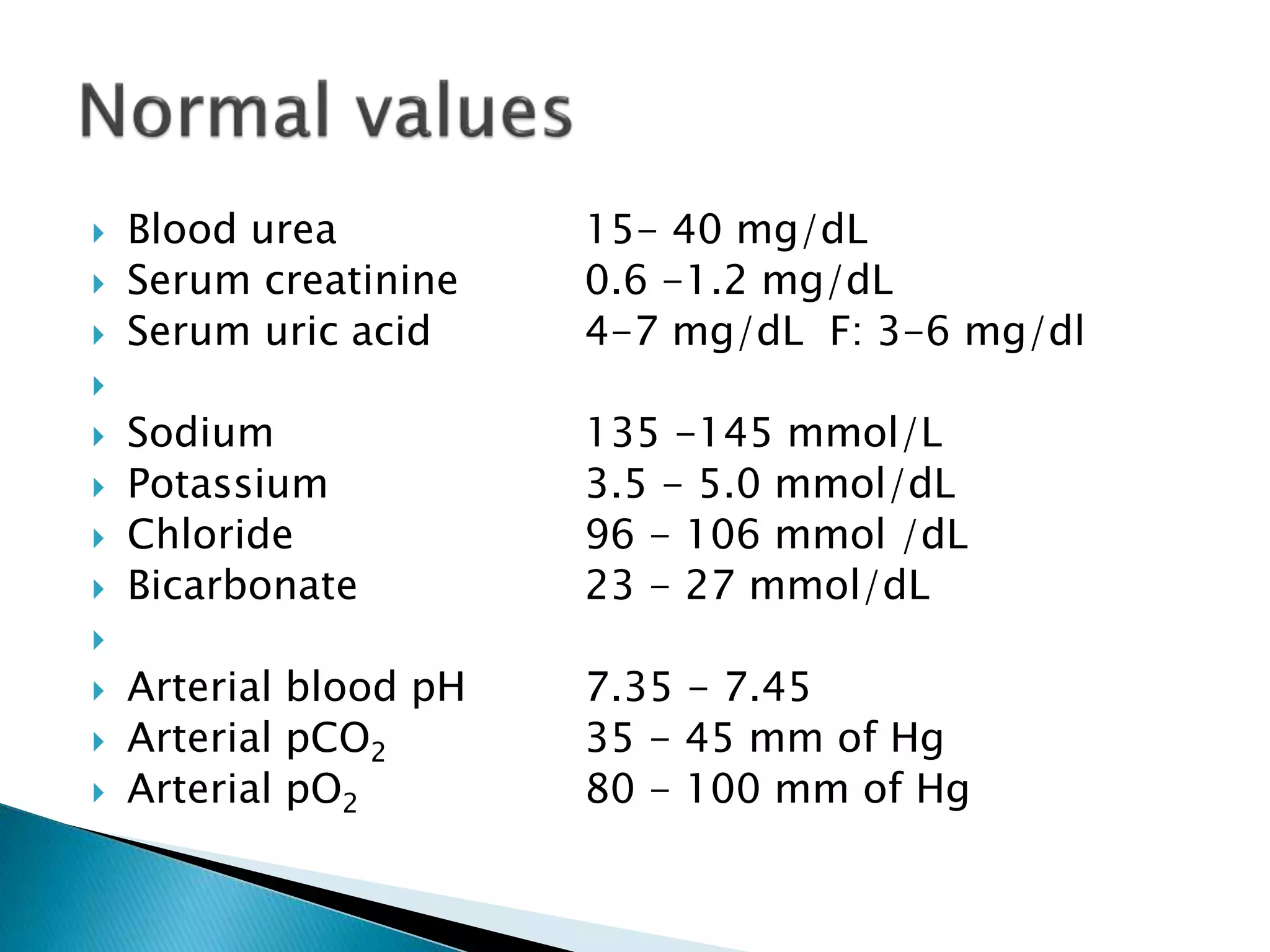
 Blood urea 15- 40 mg/dL
 Serum creatinine 0.6 -1.2 mg/dL
 Serum uric acid 4-7 mg/dL F: 3-6 mg/dl

 Sodium 135 -145 mmol/L
 Potassium 3.5 - 5.0 mmol/dL
 Chloride 96 - 106 mmol /dL
 Bicarbonate 23 - 27 mmol/dL

 Arterial blood pH 7.35 - 7.45
 Arterial pCO2 35 - 45 mm of Hg
 Arterial pO2 80 - 100 mm of Hg
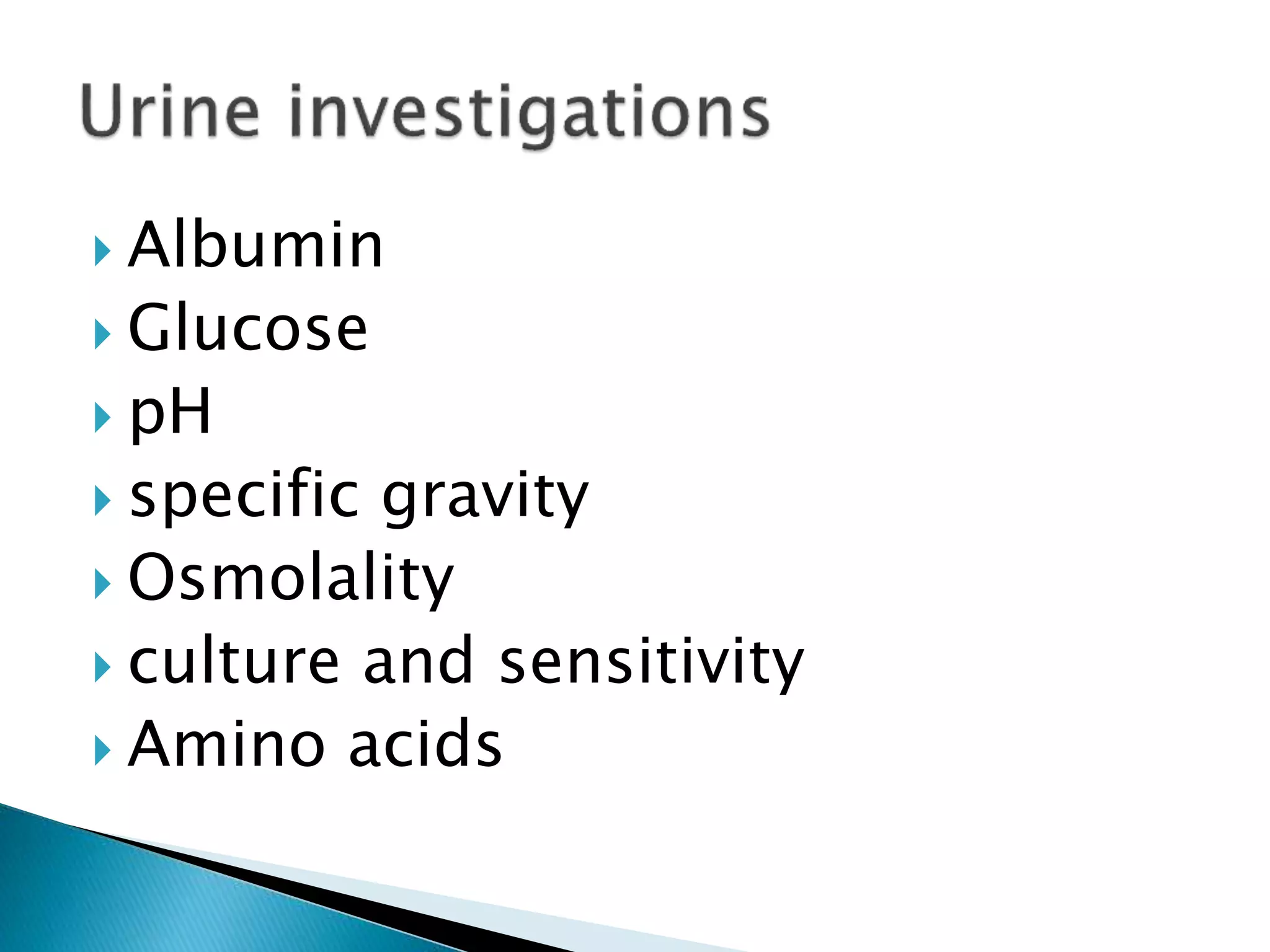
 Albumin
 Glucose
 pH
 specific gravity
 Osmolality
 culture and sensitivity
 Amino acids
Thank you

Renal function tests

  • 1.
  • 2.
    1 Excretion ofwaste products Kidney excretes metabolic waste products such as urea, creatinine and uric acid. 2 Maintains homeostasis Kidney maintains water and electrolyte balance with the help of antidiuretic hormone (Water Balance ) and renin – angiotensin – aldosterone mechanism (Electrolyte balance) and maintains acid base balance by reabsorbing sodium bicarbonate .
  • 3.
    3.Hormonal function It produceserythropoietin which helps in promoting erythropoiesis in bone narrow . It plays a role in calcium metabolism Renal enzyme 1- alpha-hydroxylase converts 25-hydroxy cholecalciferol to 1,25 dihydroxy cholecalcified (calcitriol) which is highly potent in promoting intestinal calcium absorption.
  • 4.
     It hastwo components  1. Glomerular apparatus - the Filtration unit  2. Tubular system for selective reabsorption  The renal function tests are used to assess glomerular and tubular functional efficiency for which blood and urine samples are used.
  • 5.
     When itis unusually more than 2500 ml / 24 hours it is called polyuria. It can be due to  1. Increase in water excretion  2. Increase in solute excretion causing osmotic water loss  Increase in water loss due to either diminished tubular dysfunction with decreased concentration ability or ADH deficiency. ADH deficiency results in diabetes insipidus. In this case urine specific gravity will be lower.  In case of diabetic mellitus due to glucosuria, there will be polyuria. In this case urine specific gravity will be higher.
  • 6.
    When urine outputis lesser then 400 ml / 24 hrs, it is called oliguria. If no urine is passed, then it is called anuria. Oliguria and anuria can be the result of following: Diminished perfusion of the kidney due to Diminished blood volume (eg. Dehydration, hemorrhage) or Diminished blood flow (eg. Cardiac failure) Renal diseases such as acute glomerulonephritis, tubular necrosis. Obstruction to the outflow e.g. prostate tumor, bladder stones, renal stones etc.
  • 7.
     Normally itis pale yellow or amber colour  Hematuria or hemoglobinuria produce a dark brown colour. By microscopy, hematuria can be detected.  Pyuria (pale, turbid ) can be due to infection .  Yellow colour can be due to jaundice or B complex vitamins intake or concentrated urine due to reduced water intake
  • 8.
     pH ofurine  usually acidic pH6 (4.5-8-pH )  specific gravity  Normally varies from 1.016 to 1.025  Osmolality  On average fluid intake, it ranges from 300 to 900 mosmol/kg  Odour  Foul smell indicates bacterial infection
  • 9.
     Detectable amountof protein in urine indicates glomerular leak and is the first sign of glomerular injury.  Normally the urinary excretion of albumin is lesser then 30 mg/24 hrs.  When the excretion is between 30-299 mg/24 hrs, it is detected by special test called test for microalbuminuria or paucialbuminuria  If it is more than 300 mg/24 hrs, it is called macroalbuminuria which can be detected by heat coagulation test or uristicks.  In case of severe damage to glomerulus, hematuira also occurs.
  • 10.
     The renalclearance of a substance is defined as the volume of plasma from which the substance is completely cleared by the kidneys per unit time.  Creatinine clearance test is based on the rate of excretion of creatinine, a metabolic waste product produced at a steady level.  For this test, 24 hours urine is collected. It's volume, the urinary creatinine concentration and the plasma creatinine concentration were measured.
  • 11.
     Creatinine clearanceis calculated as follows:  C = u x v --------- P  C = creatinine clearance in ml/min  U= concentration of creatinine in urine (mg/dl)  P = plasma creatinine concentration (mg/dl)  V = volume of urine passed per minute  (Volume of urine collected in 24 hours / (24 x 60 ) = urine volume per minute)  Normal value  Men : 75-125 ml/min ; Women : 65-115 ml/min  It is decreased in renal dysfunction and indicates decreased glomerular filtration rate (GFR)
  • 12.
     Inulin clearanceis exogenous compound and the blood level is maintained, It is neither secreted nor reabsorbed. It gives true GFR.  Clearance test is useful in the early stages of renal disease  In moderate impairment, blood urea, serum creatinine are elevated. That condition is known as azotemia or uremia  Creatinine clearance is little higher because some amount is secreted.  Urea clearance is lesser because some amount of urea is reabsorbed.
  • 13.
     Urine concentration(or) fluid deprivation test  After 15 hrs of withholding fluid intake, the first urine sample collected should have osmolality more than 850 mosm/kg or specific gravity more than 1.025  If it is lesser then these values, it could be due to  1. Renal tubular defect (nephrogenic diabetes insipidus)  2. ADH deficiency (diabetes insipidus)  On ADH stimulation test, if it becomes normal then it is due to ADH deficiency and not due to tubular defect.
  • 14.
     In dilutiontest, after emptying the bladder, 1200 ml of water is given. Urinary specific gravity should fall to 1.005 or an osmolality lesser the 100 mosml/kg  Urine specimens are collected hourly for next four hours  In renal tubular disease, there will be a fixed specific gravity.
  • 15.
     To assessthe ability of kidney to reabsorb bicarbonate and excrete hydrogen ions.  Ammonium chloride (100 mg/kg) in gelatin capsule is given.  Urine is collected hourly for eight hours. pH of urine normally falls between 4.6 and 5.0.  But in renal tubular acidosis, it does not fall below 5.3.
  • 16.
     Patient isgiven 600 ml water initially.  Phenolsulphthalein test dye 6 mg in 1 ml saline is given intravenously and urine samples are collected at 15, 30, 60, 120 minutes.  If the 15 minute urine contains 25% or more, the test is normal.  If it is lesser than 25%, it indicates impaired renal excretory function.
  • 17.
     Blood urea15- 40 mg/dL  Serum creatinine 0.6 -1.2 mg/dL  Serum uric acid 4-7 mg/dL F: 3-6 mg/dl   Sodium 135 -145 mmol/L  Potassium 3.5 - 5.0 mmol/dL  Chloride 96 - 106 mmol /dL  Bicarbonate 23 - 27 mmol/dL   Arterial blood pH 7.35 - 7.45  Arterial pCO2 35 - 45 mm of Hg  Arterial pO2 80 - 100 mm of Hg
  • 18.
     Albumin  Glucose pH  specific gravity  Osmolality  culture and sensitivity  Amino acids
  • 19.