Estimation of Sodium &
Potassium
Ashikh Seethy
Senior Resident
Department of Biochemistry
Objectives:
At the end of this briefing, you should be able to describe:
 The distribution of Na+, K+ and water in the body.
 The role of Na+ and K+ in maintenance of homeostasis.
 The different pathological conditions in which Na+ and K+
balance is disturbed.
 Various techniques utilized for estimation of serum Na+ and
K+.
The Body as Organized
“Solutions”
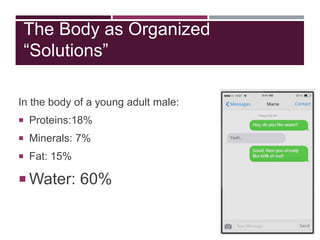
In the body of a young adult male:
 Proteins:18%
 Minerals: 7%
 Fat: 15%
 Water: 60%
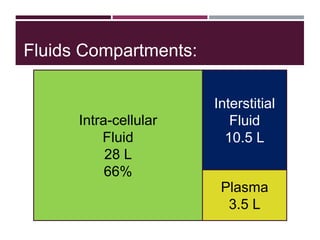
Fluids Compartments:
Total Body Water: 42 L
Intra-cellular
Fluid
28 L
66%
Extra-
cellular
Fluid
14 L
34%
Interstitial
Fluid
10.5 L
Plasma
3.5 L
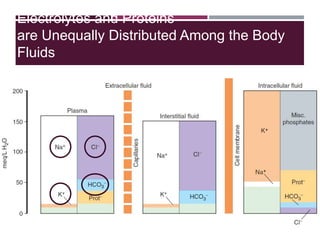
Electrolytes and Proteins
are Unequally Distributed Among the Body
Fluids
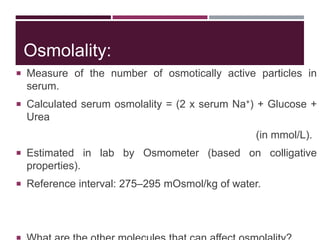
Osmolality:
 Measure of the number of osmotically active particles in
serum.
 Calculated serum osmolality = (2 x serum Na+) + Glucose +
Urea
(in mmol/L).
 Estimated in lab by Osmometer (based on colligative
properties).
 Reference interval: 275–295 mOsmol/kg of water.
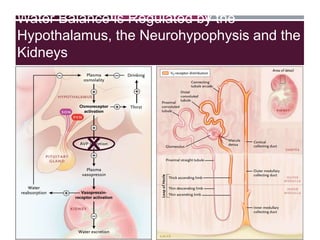
Water Balance is Regulated by the
Hypothalamus, the Neurohypophysis and the
Kidneys
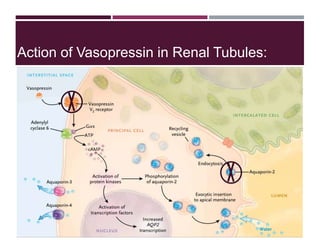
Action of Vasopressin in Renal Tubules:
Water and electrolytes can be lost through
 Gastrointestinal tract
 Skin
 Bronchial tree etc.
 But kidneys are the only organs able to conserve or excrete
electrolytes and water under tight regulatory control.
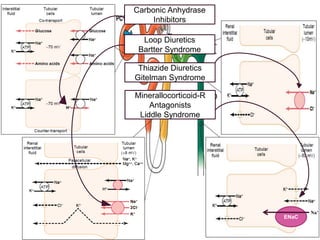
Osmolality:
Carbonic Anhydrase
Inhibitors
Loop Diuretics
Bartter Syndrome
Thiazide Diuretics
Gitelman Syndrome
Minerallocorticoid-R
Antagonists
Liddle Syndrome
ENaC
Na+
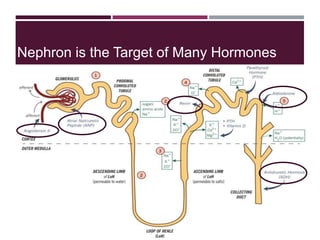
Nephron is the Target of Many Hormones
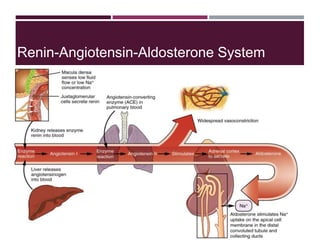
Renin-Angiotensin-Aldosterone System
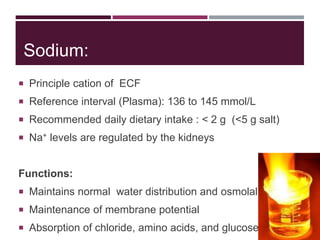
Sodium:
 Principle cation of ECF
 Reference interval (Plasma): 136 to 145 mmol/L
 Recommended daily dietary intake : < 2 g (<5 g salt)
 Na+ levels are regulated by the kidneys
Functions:
 Maintains normal water distribution and osmolality
 Maintenance of membrane potential
 Absorption of chloride, amino acids, and glucose
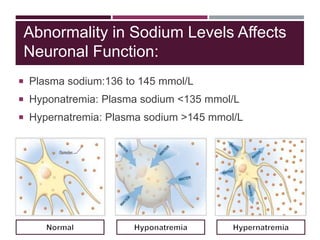
Abnormality in Sodium Levels Affects
Neuronal Function:
 Plasma sodium:136 to 145 mmol/L
 Hyponatremia: Plasma sodium <135 mmol/L
 Hypernatremia: Plasma sodium >145 mmol/L
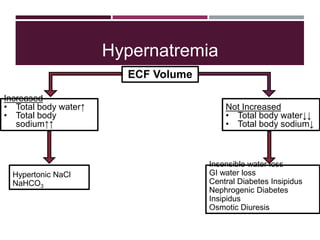
Hypernatremia
ECF Volume
Increased
• Total body water↑
• Total body
sodium↑↑
Not Increased
• Total body water↓↓
• Total body sodium↓
Hypertonic NaCl
NaHCO3
Insensible water loss
GI water loss
Central Diabetes Insipidus
Nephrogenic Diabetes
Insipidus
Osmotic Diuresis
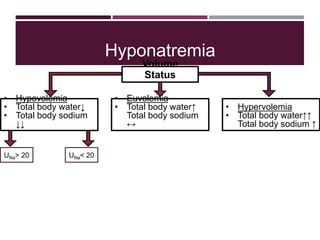
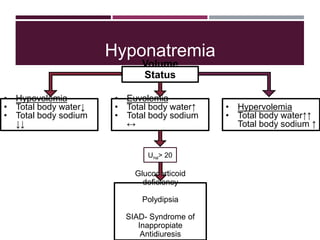
Hyponatremia
Volume
Status
• Hypovolemia
• Total body water↓
• Total body sodium
↓↓
• Euvolemia
• Total body water↑
Total body sodium
↔
• Hypervolemia
• Total body water↑↑
Total body sodium ↑
UNa> 20 UNa< 20
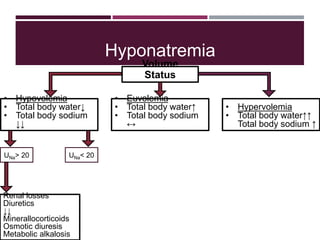
Hyponatremia
Volume
Status
• Hypovolemia
• Total body water↓
• Total body sodium
↓↓
• Euvolemia
• Total body water↑
• Total body sodium
↔
• Hypervolemia
• Total body water↑↑
Total body sodium ↑
UNa> 20 UNa< 20
Renal losses
Diuretics
↓↓
Minerallocorticoids
Osmotic diuresis
Metabolic alkalosis
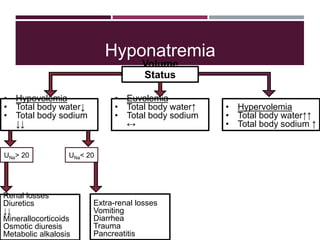
Hyponatremia
Volume
Status
• Hypovolemia
• Total body water↓
• Total body sodium
↓↓
• Euvolemia
• Total body water↑
• Total body sodium
↔
• Hypervolemia
• Total body water↑↑
• Total body sodium ↑
UNa> 20 UNa< 20
Renal losses
Diuretics
↓↓
Minerallocorticoids
Osmotic diuresis
Metabolic alkalosis
Extra-renal losses
Vomiting
Diarrhea
Trauma
Pancreatitis
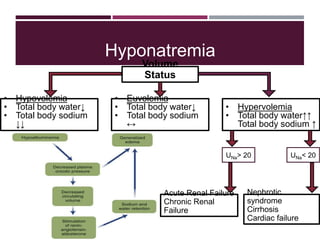
Hyponatremia
Volume
Status
• Hypovolemia
• Total body water↓
• Total body sodium
↓↓
• Euvolemia
• Total body water↓
• Total body sodium
↔
• Hypervolemia
• Total body water↑↑
Total body sodium ↑
UNa> 20 UNa< 20
Nephrotic
syndrome
Cirrhosis
Cardiac failure
Acute Renal Failure
Chronic Renal
Failure
Hyponatremia
Volume
Status
• Hypovolemia
• Total body water↓
• Total body sodium
↓↓
• Euvolemia
• Total body water↑
• Total body sodium
↔
• Hypervolemia
• Total body water↑↑
Total body sodium ↑
Una> 20
Glucocorticoid
deficiency
Polydipsia
SIAD- Syndrome of
Inappropiate
Antidiuresis
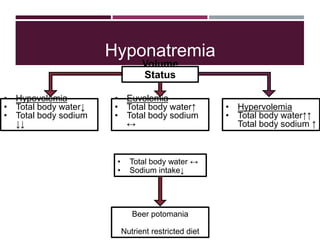
Hyponatremia
Volume
Status
• Hypovolemia
• Total body water↓
• Total body sodium
↓↓
• Euvolemia
• Total body water↑
• Total body sodium
↔
• Hypervolemia
• Total body water↑↑
Total body sodium ↑
• Total body water ↔
• Sodium intake↓
Beer potomania
Nutrient restricted diet
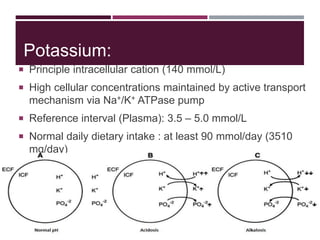
Potassium:
 Principle intracellular cation (140 mmol/L)
 High cellular concentrations maintained by active transport
mechanism via Na+/K+ ATPase pump
 Reference interval (Plasma): 3.5 – 5.0 mmol/L
 Normal daily dietary intake : at least 90 mmol/day (3510
mg/day)
Functions:
 Maintenance of ionic gradients which is required for:
• Nerve impulse transmission
• Muscle contractility
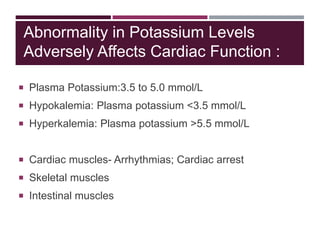
Abnormality in Potassium Levels
Adversely Affects Cardiac Function :
 Plasma Potassium:3.5 to 5.0 mmol/L
 Hypokalemia: Plasma potassium <3.5 mmol/L
 Hyperkalemia: Plasma potassium >5.5 mmol/L
 Cardiac muscles- Arrhythmias; Cardiac arrest
 Skeletal muscles
 Intestinal muscles
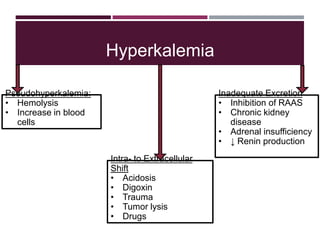
Hyperkalemia
Pseudohyperkalemia:
• Hemolysis
• Increase in blood
cells
Intra- to Extracellular
Shift
• Acidosis
• Digoxin
• Trauma
• Tumor lysis
• Drugs
Inadequate Excretion
• Inhibition of RAAS
• Chronic kidney
disease
• Adrenal insufficiency
• ↓ Renin production
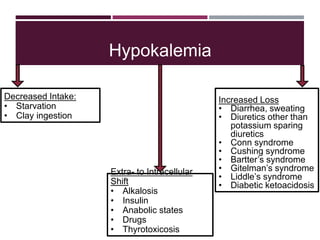
Hypokalemia
Decreased Intake:
• Starvation
• Clay ingestion
Extra- to Intracellular
Shift
• Alkalosis
• Insulin
• Anabolic states
• Drugs
• Thyrotoxicosis
Increased Loss
• Diarrhea, sweating
• Diuretics other than
potassium sparing
diuretics
• Conn syndrome
• Cushing syndrome
• Bartter’s syndrome
• Gitelman’s syndrome
• Liddle’s syndrome
• Diabetic ketoacidosis
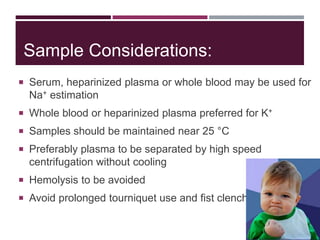
Sample Considerations:
 Serum, heparinized plasma or whole blood may be used for
Na+ estimation
 Whole blood or heparinized plasma preferred for K+
 Samples should be maintained near 25 °C
 Preferably plasma to be separated by high speed
centrifugation without cooling
 Hemolysis to be avoided
 Avoid prolonged tourniquet use and fist clenching
Techniques for Estimation of Na+ and
K+
 Ion selective electrode (ISE)
 Atomic absorption spectroscopy
 Flame emission photometry
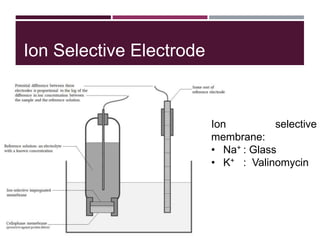
Ion Selective Electrode
Ion selective
membrane:
• Na+ : Glass
• K+ : Valinomycin
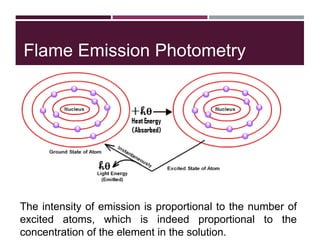
Flame Emission Photometry
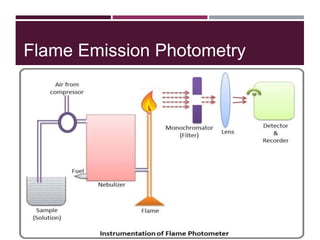
The intensity of emission is proportional to the number of
excited atoms, which is indeed proportional to the
concentration of the element in the solution.
Flame Emission Photometry
 Ion selective electrode (ISE)
 Atomic absorption spectroscopy
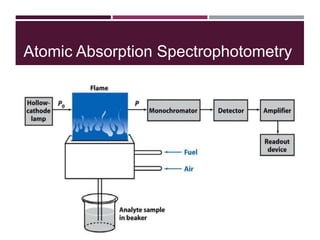
Atomic Absorption Spectrophotometry
THANK
YOU

Serum Electrolytes

  • 1.
    Estimation of Sodium& Potassium Ashikh Seethy Senior Resident Department of Biochemistry
  • 2.
    Objectives: At the endof this briefing, you should be able to describe:  The distribution of Na+, K+ and water in the body.  The role of Na+ and K+ in maintenance of homeostasis.  The different pathological conditions in which Na+ and K+ balance is disturbed.  Various techniques utilized for estimation of serum Na+ and K+.
  • 3.
    The Body asOrganized “Solutions” In the body of a young adult male:  Proteins:18%  Minerals: 7%  Fat: 15%  Water: 60%
  • 4.
    Fluids Compartments: Total BodyWater: 42 L Intra-cellular Fluid 28 L 66% Extra- cellular Fluid 14 L 34% Interstitial Fluid 10.5 L Plasma 3.5 L
  • 5.
    Electrolytes and Proteins areUnequally Distributed Among the Body Fluids
  • 6.
    Osmolality:  Measure ofthe number of osmotically active particles in serum.  Calculated serum osmolality = (2 x serum Na+) + Glucose + Urea (in mmol/L).  Estimated in lab by Osmometer (based on colligative properties).  Reference interval: 275–295 mOsmol/kg of water.
  • 7.
    Water Balance isRegulated by the Hypothalamus, the Neurohypophysis and the Kidneys
  • 8.
    Action of Vasopressinin Renal Tubules:
  • 9.
    Water and electrolytescan be lost through  Gastrointestinal tract  Skin  Bronchial tree etc.  But kidneys are the only organs able to conserve or excrete electrolytes and water under tight regulatory control.
  • 10.
    Osmolality: Carbonic Anhydrase Inhibitors Loop Diuretics BartterSyndrome Thiazide Diuretics Gitelman Syndrome Minerallocorticoid-R Antagonists Liddle Syndrome ENaC Na+
  • 11.
    Nephron is theTarget of Many Hormones
  • 12.
  • 13.
    Sodium:  Principle cationof ECF  Reference interval (Plasma): 136 to 145 mmol/L  Recommended daily dietary intake : < 2 g (<5 g salt)  Na+ levels are regulated by the kidneys Functions:  Maintains normal water distribution and osmolality  Maintenance of membrane potential  Absorption of chloride, amino acids, and glucose
  • 14.
    Abnormality in SodiumLevels Affects Neuronal Function:  Plasma sodium:136 to 145 mmol/L  Hyponatremia: Plasma sodium <135 mmol/L  Hypernatremia: Plasma sodium >145 mmol/L
  • 15.
    Hypernatremia ECF Volume Increased • Totalbody water↑ • Total body sodium↑↑ Not Increased • Total body water↓↓ • Total body sodium↓ Hypertonic NaCl NaHCO3 Insensible water loss GI water loss Central Diabetes Insipidus Nephrogenic Diabetes Insipidus Osmotic Diuresis
  • 16.
    Hyponatremia Volume Status • Hypovolemia • Totalbody water↓ • Total body sodium ↓↓ • Euvolemia • Total body water↑ Total body sodium ↔ • Hypervolemia • Total body water↑↑ Total body sodium ↑ UNa> 20 UNa< 20
  • 17.
    Hyponatremia Volume Status • Hypovolemia • Totalbody water↓ • Total body sodium ↓↓ • Euvolemia • Total body water↑ • Total body sodium ↔ • Hypervolemia • Total body water↑↑ Total body sodium ↑ UNa> 20 UNa< 20 Renal losses Diuretics ↓↓ Minerallocorticoids Osmotic diuresis Metabolic alkalosis
  • 18.
    Hyponatremia Volume Status • Hypovolemia • Totalbody water↓ • Total body sodium ↓↓ • Euvolemia • Total body water↑ • Total body sodium ↔ • Hypervolemia • Total body water↑↑ • Total body sodium ↑ UNa> 20 UNa< 20 Renal losses Diuretics ↓↓ Minerallocorticoids Osmotic diuresis Metabolic alkalosis Extra-renal losses Vomiting Diarrhea Trauma Pancreatitis
  • 19.
    Hyponatremia Volume Status • Hypovolemia • Totalbody water↓ • Total body sodium ↓↓ • Euvolemia • Total body water↓ • Total body sodium ↔ • Hypervolemia • Total body water↑↑ Total body sodium ↑ UNa> 20 UNa< 20 Nephrotic syndrome Cirrhosis Cardiac failure Acute Renal Failure Chronic Renal Failure
  • 20.
    Hyponatremia Volume Status • Hypovolemia • Totalbody water↓ • Total body sodium ↓↓ • Euvolemia • Total body water↑ • Total body sodium ↔ • Hypervolemia • Total body water↑↑ Total body sodium ↑ Una> 20 Glucocorticoid deficiency Polydipsia SIAD- Syndrome of Inappropiate Antidiuresis
  • 21.
    Hyponatremia Volume Status • Hypovolemia • Totalbody water↓ • Total body sodium ↓↓ • Euvolemia • Total body water↑ • Total body sodium ↔ • Hypervolemia • Total body water↑↑ Total body sodium ↑ • Total body water ↔ • Sodium intake↓ Beer potomania Nutrient restricted diet
  • 22.
    Potassium:  Principle intracellularcation (140 mmol/L)  High cellular concentrations maintained by active transport mechanism via Na+/K+ ATPase pump  Reference interval (Plasma): 3.5 – 5.0 mmol/L  Normal daily dietary intake : at least 90 mmol/day (3510 mg/day) Functions:  Maintenance of ionic gradients which is required for: • Nerve impulse transmission • Muscle contractility
  • 23.
    Abnormality in PotassiumLevels Adversely Affects Cardiac Function :  Plasma Potassium:3.5 to 5.0 mmol/L  Hypokalemia: Plasma potassium <3.5 mmol/L  Hyperkalemia: Plasma potassium >5.5 mmol/L  Cardiac muscles- Arrhythmias; Cardiac arrest  Skeletal muscles  Intestinal muscles
  • 24.
    Hyperkalemia Pseudohyperkalemia: • Hemolysis • Increasein blood cells Intra- to Extracellular Shift • Acidosis • Digoxin • Trauma • Tumor lysis • Drugs Inadequate Excretion • Inhibition of RAAS • Chronic kidney disease • Adrenal insufficiency • ↓ Renin production
  • 25.
    Hypokalemia Decreased Intake: • Starvation •Clay ingestion Extra- to Intracellular Shift • Alkalosis • Insulin • Anabolic states • Drugs • Thyrotoxicosis Increased Loss • Diarrhea, sweating • Diuretics other than potassium sparing diuretics • Conn syndrome • Cushing syndrome • Bartter’s syndrome • Gitelman’s syndrome • Liddle’s syndrome • Diabetic ketoacidosis
  • 26.
    Sample Considerations:  Serum,heparinized plasma or whole blood may be used for Na+ estimation  Whole blood or heparinized plasma preferred for K+  Samples should be maintained near 25 °C  Preferably plasma to be separated by high speed centrifugation without cooling  Hemolysis to be avoided  Avoid prolonged tourniquet use and fist clenching
  • 27.
    Techniques for Estimationof Na+ and K+  Ion selective electrode (ISE)  Atomic absorption spectroscopy  Flame emission photometry
  • 28.
    Ion Selective Electrode Ionselective membrane: • Na+ : Glass • K+ : Valinomycin
  • 29.
    Flame Emission Photometry Theintensity of emission is proportional to the number of excited atoms, which is indeed proportional to the concentration of the element in the solution.
  • 30.
    Flame Emission Photometry Ion selective electrode (ISE)  Atomic absorption spectroscopy
  • 31.
  • 32.