LABORATORY SAFETY 
Dr. Ashok Kumar Jeppu 
Biochemistry Unit 
International Medical School 
Management and Science University 
Malaysia
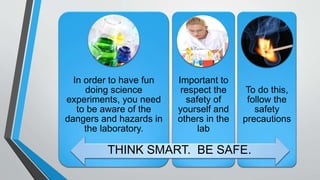
In order to have fun 
doing science 
experiments, you need 
to be aware of the 
dangers and hazards in 
the laboratory. 
Important to 
respect the 
safety of 
yourself and 
others in the 
lab 
To do this, 
follow the 
safety 
precautions 
THINK SMART. BE SAFE.
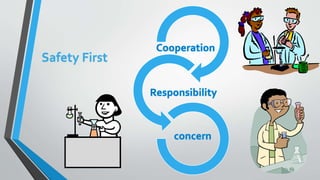
Safety First
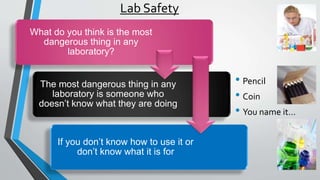
Lab Safety 
What do you think is the most 
dangerous thing in any 
laboratory? 
The most dangerous thing in any 
laboratory is someone who 
doesn’t know what they are doing 
If you don’t know how to use it or 
don’t know what it is for 
• Pencil 
• Coin 
• You name it…
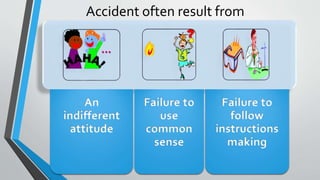
Accident often result from
GENERAL 
SAFETY RULES
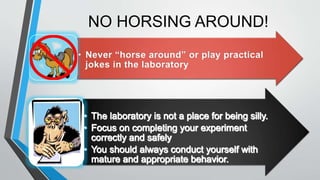
NO HORSING AROUND!
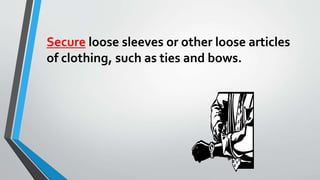
Secure loose sleeves or other loose articles 
of clothing, such as ties and bows.
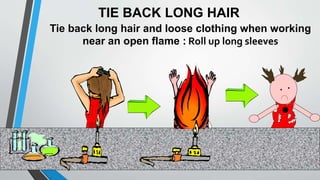
TIE BACK LONG HAIR 
Tie back long hair and loose clothing when working 
near an open flame : Roll up long sleeves
During lab work, keep your hands away from 
your face 
Don’t wear open-toed shoes or sandals in 
laboratory situations
Never put anything into your mouth during 
a lab experiment 
Never eat, drink, or apply cosmetics in a 
laboratory setting; food, drink, and cosmetics 
can easily become contaminated with 
dangerous chemicals
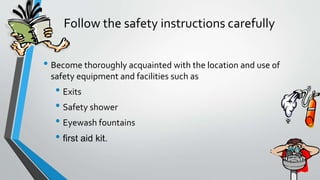
Follow the safety instructions carefully 
• Become thoroughly acquainted with the location and use of 
safety equipment and facilities such as 
• Exits 
• Safety shower 
• Eyewash fountains 
• first aid kit.
Notify your teacher if any accidents 
occur
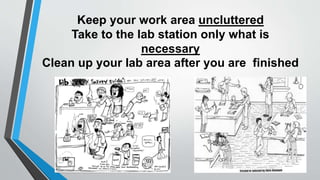
Keep your work area uncluttered 
Take to the lab station only what is 
necessary 
Clean up your lab area after you are finished
Chemical Safety
Chemical Safety 
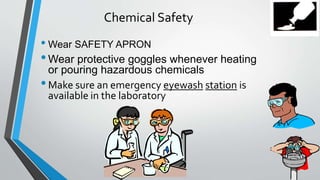
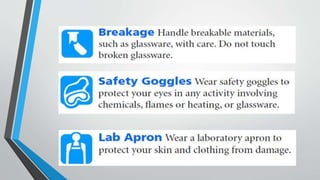
• Wear SAFETY APRON 
•Wear protective goggles whenever heating 
or pouring hazardous chemicals 
• Make sure an emergency eyewash station is 
available in the laboratory
Chemical Safety 
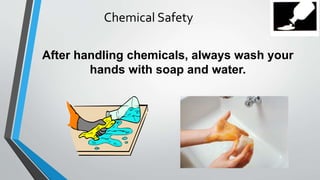
After handling chemicals, always wash your 
hands with soap and water.
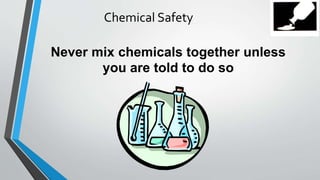
Chemical Safety 
Never mix chemicals together unless 
you are told to do so
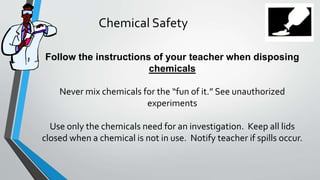
Chemical Safety 
Follow the instructions of your teacher when disposing 
chemicals 
Never mix chemicals for the “fun of it.” See unauthorized 
experiments 
Use only the chemicals need for an investigation. Keep all lids 
closed when a chemical is not in use. Notify teacher if spills occur.
Chemical Safety 
• Dispose of all chemicals as instructed by teacher. To avoid 
contamination do not return chemicals to their original containers 
• Be careful when working with chemicals such as acids or bases. 
Always pour them over the sink rather than over your work area 
• When diluting an acid always add small amounts of Acid to Water. 
A to W. Awww. W to A. WAAAAA! 
• Rinse acids or bases off of skin immediately. Notify teacher 
immediately of spills.
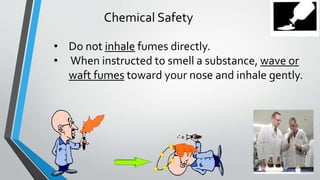
Chemical Safety 
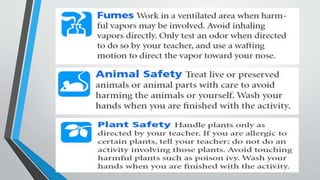
• Do not inhale fumes directly. 
• When instructed to smell a substance, wave or 
waft fumes toward your nose and inhale gently.
Chemical Safety 
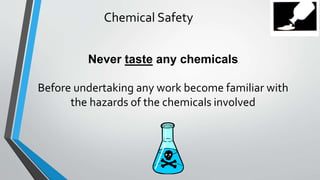
Never taste any chemicals 
Before undertaking any work become familiar with 
the hazards of the chemicals involved
Glassware Safety
Glassware Safety 
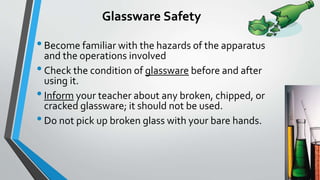
• Become familiar with the hazards of the apparatus 
and the operations involved 
• Check the condition of glassware before and after 
using it. 
• Inform your teacher about any broken, chipped, or 
cracked glassware; it should not be used. 
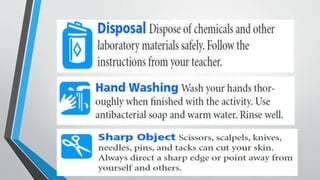
• Do not pick up broken glass with your bare hands.
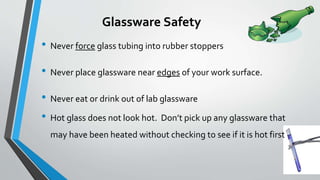
Glassware Safety 
• Never force glass tubing into rubber stoppers 
• Never place glassware near edges of your work surface. 
• Never eat or drink out of lab glassware 
• Hot glass does not look hot. Don’t pick up any glassware that 
may have been heated without checking to see if it is hot first
Using Sharp Instruments 
• Handle scalpels and razor blades with extreme care. 
• Never cut material toward yourself or others. Cut away from 
you and others. 
• Notify your teacher if you cut yourself.
Electrical Safety
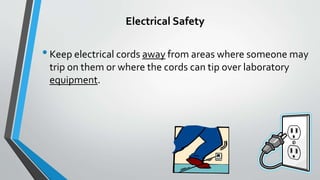
Electrical Safety 
• Keep electrical cords away from areas where someone may 
trip on them or where the cords can tip over laboratory 
equipment.
Electrical Safety 
•Never handle electrical equipment with wet 
hands. 
• Be sure your hands and your lab area are dry 
before using electrical equipment
Electrical Safety 
•Never poke anything into electrical outlets 
•Unplug cords by pulling the plug and NOT 
the cord 
•Turn off and unplug all electrical equipment 
as soon as you are finished using the 
equipment.
Heating Safety
Heating Safety 
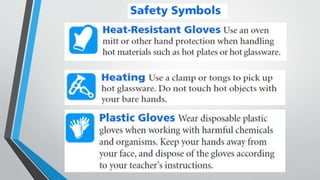
1. Let hotplates cool down before touching them. Test 
to see if they are cool enough by bringing the back of 
your hand close to them. 
2. Use tongs to handle hot objects. 
3. The only type of glassware that may safely be 
heated is either Kimax or Pyrex. 
4. Never heat anything that you are not instructed to 
heat
Heating Safety 
•Never heat a closed container 
•Point test tubes or bottles that are being heated 
away from you and others. Chemicals can boil or 
splash out of the tube 
•Only glassware that is thoroughly dry should be 
heated. 
•Never leave a hotplate unattended.
Fire Safety
Fire Safety 
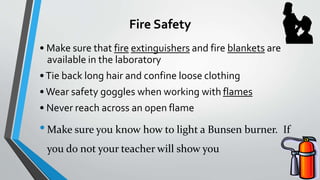
• Make sure that fire extinguishers and fire blankets are 
available in the laboratory 
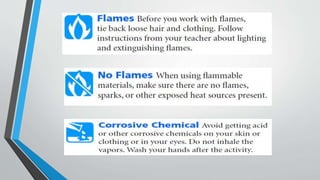
• Tie back long hair and confine loose clothing 
• Wear safety goggles when working with flames 
• Never reach across an open flame 
•Make sure you know how to light a Bunsen burner. If 
you do not your teacher will show you
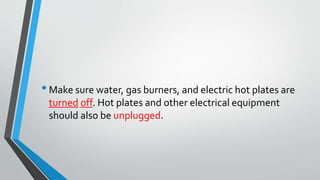
• Make sure water, gas burners, and electric hot plates are 
turned off. Hot plates and other electrical equipment 
should also be unplugged.
First Aid 
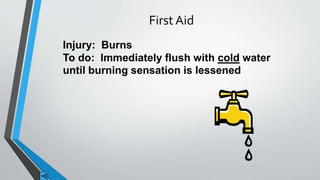
Injury: Burns 
To do: Immediately flush with cold water 
until burning sensation is lessened
First Aid 
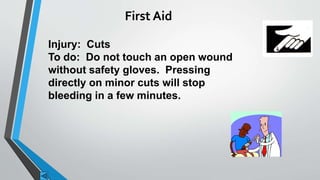
Injury: Cuts 
To do: Do not touch an open wound 
without safety gloves. Pressing 
directly on minor cuts will stop 
bleeding in a few minutes.
First Aid 
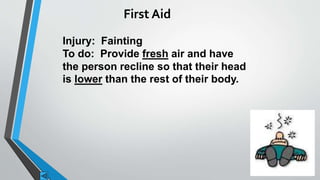
Injury: Fainting 
To do: Provide fresh air and have 
the person recline so that their head 
is lower than the rest of their body.
First Aid 
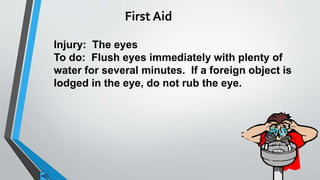
Injury: The eyes 
To do: Flush eyes immediately with plenty of 
water for several minutes. If a foreign object is 
lodged in the eye, do not rub the eye.
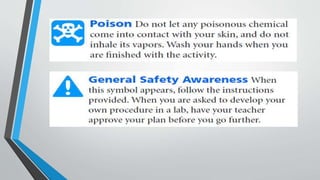
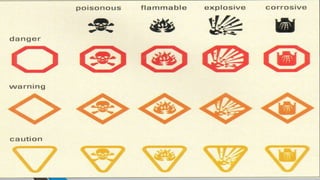
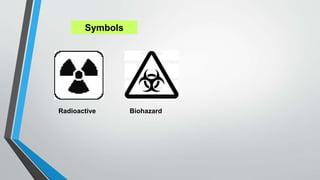
Symbols 
Radioactive Biohazard
Lab Safety Rules 
Dress Code 
1.Wear a lab coat or apron when directed 
2.Wear safety goggles when directed. 
3. Tie back loose hair whenever chemicals or open flames 
are being used. 
4.Do not wear loose, baggy clothing or loose jewelry (ID 
badge lanyards) when working with chemicals or open 
flames.
Lab Safety Rules 
General Safety 
• Listen and follow directions 
• No Monkey or Horseplay 
• Don’t eat or drink without permission 
• Keep your hands and place dry 
• Touch electrical instruments with dry hand 
• Be careful with hot or electrical appliances
•Tell your teacher if anything breaks or spills 
•Clean your desk before and after experiments 
•Wash your hands 
•Handle animals with care and respect 
•Report all accidents, no matter how minor, immediately 
to the teacher. 
•Know what to do in the case of specific accidents such as 
acid spills, fires, or chemicals on skin or in eyes.
To Summarize 
1. Use common sense. 
2. Follow the teacher’s directions. 
3. If you don’t know, ask. 
4. Do the right thing.
Thank You 
BE SMART! THINK SAFE!
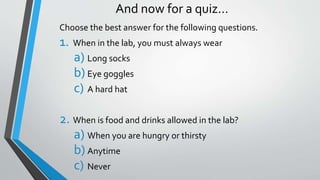
And now for a quiz… 
Choose the best answer for the following questions. 
1. When in the lab, you must always wear 
a) Long socks 
b) Eye goggles 
c) A hard hat 
2. When is food and drinks allowed in the lab? 
a) When you are hungry or thirsty 
b) Anytime 
c) Never
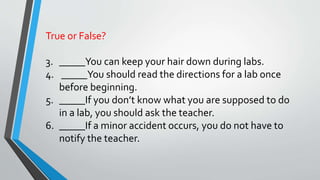
True or False? 
3. _____You can keep your hair down during labs. 
4. _____You should read the directions for a lab once 
before beginning. 
5. _____If you don’t know what you are supposed to do 
in a lab, you should ask the teacher. 
6. _____If a minor accident occurs, you do not have to 
notify the teacher.
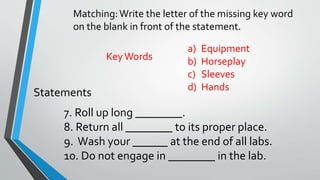
Matching: Write the letter of the missing key word 
on the blank in front of the statement. 
a) Equipment 
b) Horseplay 
c) Sleeves 
d) Hands 
Key Words 
Statements 
7. Roll up long ________. 
8. Return all ________ to its proper place. 
9. Wash your ______ at the end of all labs. 
10. Do not engage in ________ in the lab.

Lab safety by dr. Ashok kumar j

  • 1.
    LABORATORY SAFETY Dr.Ashok Kumar Jeppu Biochemistry Unit International Medical School Management and Science University Malaysia
  • 3.
    In order tohave fun doing science experiments, you need to be aware of the dangers and hazards in the laboratory. Important to respect the safety of yourself and others in the lab To do this, follow the safety precautions THINK SMART. BE SAFE.
  • 4.
  • 5.
    Lab Safety Whatdo you think is the most dangerous thing in any laboratory? The most dangerous thing in any laboratory is someone who doesn’t know what they are doing If you don’t know how to use it or don’t know what it is for • Pencil • Coin • You name it…
  • 6.
  • 7.
  • 8.
  • 9.
    Secure loose sleevesor other loose articles of clothing, such as ties and bows.
  • 10.
    TIE BACK LONGHAIR Tie back long hair and loose clothing when working near an open flame : Roll up long sleeves
  • 11.
    During lab work,keep your hands away from your face Don’t wear open-toed shoes or sandals in laboratory situations
  • 12.
    Never put anythinginto your mouth during a lab experiment Never eat, drink, or apply cosmetics in a laboratory setting; food, drink, and cosmetics can easily become contaminated with dangerous chemicals
  • 13.
    Follow the safetyinstructions carefully • Become thoroughly acquainted with the location and use of safety equipment and facilities such as • Exits • Safety shower • Eyewash fountains • first aid kit.
  • 14.
    Notify your teacherif any accidents occur
  • 15.
    Keep your workarea uncluttered Take to the lab station only what is necessary Clean up your lab area after you are finished
  • 16.
  • 17.
    Chemical Safety •Wear SAFETY APRON •Wear protective goggles whenever heating or pouring hazardous chemicals • Make sure an emergency eyewash station is available in the laboratory
  • 18.
    Chemical Safety Afterhandling chemicals, always wash your hands with soap and water.
  • 19.
    Chemical Safety Nevermix chemicals together unless you are told to do so
  • 20.
    Chemical Safety Followthe instructions of your teacher when disposing chemicals Never mix chemicals for the “fun of it.” See unauthorized experiments Use only the chemicals need for an investigation. Keep all lids closed when a chemical is not in use. Notify teacher if spills occur.
  • 21.
    Chemical Safety •Dispose of all chemicals as instructed by teacher. To avoid contamination do not return chemicals to their original containers • Be careful when working with chemicals such as acids or bases. Always pour them over the sink rather than over your work area • When diluting an acid always add small amounts of Acid to Water. A to W. Awww. W to A. WAAAAA! • Rinse acids or bases off of skin immediately. Notify teacher immediately of spills.
  • 22.
    Chemical Safety •Do not inhale fumes directly. • When instructed to smell a substance, wave or waft fumes toward your nose and inhale gently.
  • 23.
    Chemical Safety Nevertaste any chemicals Before undertaking any work become familiar with the hazards of the chemicals involved
  • 24.
  • 25.
    Glassware Safety •Become familiar with the hazards of the apparatus and the operations involved • Check the condition of glassware before and after using it. • Inform your teacher about any broken, chipped, or cracked glassware; it should not be used. • Do not pick up broken glass with your bare hands.
  • 26.
    Glassware Safety •Never force glass tubing into rubber stoppers • Never place glassware near edges of your work surface. • Never eat or drink out of lab glassware • Hot glass does not look hot. Don’t pick up any glassware that may have been heated without checking to see if it is hot first
  • 27.
    Using Sharp Instruments • Handle scalpels and razor blades with extreme care. • Never cut material toward yourself or others. Cut away from you and others. • Notify your teacher if you cut yourself.
  • 28.
  • 29.
    Electrical Safety •Keep electrical cords away from areas where someone may trip on them or where the cords can tip over laboratory equipment.
  • 30.
    Electrical Safety •Neverhandle electrical equipment with wet hands. • Be sure your hands and your lab area are dry before using electrical equipment
  • 31.
    Electrical Safety •Neverpoke anything into electrical outlets •Unplug cords by pulling the plug and NOT the cord •Turn off and unplug all electrical equipment as soon as you are finished using the equipment.
  • 32.
  • 33.
    Heating Safety 1.Let hotplates cool down before touching them. Test to see if they are cool enough by bringing the back of your hand close to them. 2. Use tongs to handle hot objects. 3. The only type of glassware that may safely be heated is either Kimax or Pyrex. 4. Never heat anything that you are not instructed to heat
  • 34.
    Heating Safety •Neverheat a closed container •Point test tubes or bottles that are being heated away from you and others. Chemicals can boil or splash out of the tube •Only glassware that is thoroughly dry should be heated. •Never leave a hotplate unattended.
  • 35.
  • 36.
    Fire Safety •Make sure that fire extinguishers and fire blankets are available in the laboratory • Tie back long hair and confine loose clothing • Wear safety goggles when working with flames • Never reach across an open flame •Make sure you know how to light a Bunsen burner. If you do not your teacher will show you
  • 37.
    • Make surewater, gas burners, and electric hot plates are turned off. Hot plates and other electrical equipment should also be unplugged.
  • 45.
    First Aid Injury:Burns To do: Immediately flush with cold water until burning sensation is lessened
  • 46.
    First Aid Injury:Cuts To do: Do not touch an open wound without safety gloves. Pressing directly on minor cuts will stop bleeding in a few minutes.
  • 47.
    First Aid Injury:Fainting To do: Provide fresh air and have the person recline so that their head is lower than the rest of their body.
  • 48.
    First Aid Injury:The eyes To do: Flush eyes immediately with plenty of water for several minutes. If a foreign object is lodged in the eye, do not rub the eye.
  • 50.
  • 51.
    Lab Safety Rules Dress Code 1.Wear a lab coat or apron when directed 2.Wear safety goggles when directed. 3. Tie back loose hair whenever chemicals or open flames are being used. 4.Do not wear loose, baggy clothing or loose jewelry (ID badge lanyards) when working with chemicals or open flames.
  • 52.
    Lab Safety Rules General Safety • Listen and follow directions • No Monkey or Horseplay • Don’t eat or drink without permission • Keep your hands and place dry • Touch electrical instruments with dry hand • Be careful with hot or electrical appliances
  • 53.
    •Tell your teacherif anything breaks or spills •Clean your desk before and after experiments •Wash your hands •Handle animals with care and respect •Report all accidents, no matter how minor, immediately to the teacher. •Know what to do in the case of specific accidents such as acid spills, fires, or chemicals on skin or in eyes.
  • 54.
    To Summarize 1.Use common sense. 2. Follow the teacher’s directions. 3. If you don’t know, ask. 4. Do the right thing.
  • 55.
    Thank You BESMART! THINK SAFE!
  • 56.
    And now fora quiz… Choose the best answer for the following questions. 1. When in the lab, you must always wear a) Long socks b) Eye goggles c) A hard hat 2. When is food and drinks allowed in the lab? a) When you are hungry or thirsty b) Anytime c) Never
  • 57.
    True or False? 3. _____You can keep your hair down during labs. 4. _____You should read the directions for a lab once before beginning. 5. _____If you don’t know what you are supposed to do in a lab, you should ask the teacher. 6. _____If a minor accident occurs, you do not have to notify the teacher.
  • 58.
    Matching: Write theletter of the missing key word on the blank in front of the statement. a) Equipment b) Horseplay c) Sleeves d) Hands Key Words Statements 7. Roll up long ________. 8. Return all ________ to its proper place. 9. Wash your ______ at the end of all labs. 10. Do not engage in ________ in the lab.

Editor's Notes