
TESTS FOR PANCREATIC AND
INTESTINAL FUNCTIONS
Dr.S.Sethupathy,M.D,Ph.D.,
Professor of Biochemistry,
Rajah Muthiah Medical college,
Annamalai university
PANCREATIC FUNCTION TESTS
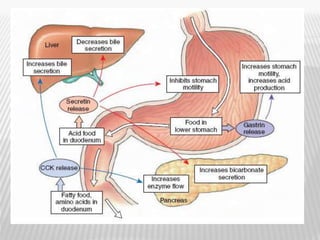
 Pancreas performs both exocrine and endocrine
functions.
 Exocrine pancreas secretes about 1000-2500 ml of
juice in 24 hrs.
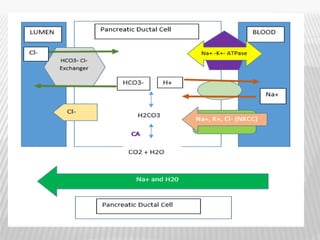
 The pancreatic juice is alkaline and contains
bicarbonate and enzymes.
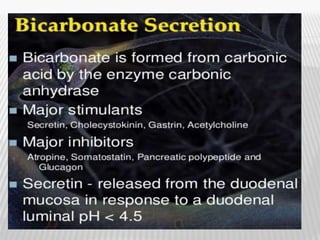
 Secretin from duodenum induces the secretion of
juice with high bicarbonate.
 Cholecystokinin (CCK) produces enzyme rich
pancreatic secretion.
 Gastrin from stomach stimulates CCK production.
PANCREATIC ENZYMES
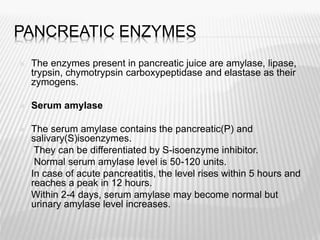
 The enzymes present in pancreatic juice are amylase, lipase,
trypsin, chymotrypsin carboxypeptidase and elastase as their
zymogens.
 Serum amylase
 The serum amylase contains the pancreatic(P) and
salivary(S)isoenzymes.
 They can be differentiated by S-isoenzyme inhibitor.
 Normal serum amylase level is 50-120 units.
 In case of acute pancreatitis, the level rises within 5 hours and
reaches a peak in 12 hours.
 Within 2-4 days, serum amylase may become normal but
urinary amylase level increases.
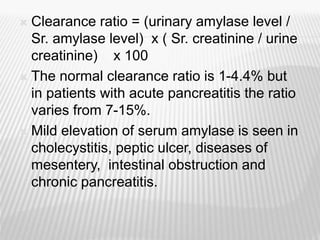
 Clearance ratio = (urinary amylase level /
Sr. amylase level) x ( Sr. creatinine / urine
creatinine) x 100
 The normal clearance ratio is 1-4.4% but
in patients with acute pancreatitis the ratio
varies from 7-15%.
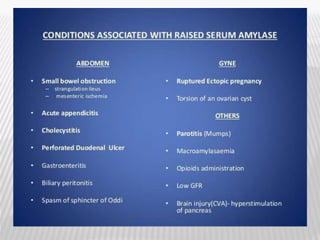
 Mild elevation of serum amylase is seen in
cholecystitis, peptic ulcer, diseases of
mesentery, intestinal obstruction and
chronic pancreatitis.
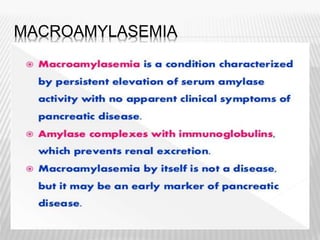
MACROAMYLASEMIA
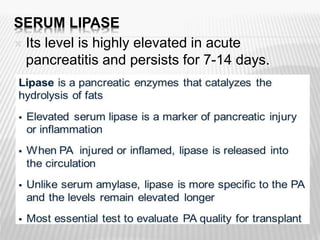
SERUM LIPASE
 Its level is highly elevated in acute
pancreatitis and persists for 7-14 days.

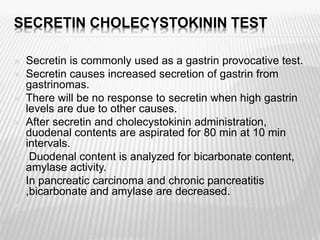
SECRETIN CHOLECYSTOKININ TEST
 Secretin is commonly used as a gastrin provocative test.
 Secretin causes increased secretion of gastrin from
gastrinomas.
 There will be no response to secretin when high gastrin
levels are due to other causes.
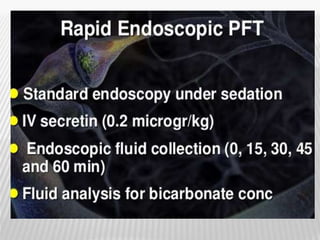
 After secretin and cholecystokinin administration,
duodenal contents are aspirated for 80 min at 10 min
intervals.
 Duodenal content is analyzed for bicarbonate content,
amylase activity.
 In pancreatic carcinoma and chronic pancreatitis
,bicarbonate and amylase are decreased.

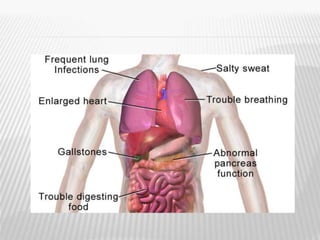
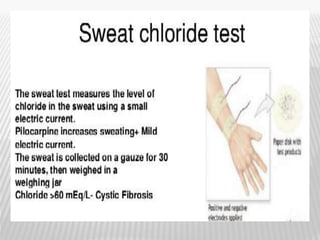
SWEAT ELECTROLYTES
 In pancreatic fibrocystic diseases, sweat
sodium chloride is increased.
 Sweat chloride more than 60 nmol/L on
two separate occasions is diagnostic of
cystic fibrosis

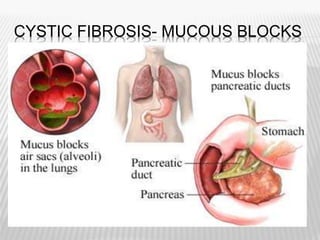
CYSTIC FIBROSIS- MUCOUS BLOCKS
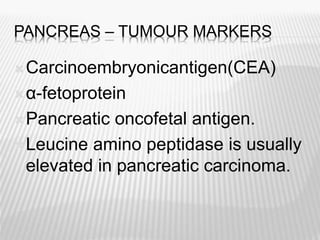
PANCREAS – TUMOUR MARKERS
Carcinoembryonicantigen(CEA)
α-fetoprotein
Pancreatic oncofetal antigen.
Leucine amino peptidase is usually
elevated in pancreatic carcinoma.
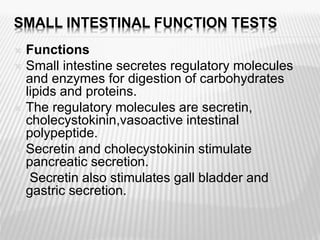
SMALL INTESTINAL FUNCTION TESTS
 Functions
 Small intestine secretes regulatory molecules
and enzymes for digestion of carbohydrates
lipids and proteins.
 The regulatory molecules are secretin,
cholecystokinin,vasoactive intestinal
polypeptide.
 Secretin and cholecystokinin stimulate
pancreatic secretion.
 Secretin also stimulates gall bladder and
gastric secretion.

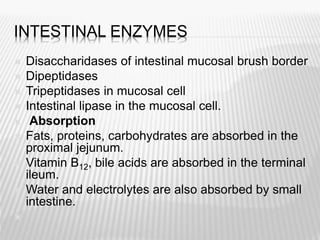
INTESTINAL ENZYMES
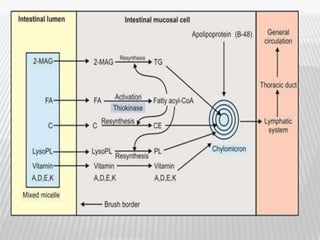
 Disaccharidases of intestinal mucosal brush border
 Dipeptidases
 Tripeptidases in mucosal cell
 Intestinal lipase in the mucosal cell.
 Absorption
 Fats, proteins, carbohydrates are absorbed in the
proximal jejunum.
 Vitamin B12, bile acids are absorbed in the terminal
ileum.
 Water and electrolytes are also absorbed by small
intestine.

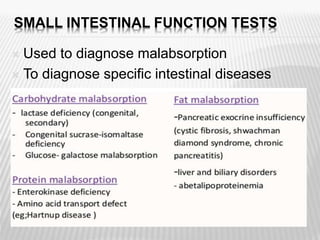
SMALL INTESTINAL FUNCTION TESTS
 Used to diagnose malabsorption
 To diagnose specific intestinal diseases
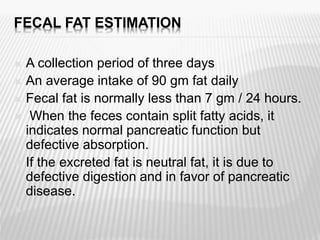
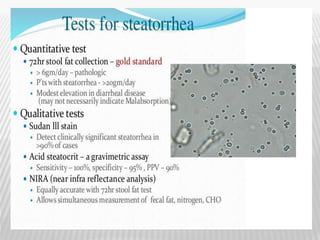
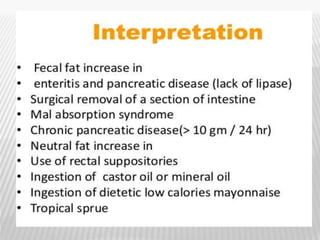
FECAL FAT ESTIMATION
 A collection period of three days
 An average intake of 90 gm fat daily
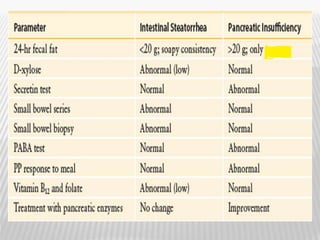
 Fecal fat is normally less than 7 gm / 24 hours.
 When the feces contain split fatty acids, it
indicates normal pancreatic function but
defective absorption.
 If the excreted fat is neutral fat, it is due to
defective digestion and in favor of pancreatic
disease.

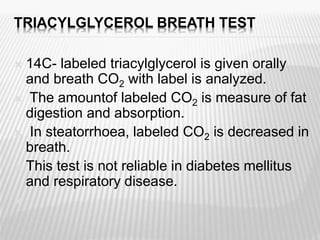
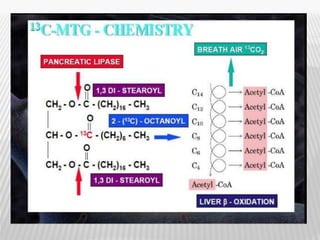
TRIACYLGLYCEROL BREATH TEST
 14C- labeled triacylglycerol is given orally
and breath CO2 with label is analyzed.
 The amountof labeled CO2 is measure of fat
digestion and absorption.
 In steatorrhoea, labeled CO2 is decreased in
breath.
 This test is not reliable in diabetes mellitus
and respiratory disease.

LACTOSE TOLERANCE TEST
 50 gm lactose is given orally and increase in
blood glucose level is evaluated.
 The lactose tolerance test requires an individual
to drink a liquid that contains lactose.
 Several blood samples are taken over a two
hour period
 The blood test is considered abnormal if
glucose level rises less than 20 mg/dL (1.1
mmol/L) within 2 hours of drinking
the lactose solution.
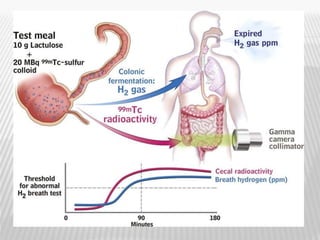
LACTOSE BREATH TEST
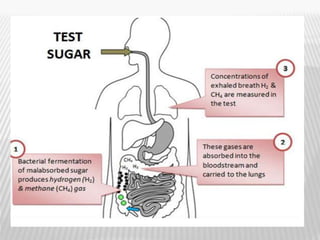
 14C labeled lactose is given orally and
breath 14C labeled CO2 is estimated.
 In lactose intolerance labeled CO2 will be
low.

AMINO ACIDS ABSORPTION
 Specific disorders of amino acid transport
affect both proximal jejunum and proximal
renal tubules.
 Eg.Cystinuria, Hartnup disease.
 Diagnosed by chromatography of amino
acids in urine samples.
TESTS FOR GUT PERMEABILITY
 Normally lactulose is not absorbed by intestinal
mucosal cell whereas rhammose is well
absorbed.
 In case of Celiac disease and Crohn’s disease,
there will be increased absorption of lactulose
and decreased absorption of rhammose.
 Alcohol also alters gut permeability and
increases the absorption of endotoxin leading to
liver injury.
TESTS FOR ABSORPTIONS DEFECTS
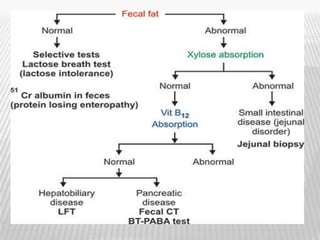
 51cr EDTA
 51 Cr EDTA is given orally
 It is increased excretion in urine indicates
altered gut permeability.
 It is not to be done in renal failure

 Test for protein loss
 51 Cr- albumin excretion is increased in protein
losing enteropathy.

TESTS FOR BACTERIAL GROWTH
 By intubation intestinal samples collected are
analyzed for bacterial contamination.
 It is an invasive procedure.
 Indican is derived from tryptophan by bacterial
overgrowth.
 It results in increased excretion of indican in urine.
 14C- Xylose breath test
 Xylose is metabolized by bacteria and labeled CO2 is
released in breath.

 14C-glycocholatebreath test
Glycocholate is deconjugated by bacteria and labeled
CO2 appears in breath.
 In bacterial overgrowth, there will be increase in
labeled CO2 in breath.
 Schilling’s test
 Pernicious anemia.
 Initially body B12 stores are replenished by B12
injection.
 Then radio labeled B12 is given orally and the
excretion of labeled B12 indicates the presence of
intrinsic factor.
 If labeled B12 and intrinsic factor are given orally and
labeled B12 is not excreted, it indicates intestinal
disease.
 Detection of antibodies
 Antibodies of a gliadin detected in
plasma in Celiac disease.
 Tropical sprue is characterized by
villous atrophy and malabsorption.
 It may be due to bacterial infection and
respond to broad spectrum antibiotics.
 Antibodies to gliadin are not present.
CARCINOID SYNDROME
 Increased excretion of 5-hydroxy indole acetic acid
(5-HIAA).
 Normal excretion of HIAA is less than 7 mg/day
 Carcinoid syndrome is caused by tumor of
Argentaffin cells from small intestine
 It produces large amount of serotonin and the
metabolites of it, 5- HIAA.
 Tumor markers
 Serum CA 125 and carcino embryonic antigen
(CEA) are increased in colon cancer.


Thank you

Tests for pancreatic and intestinal functions

  • 1.
    TESTS FOR PANCREATICAND INTESTINAL FUNCTIONS Dr.S.Sethupathy,M.D,Ph.D., Professor of Biochemistry, Rajah Muthiah Medical college, Annamalai university
  • 2.
    PANCREATIC FUNCTION TESTS Pancreas performs both exocrine and endocrine functions.  Exocrine pancreas secretes about 1000-2500 ml of juice in 24 hrs.  The pancreatic juice is alkaline and contains bicarbonate and enzymes.  Secretin from duodenum induces the secretion of juice with high bicarbonate.  Cholecystokinin (CCK) produces enzyme rich pancreatic secretion.  Gastrin from stomach stimulates CCK production.
  • 9.
    PANCREATIC ENZYMES  Theenzymes present in pancreatic juice are amylase, lipase, trypsin, chymotrypsin carboxypeptidase and elastase as their zymogens.  Serum amylase  The serum amylase contains the pancreatic(P) and salivary(S)isoenzymes.  They can be differentiated by S-isoenzyme inhibitor.  Normal serum amylase level is 50-120 units.  In case of acute pancreatitis, the level rises within 5 hours and reaches a peak in 12 hours.  Within 2-4 days, serum amylase may become normal but urinary amylase level increases.
  • 10.
     Clearance ratio= (urinary amylase level / Sr. amylase level) x ( Sr. creatinine / urine creatinine) x 100  The normal clearance ratio is 1-4.4% but in patients with acute pancreatitis the ratio varies from 7-15%.  Mild elevation of serum amylase is seen in cholecystitis, peptic ulcer, diseases of mesentery, intestinal obstruction and chronic pancreatitis.
  • 11.
  • 13.
    SERUM LIPASE  Itslevel is highly elevated in acute pancreatitis and persists for 7-14 days. 
  • 14.
    SECRETIN CHOLECYSTOKININ TEST Secretin is commonly used as a gastrin provocative test.  Secretin causes increased secretion of gastrin from gastrinomas.  There will be no response to secretin when high gastrin levels are due to other causes.  After secretin and cholecystokinin administration, duodenal contents are aspirated for 80 min at 10 min intervals.  Duodenal content is analyzed for bicarbonate content, amylase activity.  In pancreatic carcinoma and chronic pancreatitis ,bicarbonate and amylase are decreased. 
  • 18.
    SWEAT ELECTROLYTES  Inpancreatic fibrocystic diseases, sweat sodium chloride is increased.  Sweat chloride more than 60 nmol/L on two separate occasions is diagnostic of cystic fibrosis 
  • 19.
  • 22.
    PANCREAS – TUMOURMARKERS Carcinoembryonicantigen(CEA) α-fetoprotein Pancreatic oncofetal antigen. Leucine amino peptidase is usually elevated in pancreatic carcinoma.
  • 23.
    SMALL INTESTINAL FUNCTIONTESTS  Functions  Small intestine secretes regulatory molecules and enzymes for digestion of carbohydrates lipids and proteins.  The regulatory molecules are secretin, cholecystokinin,vasoactive intestinal polypeptide.  Secretin and cholecystokinin stimulate pancreatic secretion.  Secretin also stimulates gall bladder and gastric secretion. 
  • 25.
    INTESTINAL ENZYMES  Disaccharidasesof intestinal mucosal brush border  Dipeptidases  Tripeptidases in mucosal cell  Intestinal lipase in the mucosal cell.  Absorption  Fats, proteins, carbohydrates are absorbed in the proximal jejunum.  Vitamin B12, bile acids are absorbed in the terminal ileum.  Water and electrolytes are also absorbed by small intestine. 
  • 26.
    SMALL INTESTINAL FUNCTIONTESTS  Used to diagnose malabsorption  To diagnose specific intestinal diseases
  • 27.
    FECAL FAT ESTIMATION A collection period of three days  An average intake of 90 gm fat daily  Fecal fat is normally less than 7 gm / 24 hours.  When the feces contain split fatty acids, it indicates normal pancreatic function but defective absorption.  If the excreted fat is neutral fat, it is due to defective digestion and in favor of pancreatic disease. 
  • 35.
    TRIACYLGLYCEROL BREATH TEST 14C- labeled triacylglycerol is given orally and breath CO2 with label is analyzed.  The amountof labeled CO2 is measure of fat digestion and absorption.  In steatorrhoea, labeled CO2 is decreased in breath.  This test is not reliable in diabetes mellitus and respiratory disease. 
  • 38.
    LACTOSE TOLERANCE TEST 50 gm lactose is given orally and increase in blood glucose level is evaluated.  The lactose tolerance test requires an individual to drink a liquid that contains lactose.  Several blood samples are taken over a two hour period  The blood test is considered abnormal if glucose level rises less than 20 mg/dL (1.1 mmol/L) within 2 hours of drinking the lactose solution.
  • 39.
    LACTOSE BREATH TEST 14C labeled lactose is given orally and breath 14C labeled CO2 is estimated.  In lactose intolerance labeled CO2 will be low. 
  • 41.
    AMINO ACIDS ABSORPTION Specific disorders of amino acid transport affect both proximal jejunum and proximal renal tubules.  Eg.Cystinuria, Hartnup disease.  Diagnosed by chromatography of amino acids in urine samples.
  • 42.
    TESTS FOR GUTPERMEABILITY  Normally lactulose is not absorbed by intestinal mucosal cell whereas rhammose is well absorbed.  In case of Celiac disease and Crohn’s disease, there will be increased absorption of lactulose and decreased absorption of rhammose.  Alcohol also alters gut permeability and increases the absorption of endotoxin leading to liver injury.
  • 43.
    TESTS FOR ABSORPTIONSDEFECTS  51cr EDTA  51 Cr EDTA is given orally  It is increased excretion in urine indicates altered gut permeability.  It is not to be done in renal failure   Test for protein loss  51 Cr- albumin excretion is increased in protein losing enteropathy. 
  • 44.
    TESTS FOR BACTERIALGROWTH  By intubation intestinal samples collected are analyzed for bacterial contamination.  It is an invasive procedure.  Indican is derived from tryptophan by bacterial overgrowth.  It results in increased excretion of indican in urine.  14C- Xylose breath test  Xylose is metabolized by bacteria and labeled CO2 is released in breath. 
  • 46.
     14C-glycocholatebreath test Glycocholateis deconjugated by bacteria and labeled CO2 appears in breath.  In bacterial overgrowth, there will be increase in labeled CO2 in breath.  Schilling’s test  Pernicious anemia.  Initially body B12 stores are replenished by B12 injection.  Then radio labeled B12 is given orally and the excretion of labeled B12 indicates the presence of intrinsic factor.  If labeled B12 and intrinsic factor are given orally and labeled B12 is not excreted, it indicates intestinal disease.
  • 47.
     Detection ofantibodies  Antibodies of a gliadin detected in plasma in Celiac disease.  Tropical sprue is characterized by villous atrophy and malabsorption.  It may be due to bacterial infection and respond to broad spectrum antibiotics.  Antibodies to gliadin are not present.
  • 48.
    CARCINOID SYNDROME  Increasedexcretion of 5-hydroxy indole acetic acid (5-HIAA).  Normal excretion of HIAA is less than 7 mg/day  Carcinoid syndrome is caused by tumor of Argentaffin cells from small intestine  It produces large amount of serotonin and the metabolites of it, 5- HIAA.  Tumor markers  Serum CA 125 and carcino embryonic antigen (CEA) are increased in colon cancer.  
  • 50.