Dr.S.Sethupathy, M.D.Ph.D.,
Professor of Biochemistry,
Rajah Muthiah Medical College,
Annamalai University
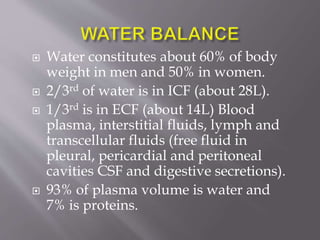
 Water constitutes about 60% of body
weight in men and 50% in women.
 2/3rd of water is in ICF (about 28L).
 1/3rd is in ECF (about 14L) Blood
plasma, interstitial fluids, lymph and
transcellular fluids (free fluid in
pleural, pericardial and peritoneal
cavities CSF and digestive secretions).
 93% of plasma volume is water and
7% is proteins.
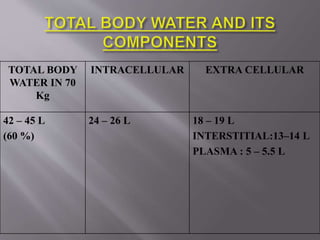
TOTAL BODY
WATER IN 70
Kg
INTRACELLULAR EXTRA CELLULAR
42 – 45 L
(60 %)
24 – 26 L 18 – 19 L
INTERSTITIAL:13–14 L
PLASMA : 5 – 5.5 L
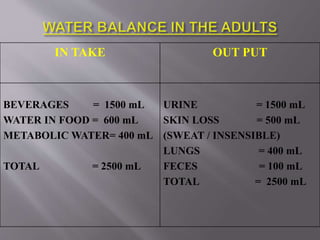
IN TAKE OUT PUT
BEVERAGES = 1500 mL
WATER IN FOOD = 600 mL
METABOLIC WATER= 400 mL
TOTAL = 2500 mL
URINE = 1500 mL
SKIN LOSS = 500 mL
(SWEAT / INSENSIBLE)
LUNGS = 400 mL
FECES = 100 mL
TOTAL = 2500 mL
 Maintained by the electrolyte balance
and the Antidiuretic Hormone (ADH)
and thirst mechanism
 Proximal Renal Convoluted Tubules &
Collecting Ducts have small integral
proteins hydrophilic Aquaporin
Channels AQP1, AQP2, AQP3, AQP4
& AQP6
 Under the influence of ADH , water
reabsorption enhanced.
 Water content of ICF and ECF is
determined by osmolality of them
 The osmolality between the two
must be equal
 Other wise the water will move
from lower osmolality to high
osmolality until new equilibrium
is attained.
 Non-brain capillary endothelium is
permeable to everything except
colloid
 Only colloid is osmotically active at
non-brain capillary membrane.
 Cell membrane and healthy BBB
are only permeable to water,
therefore, all ions, sugars and
large molecules are osmotically
active at cell membrane and BBB.
 Behaves just like the cell
membrane– a tight, lipid rich
membrane which is
impermeable to everything but
water and lipophilic drugs.
Ions: Na+ , Cl-, K+, PO4---
Sugars: glucose, mannitol
Large molecules (colloids): proteins,
albumin, hetastarch
 It is diffusion of water down its concentration
gradient.
 Osmotic pressure is a property of solutions
that depends on the number of osmotically
active molecules or ions in solution and not
upon the ionic charge of those molecules, the
size of the molecules, or the physical-chemical
properties of the molecules.
 1 gram-molecular weight (1 mole) of a
compound (such as glucose) is termed 1
osmole (osmol, Osm).
 Most biological concentrations are expressed in
milliosmolar (mOsm) or microOsmolar (µOsm)
concentrations.
 Ionized molecules (e.g. NaCl) dissociate in solution
and therefore 1 mM of NaCl exerts 2 mOsm ;
 1mM of CaCl2 - 3 mOsm of osmotic pressure
 Osmolality is the expression of this quantity of
osmotically active particles per 1000 gm of water or
solvent
 Osmolarity expresses the number of osmotically
active particles per liter of solvent.
 Brain trauma: mannitol to shrink normal
brain to make room for mass lesion.
 Brain trauma or blood loss: Hypertonic
saline to shrink normal brain or expand ISF
and IVF.
 Hyperglycemia causes osmotic diuresis and
hypovolemia.
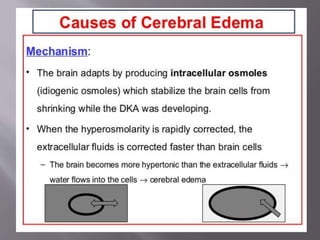
 Hyperglycemia causes brain dehydration
(with potential for cerebral edema with
rapid correction of hyperglycemia).
 WATER DEPLETION : occurs in
variety of diseases like diarrhea,
vomiting, fever, burns etc.
 The loss of water increases plasma
osmolality and causes dehydration of
ICF especially CNS tissues
 It is more dangerous than ECF
dehydration
 It may result in coma and death in
severe cases.
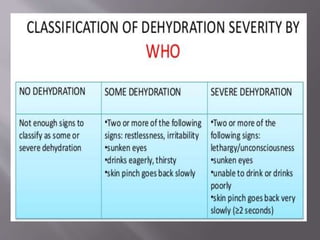
 Occurs when fluid loss exceeds
intake
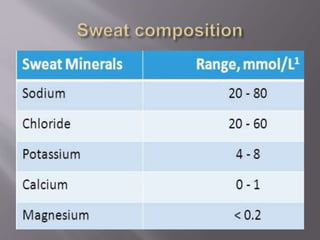
 sweating vs time
 Fluid lost mostly from ECF
 decreased circulating blood volume
inadequate tissue perfusion, inefficient
transport of substrates to muscle, and
elevated HR
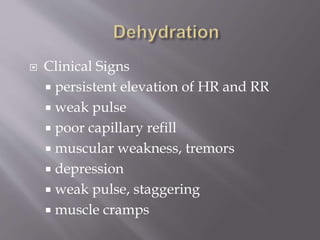
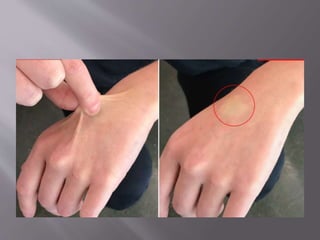
 Clinical Signs
 persistent elevation of HR and RR
 weak pulse
 poor capillary refill
 muscular weakness, tremors
 depression
 weak pulse, staggering
 muscle cramps
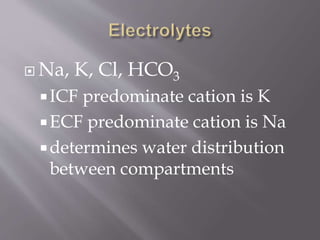
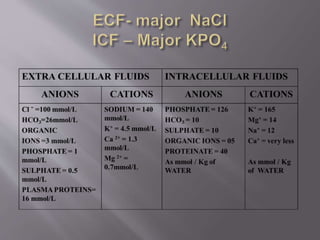
 Na, K, Cl, HCO3
ICF predominate cation is K
ECF predominate cation is Na
determines water distribution
between compartments
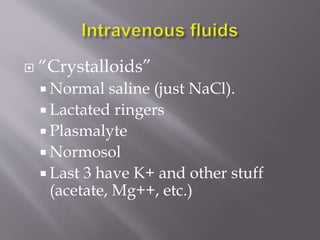
 “Crystalloids”
 Normal saline (just NaCl).
 Lactated ringers
 Plasmalyte
 Normosol
 Last 3 have K+ and other stuff
(acetate, Mg++, etc.)
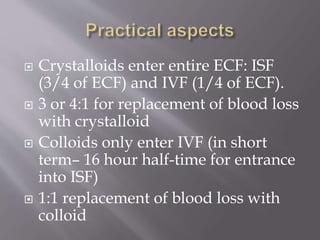
 Crystalloids enter entire ECF: ISF
(3/4 of ECF) and IVF (1/4 of ECF).
 3 or 4:1 for replacement of blood loss
with crystalloid
 Colloids only enter IVF (in short
term– 16 hour half-time for entrance
into ISF)
 1:1 replacement of blood loss with
colloid
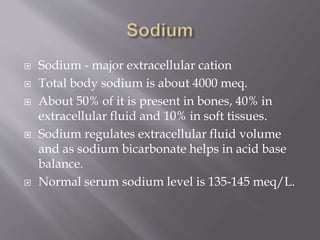
 Sodium - major extracellular cation
 Total body sodium is about 4000 meq.
 About 50% of it is present in bones, 40% in
extracellular fluid and 10% in soft tissues.
 Sodium regulates extracellular fluid volume
and as sodium bicarbonate helps in acid base
balance.
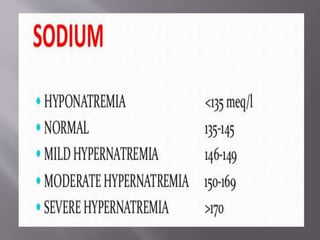
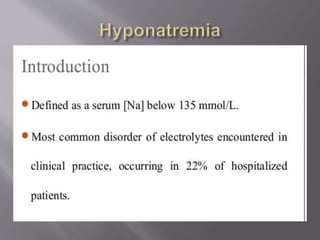
 Normal serum sodium level is 135-145 meq/L.
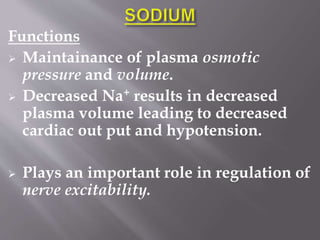
Functions
 Maintainance of plasma osmotic
pressure and volume.
 Decreased Na+ results in decreased
plasma volume leading to decreased
cardiac out put and hypotension.
 Plays an important role in regulation of
nerve excitability.
 Due to its association with
chloride, it serves as an important
source of Cl- for formation of HCl
in gastric juice and in transport of
carbon dioxide from tissues to the
lungs.
 Involved in exchange for H+ ion
excretion from kidneys and helps
in the regulation of blood pH.
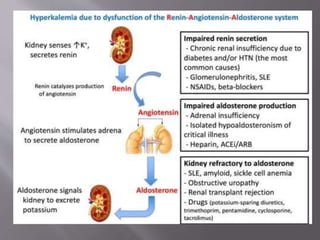
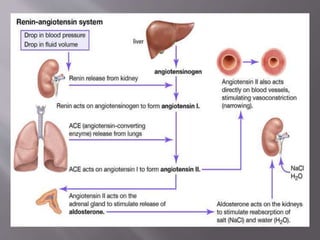
 ‘Renin’ is a proteolytic enzyme secreted by
‘juxtaglomerular apparatus’ adjacent to
renal glomeruli.
 It splits A Decapeptide, ‘Angiotensin-I’
From
Αlpha-2 Globulin.
 Another Peptidase ‘Angiotensin
Converting Enzyme (ACE)’ Present Mostly
In Lungs Converts It Into A Hormone
‘Angiotensin-II’
1. Cause Vasoconstriction and
Maintains Blood Pressure.
2.Stimulates cells of zona
glomerulosa in adrenal cortex to
synthesize and secret
mineralocorticoid hormone
Aldosterone.
DISORDERS OF ALDOSTERONE
 PRIMARY ALDOSTERONISM
‘(CONN,S SYNDROME)’.
 ‘ADENOMAS ‘OF GLOMERULOSA
CELLS.
CLINICAL FEATURES
 Na+ RETENTION AND
‘HYPERTENTION’
 Hypokalemia AND ‘ALKALOSIS’.
 MUSCLES PARASTHESIAS’,
WEAKNESS, ‘PARALYSIS’.
 ‘POLYDIPSIA’, ‘POLYURIA’ AND
‘TETANY’.
TREATMENT
 REMOVAL OF ‘TUMOUR’ AND
SPIRANOLACTONE THERAPY.
SECONDARY ALDOSTERONISM
 Renal artery stenosis’ : Hyperplasia
and Hyperfunction of ‘Juxtaglomerular
cells’.
CIRRHOSIS OF LIVER
CARDIAC FAILURE
NEPHROTIC SYNDROME’
.
 Signs and symptoms same as in
‘Primary’.
ALDOSTERONE
 Plasma aldosterone, supine position
and normal sodium diet: 2-9 ng/dl (55 -
250 pmol/L)
 Upright position (standing / seated for at
least 2 hr) and normal sodium diet: 2 - 5x
supine value.
 Urine aldosterone: 5 - 20 μmg/24 hr (14 -
56 nmol/24 hr)
 FUNCTIONS
 Reabsorption of Na+ in exchange for K+
and H+ .
 Glomerular filtrate contains sodium 800
gm/day
 99% is reabsorbed mainly in PCT.
 Aldosterone increases sodium
reabsorption in distal tubules.
 Sodium restriction is advised in
congestive cardiac failure, hypertension.
 In edema, sodium content is increased.
 It enters the cells through
ATPdependent ‘Sodium
Potassium ATPase’ pump.
 It is reabsorbed from renal
tubules under the effect of
Aldosterone.
 ACTH, Deoxycorticosterone
also cause renal reabsorption
to some extent.
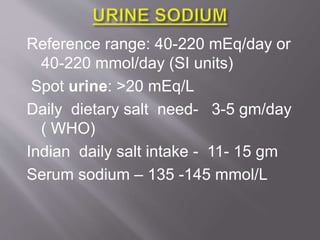
Reference range: 40-220 mEq/day or
40-220 mmol/day (SI units)
Spot urine: >20 mEq/L
Daily dietary salt need- 3-5 gm/day
( WHO)
Indian daily salt intake - 11- 15 gm
Serum sodium – 135 -145 mmol/L
 Cushing’s disease
 Prolonged cortisome therapy
 Pregnancy – sodium is retained.
 In predominant water loss
sodium concentration is
increased.
 Old age- if lesser access to water
 DECREASED INTAKE OF WATER,
UNCONSCIOUSNESS
 DAMAGE TO THIRST CENTRE
 EXCESSIVE WATER LOSS AS IN DIABETES
INSIPIDUS
 GLYCOSURIA – osmotic diuresis
 EXCESSIVE INTAKE OF Na+ IN DIET OR IN
DRUGS,
 EXCESSIVE RETENTION OF Na+ AS IN
CUSHING,S SYNDROME AND CONN,S
SYNDROME.
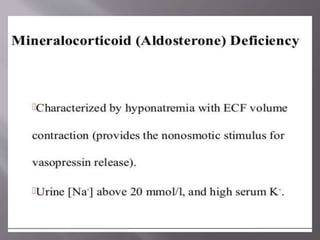
 Vomiting , diarrhoea, burns,Addison’s disease
 Severe sweating -results in muscle cramps and
head ache.
 In cases of hyperlipidemia or hyper
globulinamia, there is a apparent decrease of
serum sodium known as ( Isotonic
hyponatremia) or pseudohyponatremia.
 In hyper glycemia serum sodium
concentration reduced by 1.6 meq/L per 100
mg/dl glucose due to shifting of water into
extracellular fluid.
 Isotonic (proteins or lipids dilute Na+ on bulk
basis). Often called “artifactual.” “Watery”
portion of serum has normal tonicity.
 Hypertonic (osmotic agent “sucks” water out
of ICF, diluting Na+, but tonicity stays high).
 Hypotonic. By far the most common (and
hardest to understand).
 Hyperproteinemia or hyperlipidemia dilutes
out the Na+. [Na+] in the water portion of the
blood is normal.
 Glycine solution with TURP.
 Treatment is to work up and treat underlying
cause
Protein or lipid
“phase”
[NaCl] = 0
Aqueous “phase”
[NaCl] = 135
Serum
(combined)
[NaCl] = 123
Isotonic hyponatremia (“artifactual”). Protein or lipid
takes up some of the plasma volume. Aqueous “portion”
of plasma has normal [NaCl].
Osmolarity
(tonicity)
normal
 Due to hyperglycemia, mannitol or glycerol.
 Decreased [Na+] in serum, but osmolality is
high (>290), due to sugar in the blood.
 Sugar has “sucked” water out of cells, into the
ECF. Water dilutes Na+.
Water in ICF and
interstitial ECF
[NaCl] =
140 [NaCl] =
123
Glucose,
mannitol,
glycerol
Hypertonic hyponatremia– osmotically active sugar
“draws” water into vascular space, diluting NaCl, but
increasing overall osmolarity (tonicity).
Osmolarity (tonicity)
increased
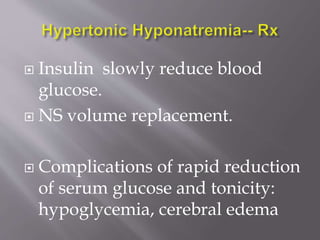
 Insulin slowly reduce blood
glucose.
 NS volume replacement.
 Complications of rapid reduction
of serum glucose and tonicity:
hypoglycemia, cerebral edema
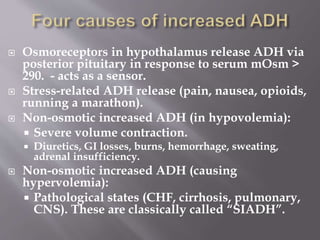
 Osmoreceptors in hypothalamus release ADH via
posterior pituitary in response to serum mOsm >
290. - acts as a sensor.
 Stress-related ADH release (pain, nausea, opioids,
running a marathon).
 Non-osmotic increased ADH (in hypovolemia):
 Severe volume contraction.
 Diuretics, GI losses, burns, hemorrhage, sweating,
adrenal insufficiency.
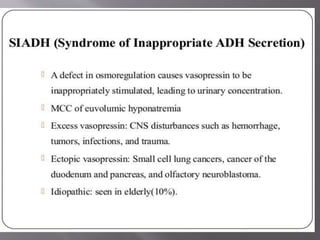
 Non-osmotic increased ADH (causing
hypervolemia):
 Pathological states (CHF, cirrhosis, pulmonary,
CNS). These are classically called “SIADH”.
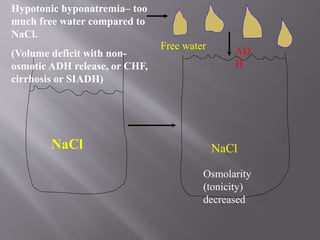
NaCl NaCl
Free water
Hypotonic hyponatremia– too
much free water compared to
NaCl.
(Volume deficit with non-
osmotic ADH release, or CHF,
cirrhosis or SIADH)
Osmolarity
(tonicity)
decreased
AD
H
 Therefore D5, 1/4 NS not to be
given in surgery.
 Only NS, Normosol or LR to be
given.
 Free water not given because of
kidney’s reduced ability to excrete it
(due to non-osmotic ADH release).
 Volume restoration with NS if
hypovolemic (GI losses, diuretics).
 Explanation: Severe hypovolemia causes
non-osmotic ADH release. Body tries to
“defend intravascular volume” by
secreting ADH.
 Volume restoration suppresses non-
osmotic ADH release and cures
hyponatremia by allowing free water
excretion.
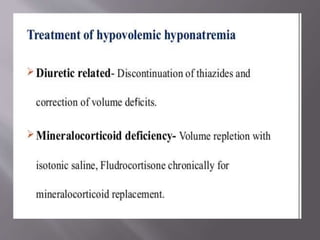
Hypovolemic
hyponatremia
Na+ loss > water loss
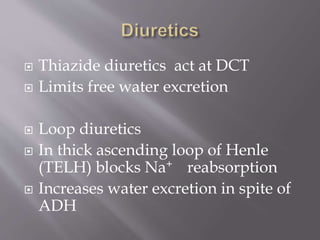
 Thiazide diuretics act at DCT
 Limits free water excretion
 Loop diuretics
 In thick ascending loop of Henle
(TELH) blocks Na+ reabsorption
 Increases water excretion in spite of
ADH
Euvolemic
hyponatremia
Water regained
more than Na+
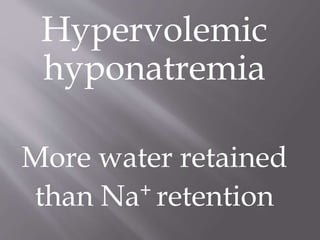
Hypervolemic
hyponatremia
More water retained
than Na+ retention
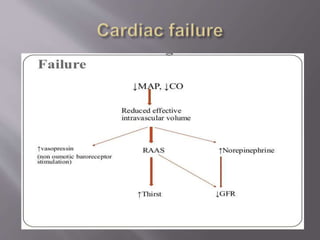
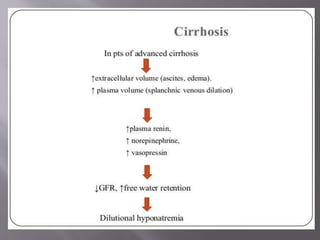
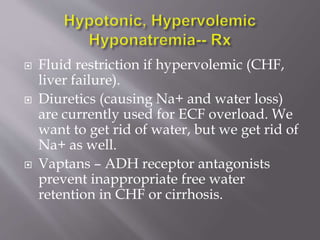
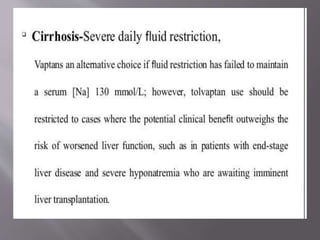
 Fluid restriction if hypervolemic (CHF,
liver failure).
 Diuretics (causing Na+ and water loss)
are currently used for ECF overload. We
want to get rid of water, but we get rid of
Na+ as well.
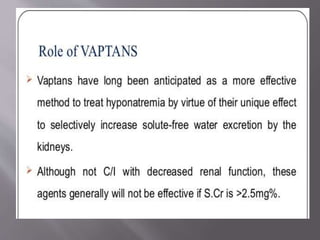
 Vaptans – ADH receptor antagonists
prevent inappropriate free water
retention in CHF or cirrhosis.
 Potassium is the major intracellular cation and
maintains intracellular osmotic pressure.
 Total body potassium is about 350 meq out of
which 75% is present in muscles.
 The depolarization and contraction of heart
muscle require potassium.
 During nerve transmission of impulses, there is
sodium influx and potassium effects with
depoloarization.
 During repolarization, these changes are reversed.
 Potassium ions easily pass by facilitated diffusion
thro pores of Potassium channel proteins.
 Rich sources are banana, orange,
apples , pineapple, almond,
dates ,beans and potato. Tender
coconut water is a good source.
 Daily requirement is 3-4 gms
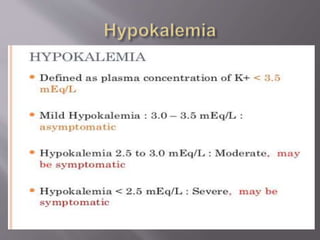
 Serum potassium level :
3.5-5.0 m eq/L
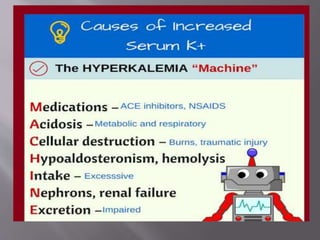
 If potassium level is more than 5.5 mmol/L, it
is known as hyper kelemia
 Features : ventiricular arrhythmia, ventricular
fibrillation, flacial paralysis, bradycardaic
cardiac arrest.
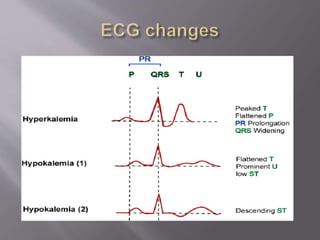
 ECG shows elevated towards widening of QRS
complex and lengthening of PR interval.
 Treatment is to give intravenous glucose and
insulin.
Clinical features
 Weakness and numbness of
muscles tingling of extremities.
 Broad QRS complex with peaked
“T” wave and no “P” wave.
 Arrhythmias like bradycardia
appear and heart may stock
diastole.
 It is seen in hemolysis,
thrombocytosis,
polycythemia.
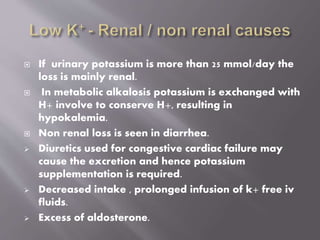
 If urinary potassium is more than 25 mmol/day the
loss is mainly renal.
 In metabolic alkalosis potassium is exchanged with
H+ involve to conserve H+, resulting in
hypokalemia.
 Non renal loss is seen in diarrhea.
 Diuretics used for congestive cardiac failure may
cause the excretion and hence potassium
supplementation is required.
 Decreased intake , prolonged infusion of k+ free iv
fluids.
 Excess of aldosterone.
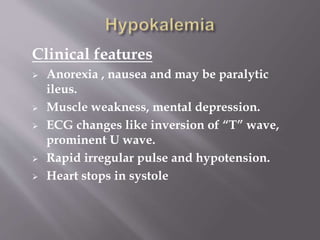
Clinical features
 Anorexia , nausea and may be paralytic
ileus.
 Muscle weakness, mental depression.
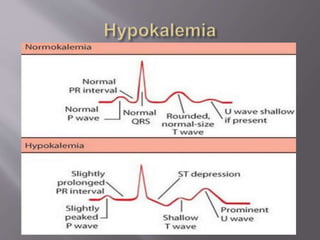
 ECG changes like inversion of “T” wave,
prominent U wave.
 Rapid irregular pulse and hypotension.
 Heart stops in systole
 Present in close association with
sodium .
 Maintainance of Water and Electrolytes
Balance.
 ‘Plasma Osmotic Pressure’.
 Acid base balance : in transport of CO2
from tissue to lungs in also in the
excretion of NH4 ions.
 Excessive vomiting which result in loss
of HCl.
 There will be compensatory increase in
plasma bicarbonate and there will be
hypochloremic metabolic alkalosis.
 Addison’s disease - diminished
reabsorption of NaCl.
 Respiratory alkalosis – CO2 eliminated,
HCO3
- increases and chloride decreases
 Chloride is inversely related to bicarbonate.
Causes:
 Dehydration
 Cushings syndrome- excess NaCl
reabsorption
 Severe diarrheoa – loss of bicarbonate
 Respiratory acidosis – Bicarbonate less
 Renal tubular acidosis – Bicarbonate less
 Hemodialysis
Water and electrolytes balance ss

Water and electrolytes balance ss

  • 1.
    Dr.S.Sethupathy, M.D.Ph.D., Professor ofBiochemistry, Rajah Muthiah Medical College, Annamalai University
  • 2.
     Water constitutesabout 60% of body weight in men and 50% in women.  2/3rd of water is in ICF (about 28L).  1/3rd is in ECF (about 14L) Blood plasma, interstitial fluids, lymph and transcellular fluids (free fluid in pleural, pericardial and peritoneal cavities CSF and digestive secretions).  93% of plasma volume is water and 7% is proteins.
  • 3.
    TOTAL BODY WATER IN70 Kg INTRACELLULAR EXTRA CELLULAR 42 – 45 L (60 %) 24 – 26 L 18 – 19 L INTERSTITIAL:13–14 L PLASMA : 5 – 5.5 L
  • 4.
    IN TAKE OUTPUT BEVERAGES = 1500 mL WATER IN FOOD = 600 mL METABOLIC WATER= 400 mL TOTAL = 2500 mL URINE = 1500 mL SKIN LOSS = 500 mL (SWEAT / INSENSIBLE) LUNGS = 400 mL FECES = 100 mL TOTAL = 2500 mL
  • 5.
     Maintained bythe electrolyte balance and the Antidiuretic Hormone (ADH) and thirst mechanism  Proximal Renal Convoluted Tubules & Collecting Ducts have small integral proteins hydrophilic Aquaporin Channels AQP1, AQP2, AQP3, AQP4 & AQP6  Under the influence of ADH , water reabsorption enhanced.
  • 6.
     Water contentof ICF and ECF is determined by osmolality of them  The osmolality between the two must be equal  Other wise the water will move from lower osmolality to high osmolality until new equilibrium is attained.
  • 7.
     Non-brain capillaryendothelium is permeable to everything except colloid  Only colloid is osmotically active at non-brain capillary membrane.
  • 8.
     Cell membraneand healthy BBB are only permeable to water, therefore, all ions, sugars and large molecules are osmotically active at cell membrane and BBB.
  • 9.
     Behaves justlike the cell membrane– a tight, lipid rich membrane which is impermeable to everything but water and lipophilic drugs.
  • 10.
    Ions: Na+ ,Cl-, K+, PO4--- Sugars: glucose, mannitol Large molecules (colloids): proteins, albumin, hetastarch
  • 11.
     It isdiffusion of water down its concentration gradient.  Osmotic pressure is a property of solutions that depends on the number of osmotically active molecules or ions in solution and not upon the ionic charge of those molecules, the size of the molecules, or the physical-chemical properties of the molecules.  1 gram-molecular weight (1 mole) of a compound (such as glucose) is termed 1 osmole (osmol, Osm).
  • 12.
     Most biologicalconcentrations are expressed in milliosmolar (mOsm) or microOsmolar (µOsm) concentrations.  Ionized molecules (e.g. NaCl) dissociate in solution and therefore 1 mM of NaCl exerts 2 mOsm ;  1mM of CaCl2 - 3 mOsm of osmotic pressure  Osmolality is the expression of this quantity of osmotically active particles per 1000 gm of water or solvent  Osmolarity expresses the number of osmotically active particles per liter of solvent.
  • 13.
     Brain trauma:mannitol to shrink normal brain to make room for mass lesion.  Brain trauma or blood loss: Hypertonic saline to shrink normal brain or expand ISF and IVF.  Hyperglycemia causes osmotic diuresis and hypovolemia.  Hyperglycemia causes brain dehydration (with potential for cerebral edema with rapid correction of hyperglycemia).
  • 14.
     WATER DEPLETION: occurs in variety of diseases like diarrhea, vomiting, fever, burns etc.  The loss of water increases plasma osmolality and causes dehydration of ICF especially CNS tissues  It is more dangerous than ECF dehydration  It may result in coma and death in severe cases.
  • 15.
     Occurs whenfluid loss exceeds intake  sweating vs time  Fluid lost mostly from ECF  decreased circulating blood volume inadequate tissue perfusion, inefficient transport of substrates to muscle, and elevated HR
  • 16.
     Clinical Signs persistent elevation of HR and RR  weak pulse  poor capillary refill  muscular weakness, tremors  depression  weak pulse, staggering  muscle cramps
  • 22.
     Na, K,Cl, HCO3 ICF predominate cation is K ECF predominate cation is Na determines water distribution between compartments
  • 23.
     “Crystalloids”  Normalsaline (just NaCl).  Lactated ringers  Plasmalyte  Normosol  Last 3 have K+ and other stuff (acetate, Mg++, etc.)
  • 24.
     Crystalloids enterentire ECF: ISF (3/4 of ECF) and IVF (1/4 of ECF).  3 or 4:1 for replacement of blood loss with crystalloid  Colloids only enter IVF (in short term– 16 hour half-time for entrance into ISF)  1:1 replacement of blood loss with colloid
  • 26.
     Sodium -major extracellular cation  Total body sodium is about 4000 meq.  About 50% of it is present in bones, 40% in extracellular fluid and 10% in soft tissues.  Sodium regulates extracellular fluid volume and as sodium bicarbonate helps in acid base balance.  Normal serum sodium level is 135-145 meq/L.
  • 27.
    Functions  Maintainance ofplasma osmotic pressure and volume.  Decreased Na+ results in decreased plasma volume leading to decreased cardiac out put and hypotension.  Plays an important role in regulation of nerve excitability.
  • 28.
     Due toits association with chloride, it serves as an important source of Cl- for formation of HCl in gastric juice and in transport of carbon dioxide from tissues to the lungs.  Involved in exchange for H+ ion excretion from kidneys and helps in the regulation of blood pH.
  • 29.
     ‘Renin’ isa proteolytic enzyme secreted by ‘juxtaglomerular apparatus’ adjacent to renal glomeruli.  It splits A Decapeptide, ‘Angiotensin-I’ From Αlpha-2 Globulin.  Another Peptidase ‘Angiotensin Converting Enzyme (ACE)’ Present Mostly In Lungs Converts It Into A Hormone ‘Angiotensin-II’
  • 30.
    1. Cause Vasoconstrictionand Maintains Blood Pressure. 2.Stimulates cells of zona glomerulosa in adrenal cortex to synthesize and secret mineralocorticoid hormone Aldosterone.
  • 32.
    DISORDERS OF ALDOSTERONE PRIMARY ALDOSTERONISM ‘(CONN,S SYNDROME)’.  ‘ADENOMAS ‘OF GLOMERULOSA CELLS. CLINICAL FEATURES  Na+ RETENTION AND ‘HYPERTENTION’  Hypokalemia AND ‘ALKALOSIS’.
  • 33.
     MUSCLES PARASTHESIAS’, WEAKNESS,‘PARALYSIS’.  ‘POLYDIPSIA’, ‘POLYURIA’ AND ‘TETANY’. TREATMENT  REMOVAL OF ‘TUMOUR’ AND SPIRANOLACTONE THERAPY.
  • 34.
    SECONDARY ALDOSTERONISM  Renalartery stenosis’ : Hyperplasia and Hyperfunction of ‘Juxtaglomerular cells’. CIRRHOSIS OF LIVER CARDIAC FAILURE NEPHROTIC SYNDROME’ .  Signs and symptoms same as in ‘Primary’.
  • 35.
    ALDOSTERONE  Plasma aldosterone,supine position and normal sodium diet: 2-9 ng/dl (55 - 250 pmol/L)  Upright position (standing / seated for at least 2 hr) and normal sodium diet: 2 - 5x supine value.  Urine aldosterone: 5 - 20 μmg/24 hr (14 - 56 nmol/24 hr)  FUNCTIONS  Reabsorption of Na+ in exchange for K+ and H+ .
  • 36.
     Glomerular filtratecontains sodium 800 gm/day  99% is reabsorbed mainly in PCT.  Aldosterone increases sodium reabsorption in distal tubules.  Sodium restriction is advised in congestive cardiac failure, hypertension.  In edema, sodium content is increased.
  • 37.
     It entersthe cells through ATPdependent ‘Sodium Potassium ATPase’ pump.  It is reabsorbed from renal tubules under the effect of Aldosterone.  ACTH, Deoxycorticosterone also cause renal reabsorption to some extent.
  • 38.
    Reference range: 40-220mEq/day or 40-220 mmol/day (SI units) Spot urine: >20 mEq/L Daily dietary salt need- 3-5 gm/day ( WHO) Indian daily salt intake - 11- 15 gm Serum sodium – 135 -145 mmol/L
  • 40.
     Cushing’s disease Prolonged cortisome therapy  Pregnancy – sodium is retained.  In predominant water loss sodium concentration is increased.  Old age- if lesser access to water
  • 41.
     DECREASED INTAKEOF WATER, UNCONSCIOUSNESS  DAMAGE TO THIRST CENTRE  EXCESSIVE WATER LOSS AS IN DIABETES INSIPIDUS  GLYCOSURIA – osmotic diuresis  EXCESSIVE INTAKE OF Na+ IN DIET OR IN DRUGS,  EXCESSIVE RETENTION OF Na+ AS IN CUSHING,S SYNDROME AND CONN,S SYNDROME.
  • 48.
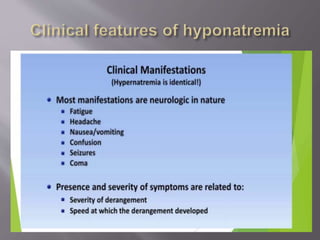
     Vomiting ,diarrhoea, burns,Addison’s disease  Severe sweating -results in muscle cramps and head ache.  In cases of hyperlipidemia or hyper globulinamia, there is a apparent decrease of serum sodium known as ( Isotonic hyponatremia) or pseudohyponatremia.  In hyper glycemia serum sodium concentration reduced by 1.6 meq/L per 100 mg/dl glucose due to shifting of water into extracellular fluid.
  • 49.
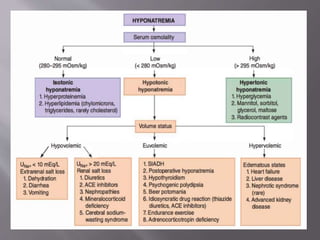
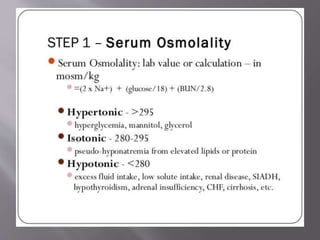
     Isotonic (proteinsor lipids dilute Na+ on bulk basis). Often called “artifactual.” “Watery” portion of serum has normal tonicity.  Hypertonic (osmotic agent “sucks” water out of ICF, diluting Na+, but tonicity stays high).  Hypotonic. By far the most common (and hardest to understand).
  • 50.
     Hyperproteinemia orhyperlipidemia dilutes out the Na+. [Na+] in the water portion of the blood is normal.  Glycine solution with TURP.  Treatment is to work up and treat underlying cause
  • 51.
    Protein or lipid “phase” [NaCl]= 0 Aqueous “phase” [NaCl] = 135 Serum (combined) [NaCl] = 123 Isotonic hyponatremia (“artifactual”). Protein or lipid takes up some of the plasma volume. Aqueous “portion” of plasma has normal [NaCl]. Osmolarity (tonicity) normal
  • 52.
     Due tohyperglycemia, mannitol or glycerol.  Decreased [Na+] in serum, but osmolality is high (>290), due to sugar in the blood.  Sugar has “sucked” water out of cells, into the ECF. Water dilutes Na+.
  • 53.
    Water in ICFand interstitial ECF [NaCl] = 140 [NaCl] = 123 Glucose, mannitol, glycerol Hypertonic hyponatremia– osmotically active sugar “draws” water into vascular space, diluting NaCl, but increasing overall osmolarity (tonicity). Osmolarity (tonicity) increased
  • 54.
     Insulin slowlyreduce blood glucose.  NS volume replacement.  Complications of rapid reduction of serum glucose and tonicity: hypoglycemia, cerebral edema
  • 56.
     Osmoreceptors inhypothalamus release ADH via posterior pituitary in response to serum mOsm > 290. - acts as a sensor.  Stress-related ADH release (pain, nausea, opioids, running a marathon).  Non-osmotic increased ADH (in hypovolemia):  Severe volume contraction.  Diuretics, GI losses, burns, hemorrhage, sweating, adrenal insufficiency.  Non-osmotic increased ADH (causing hypervolemia):  Pathological states (CHF, cirrhosis, pulmonary, CNS). These are classically called “SIADH”.
  • 57.
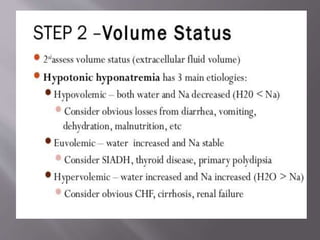
    NaCl NaCl Free water Hypotonichyponatremia– too much free water compared to NaCl. (Volume deficit with non- osmotic ADH release, or CHF, cirrhosis or SIADH) Osmolarity (tonicity) decreased AD H
  • 58.
     Therefore D5,1/4 NS not to be given in surgery.  Only NS, Normosol or LR to be given.  Free water not given because of kidney’s reduced ability to excrete it (due to non-osmotic ADH release).
  • 59.
     Volume restorationwith NS if hypovolemic (GI losses, diuretics).  Explanation: Severe hypovolemia causes non-osmotic ADH release. Body tries to “defend intravascular volume” by secreting ADH.  Volume restoration suppresses non- osmotic ADH release and cures hyponatremia by allowing free water excretion.
  • 60.
  • 62.
     Thiazide diureticsact at DCT  Limits free water excretion  Loop diuretics  In thick ascending loop of Henle (TELH) blocks Na+ reabsorption  Increases water excretion in spite of ADH
  • 64.
  • 71.
  • 76.
     Fluid restrictionif hypervolemic (CHF, liver failure).  Diuretics (causing Na+ and water loss) are currently used for ECF overload. We want to get rid of water, but we get rid of Na+ as well.  Vaptans – ADH receptor antagonists prevent inappropriate free water retention in CHF or cirrhosis.
  • 97.
     Potassium isthe major intracellular cation and maintains intracellular osmotic pressure.  Total body potassium is about 350 meq out of which 75% is present in muscles.  The depolarization and contraction of heart muscle require potassium.  During nerve transmission of impulses, there is sodium influx and potassium effects with depoloarization.  During repolarization, these changes are reversed.  Potassium ions easily pass by facilitated diffusion thro pores of Potassium channel proteins.
  • 98.
     Rich sourcesare banana, orange, apples , pineapple, almond, dates ,beans and potato. Tender coconut water is a good source.  Daily requirement is 3-4 gms  Serum potassium level : 3.5-5.0 m eq/L
  • 99.
     If potassiumlevel is more than 5.5 mmol/L, it is known as hyper kelemia  Features : ventiricular arrhythmia, ventricular fibrillation, flacial paralysis, bradycardaic cardiac arrest.  ECG shows elevated towards widening of QRS complex and lengthening of PR interval.  Treatment is to give intravenous glucose and insulin.
  • 100.
    Clinical features  Weaknessand numbness of muscles tingling of extremities.  Broad QRS complex with peaked “T” wave and no “P” wave.  Arrhythmias like bradycardia appear and heart may stock diastole.
  • 101.
     It isseen in hemolysis, thrombocytosis, polycythemia.
  • 106.
     If urinarypotassium is more than 25 mmol/day the loss is mainly renal.  In metabolic alkalosis potassium is exchanged with H+ involve to conserve H+, resulting in hypokalemia.  Non renal loss is seen in diarrhea.  Diuretics used for congestive cardiac failure may cause the excretion and hence potassium supplementation is required.  Decreased intake , prolonged infusion of k+ free iv fluids.  Excess of aldosterone.
  • 107.
    Clinical features  Anorexia, nausea and may be paralytic ileus.  Muscle weakness, mental depression.  ECG changes like inversion of “T” wave, prominent U wave.  Rapid irregular pulse and hypotension.  Heart stops in systole
  • 109.
     Present inclose association with sodium .  Maintainance of Water and Electrolytes Balance.  ‘Plasma Osmotic Pressure’.  Acid base balance : in transport of CO2 from tissue to lungs in also in the excretion of NH4 ions.
  • 111.
     Excessive vomitingwhich result in loss of HCl.  There will be compensatory increase in plasma bicarbonate and there will be hypochloremic metabolic alkalosis.  Addison’s disease - diminished reabsorption of NaCl.  Respiratory alkalosis – CO2 eliminated, HCO3 - increases and chloride decreases
  • 112.
     Chloride isinversely related to bicarbonate. Causes:  Dehydration  Cushings syndrome- excess NaCl reabsorption  Severe diarrheoa – loss of bicarbonate  Respiratory acidosis – Bicarbonate less  Renal tubular acidosis – Bicarbonate less  Hemodialysis