Kidney Function Tests
 The kidney function tests are physiologically
grouped into two broad categories:
1. The tests that assess glomerular functions
(glomerular function tests)
2. The tests that assess tubular functions
(tubular function tests).
1.Glomerular function tests
1.Blood urea determination
2.Blood creatinine estimation
3.Inulin clearance test
4.Creatinine clearance test
5.Urea clearance test
6.PAH clearance test
7.Estimation of proteins in the urine
2.Tubular function tests
1. Urine concentration test
2. Urine dilution test
3. Detection acid excretion
4. Test for acidification of urine
5. Test for alkalinisation of urine
6. Test for amino acids in urine
Clinically, kidney function tests are divided
into following categories
 1.Routine tests:
 Complete urine analysis, measurement of
BUN in blood, and measurement of serum
electrolytes.
 2.Tests for further assessments:
 Clearance test, determination of urine and
plasma osmolality, concentration and
dilution tests.
3.Specific tests:
Tests to assess renal acidification,
tests to assess renal handling of
sodium, measurement of renal
plasma flow.
4.Special tests:
Ultrasonography, CT scan, MRI, etc
1.ROUTINE URINE ANALYSIS
 Routine urine analysis includes analysis of
physical and biochemical characteristics of
urine.
 Physical characteristics:
 (i)Volume:
 The normal volume of urine excreted is about 1
1.5 liters per day.
 Urine volume increases in excess water intake,
high protein diet, diuretic therapy, diabetes
mellitus, diabetes insipidus , and sometimes in
chronic renal diseases.
(ii) Appearance:
 Normally, urine is clear.
 It becomes turbid when kept in a container for a long
time as urea is converted to ammonium carbonate by
the action of bacteria, which makes the urine alkaline
and results in precipitation of calcium and magnesium
phosphates.
 Urine may also be turbid if it contains more
phosphates (as in alkaline urine) .
 Pus as seen in infection of urinary tract.
 Chyle as occurs in obstruction of lymphatics of the
(iii) Odor:
 Normally, the odor of urine is mildly aromatic due
to presence of volatile organic acids.
 If kept for a long time, urine gives unpleasant
ammoniacal smell due to conversion of urea into
ammonium carbonate.
 Diabetic urine gives acidotic-fruity odor due to the
acetone in the urine.
 Excretion of different drugs in the urine also
changes the smell of urine.
(iv) Color:
 Normal urine is straw colored or amber-yellow in color,
which is due to the presence of the pigment
urochrome in it.
 Urine becomes yellow in bilirubinuria , as occurs in
jaundice.
 It becomes dark in alkaptonuria , melanuria (seen in
malignant melanoma).
 Red in hematuria, hemoglobinuria , myoglobinuria ,
porphyria or following intake of rifampicin (anti-
tubercular antibiotic).
(v) Specific Gravity:
 The normal specific gravity of urine is 1.005-1.030.
 Specific gravity of urine is 1.010 normally corresponds
to urine osmolality of 285 m mol /kg.
 Specific gravity decreases when urine is diluted (as
seen in diabetes insipidus) and increases when urine
is concentrated (as occurs in dehydration).
 In chronic renal failure, specific gravity is fixed at
1.010.
Biochemical characteristics
 Reaction of Urine:
 Normally, urine is mildly acidic; the average pH being
6 (ranging between 4.5-7.5).
 After a normal meal, urine becomes alkaline due to
alkaline tide that occurs with secretion of acid in the
stomach, which adds bicarbonate into the plasma.
 If the meal is rich in protein, urine becomes acidic due
to formation of Sulphates and phosphates of amino
acids in tubular fluid.
 If the meal is rich in vegetables then the urine
becomes alkaline as organic acids like citric and
tartaric acids extracted from vegetables are converted
to bicarbonate in the body.
 Alkaline urine is also feature of urinary tract infection
by urease producing organisms, acetazolamide
therapy and following ingestion of alkali.
 Proteins in Urine:
 Normal, glomerulus is not permeable to
substances with molecular weight more than
69000.
 Normally proteins are absent in urine.
 Proteinuria occurs when glomerular filtering
membrane is damaged in various glomerular
diseases.
 Albumin being a smaller molecule passes easily
through the damaged glomerulus.
 Therefore, in proteinuria, albumin predominates in
 A very less amount (less than 100 mg per day) of
proteins is secreted in urine, which is secreted by
the tubular epithelial cells.
 This trace quantity of protein is not detected by
routine urine analysis test.
 Proteinuria is seen in strenuous exercise,
pregnancy, nephritis, nephrosis, eclampsia etc.
 Normally, protein filtered is reabsorbed by the
tubule.
 Therefore, either in increased filtration or in
diseases of tubule, proteinuria occurs.
 Blood in Urine:
 Blood in urine is called hematuria.
 Hematuria is seen in nephritis and injury to ureter,
urinary bladder or urethra.
 It is detected by Benzidine test.
 Reducing Sugars in Urine:
 The presence of sugar in urine is called glycosuria
.
 Glycosuria occurs in conditions in which renal
threshold for glucose is exceeded as in diabetes
mellitus.
 Glucose in urine is detected by Benedicts test.
Ketone Bodies in Urine:
 The ketone bodies are acetoacetate, β-
hydroxybutyrate and acetone.
 Excretion of ketone bodies in urine is called
ketonuria.

 Ketonuria occurs in severe diabetes mellitus,
starvation, chronic vomiting etc.
 Ketone bodies in urine are detected by Rothera's
test and Gerhardt's test.
 Bile salts in Urine:
 Bile salts appear in urine in the early phase of
obstructive jaundice.
 Bile salts are detected by Hay's test.
 Bile-Pigments in Urine:
 Bile pigments (bilirubin and biliverdin) appear in
urine in obstructive jaundice.
 Bilirubinuria is detected by modified Fouchet's test,
and van den Berg reaction .
Urobilinogen in Urine
 Normally, the main pigment in the urine is urochrome.
 Small amounts of urobilinogen may also be present in
urine.
 Urobilinogen excretion increases in persistent fevers,
liver diseases, diseases of biliary tract & hemolysis.
 This is detected by Ehrlich test.
Measurement of (NPN) in Urine:
 The non-protein nitrogen (NPN) in urine includes urea,
(15-40mg%) creatinine(0.7-1.5male, 0.5-1.2 female)&
uric acid(2-4mg/dl).
 Their concentration in urine increases in different
physiological and pathological conditions.
 Determination of creatinine is an important test for
renal function.
Measurement of (NPN) in Urine…
 Urea level is altered in many conditions.
 Even, increased intake of protein increases
urea in urine.
 Urea estimation is a non-specific kidney
function test.
 However, blood urea concentration is good
index of renal functions.
 Uric acid is increased in urine in conditions that
are associated with increased purine
2.Clearance tests
 Clearance tests mainly determine the glomerular
function.
 GFR provides the most useful index for assessment of
severity of the renal disease.
 Clearance is defined as the quantity of blood or
plasma cleared of a substance per unit time.
 This is expressed as ml per minute.
 It is the ml of plasma, which contains the amount of
 Cs = Us × V
Ps
 Cs = clearance rate of a substance ‘s’
 Ps = plasma concentration of the
substance
 Us = urine concentration of that
substance
 V = urine flow rate[volume in ml/min]
Actually, it estimates the amount of plasma that
passes through the glomeruli per minute with
complete removal of that substance (to account for
the substance actually appears in the urine).
Measurement of the clearance is predominantly a
test of glomerular filtration rate (GFR).
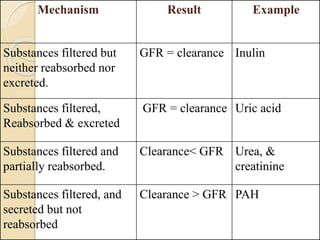
The relation between clearance value and GFR
shown in next slide.
Mechanism Result Example
Substances filtered but
neither reabsorbed nor
excreted.
GFR = clearance Inulin
Substances filtered,
Reabsorbed & excreted
GFR = clearance Uric acid
Substances filtered and
partially reabsorbed.
Clearance< GFR Urea, &
creatinine
Substances filtered, and
secreted but not
reabsorbed
Clearance > GFR PAH
 In normal practice, creatinine clearance
test, urea clearance test, and inulin
clearance test are used for determination
of kidney functions
TUBULAR FUNCTION TESTS
 Determination of Specific Gravity:
 The specific gravity depends on the concentration of
solutes whereas the osmolality detects the presence
of osmotically active particles in the urine.
 Other tests:
 Tubular functions are determined by concentration
and dilution tests
 Concentration Test:
 The patient is advised to eat usual food at 6 PM but food intake is
restricted to 200 ml.
 He is further advised not to take anything throughout night.
 Next morning, at 7 AM, the bladder is emptied and this first specimen
is discarded.
 At 8 AM, urine is collected and this second specimen is obtained for
measuring specific gravity.
 If specific gravity is more than 1.022, the renal function is normal.
 If specific gravity is below this value, a third sample is collected at
9AM.
 If this sample gives specific gravity less than 1.022, then the
concentrating ability of the kidney is considered to be impaired.
 Determination of Urine Volume:
 The measurement of the volume of urine
passed in 24 hours is a simple test of tubular
function.
 Normally, the volume of urine in night is half
the volume of urine excreted during day time.
 An increased excretion of urine during night is
an early indication of tubular dysfunctions.
Specific tests
 Tests for urine acidification.
 Ammonium chloride tablets are given to
subjects(0.1g/kg b. w)
 Urine is collected every hour for 4-8 hrs for
determination of pH of urine & ammonia
excretion of each sample.
 One sample should have pH of 5.3 or less &
ammonia excretion should be 30-90 mmole per
hour
PSP TEST
 Phenol-sulfonphthalein (phenol red) test is used to
determine secretory capacity of tubule.
 The subject is allowed to drink 600 ml of water
following which PSP is given IV (6 mg in 1ml solution).
 Bladder is emptied after 15min,30min,60min & 120
min & excretion of phenol red is noted in each sample.
 Normally 35% of dye in first sample & 70% of dye
should be eliminated in two hours.
Kidney Function Tests2012.pptx for medical

Kidney Function Tests2012.pptx for medical

  • 1.
  • 2.
    Kidney Function Tests The kidney function tests are physiologically grouped into two broad categories: 1. The tests that assess glomerular functions (glomerular function tests) 2. The tests that assess tubular functions (tubular function tests).
  • 3.
    1.Glomerular function tests 1.Bloodurea determination 2.Blood creatinine estimation 3.Inulin clearance test 4.Creatinine clearance test 5.Urea clearance test 6.PAH clearance test 7.Estimation of proteins in the urine
  • 4.
    2.Tubular function tests 1.Urine concentration test 2. Urine dilution test 3. Detection acid excretion 4. Test for acidification of urine 5. Test for alkalinisation of urine 6. Test for amino acids in urine
  • 5.
    Clinically, kidney functiontests are divided into following categories  1.Routine tests:  Complete urine analysis, measurement of BUN in blood, and measurement of serum electrolytes.  2.Tests for further assessments:  Clearance test, determination of urine and plasma osmolality, concentration and dilution tests.
  • 6.
    3.Specific tests: Tests toassess renal acidification, tests to assess renal handling of sodium, measurement of renal plasma flow. 4.Special tests: Ultrasonography, CT scan, MRI, etc
  • 7.
    1.ROUTINE URINE ANALYSIS Routine urine analysis includes analysis of physical and biochemical characteristics of urine.  Physical characteristics:  (i)Volume:  The normal volume of urine excreted is about 1 1.5 liters per day.  Urine volume increases in excess water intake, high protein diet, diuretic therapy, diabetes mellitus, diabetes insipidus , and sometimes in chronic renal diseases.
  • 8.
    (ii) Appearance:  Normally,urine is clear.  It becomes turbid when kept in a container for a long time as urea is converted to ammonium carbonate by the action of bacteria, which makes the urine alkaline and results in precipitation of calcium and magnesium phosphates.  Urine may also be turbid if it contains more phosphates (as in alkaline urine) .  Pus as seen in infection of urinary tract.  Chyle as occurs in obstruction of lymphatics of the
  • 9.
    (iii) Odor:  Normally,the odor of urine is mildly aromatic due to presence of volatile organic acids.  If kept for a long time, urine gives unpleasant ammoniacal smell due to conversion of urea into ammonium carbonate.  Diabetic urine gives acidotic-fruity odor due to the acetone in the urine.  Excretion of different drugs in the urine also changes the smell of urine.
  • 10.
    (iv) Color:  Normalurine is straw colored or amber-yellow in color, which is due to the presence of the pigment urochrome in it.  Urine becomes yellow in bilirubinuria , as occurs in jaundice.  It becomes dark in alkaptonuria , melanuria (seen in malignant melanoma).  Red in hematuria, hemoglobinuria , myoglobinuria , porphyria or following intake of rifampicin (anti- tubercular antibiotic).
  • 11.
    (v) Specific Gravity: The normal specific gravity of urine is 1.005-1.030.  Specific gravity of urine is 1.010 normally corresponds to urine osmolality of 285 m mol /kg.  Specific gravity decreases when urine is diluted (as seen in diabetes insipidus) and increases when urine is concentrated (as occurs in dehydration).  In chronic renal failure, specific gravity is fixed at 1.010.
  • 12.
    Biochemical characteristics  Reactionof Urine:  Normally, urine is mildly acidic; the average pH being 6 (ranging between 4.5-7.5).  After a normal meal, urine becomes alkaline due to alkaline tide that occurs with secretion of acid in the stomach, which adds bicarbonate into the plasma.  If the meal is rich in protein, urine becomes acidic due to formation of Sulphates and phosphates of amino acids in tubular fluid.
  • 13.
     If themeal is rich in vegetables then the urine becomes alkaline as organic acids like citric and tartaric acids extracted from vegetables are converted to bicarbonate in the body.  Alkaline urine is also feature of urinary tract infection by urease producing organisms, acetazolamide therapy and following ingestion of alkali.
  • 14.
     Proteins inUrine:  Normal, glomerulus is not permeable to substances with molecular weight more than 69000.  Normally proteins are absent in urine.  Proteinuria occurs when glomerular filtering membrane is damaged in various glomerular diseases.  Albumin being a smaller molecule passes easily through the damaged glomerulus.  Therefore, in proteinuria, albumin predominates in
  • 15.
     A veryless amount (less than 100 mg per day) of proteins is secreted in urine, which is secreted by the tubular epithelial cells.  This trace quantity of protein is not detected by routine urine analysis test.  Proteinuria is seen in strenuous exercise, pregnancy, nephritis, nephrosis, eclampsia etc.  Normally, protein filtered is reabsorbed by the tubule.  Therefore, either in increased filtration or in diseases of tubule, proteinuria occurs.
  • 16.
     Blood inUrine:  Blood in urine is called hematuria.  Hematuria is seen in nephritis and injury to ureter, urinary bladder or urethra.  It is detected by Benzidine test.  Reducing Sugars in Urine:  The presence of sugar in urine is called glycosuria .  Glycosuria occurs in conditions in which renal threshold for glucose is exceeded as in diabetes mellitus.  Glucose in urine is detected by Benedicts test.
  • 17.
    Ketone Bodies inUrine:  The ketone bodies are acetoacetate, β- hydroxybutyrate and acetone.  Excretion of ketone bodies in urine is called ketonuria.   Ketonuria occurs in severe diabetes mellitus, starvation, chronic vomiting etc.  Ketone bodies in urine are detected by Rothera's test and Gerhardt's test.
  • 18.
     Bile saltsin Urine:  Bile salts appear in urine in the early phase of obstructive jaundice.  Bile salts are detected by Hay's test.  Bile-Pigments in Urine:  Bile pigments (bilirubin and biliverdin) appear in urine in obstructive jaundice.  Bilirubinuria is detected by modified Fouchet's test, and van den Berg reaction .
  • 19.
    Urobilinogen in Urine Normally, the main pigment in the urine is urochrome.  Small amounts of urobilinogen may also be present in urine.  Urobilinogen excretion increases in persistent fevers, liver diseases, diseases of biliary tract & hemolysis.  This is detected by Ehrlich test.
  • 20.
    Measurement of (NPN)in Urine:  The non-protein nitrogen (NPN) in urine includes urea, (15-40mg%) creatinine(0.7-1.5male, 0.5-1.2 female)& uric acid(2-4mg/dl).  Their concentration in urine increases in different physiological and pathological conditions.  Determination of creatinine is an important test for renal function.
  • 21.
    Measurement of (NPN)in Urine…  Urea level is altered in many conditions.  Even, increased intake of protein increases urea in urine.  Urea estimation is a non-specific kidney function test.  However, blood urea concentration is good index of renal functions.  Uric acid is increased in urine in conditions that are associated with increased purine
  • 22.
    2.Clearance tests  Clearancetests mainly determine the glomerular function.  GFR provides the most useful index for assessment of severity of the renal disease.  Clearance is defined as the quantity of blood or plasma cleared of a substance per unit time.  This is expressed as ml per minute.  It is the ml of plasma, which contains the amount of
  • 23.
     Cs =Us × V Ps  Cs = clearance rate of a substance ‘s’  Ps = plasma concentration of the substance  Us = urine concentration of that substance  V = urine flow rate[volume in ml/min]
  • 24.
    Actually, it estimatesthe amount of plasma that passes through the glomeruli per minute with complete removal of that substance (to account for the substance actually appears in the urine). Measurement of the clearance is predominantly a test of glomerular filtration rate (GFR). The relation between clearance value and GFR shown in next slide.
  • 25.
    Mechanism Result Example Substancesfiltered but neither reabsorbed nor excreted. GFR = clearance Inulin Substances filtered, Reabsorbed & excreted GFR = clearance Uric acid Substances filtered and partially reabsorbed. Clearance< GFR Urea, & creatinine Substances filtered, and secreted but not reabsorbed Clearance > GFR PAH
  • 26.
     In normalpractice, creatinine clearance test, urea clearance test, and inulin clearance test are used for determination of kidney functions
  • 27.
    TUBULAR FUNCTION TESTS Determination of Specific Gravity:  The specific gravity depends on the concentration of solutes whereas the osmolality detects the presence of osmotically active particles in the urine.  Other tests:  Tubular functions are determined by concentration and dilution tests  Concentration Test:
  • 28.
     The patientis advised to eat usual food at 6 PM but food intake is restricted to 200 ml.  He is further advised not to take anything throughout night.  Next morning, at 7 AM, the bladder is emptied and this first specimen is discarded.  At 8 AM, urine is collected and this second specimen is obtained for measuring specific gravity.  If specific gravity is more than 1.022, the renal function is normal.  If specific gravity is below this value, a third sample is collected at 9AM.  If this sample gives specific gravity less than 1.022, then the concentrating ability of the kidney is considered to be impaired.
  • 29.
     Determination ofUrine Volume:  The measurement of the volume of urine passed in 24 hours is a simple test of tubular function.  Normally, the volume of urine in night is half the volume of urine excreted during day time.  An increased excretion of urine during night is an early indication of tubular dysfunctions.
  • 30.
    Specific tests  Testsfor urine acidification.  Ammonium chloride tablets are given to subjects(0.1g/kg b. w)  Urine is collected every hour for 4-8 hrs for determination of pH of urine & ammonia excretion of each sample.  One sample should have pH of 5.3 or less & ammonia excretion should be 30-90 mmole per hour
  • 31.
    PSP TEST  Phenol-sulfonphthalein(phenol red) test is used to determine secretory capacity of tubule.  The subject is allowed to drink 600 ml of water following which PSP is given IV (6 mg in 1ml solution).  Bladder is emptied after 15min,30min,60min & 120 min & excretion of phenol red is noted in each sample.  Normally 35% of dye in first sample & 70% of dye should be eliminated in two hours.