Shortest Paths
in a Graph
Fundamental Algorithms
The Problems
● Given a directed graph G with edge weights,
find
■ The shortest path from a given vertex s to all other
vertices (Single Source Shortest Paths)
■ The shortest paths between all pairs of vertices (All
Pairs Shortest Paths)
● where the length of a path is the sum of its
edge weights.
Shortest Paths: Applications
Shortest Paths: Algorithms
● Single-Source Shortest Paths (SSSP)
■ Dijkstra’s
■ Bellman-Ford
● All-Pairs Shortest Paths (APSP)
■ Floyd-Warshall
A Fact About Shortest Paths
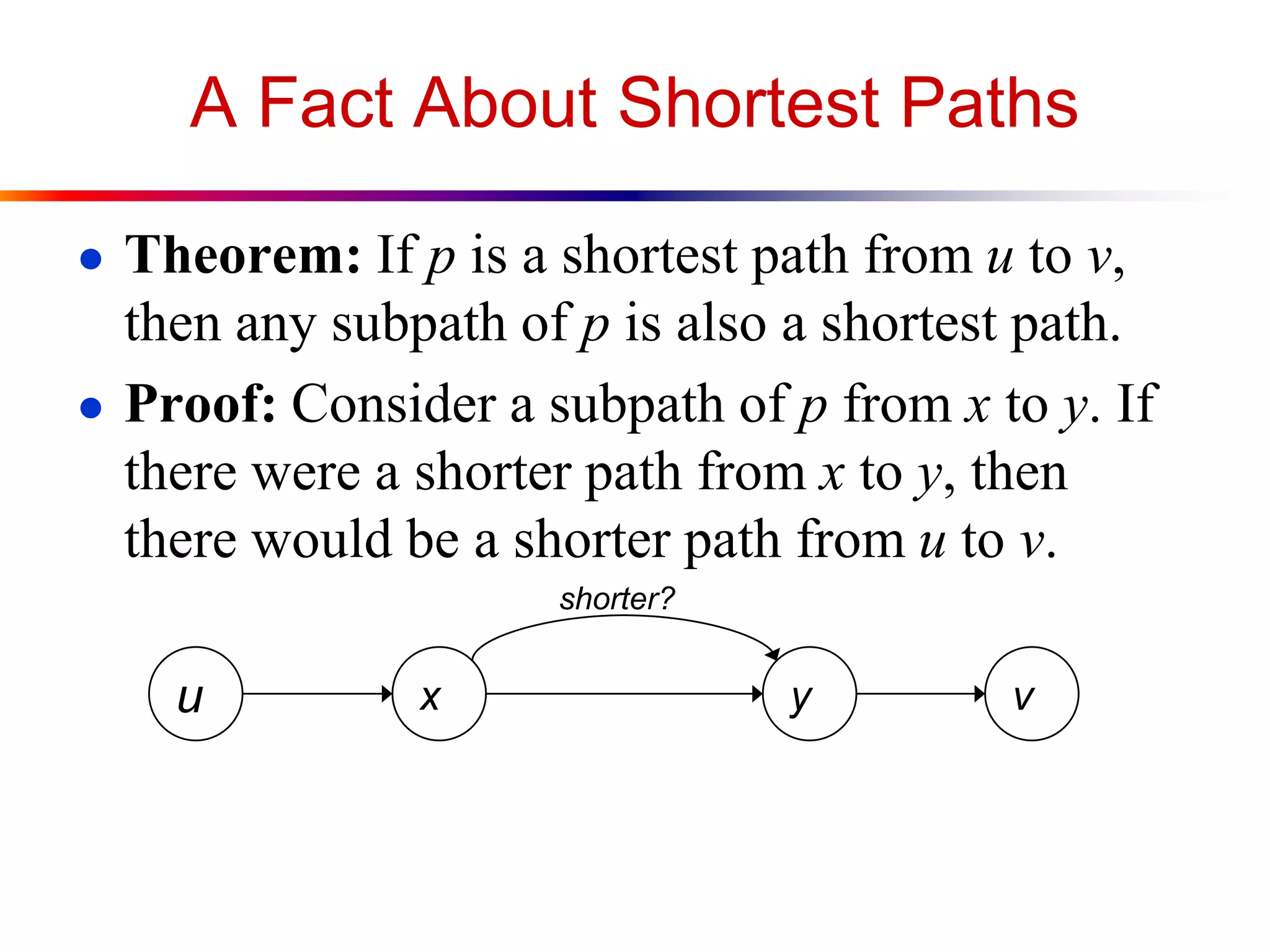
● Theorem: If p is a shortest path from u to v,
then any subpath of p is also a shortest path.
● Proof: Consider a subpath of p from x to y. If
there were a shorter path from x to y, then
there would be a shorter path from u to v.
u x y v
shorter?
Single-Source Shortest Paths
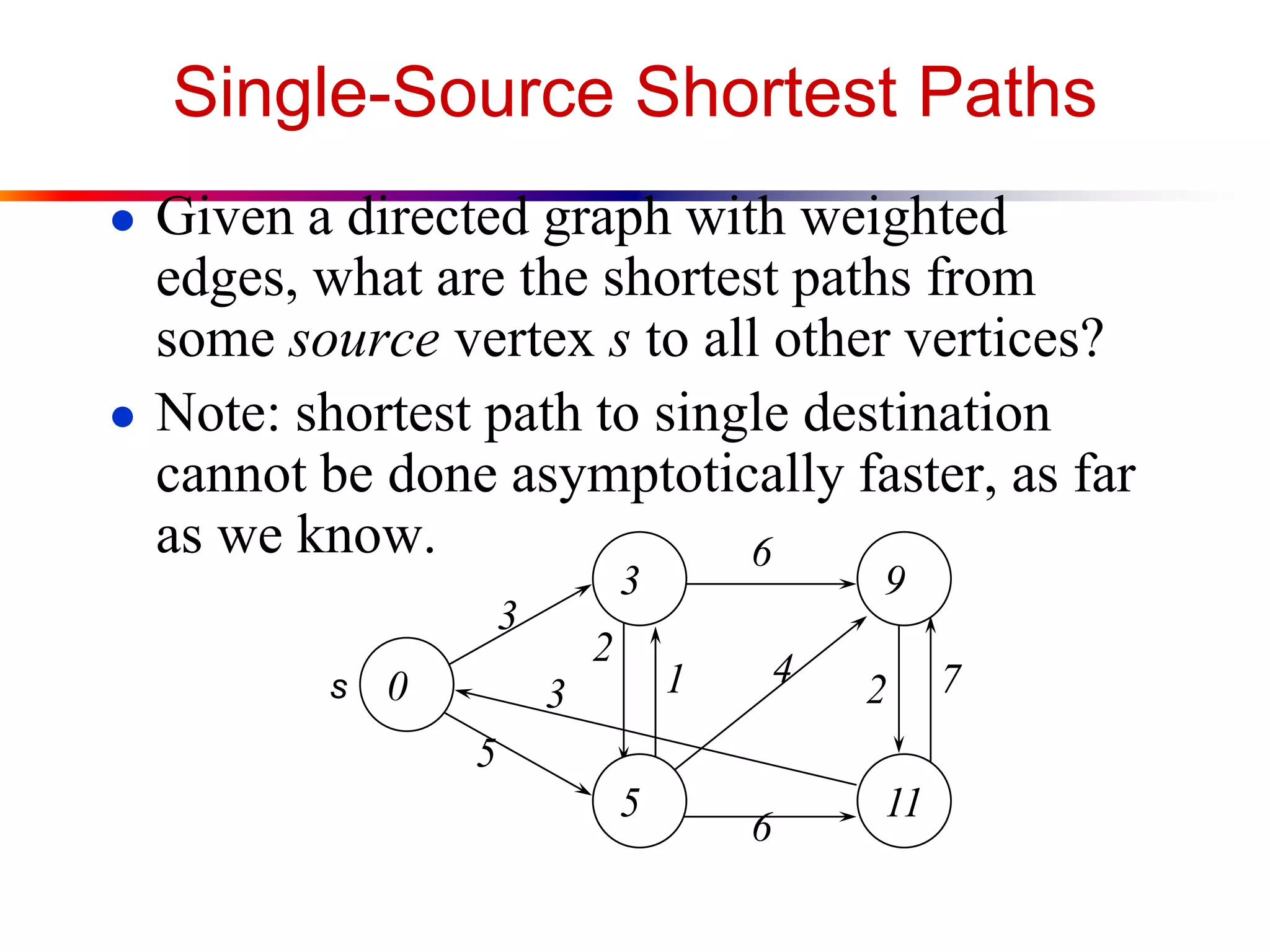
● Given a directed graph with weighted
edges, what are the shortest paths from
some source vertex s to all other vertices?
● Note: shortest path to single destination
cannot be done asymptotically faster, as far
as we know.
3
11
9
5
0
3
6
5
4
3
6
2
1 2 7s
Path Recovery
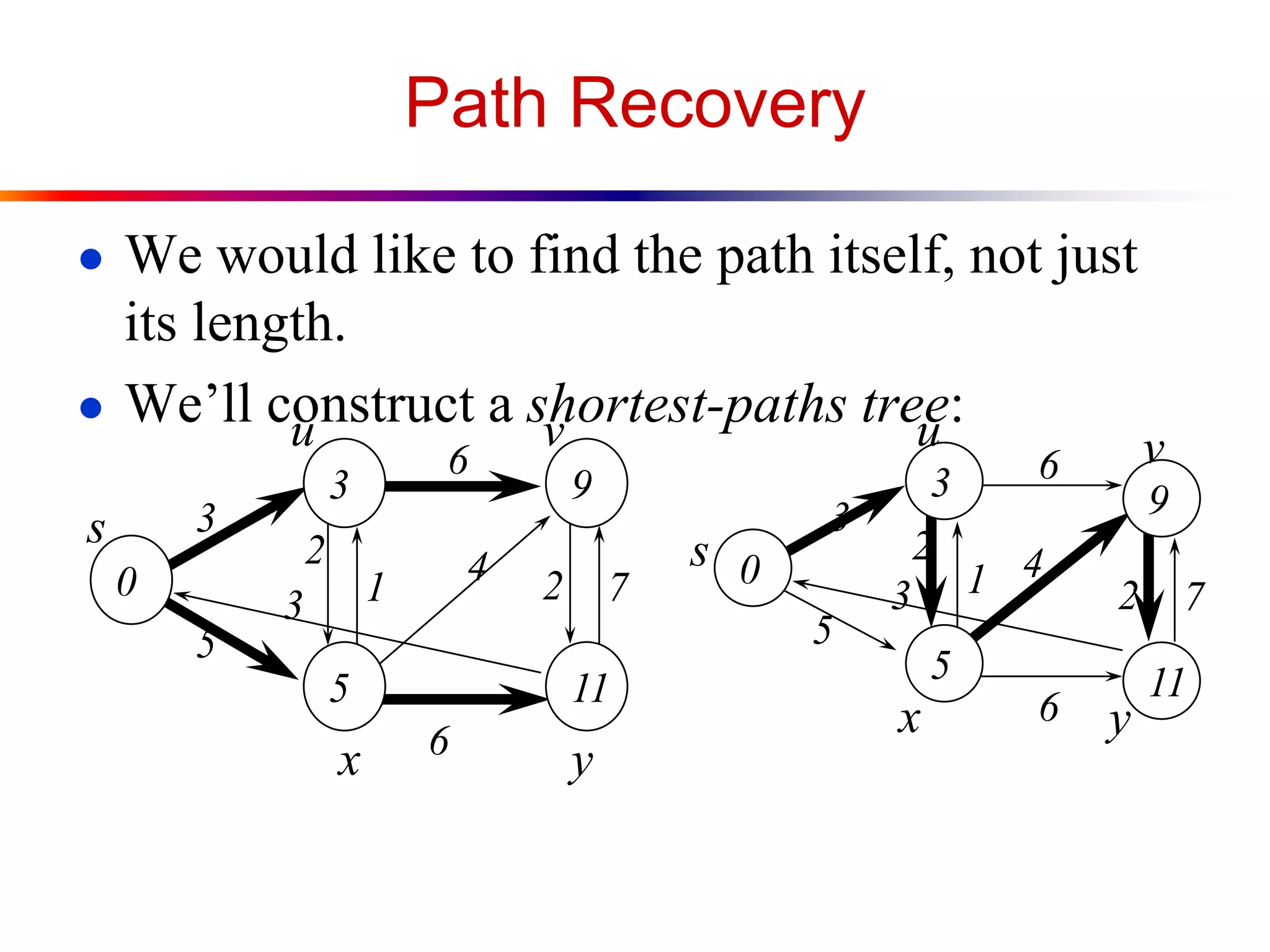
● We would like to find the path itself, not just
its length.
● We’ll construct a shortest-paths tree:
3
11
9
5
0
3
6
5
4
3
6
2 7
2
1
s
u v
x y
3
11
9
5
0
3
6
5
3
6
2 7
42
1
s
u v
x y
Shortest-Paths Idea
● d(u,v)  length of the shortest path from u to v.
● All SSSP algorithms maintain a field d[u] for every vertex
u. d[u] will be an estimate of d(s,u). As the algorithm
progresses, we will refine d[u] until, at termination,
d[u] = d(s,u). Whenever we discover a new shortest path to
u, we update d[u].
● In fact, d[u] will always be an overestimate of d(s,u):
● d[u] d(s,u)
● We’ll use p[u] to point to the parent (or predecessor) of u on
the shortest path from s to u. We update p[u] when we
update d[u].
SSSP Subroutine
RELAX(u, v, w)
> (Maybe) improve our estimate of the distance to v
> by considering a path along the edge (u, v).
if d[u] + w(u, v) < d[v] then
d[v]  d[u] + w(u, v) > actually, DECREASE-KEY
p[v]  u > remember predecessor on path
u v
w(u,v)
d[v]d[u]
Dijkstra’s Algorithm
● Assume that all edge weights are  0.
● Idea: say we have a set K containing all
vertices whose shortest paths from s are
known
(i.e. d[u] = d(s,u) for all u in K).
● Now look at the “frontier” of K—all vertices
adjacent to a vertex in K. the rest
of the
graph
s
K
Dijkstra’s: Theorem
● At each frontier
vertex u, update d[u]
to be the minimum
from all edges from
K.
● Now pick the frontier
vertex u with the
smallest value of
d[u].
● Claim: d[u] = d(s,u)
s
4
9
6
6
2
1
3
8
min(4+2, 6+1) = 6
min(4+8, 6+3) = 9
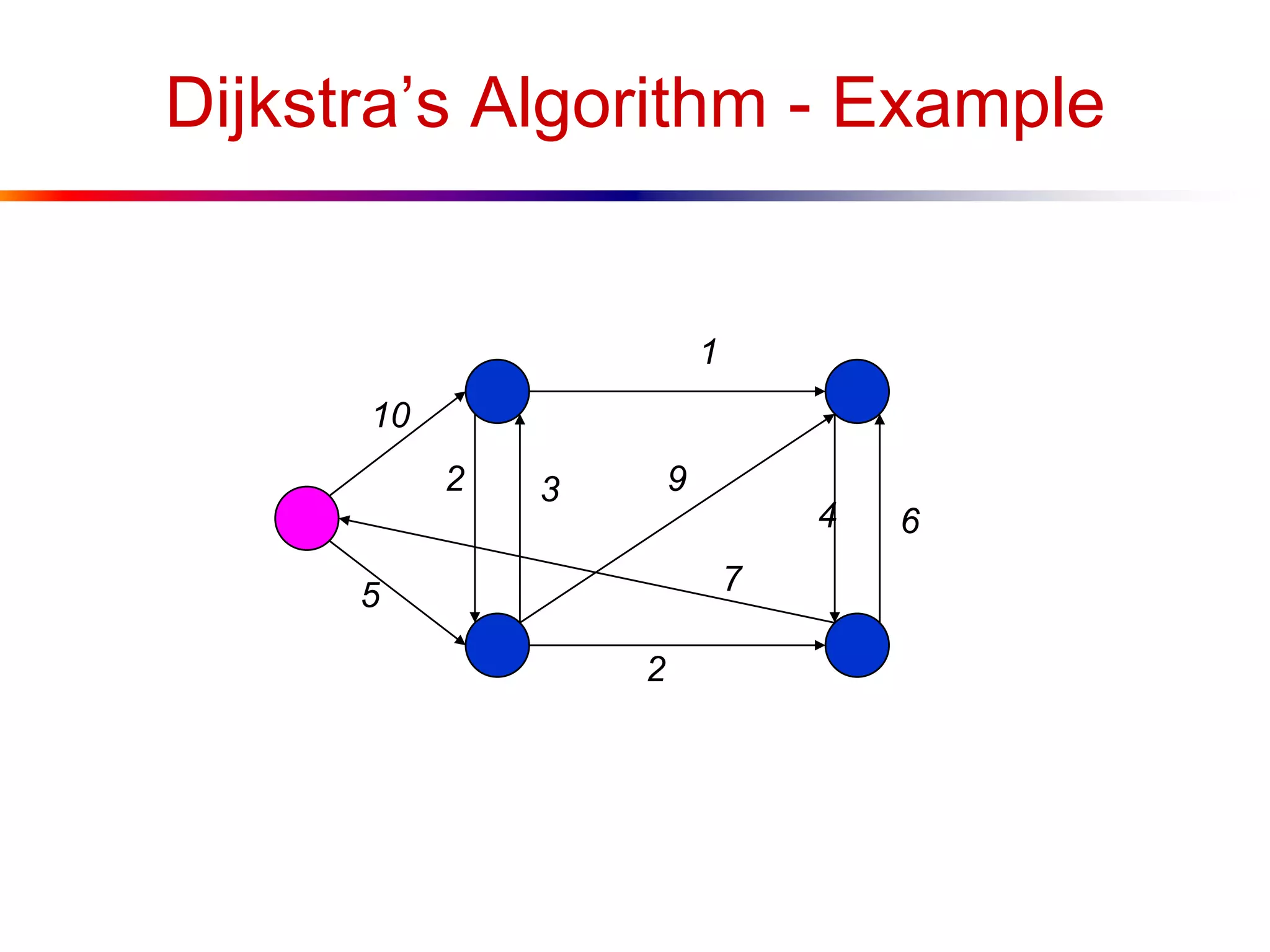
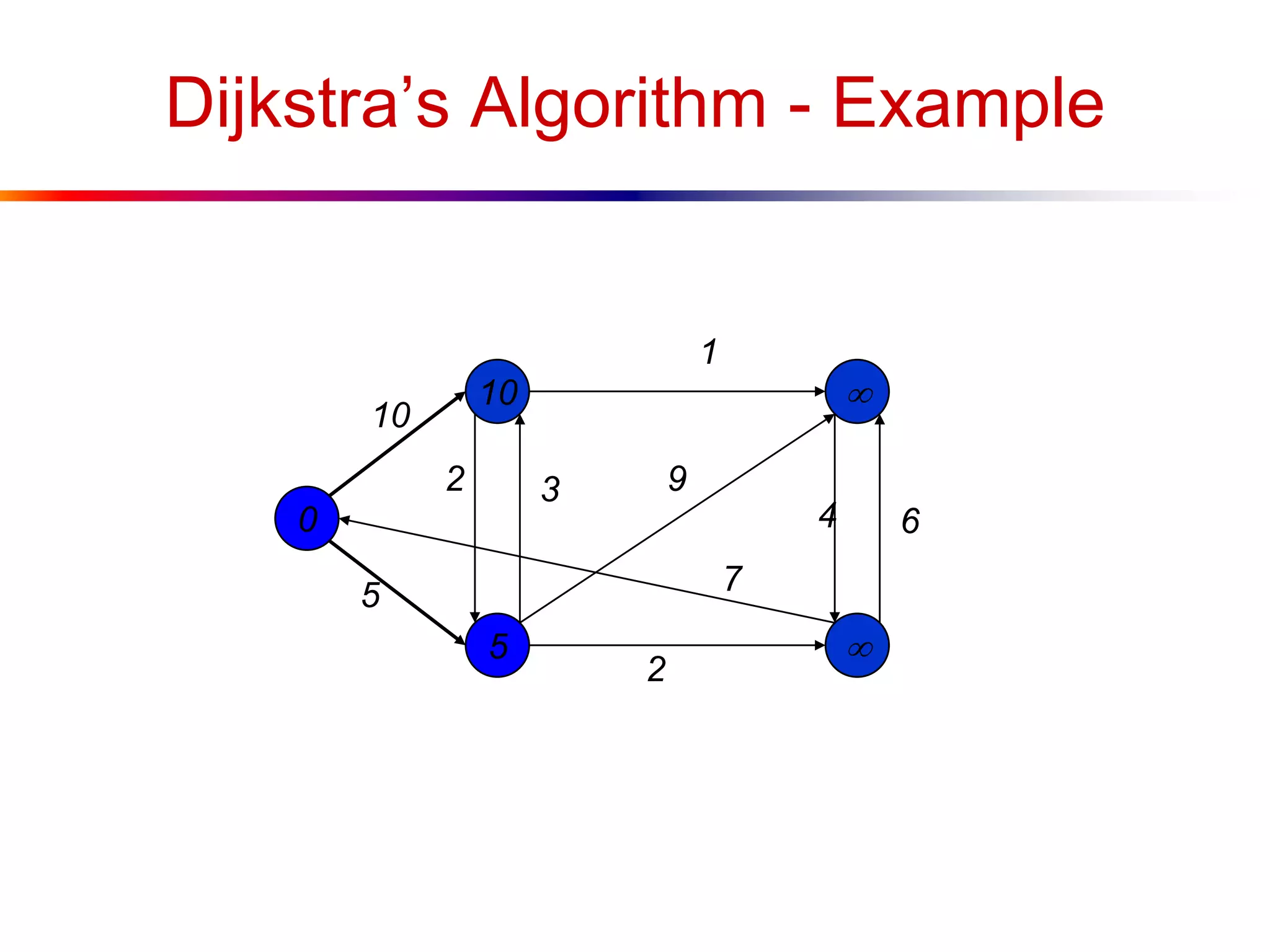
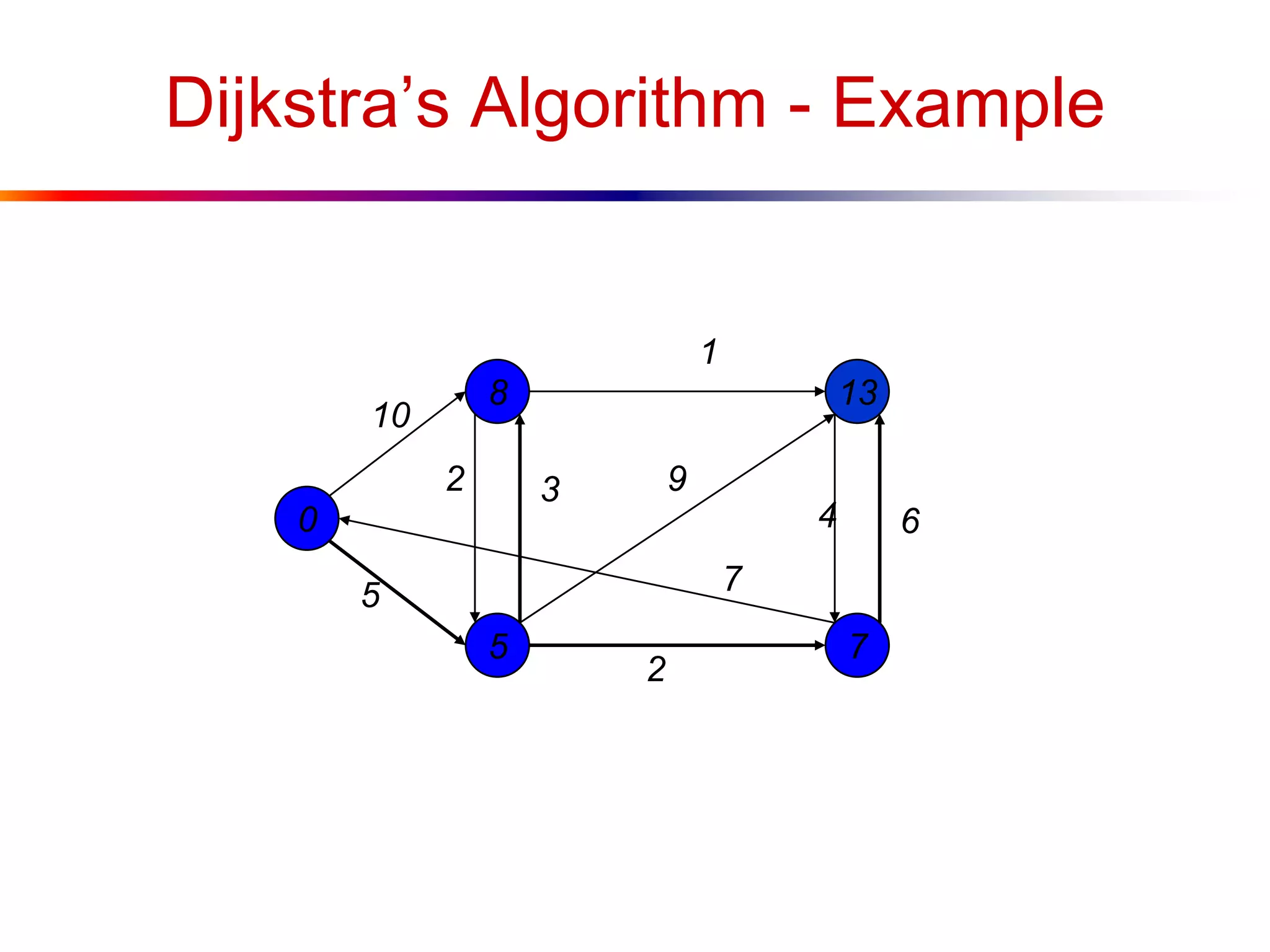
Dijkstra’s Algorithm - Example
10
1
5
2
64
9
7
2 3
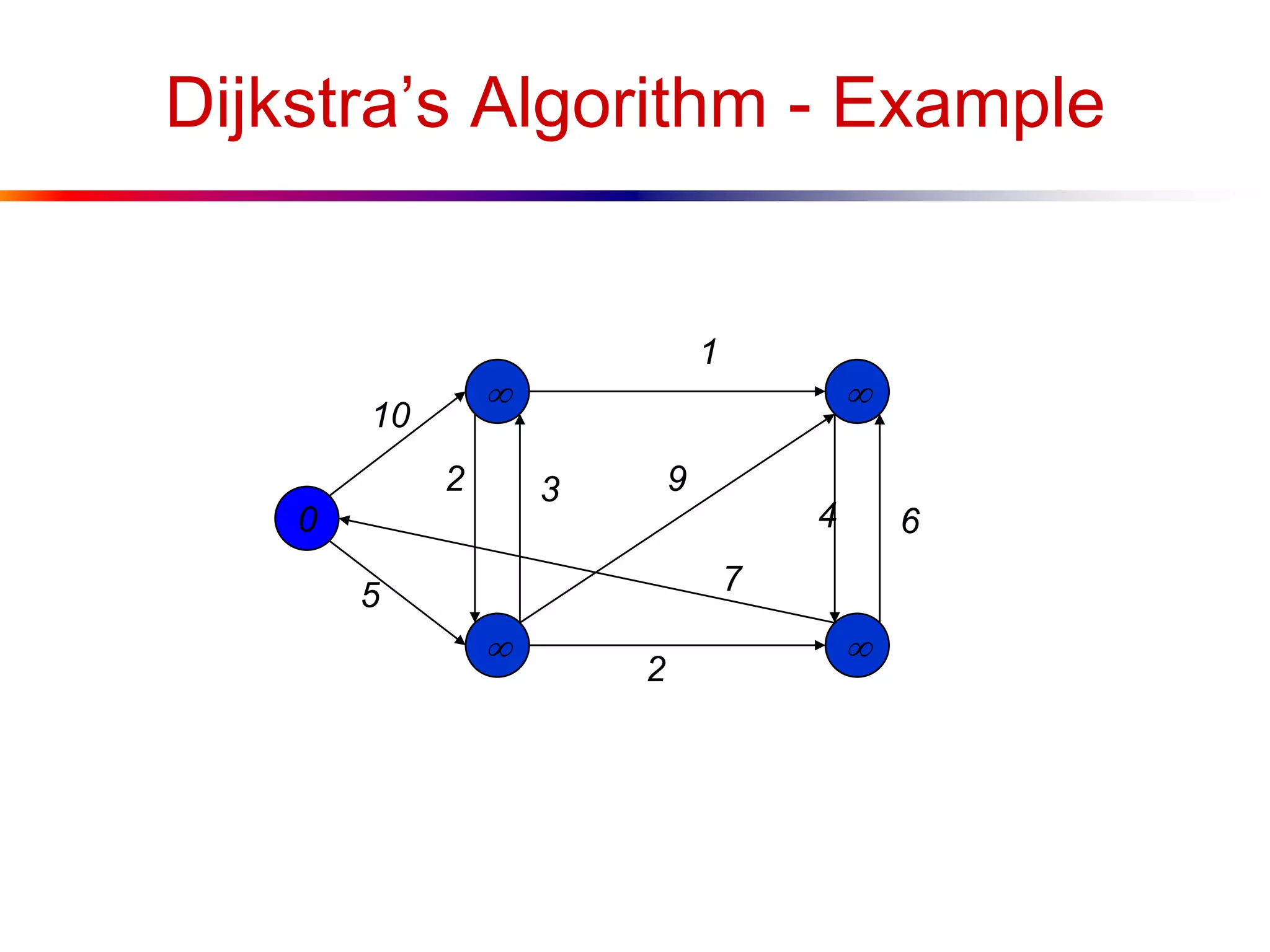
Dijkstra’s Algorithm - Example
0




10
1
5
2
64
9
7
2 3
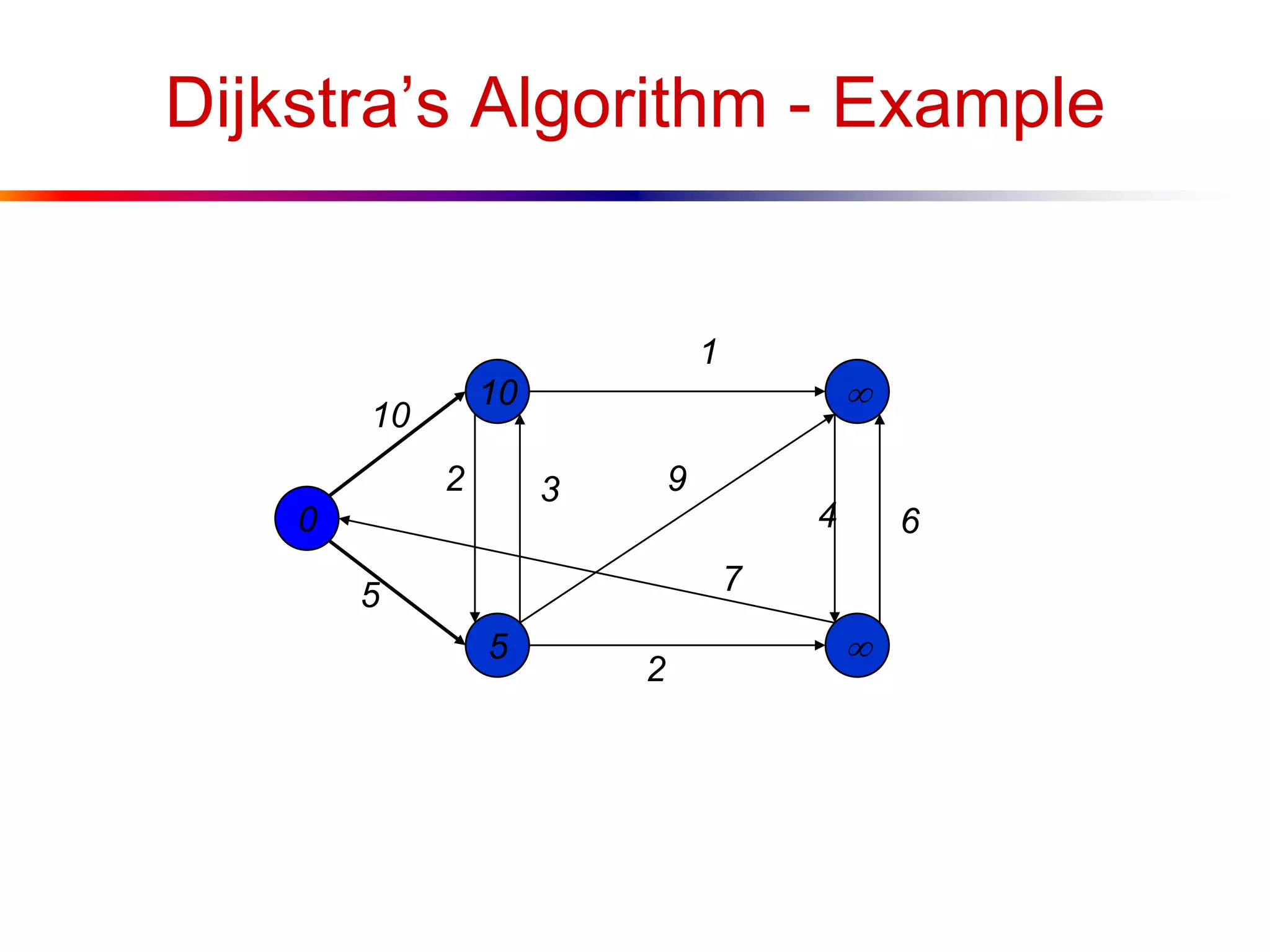
Dijkstra’s Algorithm - Example
0
5
10


10
1
5
2
64
9
7
2 3
Dijkstra’s Algorithm - Example
0
5
10


10
1
5
2
64
9
7
2 3
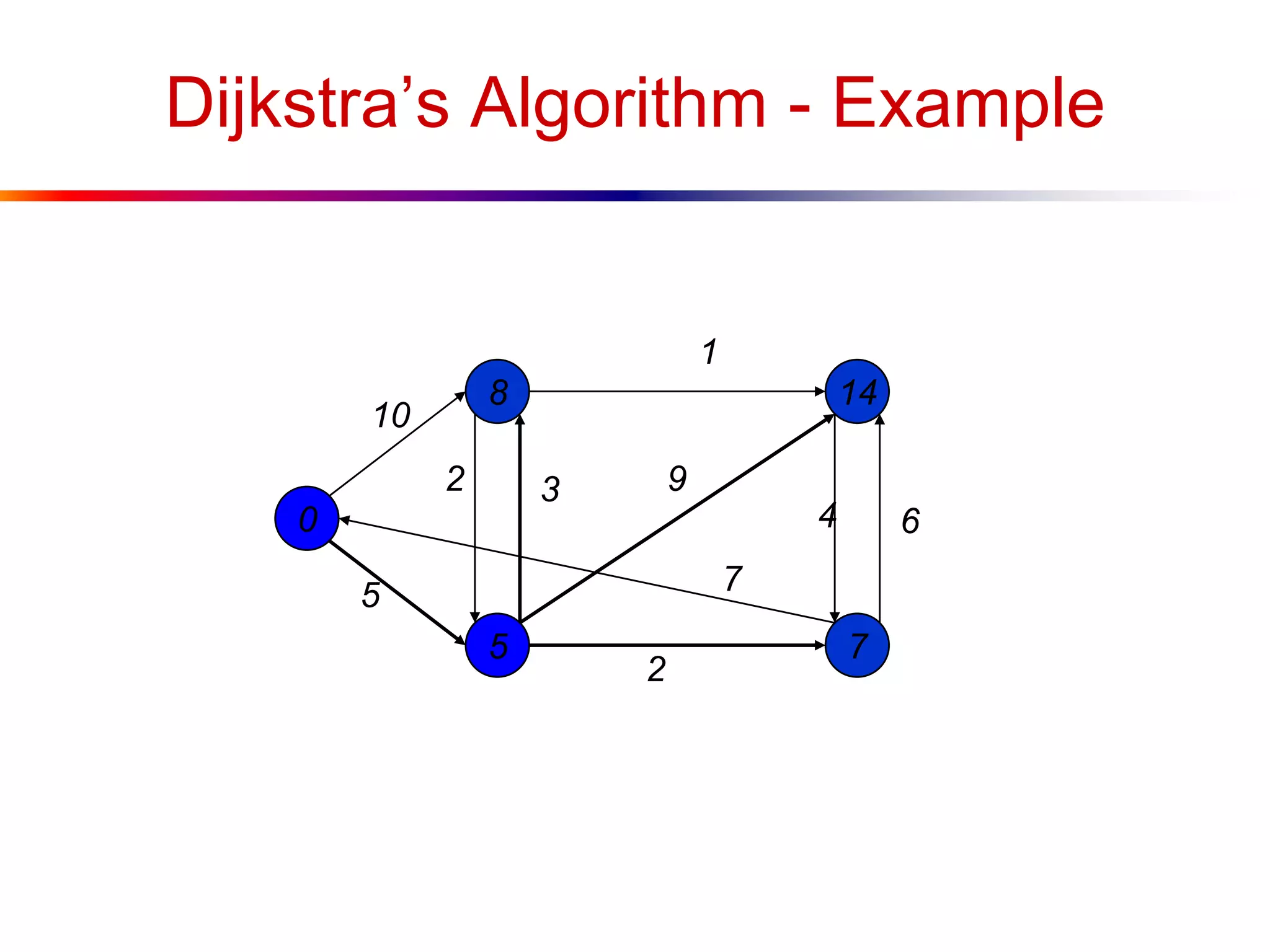
Dijkstra’s Algorithm - Example
0
5
8
7
14
10
1
5
2
64
9
7
2 3
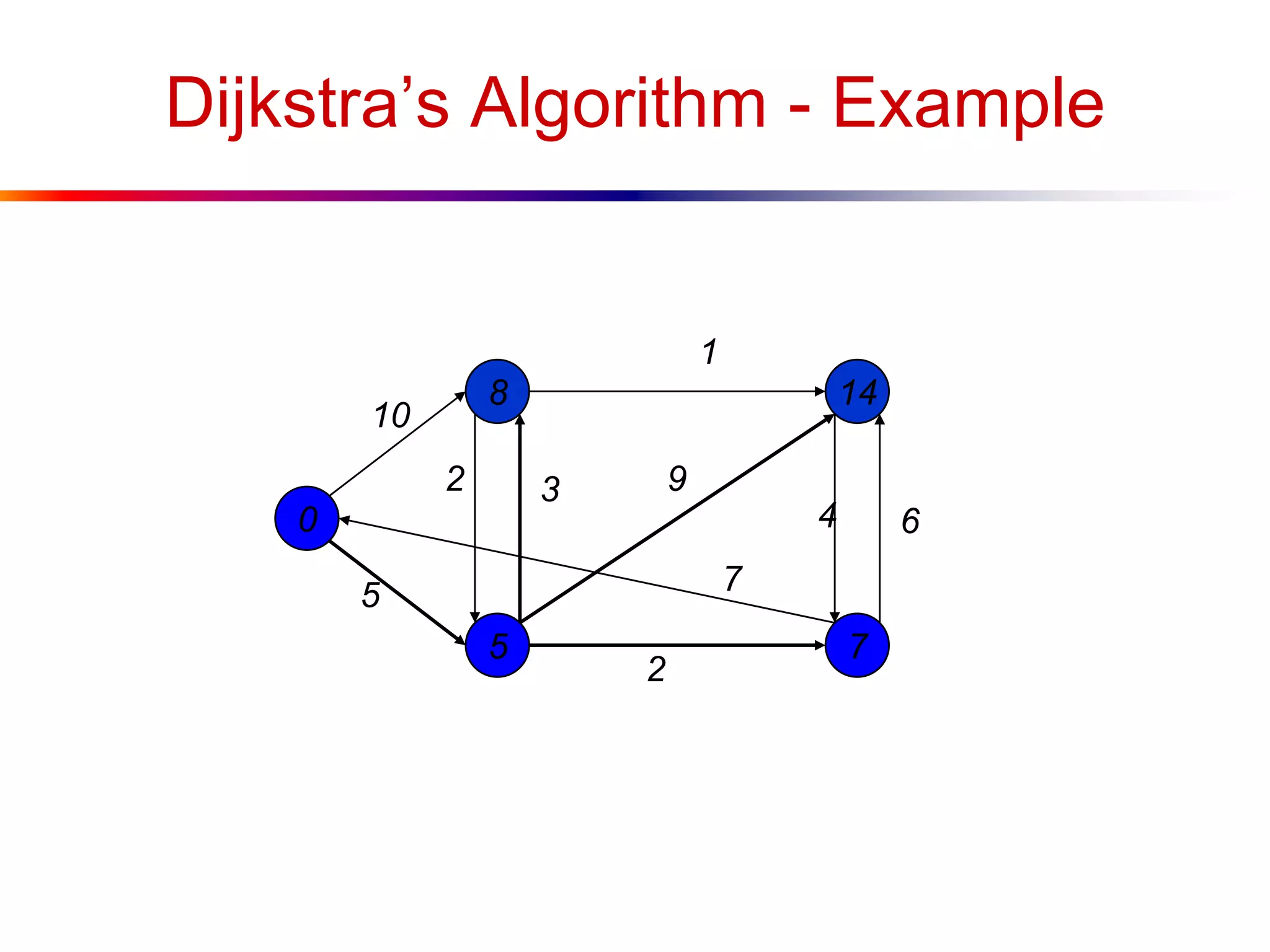
Dijkstra’s Algorithm - Example
0
5
8
7
14
10
1
5
2
64
9
7
2 3
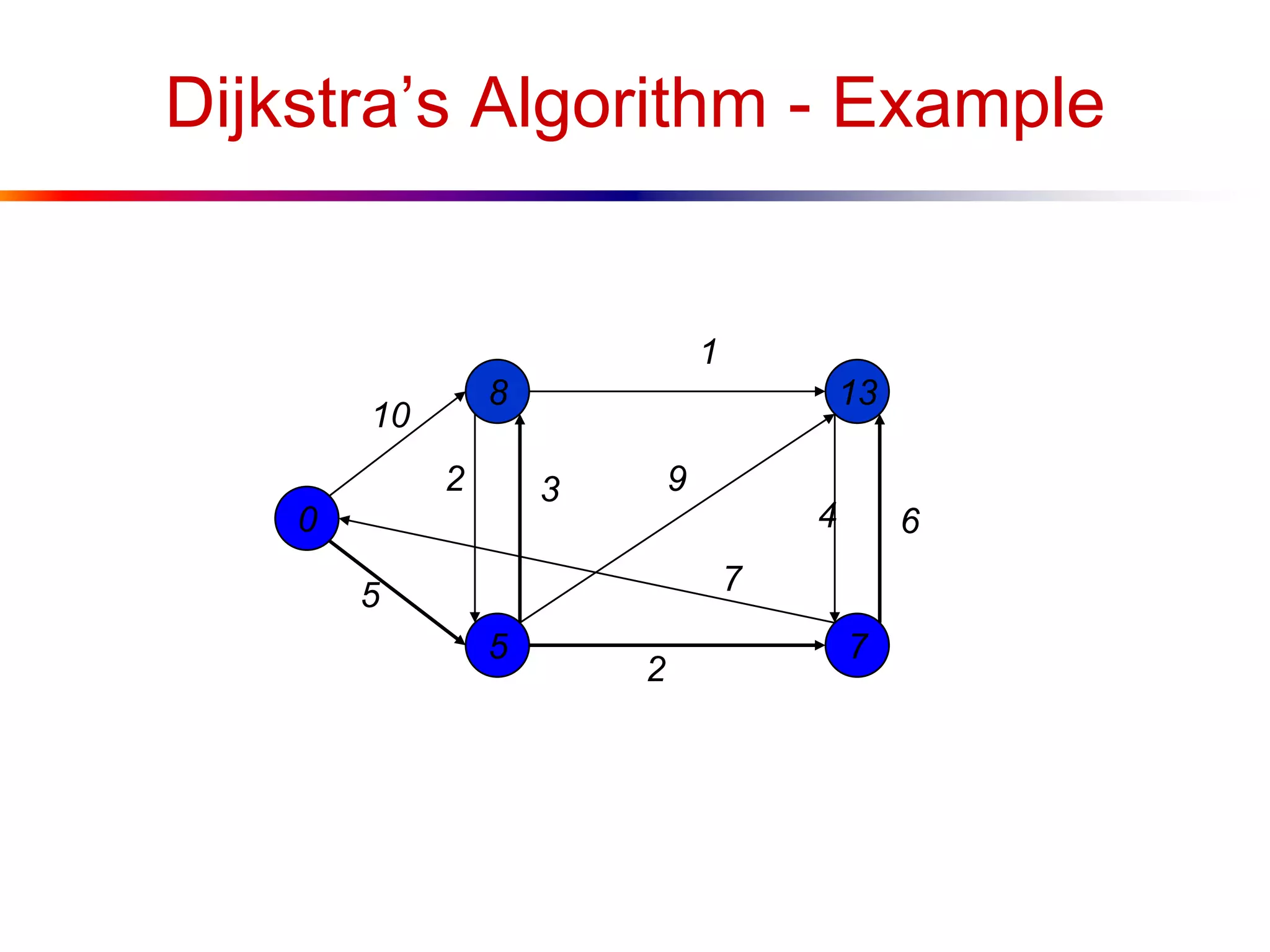
Dijkstra’s Algorithm - Example
0
5
8
7
13
10
1
5
2
64
9
7
2 3
Dijkstra’s Algorithm - Example
0
5
8
7
13
10
1
5
2
64
9
7
2 3
Dijkstra’s Algorithm - Example
0
5
8
7
9
10
1
5
2
64
9
7
2 3
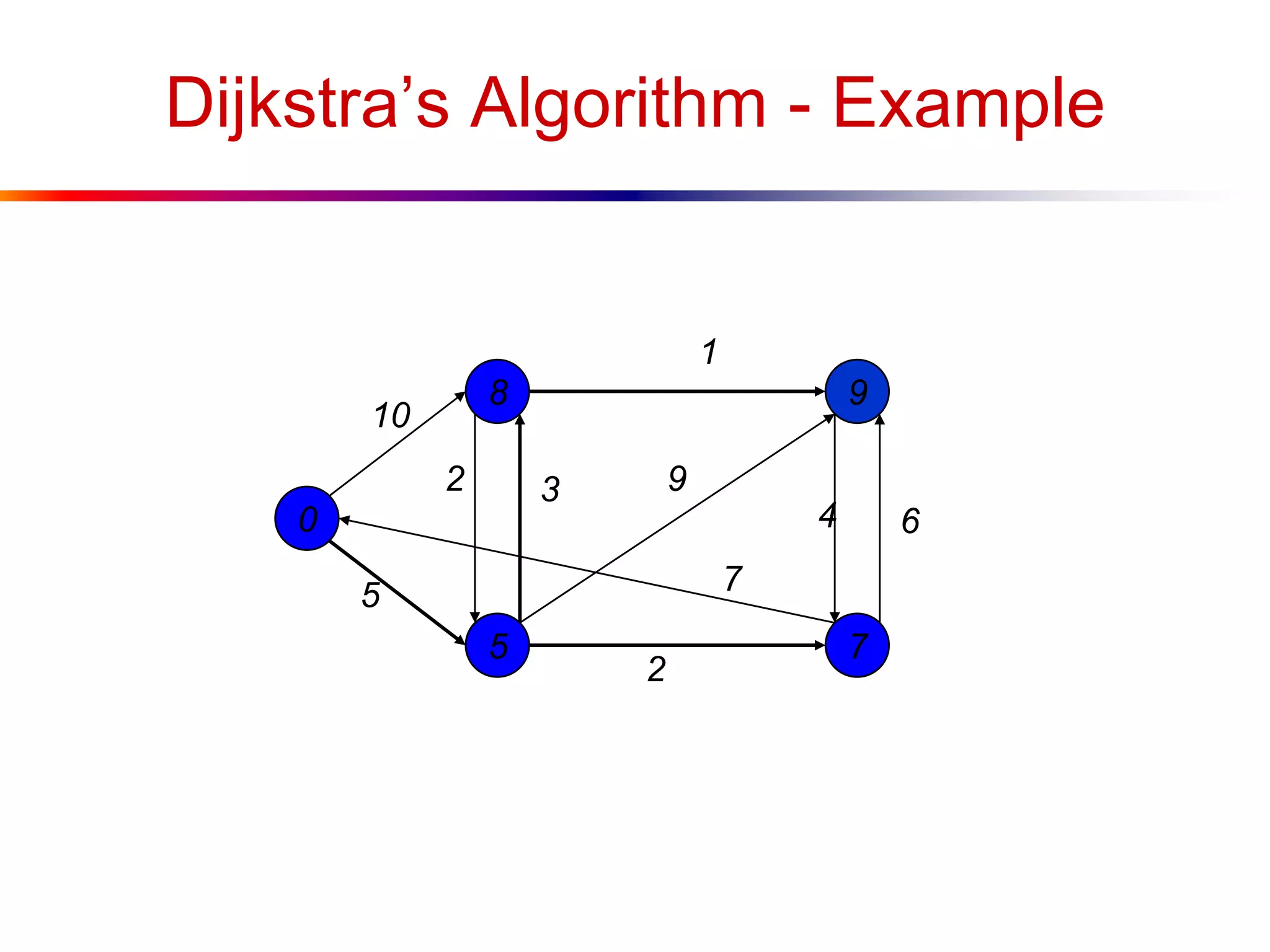
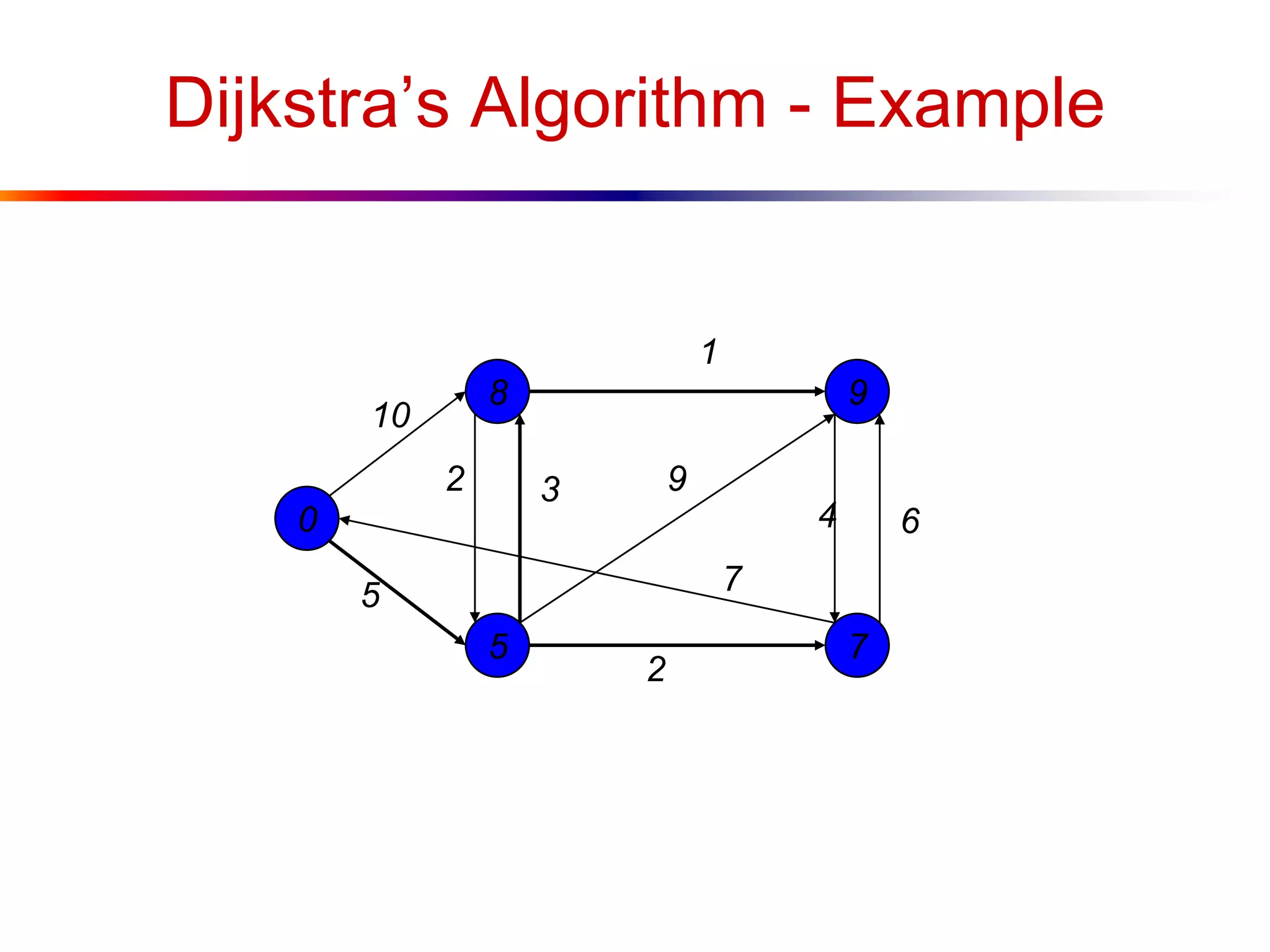
Dijkstra’s Algorithm - Example
0
5
8
7
9
10
1
5
2
64
9
7
2 3
Code for Dijkstra’s Algorithm
1 DIJKSTRA(G, w, s) > Graph, weights, start vertex
2 for each vertex v in V[G] do
3 d[v]  
4 p[v]  NIL
5 d[s]  0
6 Q  BUILD-PRIORITY-QUEUE(V[G])
7 > Q is V[G] - K
8 while Q is not empty do
9 u = EXTRACT-MIN(Q)
10 for each vertex v in Adj[u]
11 RELAX(u, v, w) // DECREASE_KEY
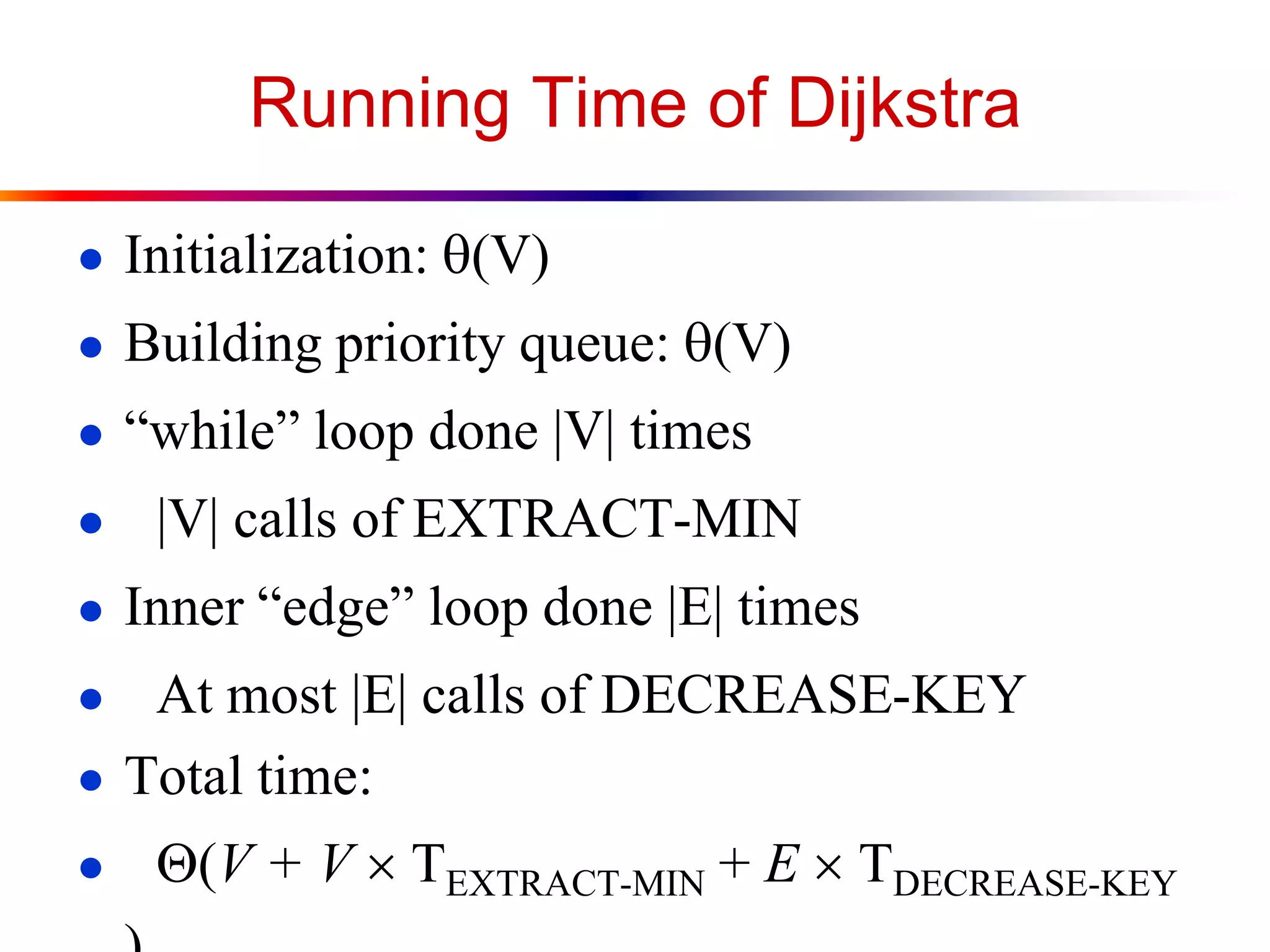
Running Time of Dijkstra
● Initialization: q(V)
● Building priority queue: q(V)
● “while” loop done |V| times
● |V| calls of EXTRACT-MIN
● Inner “edge” loop done |E| times
● At most |E| calls of DECREASE-KEY
● Total time:
● (V + V  TEXTRACT-MIN + E  TDECREASE-KEY
Dijkstra Running Time (cont.)
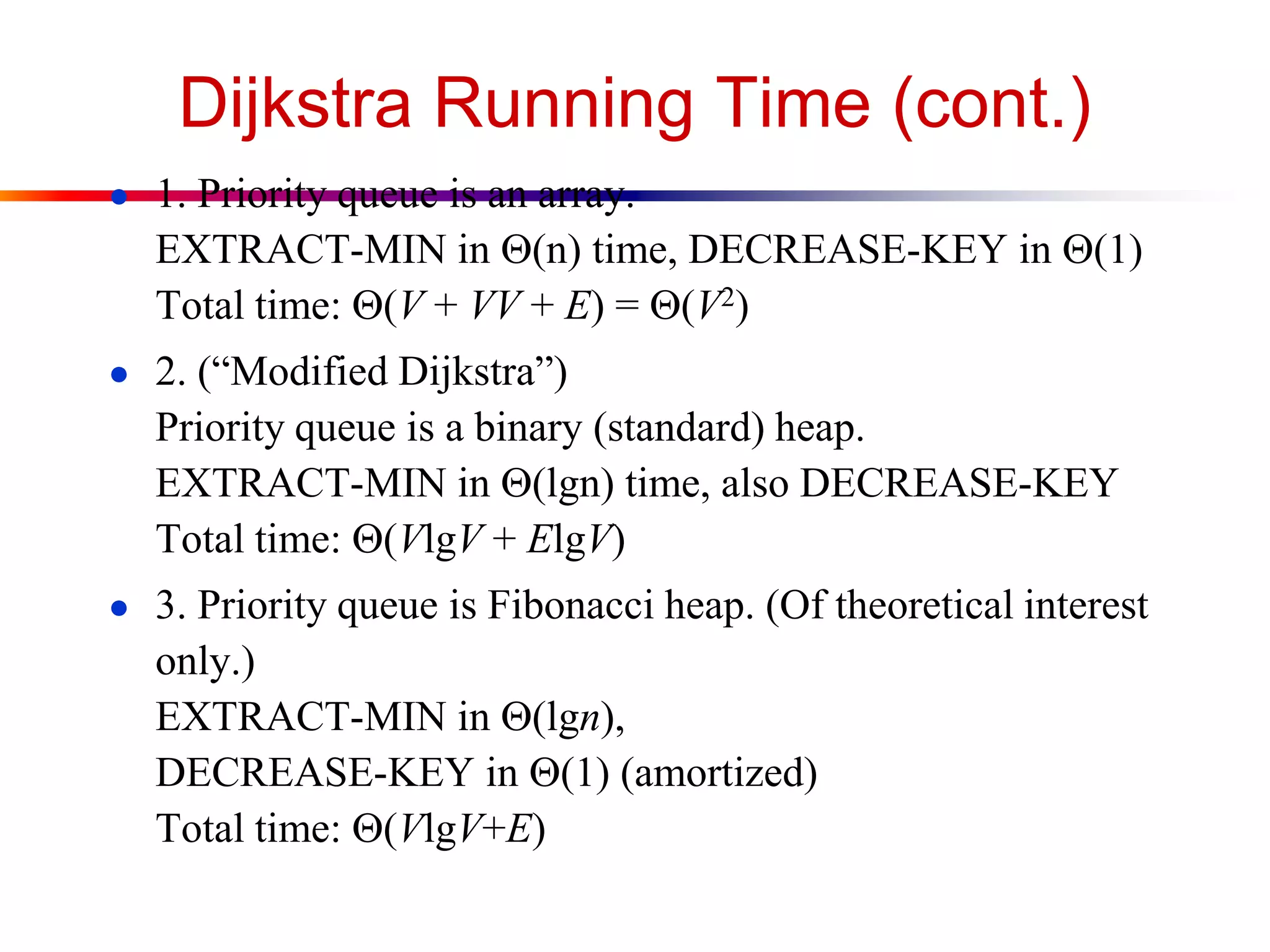
● 1. Priority queue is an array.
EXTRACT-MIN in (n) time, DECREASE-KEY in (1)
Total time: (V + VV + E) = (V2)
● 2. (“Modified Dijkstra”)
Priority queue is a binary (standard) heap.
EXTRACT-MIN in (lgn) time, also DECREASE-KEY
Total time: (VlgV + ElgV)
● 3. Priority queue is Fibonacci heap. (Of theoretical interest
only.)
EXTRACT-MIN in (lgn),
DECREASE-KEY in (1) (amortized)
Total time: (VlgV+E)
The Bellman-Ford Algorithm
● Handles negative edge weights
● Detects negative cycles
● Is slower than Dijkstra
4
5
-10
a negative cycle
Bellman-Ford: Idea
● Repeatedly update d for all pairs of vertices
connected by an edge.
● Theorem: If u and v are two vertices with an
edge from u to v, and s  u  v is a shortest
path, and d[u] = d(s,u),
● then d[u]+w(u,v) is the length of a shortest
path to v.
● Proof: Since s u  v is a shortest path, its
length is d(s,u) + w(u,v) = d[u] + w(u,v). 
Why Bellman-Ford Works
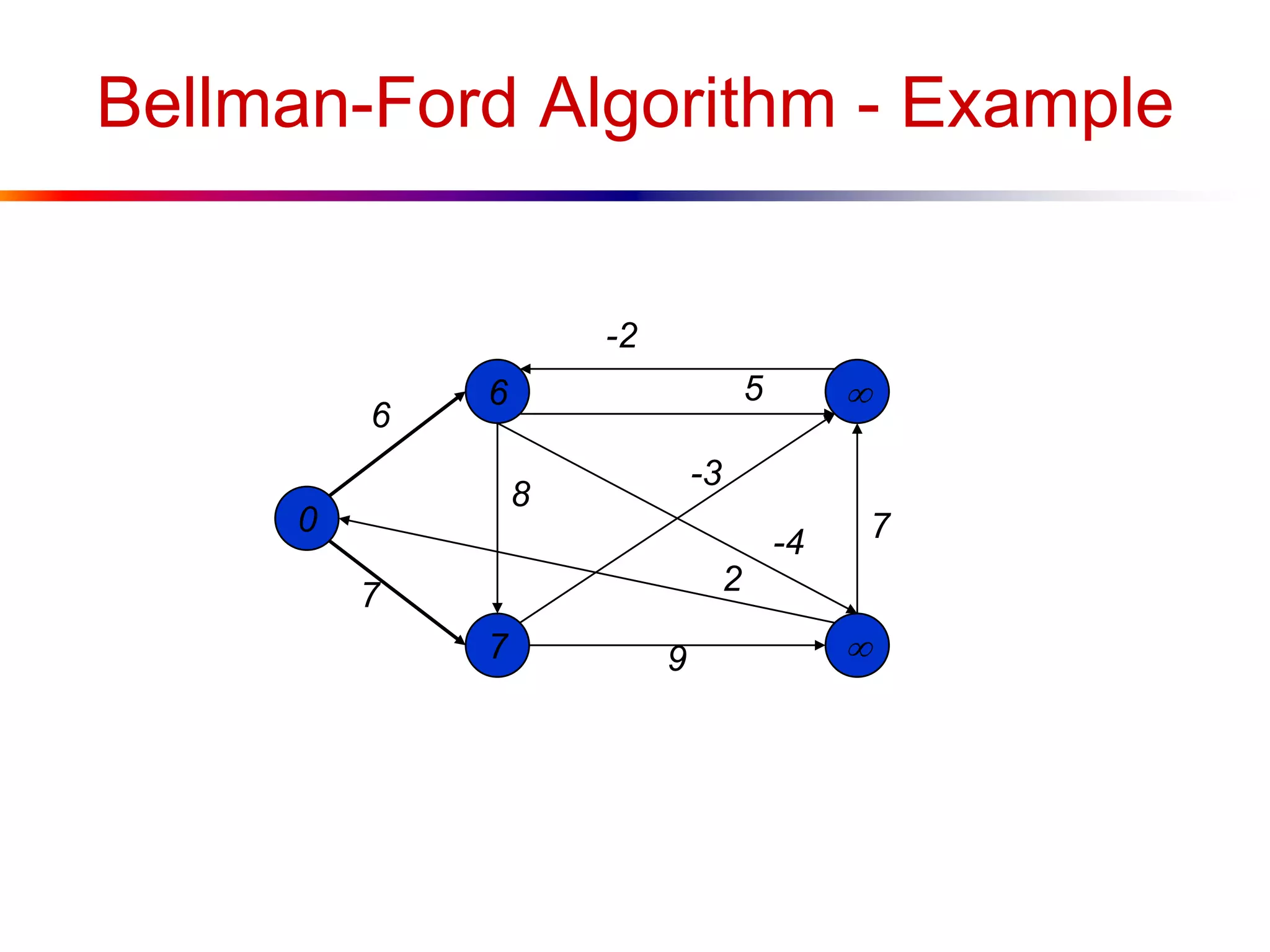
• On the first pass, we find d(s,u) for all vertices whose
shortest paths have one edge.
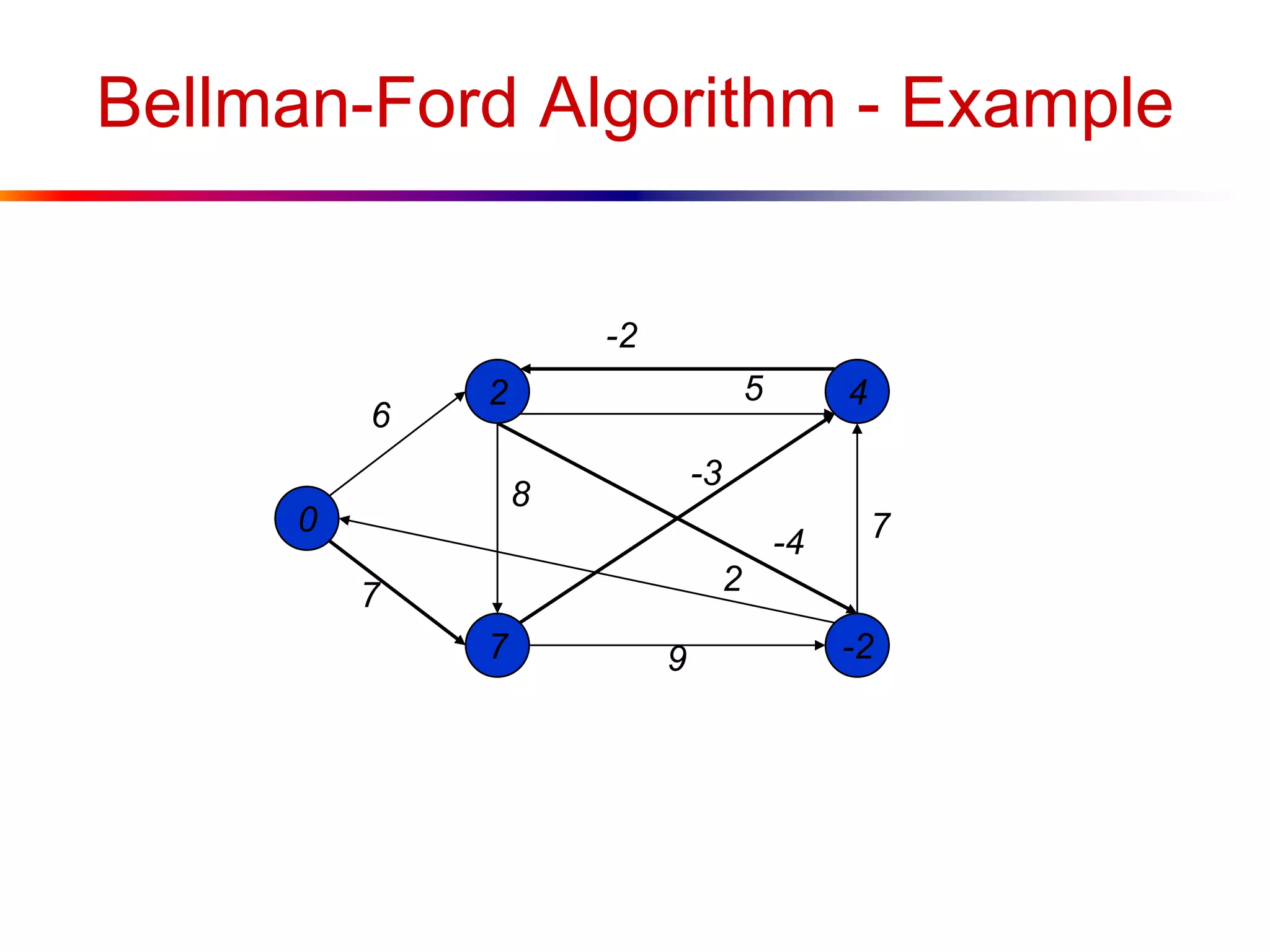
• On the second pass, the d[u] values computed for the one-
edge-away vertices are correct (= d(s,u)), so they are used
to compute the correct d values for vertices whose shortest
paths have two edges.
• Since no shortest path can have more than |V[G]|-1 edges,
after that many passes all d values are correct.
• Note: all vertices not reachable from s will have their
original values of infinity. (Same, by the way, for
Dijkstra).
Bellman-Ford: Algorithm
● BELLMAN-FORD(G, w, s)
● 1 foreach vertex v V[G] do //INIT_SINGLE_SOURCE
● 2 d[v] 
● 3 p[v] NIL
● 4 d[s] 0
● 5 for i  1 to |V[G]|-1 do > each iteration is a “pass”
● 6 for each edge (u,v) in E[G] do
● 7 RELAX(u, v, w)
● 8 > check for negative cycles
● 9 for each edge (u,v) in E[G] do
● 10 if d[v] > d[u] + w(u,v) then
● 11 return FALSE
● 12 return TRUE
Running time:(VE)
Negative Cycle Detection
● What if there is a negative-weight
cycle reachable from s?
● Assume: d[u]  d[x]+4
● d[v]  d[u]+5
● d[x]  d[v]-10
● Adding:
● d[u]+d[v]+d[x]  d[x]+d[u]+d[v]-1
● Because it’s a cycle, vertices on left are same as those on right.
Thus we get 0  -1; a contradiction.
So for at least one edge (u,v),
● d[v] > d[u] + w(u,v)
● This is exactly what Bellman-Ford checks for.
u
x
v
4
5
-10
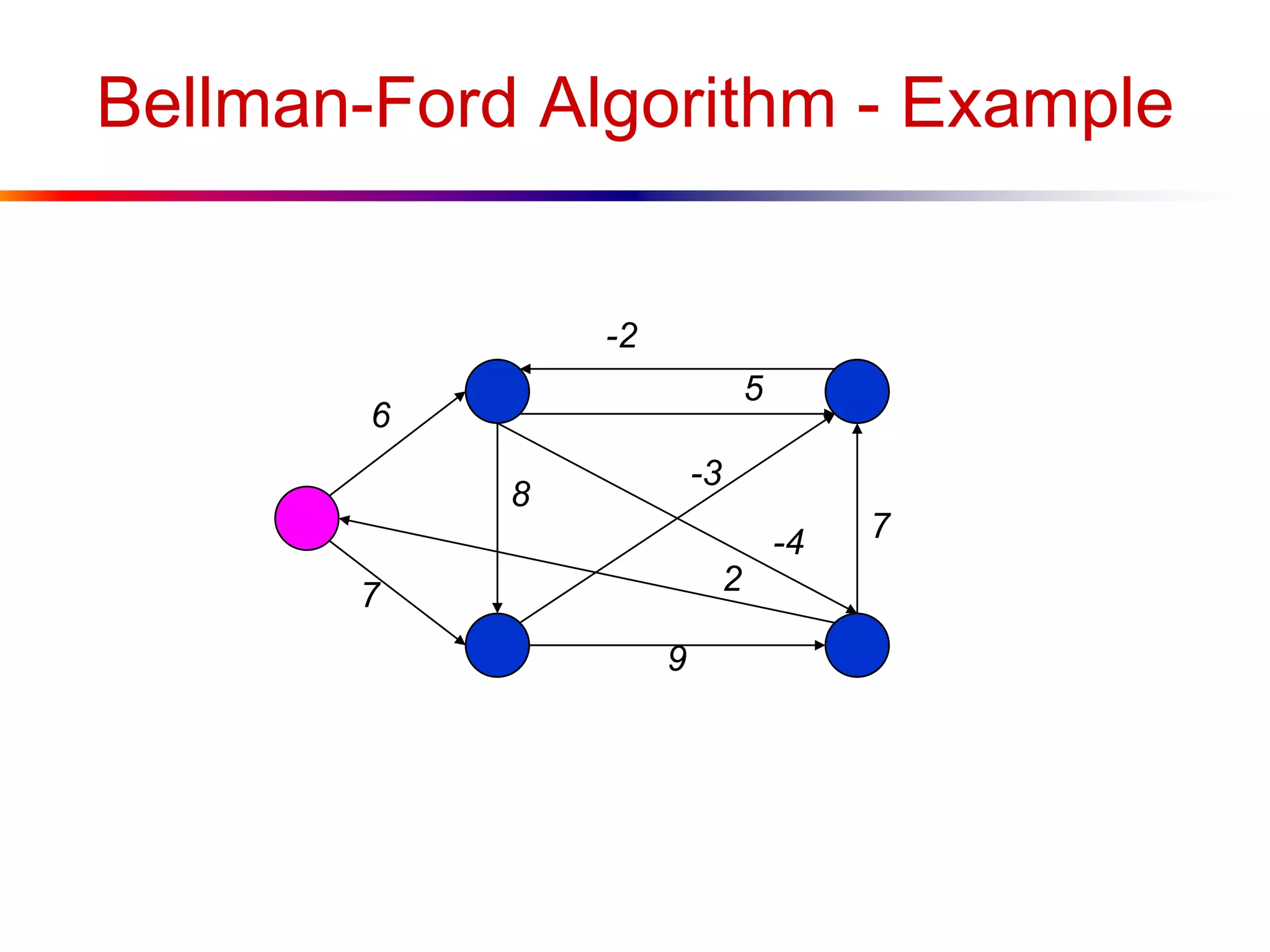
Bellman-Ford Algorithm - Example
6
7
7
-3
2
8
-4
9
5
-2
Bellman-Ford Algorithm - Example
0




6
7
7
-3
2
8
-4
9
5
-2
Bellman-Ford Algorithm - Example
0
7
6


6
7
7
-3
2
8
-4
9
5
-2
Bellman-Ford Algorithm - Example
0
7
6
2
4
6
7
7
-3
2
8
-4
9
5
-2
Bellman-Ford Algorithm - Example
0
7
2
2
4
6
5
7
7
-3
2
8
-2
-4
9
Bellman-Ford Algorithm - Example
0
7
2
-2
4
6
5
7
7
-3
2
8
-2
-4
9
All-Pairs Shortest Paths
Given graph (directed or undirected) G = (V,E) with
weight function w: E  R find for all pairs of vertices
u,v  V the minimum possible weight for path from u to v.
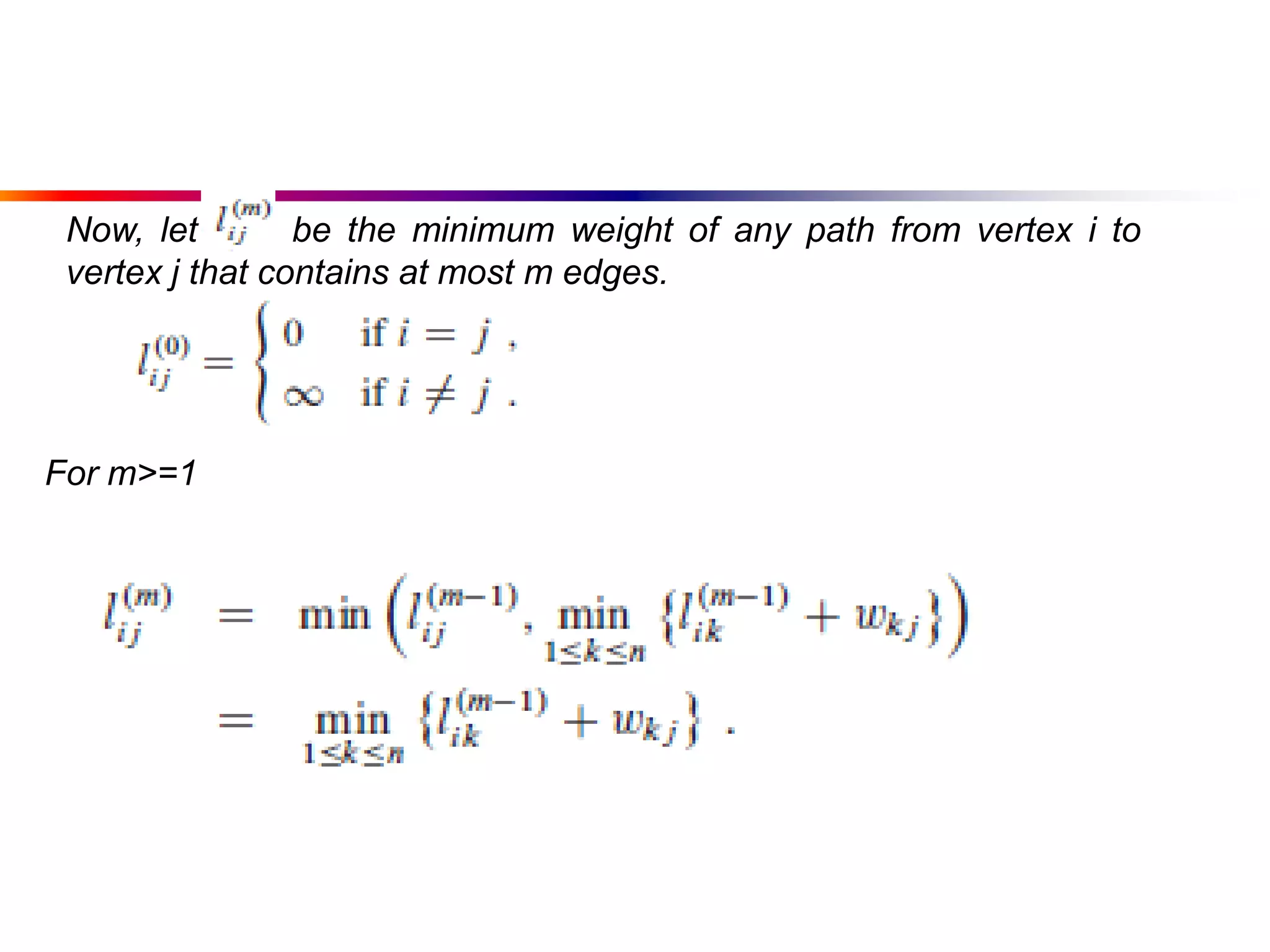
Now, let be the minimum weight of any path from vertex i to
vertex j that contains at most m edges.
For m>=1
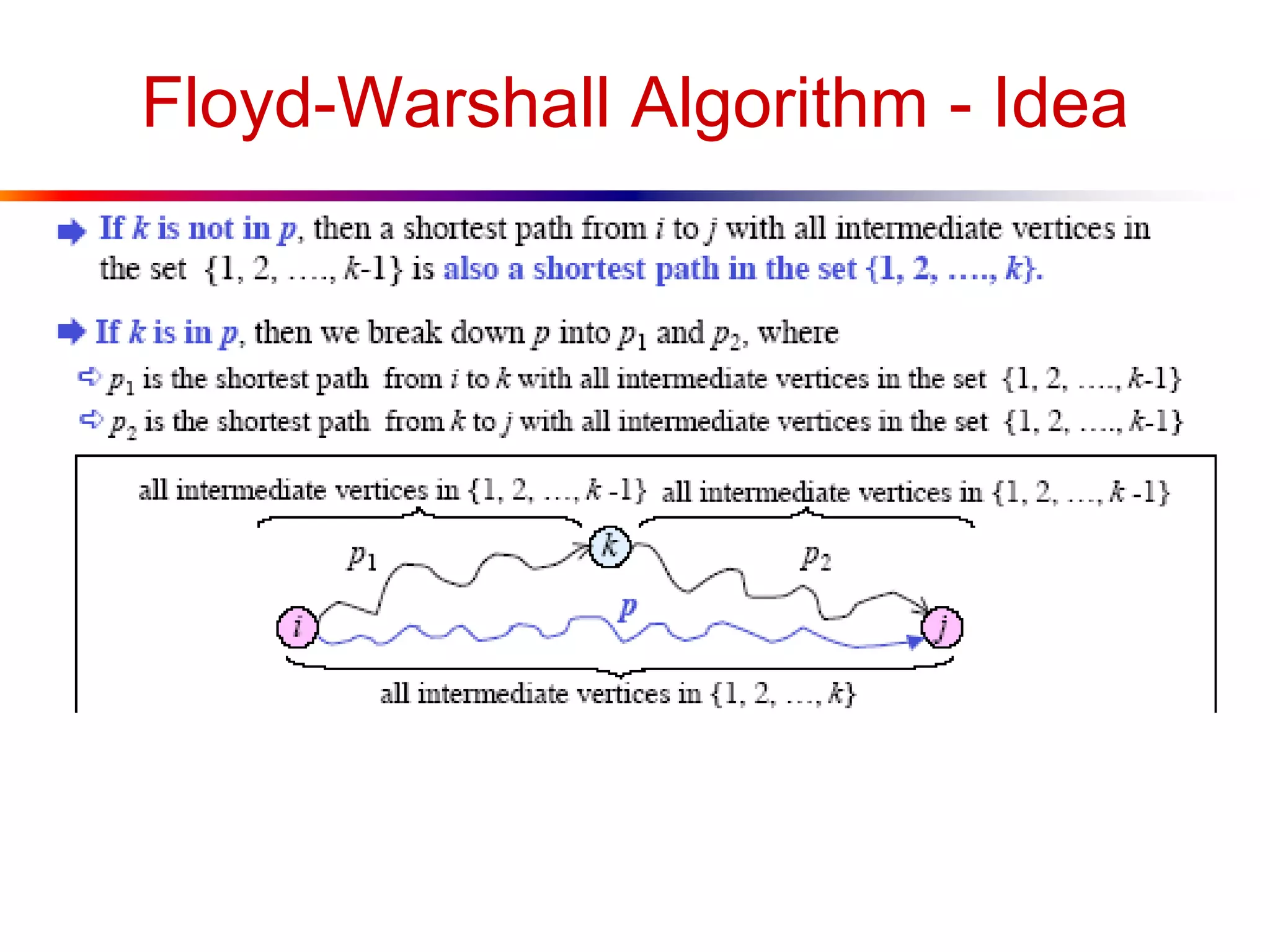
Floyd-Warshall Algorithm - Idea
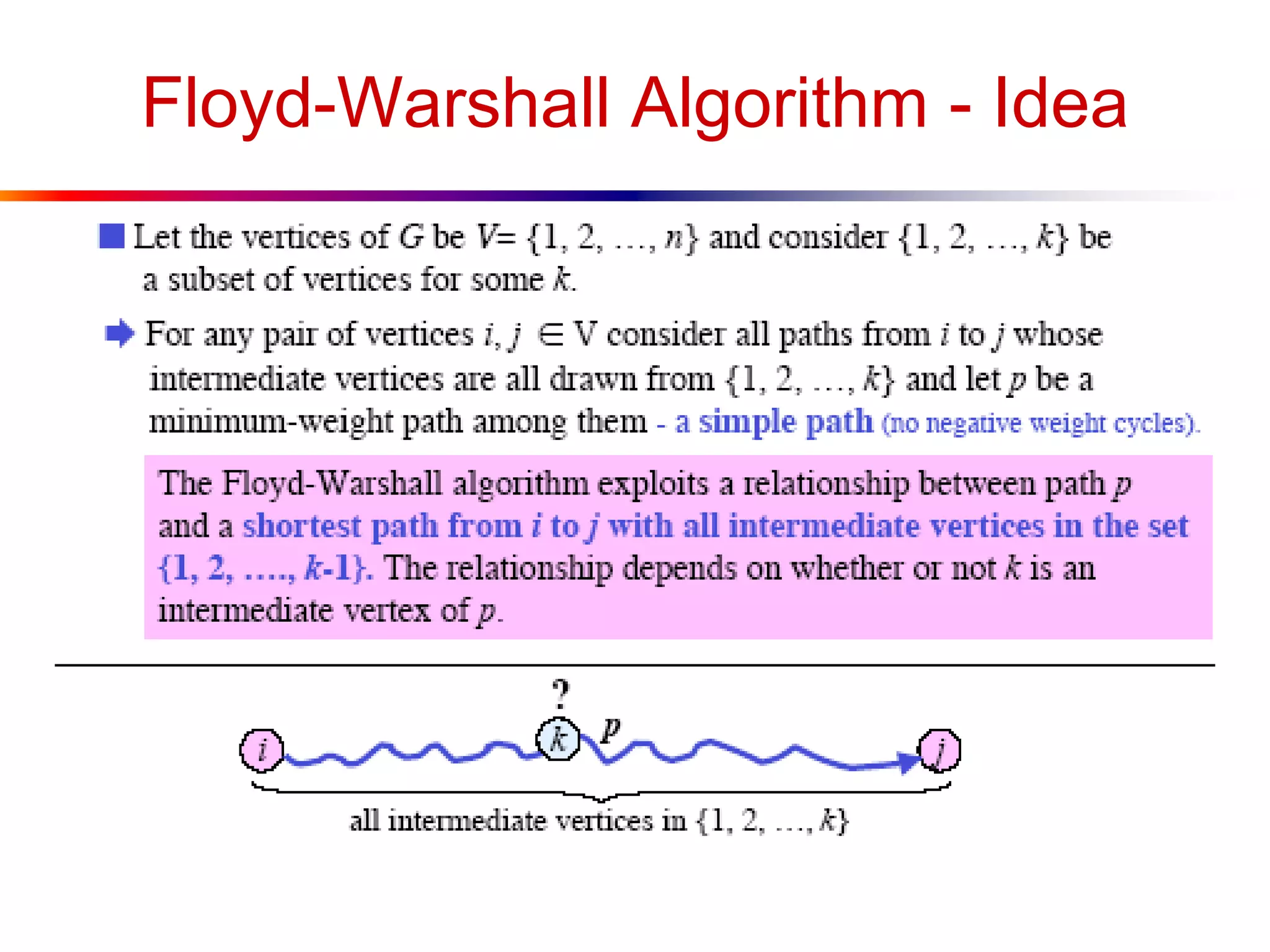
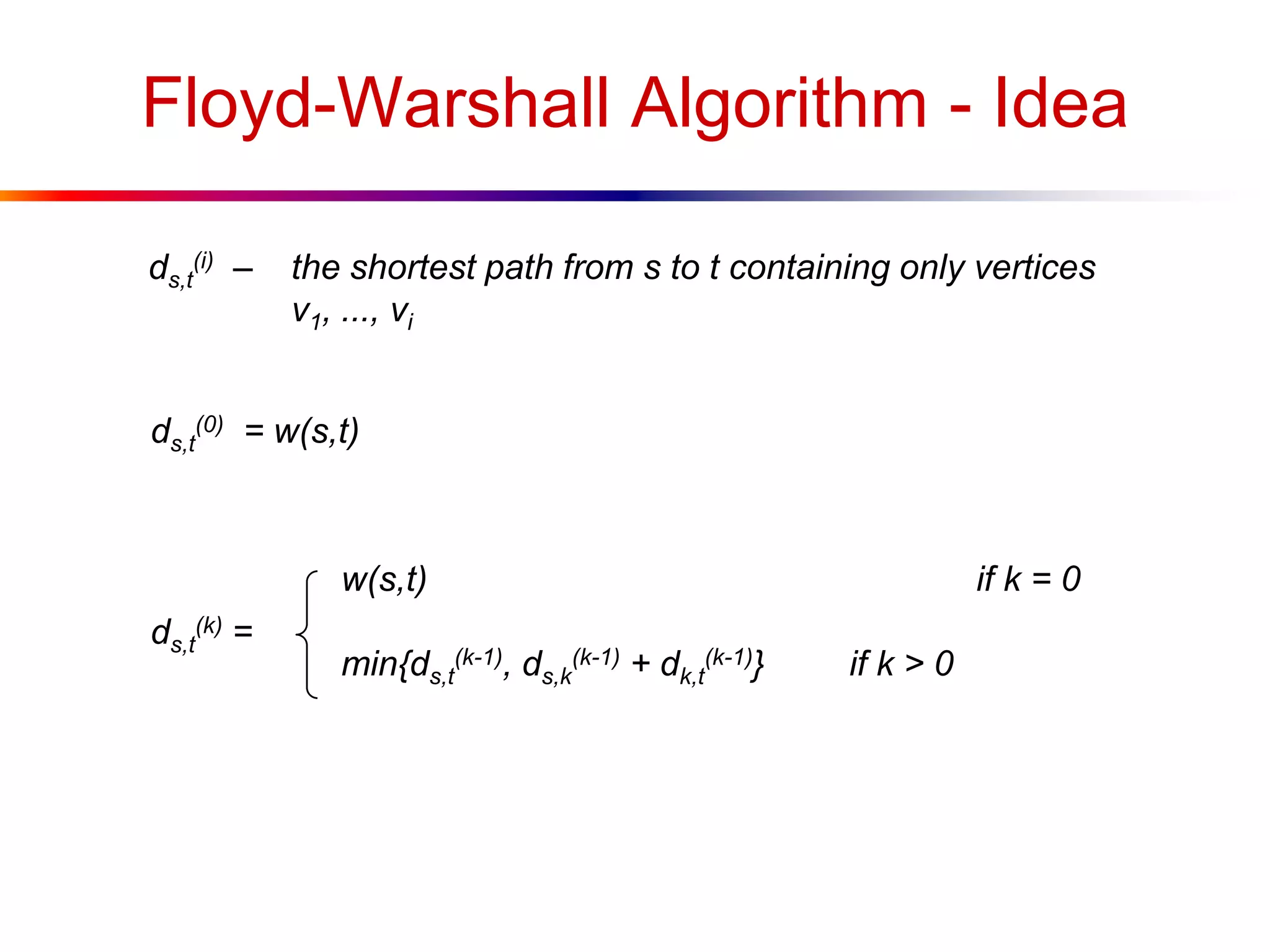
ds,t
(i) – the shortest path from s to t containing only vertices
v1, ..., vi
ds,t
(0) = w(s,t)
ds,t
(k) =
w(s,t) if k = 0
min{ds,t
(k-1), ds,k
(k-1) + dk,t
(k-1)} if k > 0
Floyd-Warshall Algorithm -
Algorithm
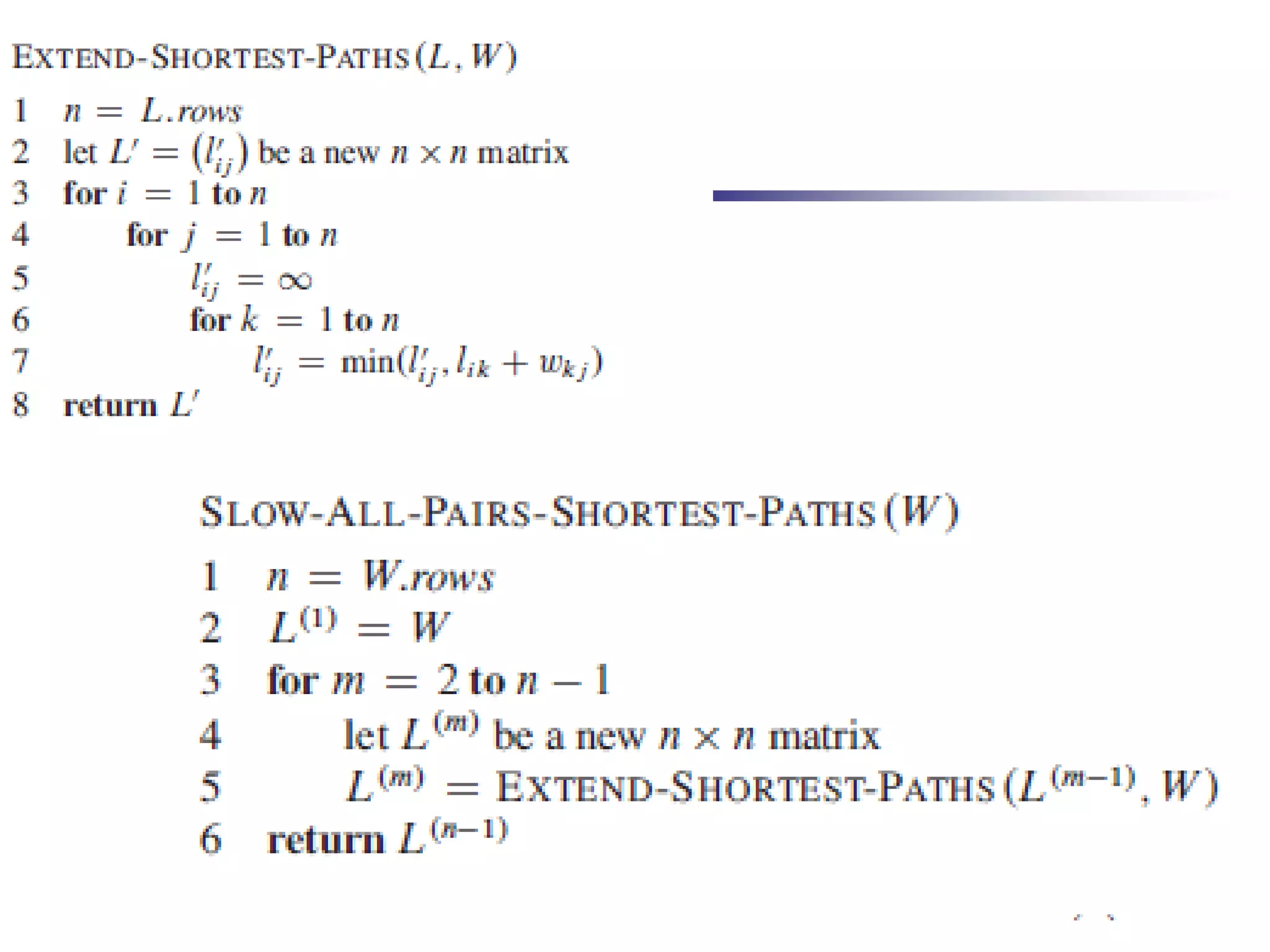
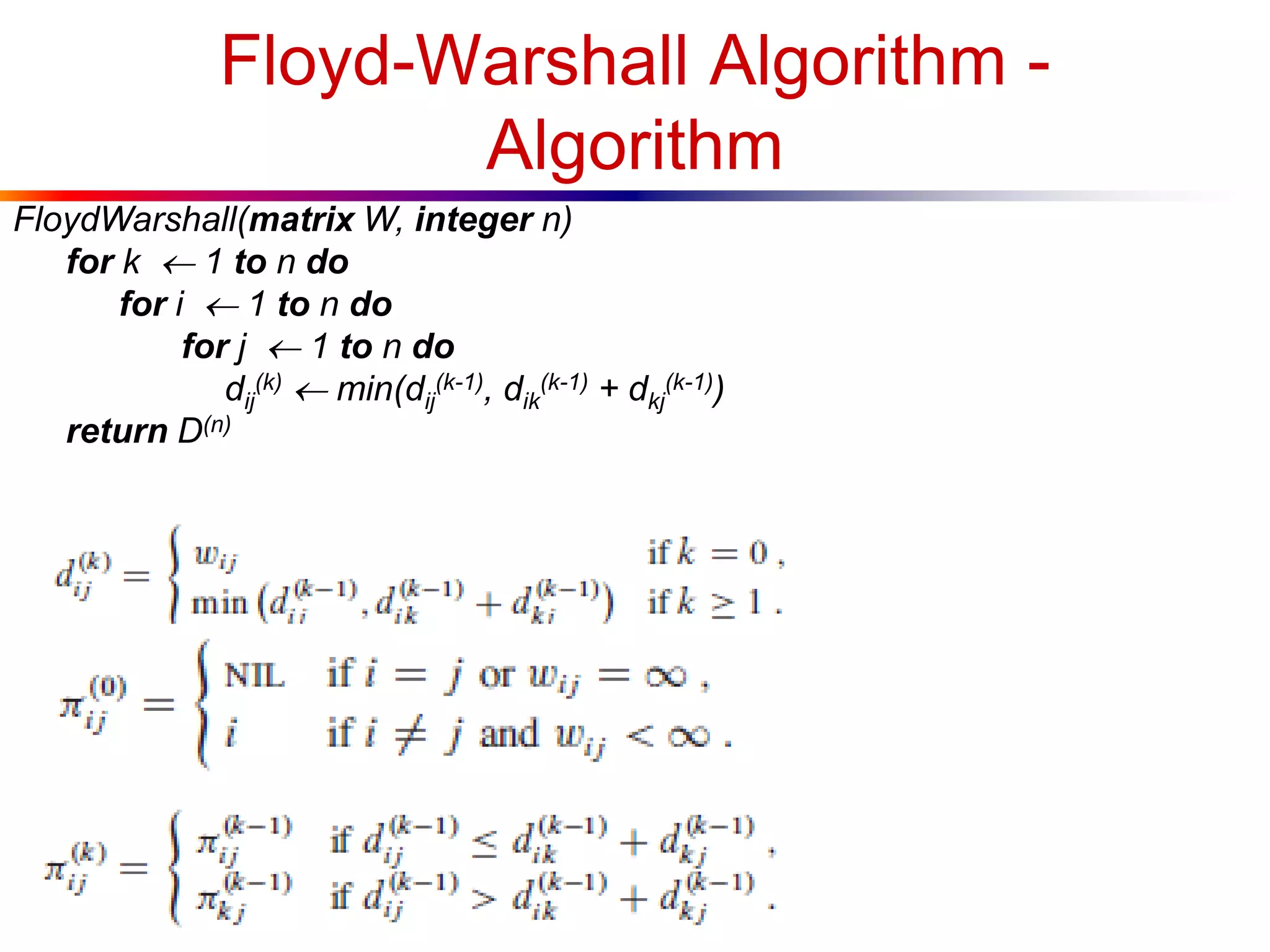
FloydWarshall(matrix W, integer n)
for k  1 to n do
for i  1 to n do
for j  1 to n do
dij
(k)  min(dij
(k-1), dik
(k-1) + dkj
(k-1))
return D(n)
Floyd-Warshall Algorithm -
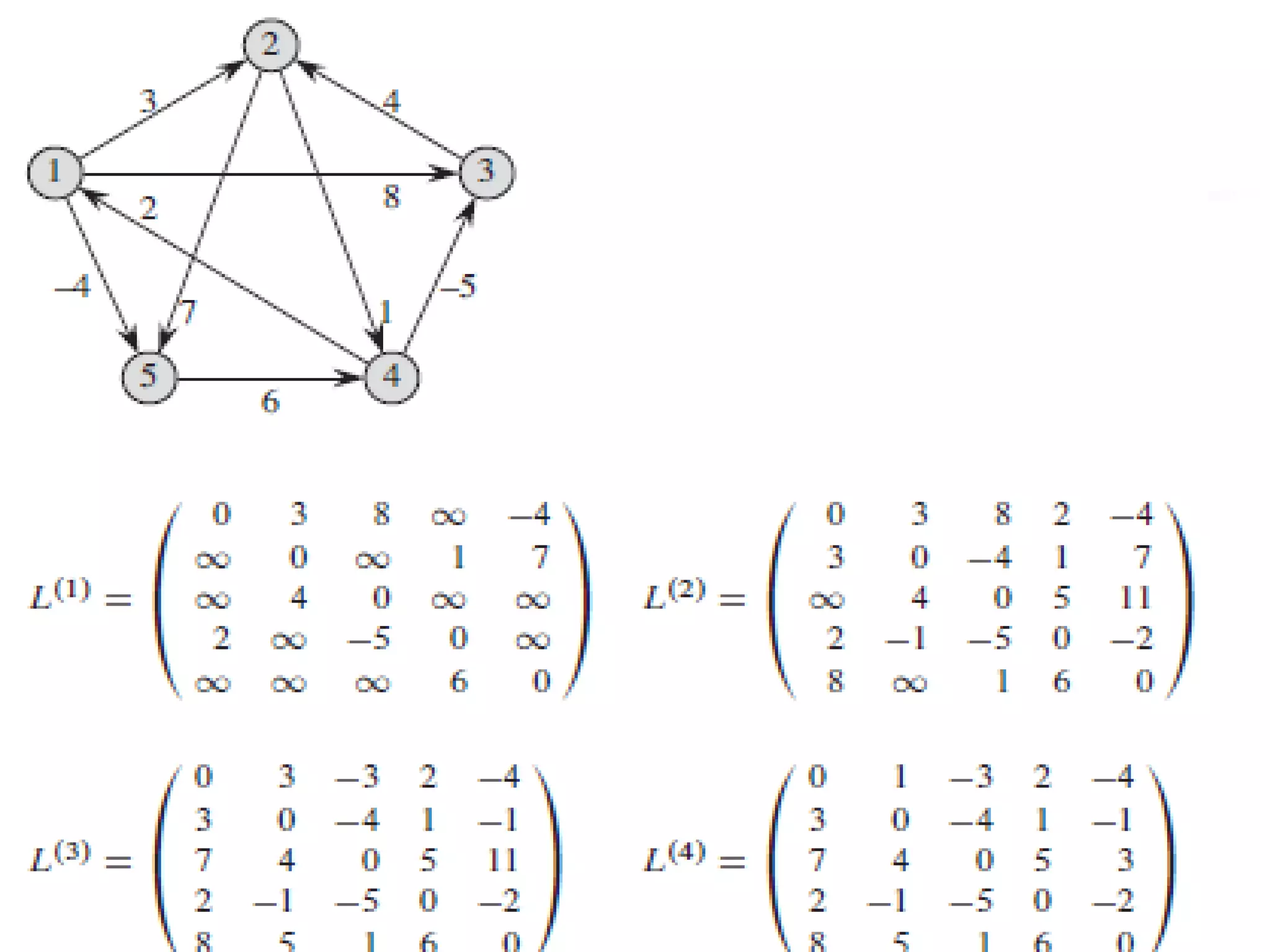
Example
2
45
1 3
3 4
-4
-5
6
7 1
8
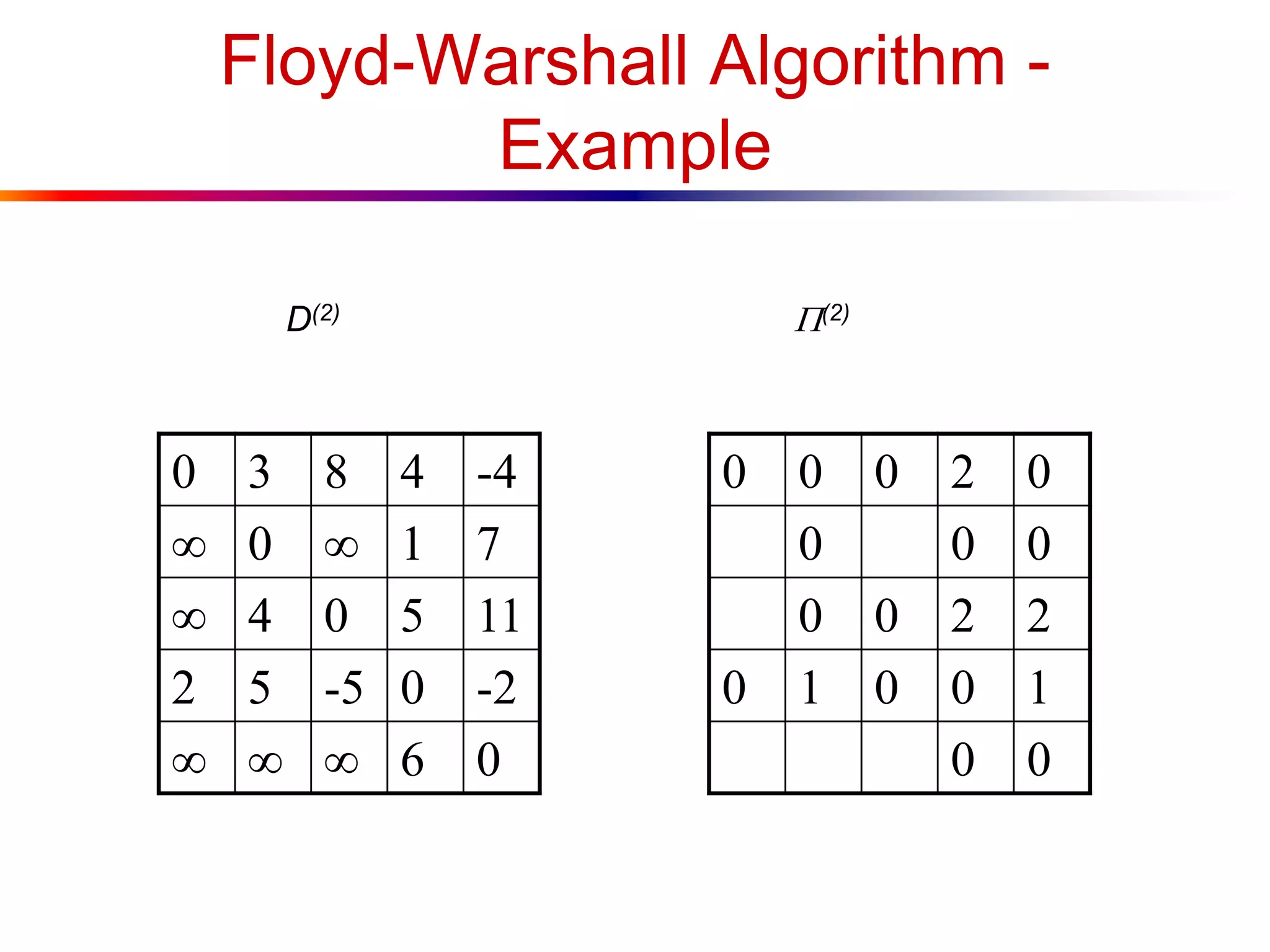
2
0 3 8  -4
 0  1 7
 4 0  
2  -5 0 
   6 0
W
Floyd-Warshall Algorithm -
Example
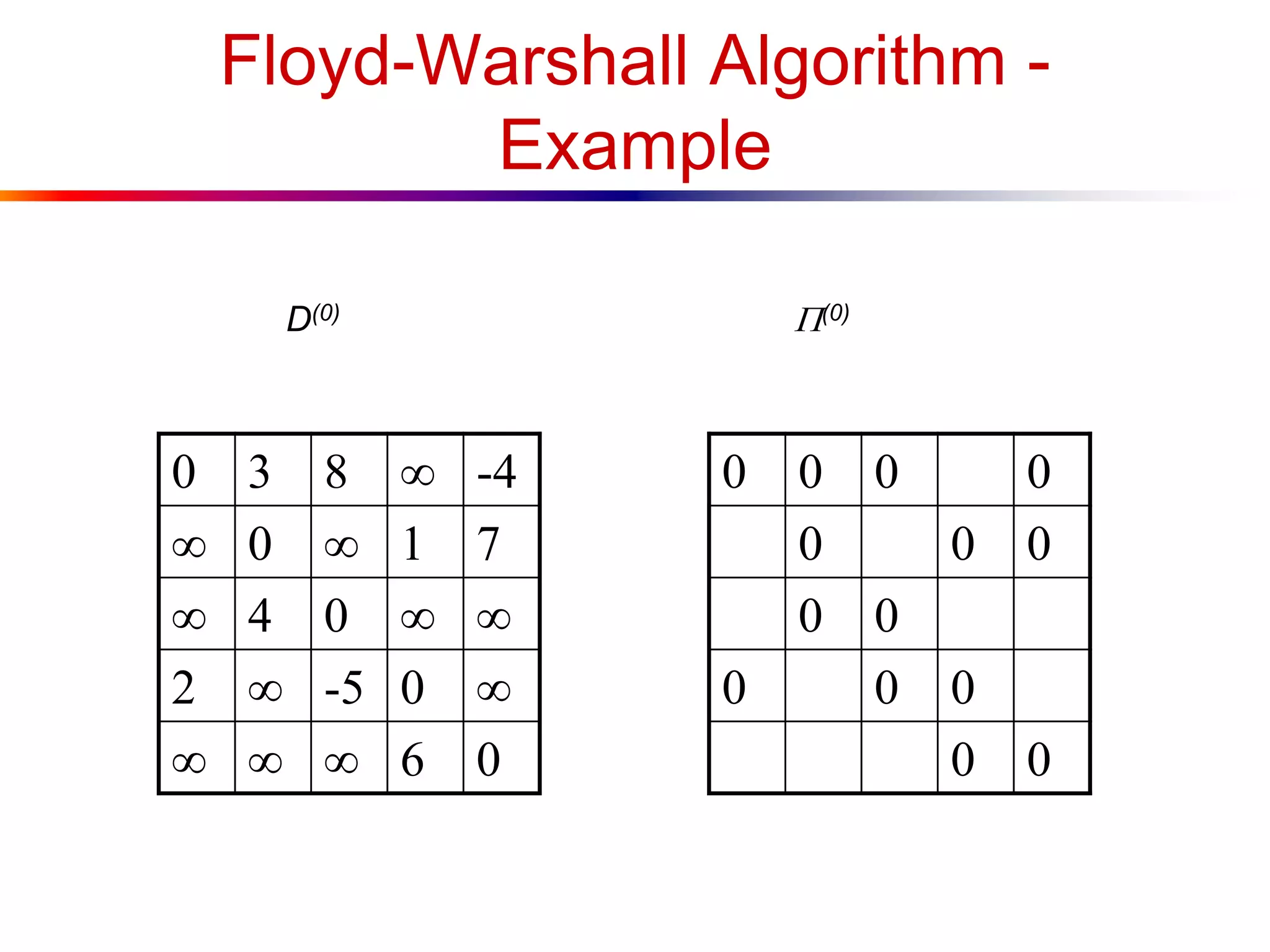
0 3 8  -4
 0  1 7
 4 0  
2  -5 0 
   6 0
0 0 0 0
0 0 0
0 0
0 0 0
0 0
D(0) (0)
Floyd-Warshall Algorithm -
Example
0 3 8  -4
 0  1 7
 4 0  
2 5 -5 0 -2
   6 0
0 0 0 0
0 0 0
0 0
0 1 0 0 1
0 0
D(1) (1)
Floyd-Warshall Algorithm -
Example
0 3 8 4 -4
 0  1 7
 4 0 5 11
2 5 -5 0 -2
   6 0
0 0 0 2 0
0 0 0
0 0 2 2
0 1 0 0 1
0 0
D(2) (2)
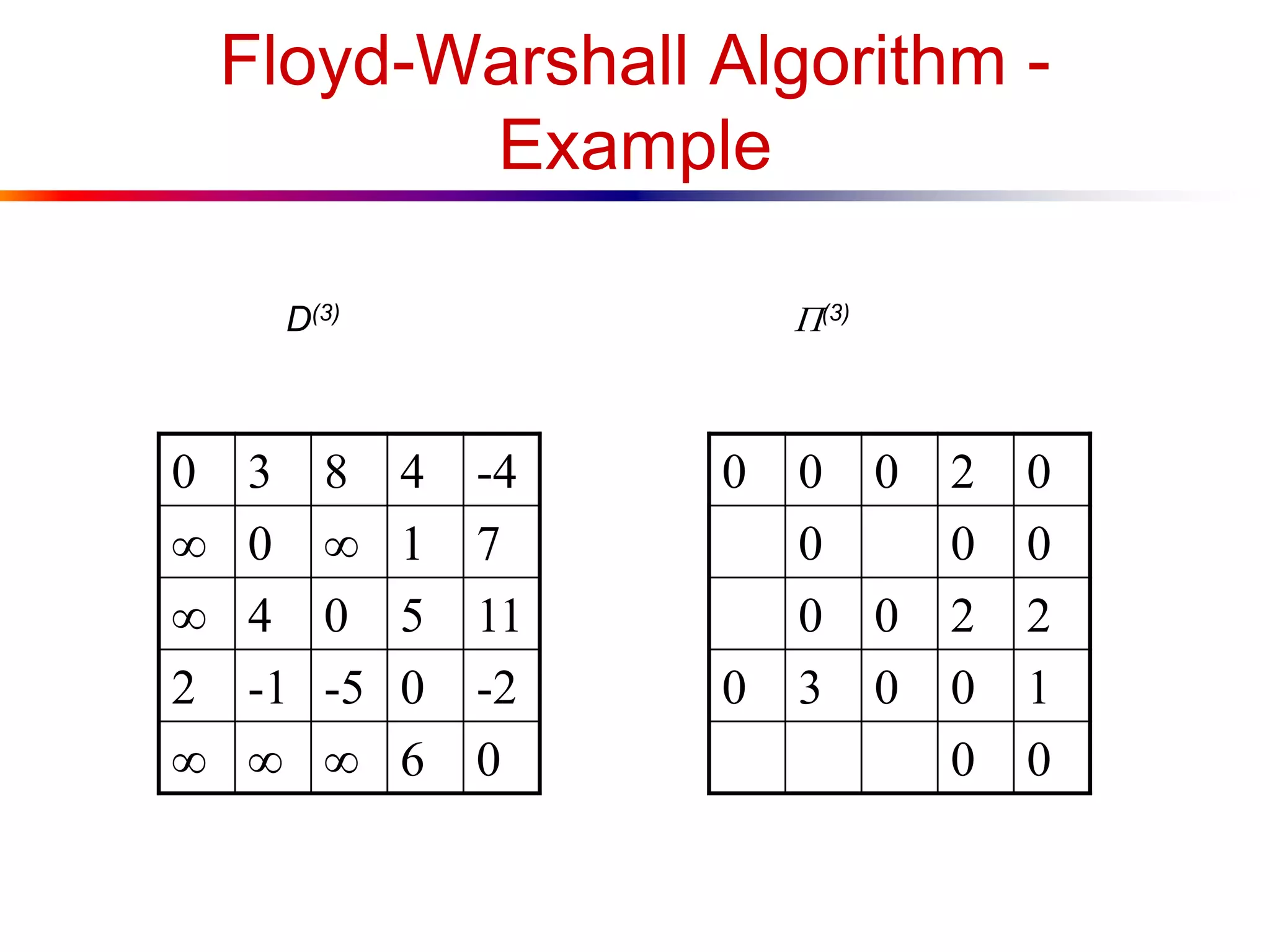
Floyd-Warshall Algorithm -
Example
0 3 8 4 -4
 0  1 7
 4 0 5 11
2 -1 -5 0 -2
   6 0
0 0 0 2 0
0 0 0
0 0 2 2
0 3 0 0 1
0 0
D(3) (3)
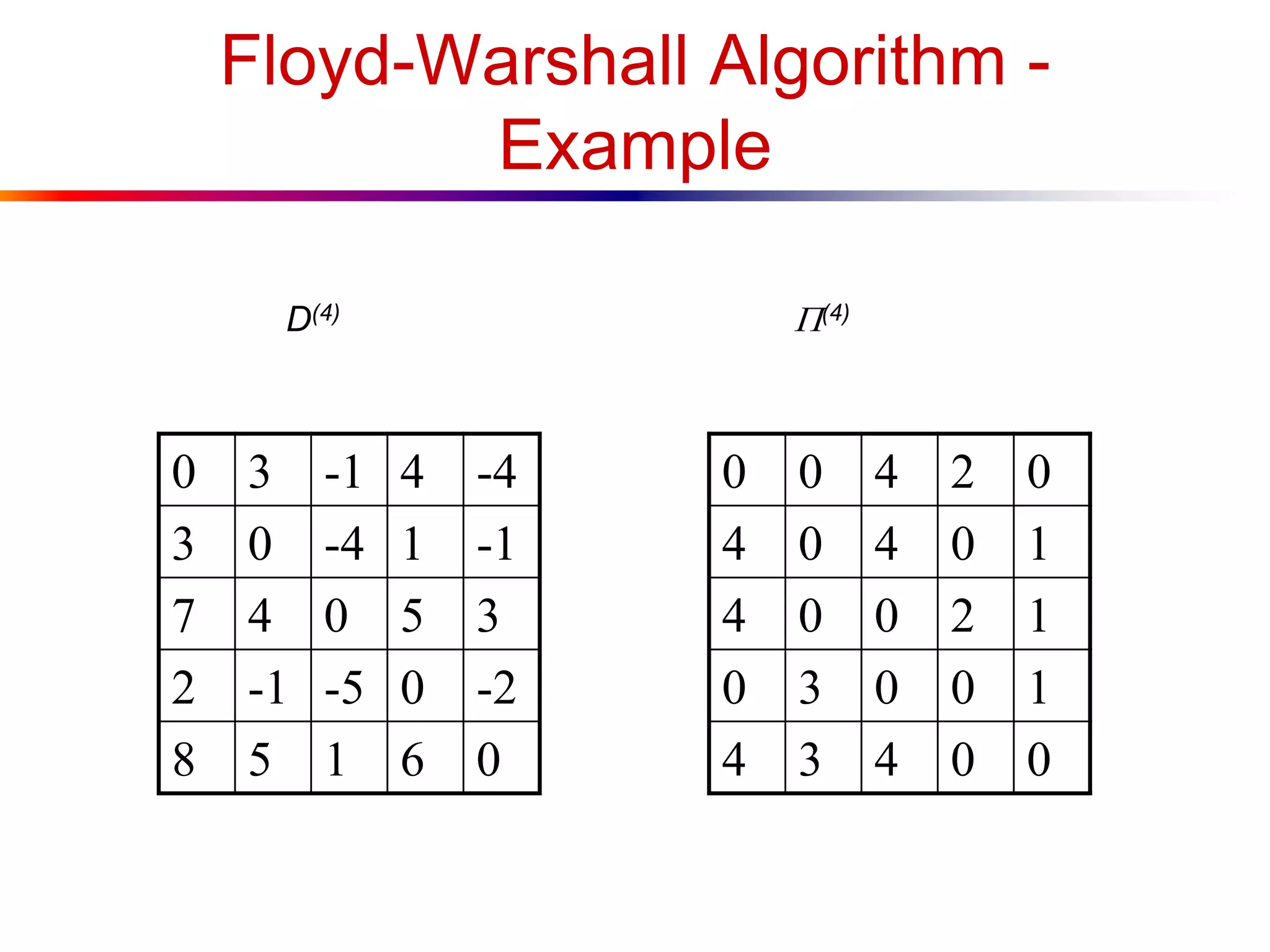
Floyd-Warshall Algorithm -
Example
0 3 -1 4 -4
3 0 -4 1 -1
7 4 0 5 3
2 -1 -5 0 -2
8 5 1 6 0
0 0 4 2 0
4 0 4 0 1
4 0 0 2 1
0 3 0 0 1
4 3 4 0 0
D(4) (4)
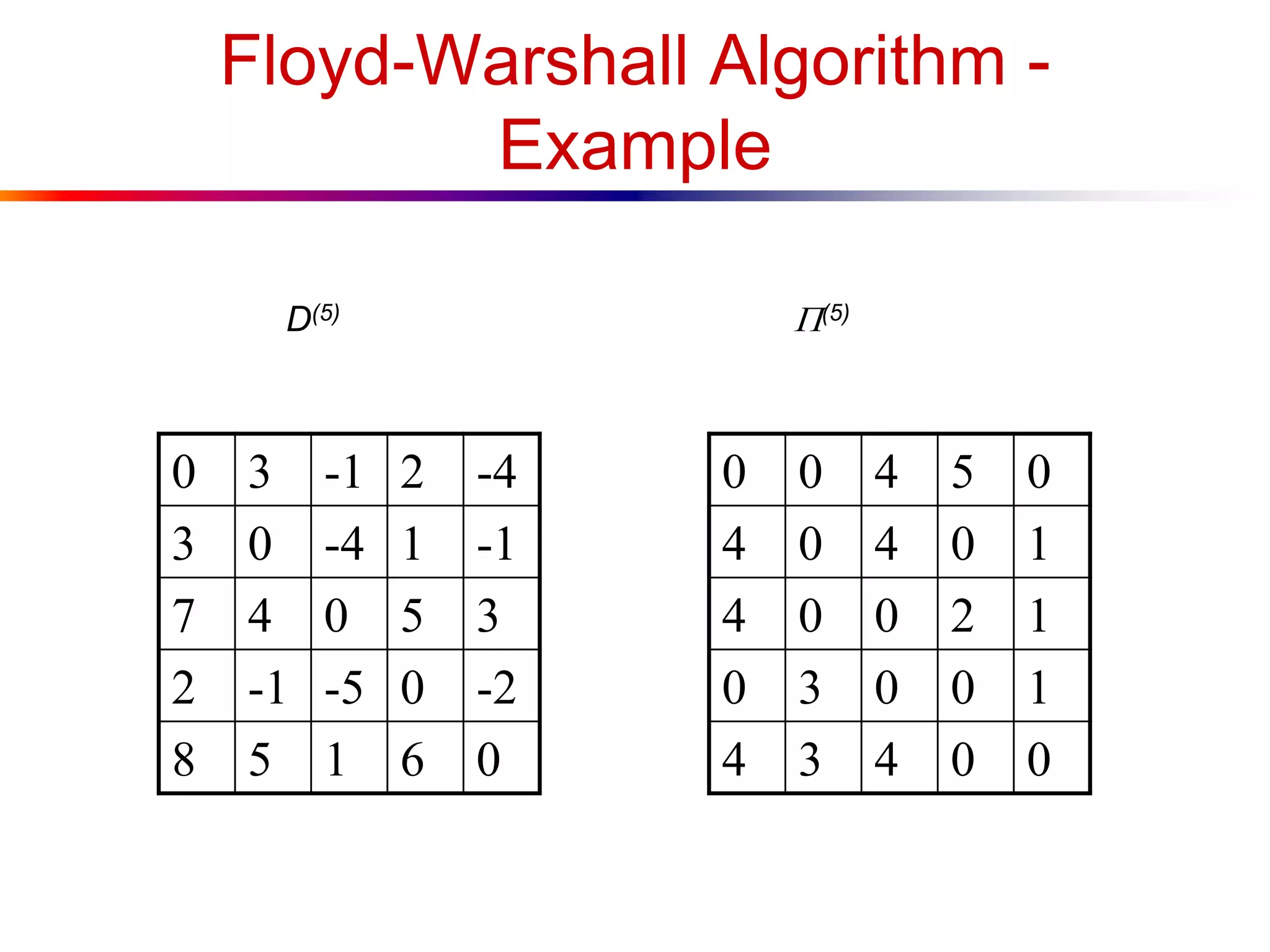
Floyd-Warshall Algorithm -
Example
0 3 -1 2 -4
3 0 -4 1 -1
7 4 0 5 3
2 -1 -5 0 -2
8 5 1 6 0
0 0 4 5 0
4 0 4 0 1
4 0 0 2 1
0 3 0 0 1
4 3 4 0 0
D(5) (5)

Shortest Path in Graph

  • 1.
    Shortest Paths in aGraph Fundamental Algorithms
  • 2.
    The Problems ● Givena directed graph G with edge weights, find ■ The shortest path from a given vertex s to all other vertices (Single Source Shortest Paths) ■ The shortest paths between all pairs of vertices (All Pairs Shortest Paths) ● where the length of a path is the sum of its edge weights.
  • 3.
  • 4.
    Shortest Paths: Algorithms ●Single-Source Shortest Paths (SSSP) ■ Dijkstra’s ■ Bellman-Ford ● All-Pairs Shortest Paths (APSP) ■ Floyd-Warshall
  • 5.
    A Fact AboutShortest Paths ● Theorem: If p is a shortest path from u to v, then any subpath of p is also a shortest path. ● Proof: Consider a subpath of p from x to y. If there were a shorter path from x to y, then there would be a shorter path from u to v. u x y v shorter?
  • 6.
    Single-Source Shortest Paths ●Given a directed graph with weighted edges, what are the shortest paths from some source vertex s to all other vertices? ● Note: shortest path to single destination cannot be done asymptotically faster, as far as we know. 3 11 9 5 0 3 6 5 4 3 6 2 1 2 7s
  • 7.
    Path Recovery ● Wewould like to find the path itself, not just its length. ● We’ll construct a shortest-paths tree: 3 11 9 5 0 3 6 5 4 3 6 2 7 2 1 s u v x y 3 11 9 5 0 3 6 5 3 6 2 7 42 1 s u v x y
  • 8.
    Shortest-Paths Idea ● d(u,v) length of the shortest path from u to v. ● All SSSP algorithms maintain a field d[u] for every vertex u. d[u] will be an estimate of d(s,u). As the algorithm progresses, we will refine d[u] until, at termination, d[u] = d(s,u). Whenever we discover a new shortest path to u, we update d[u]. ● In fact, d[u] will always be an overestimate of d(s,u): ● d[u] d(s,u) ● We’ll use p[u] to point to the parent (or predecessor) of u on the shortest path from s to u. We update p[u] when we update d[u].
  • 9.
    SSSP Subroutine RELAX(u, v,w) > (Maybe) improve our estimate of the distance to v > by considering a path along the edge (u, v). if d[u] + w(u, v) < d[v] then d[v]  d[u] + w(u, v) > actually, DECREASE-KEY p[v]  u > remember predecessor on path u v w(u,v) d[v]d[u]
  • 10.
    Dijkstra’s Algorithm ● Assumethat all edge weights are  0. ● Idea: say we have a set K containing all vertices whose shortest paths from s are known (i.e. d[u] = d(s,u) for all u in K). ● Now look at the “frontier” of K—all vertices adjacent to a vertex in K. the rest of the graph s K
  • 11.
    Dijkstra’s: Theorem ● Ateach frontier vertex u, update d[u] to be the minimum from all edges from K. ● Now pick the frontier vertex u with the smallest value of d[u]. ● Claim: d[u] = d(s,u) s 4 9 6 6 2 1 3 8 min(4+2, 6+1) = 6 min(4+8, 6+3) = 9
  • 12.
    Dijkstra’s Algorithm -Example 10 1 5 2 64 9 7 2 3
  • 13.
    Dijkstra’s Algorithm -Example 0     10 1 5 2 64 9 7 2 3
  • 14.
    Dijkstra’s Algorithm -Example 0 5 10   10 1 5 2 64 9 7 2 3
  • 15.
    Dijkstra’s Algorithm -Example 0 5 10   10 1 5 2 64 9 7 2 3
  • 16.
    Dijkstra’s Algorithm -Example 0 5 8 7 14 10 1 5 2 64 9 7 2 3
  • 17.
    Dijkstra’s Algorithm -Example 0 5 8 7 14 10 1 5 2 64 9 7 2 3
  • 18.
    Dijkstra’s Algorithm -Example 0 5 8 7 13 10 1 5 2 64 9 7 2 3
  • 19.
    Dijkstra’s Algorithm -Example 0 5 8 7 13 10 1 5 2 64 9 7 2 3
  • 20.
    Dijkstra’s Algorithm -Example 0 5 8 7 9 10 1 5 2 64 9 7 2 3
  • 21.
    Dijkstra’s Algorithm -Example 0 5 8 7 9 10 1 5 2 64 9 7 2 3
  • 22.
    Code for Dijkstra’sAlgorithm 1 DIJKSTRA(G, w, s) > Graph, weights, start vertex 2 for each vertex v in V[G] do 3 d[v]   4 p[v]  NIL 5 d[s]  0 6 Q  BUILD-PRIORITY-QUEUE(V[G]) 7 > Q is V[G] - K 8 while Q is not empty do 9 u = EXTRACT-MIN(Q) 10 for each vertex v in Adj[u] 11 RELAX(u, v, w) // DECREASE_KEY
  • 23.
    Running Time ofDijkstra ● Initialization: q(V) ● Building priority queue: q(V) ● “while” loop done |V| times ● |V| calls of EXTRACT-MIN ● Inner “edge” loop done |E| times ● At most |E| calls of DECREASE-KEY ● Total time: ● (V + V  TEXTRACT-MIN + E  TDECREASE-KEY
  • 24.
    Dijkstra Running Time(cont.) ● 1. Priority queue is an array. EXTRACT-MIN in (n) time, DECREASE-KEY in (1) Total time: (V + VV + E) = (V2) ● 2. (“Modified Dijkstra”) Priority queue is a binary (standard) heap. EXTRACT-MIN in (lgn) time, also DECREASE-KEY Total time: (VlgV + ElgV) ● 3. Priority queue is Fibonacci heap. (Of theoretical interest only.) EXTRACT-MIN in (lgn), DECREASE-KEY in (1) (amortized) Total time: (VlgV+E)
  • 25.
    The Bellman-Ford Algorithm ●Handles negative edge weights ● Detects negative cycles ● Is slower than Dijkstra 4 5 -10 a negative cycle
  • 26.
    Bellman-Ford: Idea ● Repeatedlyupdate d for all pairs of vertices connected by an edge. ● Theorem: If u and v are two vertices with an edge from u to v, and s  u  v is a shortest path, and d[u] = d(s,u), ● then d[u]+w(u,v) is the length of a shortest path to v. ● Proof: Since s u  v is a shortest path, its length is d(s,u) + w(u,v) = d[u] + w(u,v). 
  • 27.
    Why Bellman-Ford Works •On the first pass, we find d(s,u) for all vertices whose shortest paths have one edge. • On the second pass, the d[u] values computed for the one- edge-away vertices are correct (= d(s,u)), so they are used to compute the correct d values for vertices whose shortest paths have two edges. • Since no shortest path can have more than |V[G]|-1 edges, after that many passes all d values are correct. • Note: all vertices not reachable from s will have their original values of infinity. (Same, by the way, for Dijkstra).
  • 28.
    Bellman-Ford: Algorithm ● BELLMAN-FORD(G,w, s) ● 1 foreach vertex v V[G] do //INIT_SINGLE_SOURCE ● 2 d[v]  ● 3 p[v] NIL ● 4 d[s] 0 ● 5 for i  1 to |V[G]|-1 do > each iteration is a “pass” ● 6 for each edge (u,v) in E[G] do ● 7 RELAX(u, v, w) ● 8 > check for negative cycles ● 9 for each edge (u,v) in E[G] do ● 10 if d[v] > d[u] + w(u,v) then ● 11 return FALSE ● 12 return TRUE Running time:(VE)
  • 29.
    Negative Cycle Detection ●What if there is a negative-weight cycle reachable from s? ● Assume: d[u]  d[x]+4 ● d[v]  d[u]+5 ● d[x]  d[v]-10 ● Adding: ● d[u]+d[v]+d[x]  d[x]+d[u]+d[v]-1 ● Because it’s a cycle, vertices on left are same as those on right. Thus we get 0  -1; a contradiction. So for at least one edge (u,v), ● d[v] > d[u] + w(u,v) ● This is exactly what Bellman-Ford checks for. u x v 4 5 -10
  • 30.
    Bellman-Ford Algorithm -Example 6 7 7 -3 2 8 -4 9 5 -2
  • 31.
    Bellman-Ford Algorithm -Example 0     6 7 7 -3 2 8 -4 9 5 -2
  • 32.
    Bellman-Ford Algorithm -Example 0 7 6   6 7 7 -3 2 8 -4 9 5 -2
  • 33.
    Bellman-Ford Algorithm -Example 0 7 6 2 4 6 7 7 -3 2 8 -4 9 5 -2
  • 34.
    Bellman-Ford Algorithm -Example 0 7 2 2 4 6 5 7 7 -3 2 8 -2 -4 9
  • 35.
    Bellman-Ford Algorithm -Example 0 7 2 -2 4 6 5 7 7 -3 2 8 -2 -4 9
  • 36.
    All-Pairs Shortest Paths Givengraph (directed or undirected) G = (V,E) with weight function w: E  R find for all pairs of vertices u,v  V the minimum possible weight for path from u to v.
  • 37.
    Now, let bethe minimum weight of any path from vertex i to vertex j that contains at most m edges. For m>=1
  • 40.
  • 41.
  • 42.
    Floyd-Warshall Algorithm -Idea ds,t (i) – the shortest path from s to t containing only vertices v1, ..., vi ds,t (0) = w(s,t) ds,t (k) = w(s,t) if k = 0 min{ds,t (k-1), ds,k (k-1) + dk,t (k-1)} if k > 0
  • 43.
    Floyd-Warshall Algorithm - Algorithm FloydWarshall(matrixW, integer n) for k  1 to n do for i  1 to n do for j  1 to n do dij (k)  min(dij (k-1), dik (k-1) + dkj (k-1)) return D(n)
  • 44.
    Floyd-Warshall Algorithm - Example 2 45 13 3 4 -4 -5 6 7 1 8 2 0 3 8  -4  0  1 7  4 0   2  -5 0     6 0 W
  • 45.
    Floyd-Warshall Algorithm - Example 03 8  -4  0  1 7  4 0   2  -5 0     6 0 0 0 0 0 0 0 0 0 0 0 0 0 0 0 D(0) (0)
  • 46.
    Floyd-Warshall Algorithm - Example 03 8  -4  0  1 7  4 0   2 5 -5 0 -2    6 0 0 0 0 0 0 0 0 0 0 0 1 0 0 1 0 0 D(1) (1)
  • 47.
    Floyd-Warshall Algorithm - Example 03 8 4 -4  0  1 7  4 0 5 11 2 5 -5 0 -2    6 0 0 0 0 2 0 0 0 0 0 0 2 2 0 1 0 0 1 0 0 D(2) (2)
  • 48.
    Floyd-Warshall Algorithm - Example 03 8 4 -4  0  1 7  4 0 5 11 2 -1 -5 0 -2    6 0 0 0 0 2 0 0 0 0 0 0 2 2 0 3 0 0 1 0 0 D(3) (3)
  • 49.
    Floyd-Warshall Algorithm - Example 03 -1 4 -4 3 0 -4 1 -1 7 4 0 5 3 2 -1 -5 0 -2 8 5 1 6 0 0 0 4 2 0 4 0 4 0 1 4 0 0 2 1 0 3 0 0 1 4 3 4 0 0 D(4) (4)
  • 50.
    Floyd-Warshall Algorithm - Example 03 -1 2 -4 3 0 -4 1 -1 7 4 0 5 3 2 -1 -5 0 -2 8 5 1 6 0 0 0 4 5 0 4 0 4 0 1 4 0 0 2 1 0 3 0 0 1 4 3 4 0 0 D(5) (5)