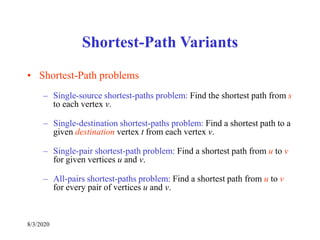
The document discusses various shortest path algorithms, including Dijkstra's and Bellman-Ford, for finding shortest paths in graphs. It explains the concepts of single-source shortest path problems and variations such as single-pair and all-pairs shortest paths, along with methods for graphs with negative weights. Additionally, it outlines the Floyd-Warshall algorithm and its matrix multiplication approach for computing all-pairs shortest paths.



![8/3/2020
Relaxation
RELAX(u, v)
if d[v] > d[u]+w(u,v) then
d[v] ← d[u]+w(u,v)
π[v] ← u
5
u v
vu
2
2
9
5 7
Relax(u,v)
5
u v
vu
2
2
6
5 6](https://image.slidesharecdn.com/shortestpathsproblem-200803170842/85/Design-and-Analysis-of-Algorithm-Shortest-paths-problem-6-320.jpg)
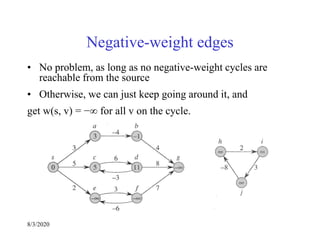
![8/3/2020
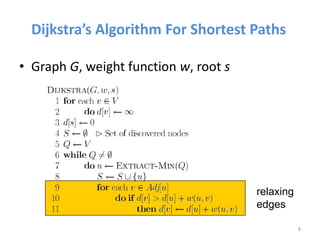
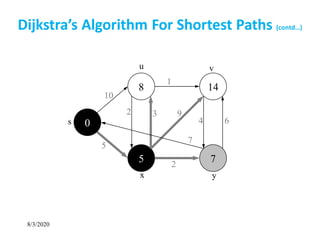
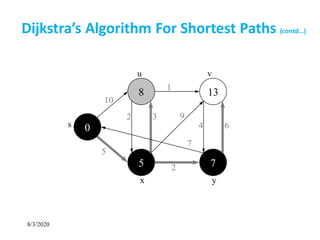
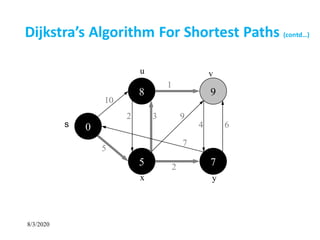
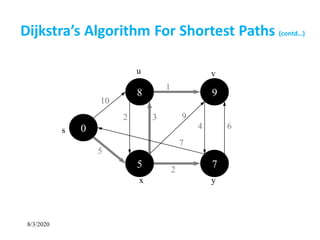
• Non-negative edge weight
• Use Q = priority queue keyed on d[v] values
Dijkstra’s Algorithm For Shortest Paths](https://image.slidesharecdn.com/shortestpathsproblem-200803170842/85/Design-and-Analysis-of-Algorithm-Shortest-paths-problem-7-320.jpg)


![8/3/2020
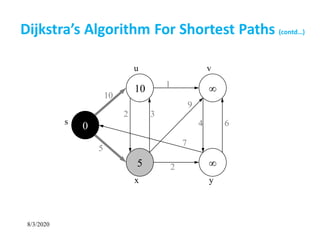
Observe :
• Each vertex is extracted from Q and inserted into S
exactly once
• Each edge is relaxed exactly once
• S = set of vertices whose final shortest paths have already
been determined
i.e. , S = {v V: d[v] = δ(s, v) ≠ ∞ }
Dijkstra’s Algorithm For Shortest Paths](https://image.slidesharecdn.com/shortestpathsproblem-200803170842/85/Design-and-Analysis-of-Algorithm-Shortest-paths-problem-16-320.jpg)

![8/3/2020
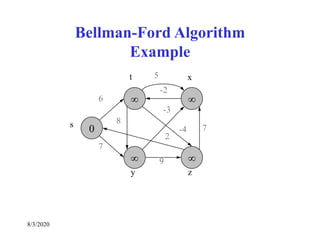
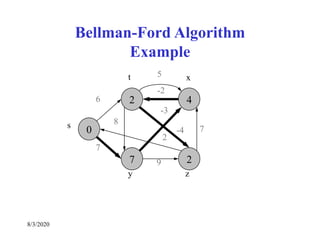
BELMAN-FORD( G, w, s )
INIT( G, s )
for i ←1 to |V|-1 do
for each edge (u, v) E do
RELAX( u, v )
for each edge ( u, v ) E do
if d[v] > d[u]+w(u,v) then
return FALSE > neg-weight cycle
return TRUE
Bellman-Ford Algorithm for Single
Source Shortest Paths](https://image.slidesharecdn.com/shortestpathsproblem-200803170842/85/Design-and-Analysis-of-Algorithm-Shortest-paths-problem-19-320.jpg)

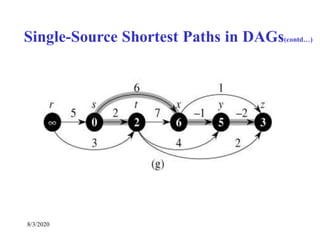
![8/3/2020
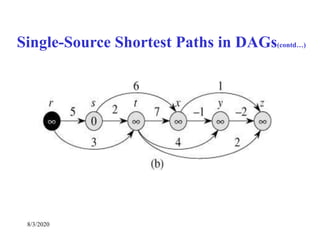
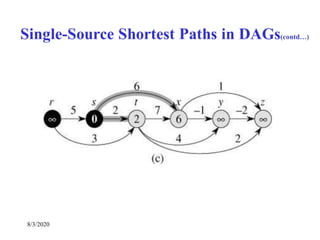
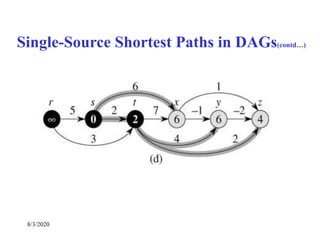
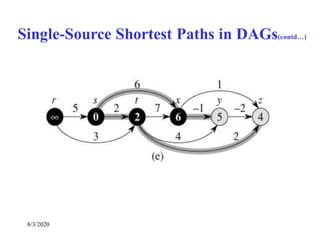
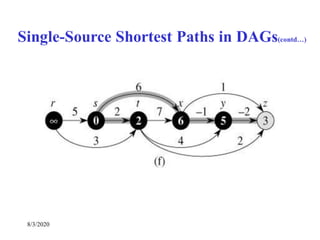
Single-Source Shortest Paths in DAGs
DAG-SHORTEST PATHS(G, s)
TOPOLOGICALLY-SORT the vertices of G
INIT(G, s)
for each vertex u taken in topologically sorted order do
for each v Adj[u] do
RELAX(u, v)](https://image.slidesharecdn.com/shortestpathsproblem-200803170842/85/Design-and-Analysis-of-Algorithm-Shortest-paths-problem-23-320.jpg)
![8/3/2020
EXTEND-SHORTEST-PATHS(D,W)
n = rows[D]
let D' = (d'ij) be an n * n matrix
for i = 1 to n do
for j = 1 to n do
d'ij = ∞
for k = 1 to n do
d'ij = min(d'ij, dik + wkj)
return D'
Shortest Path and Matrix Multiplication](https://image.slidesharecdn.com/shortestpathsproblem-200803170842/85/Design-and-Analysis-of-Algorithm-Shortest-paths-problem-30-320.jpg)
![8/3/2020
SLOW-ALL-PAIRS-SHORTEST-PATHS(W)
n = rows[W]
D(1) = W
for m = 2 to n – 1
D(m) = EXTEND-SHORTEST-PATHS(D(m-1),W)
return D(n-1)](https://image.slidesharecdn.com/shortestpathsproblem-200803170842/85/Design-and-Analysis-of-Algorithm-Shortest-paths-problem-31-320.jpg)
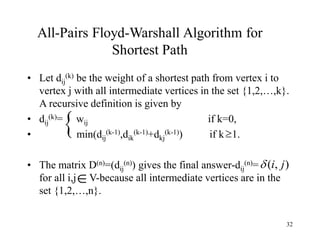
![33
• FLOYD-WARSHALL(W)
n rows[W]
D(0) W
for k 1 to n
do for i 1 to n
do for j 1 to n
dij
(k) min(dij
(k-1),dik
(k-1)+dkj
(k-1))
return D(n)
](https://image.slidesharecdn.com/shortestpathsproblem-200803170842/85/Design-and-Analysis-of-Algorithm-Shortest-paths-problem-33-320.jpg)