SHORTEST PATH ALGORITHM
SALMAN ELAHI | UZAIR ALAM | KAMRAN TARIQ
SHORTEST PATH ALGORITHM
 HISTORY, MOTIVATION & BACKGROUND
 WHAT’S IN A NUTSHELL?
 APPLICATIONS AND IMPLEMENTATION
THE KONIGSBERG BRIDGE PROBLEM
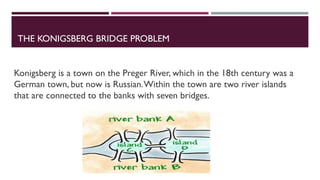
Konigsberg is a town on the Preger River, which in the 18th century was a
German town, but now is Russian.Within the town are two river islands
that are connected to the banks with seven bridges.
THE KONIGSBERG BRIDGE PROBLEM
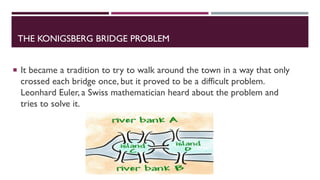
 It became a tradition to try to walk around the town in a way that only
crossed each bridge once, but it proved to be a difficult problem.
Leonhard Euler, a Swiss mathematician heard about the problem and
tries to solve it.
GRAPH THEORY
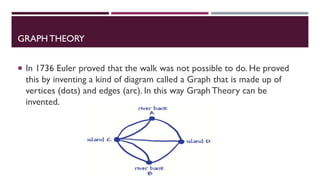
 In 1736 Euler proved that the walk was not possible to do. He proved
this by inventing a kind of diagram called a Graph that is made up of
vertices (dots) and edges (arc). In this way Graph Theory can be
invented.
SHORTEST PATH PROBLEM
 The problem of computing shortest paths is indisputably one of the well-studied
problems in computer science and can be applied on many complex system of real
life.
 In graph theory, the shortest path problem is the problem of finding a path
between two vertices (or nodes) in a graph such that the sum of the weights of its
constituent edges is minimized.
 Two well-known algorithms we used in shortest path problem are:
 Dijkstra Algorithm
 A * Search Algorithm
SHORTEST PATH ALGORITHM
 HISTORY, MOTIVATION & BACKGROUND
 WHAT’S IN A NUTSHELL?
 APPLICATIONS AND IMPLEMENTATION
APPROACHESTO PATH FINDING
 There are many different approaches to path finding and for our purposes it is not necessary to detail each one.
 DIRECTED APPROACH:
 The main strategies for directed path finding algorithms are:
 Uniform cost search g(n) modifies the search to always choose the lowest cost next node.This minimizes the cost of the
path so far, it is optimal and complete, but can be very inefficient.
 Heuristic search h(n) estimates the cost from the next node to the goal.This cuts the search cost considerably but it is
neither optimal nor complete.
 So which algorithms works on these approaches.
THETWO BIG CELEBRITIES
 The two most commonly employed algorithms for directed path finding are:
 Dijkstra’s algorithm conceived by computer scientist Edsger Dijkstra in 1956 and published in 1959
 It uses the uniform cost strategy to find the optimal path.
 First in 1968 Nils Nilsson suggested this heuristic approach for path-finding algorithm, called A1 it is then
improved by different scientist and thus called A*
algorithm
 It combines both strategies there by minimizing the total path cost.
PRESENTING LEGENDARY DIJKSTRA
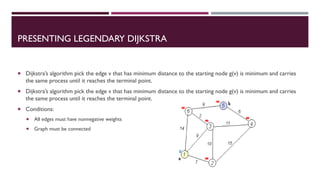
 Dijkstra’s algorithm pick the edge v that has minimum distance to the starting node g(v) is minimum and carries
the same process until it reaches the terminal point.
 Dijkstra’s algorithm pick the edge v that has minimum distance to the starting node g(v) is minimum and carries
the same process until it reaches the terminal point.
 Conditions:
 All edges must have nonnegative weights
 Graph must be connected
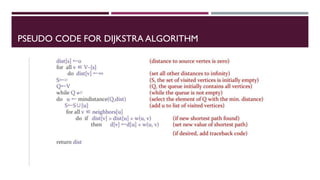
PSEUDO CODE FOR DIJKSTRA ALGORITHM
LIMITATIONS AND FLAWS
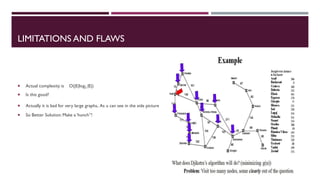
 Actual complexity is O(|E|log2 |E|)
 Is this good?
 Actually it is bad for very large graphs. As u can see in the side picture
 So Better Solution: Make a ‘hunch”!
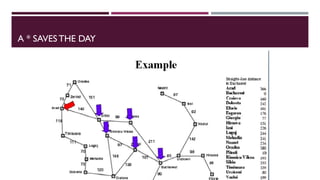
HERE COME’S THE SAVER (A*)
 A* is an algorithm that:
 Uses heuristic to guide search
 While ensuring that it will compute a path with minimum cost
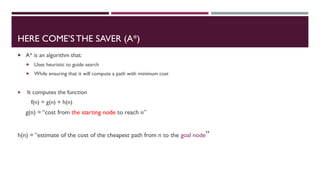
 It computes the function
f(n) = g(n) + h(n)
g(n) = “cost from the starting node to reach n”
h(n) = “estimate of the cost of the cheapest path from n to the goal node”
A * SAVES THE DAY
PROPERTIES OF A*
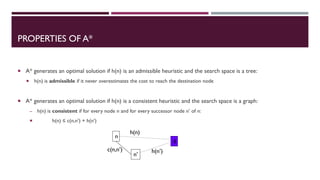
 A* generates an optimal solution if h(n) is an admissible heuristic and the search space is a tree:
 h(n) is admissible if it never overestimates the cost to reach the destination node
 A* generates an optimal solution if h(n) is a consistent heuristic and the search space is a graph:
– h(n) is consistent if for every node n and for every successor node n’ of n:
 h(n) ≤ c(n,n’) + h(n’)
n
n’
d
h(n)
c(n,n’) h(n’)
SHORTEST PATH ALGORITHM
 HISTORY, MOTIVATION & BACKGROUND
 WHAT’S IN A NUTSHELL?
 APPLICATIONS AND IMPLEMENTATION
DIJKSTRA OR A * SEARCH?
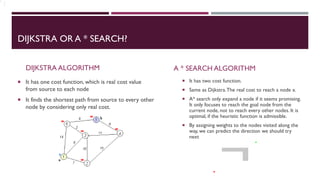
DIJKSTRA ALGORITHM
 It has one cost function, which is real cost value
from source to each node
 It finds the shortest path from source to every other
node by considering only real cost.
A * SEARCH ALGORITHM
 It has two cost function.
 Same as Dijkstra.The real cost to reach a node x.
 A* search only expand a node if it seems promising.
It only focuses to reach the goal node from the
current node, not to reach every other nodes. It is
optimal, if the heuristic function is admissible.
 By assigning weights to the nodes visited along the
way, we can predict the direction we should try
next
APPLICATIONS OF SHORTEST PATH ALGORITHM
 Games Development (Artificial Intelligence based)
 Maps
 Routing of Telecommunications Messages
 Network Routing Protocols
 Optimal Pipelining ofVLSI Chip
 Texture Mapping
 Typesetting in TeX
 UrbanTraffic Planning
 Subroutine in Advanced Algorithms
 Exploiting Arbitrage Opportunities in Currency Exchange
PATH FINDING IN GAMES DEVELOPMENT
 In many Games, computer controlled opponents need to move from one place to another in the GameWorld
 Path finding is the basic building block of most game A.I. (artificial intelligence), and with a little help from the
proper code your game will be that much smarter for it.
 If the start and end points are known in advance, and never change
 Can simply define a fixed path
 Computed before the game begins
 Most plat formers do this
 If the start and end points vary and are not known in advance (or may vary due to change in game state).
 Have to compute the path to follow while the game is running
 Need to use a path finding algorithm
A * IN GAMES DEVELOPMENT
 A * Algorithm is widely used as the conceptual core for path finding in Computer
Games
 Most commercial games use variants of the algorithm tailored to the specific game
 E.G. Star Craft Series
VIDEO
A * SEARCH BASED GAMES IN HTML5
DEMO
APPLICATIONS OF SHORTEST PATH ALGORITHM
 Games Development (Artificial Intelligence based)
 Maps
 Routing of Telecommunications Messages
 Network Routing Protocols
 Optimal Pipelining ofVLSI Chip
 Texture Mapping
 Typesetting in TeX
 UrbanTraffic Planning
 Subroutine in Advanced Algorithms
 Exploiting Arbitrage Opportunities in Currency Exchange
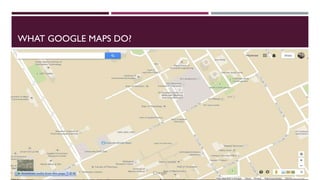
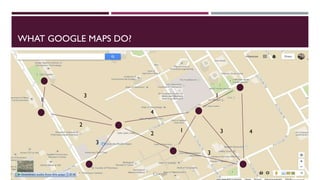
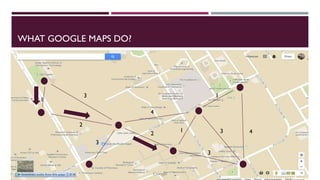
WHAT GOOGLE MAPS DO?
1
3
3
2
4
2
1 3 4
1
3
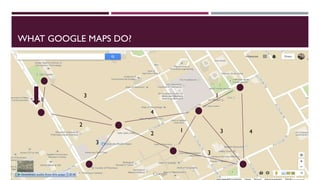
WHAT GOOGLE MAPS DO?
1
3
3
2
4
2
1 3 4
1
3
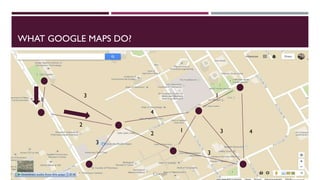
WHAT GOOGLE MAPS DO?
1
3
3
2
4
2
1 3 4
1
3
WHAT GOOGLE MAPS DO?
1
3
3
2
4
2
1 3 4
1
3
APPLICATIONS OF SHORTEST PATH ALGORITHM
 Games Development (Artificial Intelligence based)
 Maps
 Routing ofTelecommunications Messages
 Network Routing Protocols
 Optimal Pipelining ofVLSI Chip
 Texture Mapping
 Typesetting in TeX
 UrbanTraffic Planning
 Subroutine in Advanced Algorithms
 Exploiting Arbitrage Opportunities in Currency Exchange
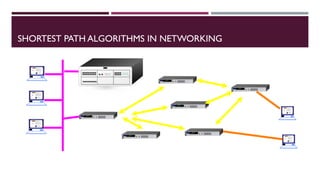
SHORTEST PATH ALGORITHMS IN NETWORKING
APPLICATIONS OF SHORTEST PATH ALGORITHM
 Games Development (Artificial Intelligence based)
 Maps
 Routing of Telecommunications Messages
 Network Routing Protocols
 Optimal Pipelining ofVLSI Chip
 Texture Mapping
 Typesetting in TeX
 UrbanTraffic Planning
 Subroutine in Advanced Algorithms
 Exploiting Arbitrage Opportunities in Currency Exchange
REFERENCES
 http://mcfunkypants.com/LD25/
 A* Path finding Algorithm (University of UC Santa Cruz)
 http://en.wikipedia.org/wiki/A*_search_algorithm
 http://gis.stackexchange.com/questions/23908/what-is-the-difference-between-astar-and-dijkstra-algorithms-in-pgrouting
 https://www.cs.sunysb.edu/~skiena/combinatorica/animations/dijkstra.html
SHORTEST PATH ALGORITHM
SALMAN ELAHI | UZAIR ALAM | KAMRAN TARIQ
THANKS!

Discrete Mathematics Presentation

  • 1.
    SHORTEST PATH ALGORITHM SALMANELAHI | UZAIR ALAM | KAMRAN TARIQ
  • 2.
    SHORTEST PATH ALGORITHM HISTORY, MOTIVATION & BACKGROUND  WHAT’S IN A NUTSHELL?  APPLICATIONS AND IMPLEMENTATION
  • 3.
    THE KONIGSBERG BRIDGEPROBLEM Konigsberg is a town on the Preger River, which in the 18th century was a German town, but now is Russian.Within the town are two river islands that are connected to the banks with seven bridges.
  • 4.
    THE KONIGSBERG BRIDGEPROBLEM  It became a tradition to try to walk around the town in a way that only crossed each bridge once, but it proved to be a difficult problem. Leonhard Euler, a Swiss mathematician heard about the problem and tries to solve it.
  • 5.
    GRAPH THEORY  In1736 Euler proved that the walk was not possible to do. He proved this by inventing a kind of diagram called a Graph that is made up of vertices (dots) and edges (arc). In this way Graph Theory can be invented.
  • 6.
    SHORTEST PATH PROBLEM The problem of computing shortest paths is indisputably one of the well-studied problems in computer science and can be applied on many complex system of real life.  In graph theory, the shortest path problem is the problem of finding a path between two vertices (or nodes) in a graph such that the sum of the weights of its constituent edges is minimized.  Two well-known algorithms we used in shortest path problem are:  Dijkstra Algorithm  A * Search Algorithm
  • 7.
    SHORTEST PATH ALGORITHM HISTORY, MOTIVATION & BACKGROUND  WHAT’S IN A NUTSHELL?  APPLICATIONS AND IMPLEMENTATION
  • 8.
    APPROACHESTO PATH FINDING There are many different approaches to path finding and for our purposes it is not necessary to detail each one.  DIRECTED APPROACH:  The main strategies for directed path finding algorithms are:  Uniform cost search g(n) modifies the search to always choose the lowest cost next node.This minimizes the cost of the path so far, it is optimal and complete, but can be very inefficient.  Heuristic search h(n) estimates the cost from the next node to the goal.This cuts the search cost considerably but it is neither optimal nor complete.  So which algorithms works on these approaches.
  • 9.
    THETWO BIG CELEBRITIES The two most commonly employed algorithms for directed path finding are:  Dijkstra’s algorithm conceived by computer scientist Edsger Dijkstra in 1956 and published in 1959  It uses the uniform cost strategy to find the optimal path.  First in 1968 Nils Nilsson suggested this heuristic approach for path-finding algorithm, called A1 it is then improved by different scientist and thus called A* algorithm  It combines both strategies there by minimizing the total path cost.
  • 10.
    PRESENTING LEGENDARY DIJKSTRA Dijkstra’s algorithm pick the edge v that has minimum distance to the starting node g(v) is minimum and carries the same process until it reaches the terminal point.  Dijkstra’s algorithm pick the edge v that has minimum distance to the starting node g(v) is minimum and carries the same process until it reaches the terminal point.  Conditions:  All edges must have nonnegative weights  Graph must be connected
  • 11.
    PSEUDO CODE FORDIJKSTRA ALGORITHM
  • 12.
    LIMITATIONS AND FLAWS Actual complexity is O(|E|log2 |E|)  Is this good?  Actually it is bad for very large graphs. As u can see in the side picture  So Better Solution: Make a ‘hunch”!
  • 13.
    HERE COME’S THESAVER (A*)  A* is an algorithm that:  Uses heuristic to guide search  While ensuring that it will compute a path with minimum cost  It computes the function f(n) = g(n) + h(n) g(n) = “cost from the starting node to reach n” h(n) = “estimate of the cost of the cheapest path from n to the goal node”
  • 14.
    A * SAVESTHE DAY
  • 15.
    PROPERTIES OF A* A* generates an optimal solution if h(n) is an admissible heuristic and the search space is a tree:  h(n) is admissible if it never overestimates the cost to reach the destination node  A* generates an optimal solution if h(n) is a consistent heuristic and the search space is a graph: – h(n) is consistent if for every node n and for every successor node n’ of n:  h(n) ≤ c(n,n’) + h(n’) n n’ d h(n) c(n,n’) h(n’)
  • 16.
    SHORTEST PATH ALGORITHM HISTORY, MOTIVATION & BACKGROUND  WHAT’S IN A NUTSHELL?  APPLICATIONS AND IMPLEMENTATION
  • 17.
    DIJKSTRA OR A* SEARCH? DIJKSTRA ALGORITHM  It has one cost function, which is real cost value from source to each node  It finds the shortest path from source to every other node by considering only real cost. A * SEARCH ALGORITHM  It has two cost function.  Same as Dijkstra.The real cost to reach a node x.  A* search only expand a node if it seems promising. It only focuses to reach the goal node from the current node, not to reach every other nodes. It is optimal, if the heuristic function is admissible.  By assigning weights to the nodes visited along the way, we can predict the direction we should try next
  • 18.
    APPLICATIONS OF SHORTESTPATH ALGORITHM  Games Development (Artificial Intelligence based)  Maps  Routing of Telecommunications Messages  Network Routing Protocols  Optimal Pipelining ofVLSI Chip  Texture Mapping  Typesetting in TeX  UrbanTraffic Planning  Subroutine in Advanced Algorithms  Exploiting Arbitrage Opportunities in Currency Exchange
  • 19.
    PATH FINDING INGAMES DEVELOPMENT  In many Games, computer controlled opponents need to move from one place to another in the GameWorld  Path finding is the basic building block of most game A.I. (artificial intelligence), and with a little help from the proper code your game will be that much smarter for it.  If the start and end points are known in advance, and never change  Can simply define a fixed path  Computed before the game begins  Most plat formers do this  If the start and end points vary and are not known in advance (or may vary due to change in game state).  Have to compute the path to follow while the game is running  Need to use a path finding algorithm
  • 20.
    A * INGAMES DEVELOPMENT  A * Algorithm is widely used as the conceptual core for path finding in Computer Games  Most commercial games use variants of the algorithm tailored to the specific game  E.G. Star Craft Series
  • 21.
  • 22.
    A * SEARCHBASED GAMES IN HTML5 DEMO
  • 23.
    APPLICATIONS OF SHORTESTPATH ALGORITHM  Games Development (Artificial Intelligence based)  Maps  Routing of Telecommunications Messages  Network Routing Protocols  Optimal Pipelining ofVLSI Chip  Texture Mapping  Typesetting in TeX  UrbanTraffic Planning  Subroutine in Advanced Algorithms  Exploiting Arbitrage Opportunities in Currency Exchange
  • 24.
  • 25.
  • 26.
    WHAT GOOGLE MAPSDO? 1 3 3 2 4 2 1 3 4 1 3
  • 27.
    WHAT GOOGLE MAPSDO? 1 3 3 2 4 2 1 3 4 1 3
  • 28.
    WHAT GOOGLE MAPSDO? 1 3 3 2 4 2 1 3 4 1 3
  • 29.
    WHAT GOOGLE MAPSDO? 1 3 3 2 4 2 1 3 4 1 3
  • 30.
    APPLICATIONS OF SHORTESTPATH ALGORITHM  Games Development (Artificial Intelligence based)  Maps  Routing ofTelecommunications Messages  Network Routing Protocols  Optimal Pipelining ofVLSI Chip  Texture Mapping  Typesetting in TeX  UrbanTraffic Planning  Subroutine in Advanced Algorithms  Exploiting Arbitrage Opportunities in Currency Exchange
  • 31.
  • 32.
    APPLICATIONS OF SHORTESTPATH ALGORITHM  Games Development (Artificial Intelligence based)  Maps  Routing of Telecommunications Messages  Network Routing Protocols  Optimal Pipelining ofVLSI Chip  Texture Mapping  Typesetting in TeX  UrbanTraffic Planning  Subroutine in Advanced Algorithms  Exploiting Arbitrage Opportunities in Currency Exchange
  • 33.
    REFERENCES  http://mcfunkypants.com/LD25/  A*Path finding Algorithm (University of UC Santa Cruz)  http://en.wikipedia.org/wiki/A*_search_algorithm  http://gis.stackexchange.com/questions/23908/what-is-the-difference-between-astar-and-dijkstra-algorithms-in-pgrouting  https://www.cs.sunysb.edu/~skiena/combinatorica/animations/dijkstra.html
  • 34.
    SHORTEST PATH ALGORITHM SALMANELAHI | UZAIR ALAM | KAMRAN TARIQ THANKS!