


Maximum Flow
Prepared by
Md. Shafiuzzaman
Lecturer, Dept. of CSE. JUST
2
Flow networks:
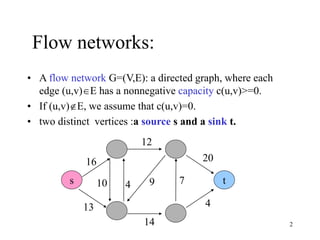
• A flow network G=(V,E): a directed graph, where each
edge (u,v)E has a nonnegative capacity c(u,v)>=0.
• If (u,v)E, we assume that c(u,v)=0.
• two distinct vertices :a source s and a sink t.
s t
16
12
20
10 4 9 7
413
14
3
Flow:
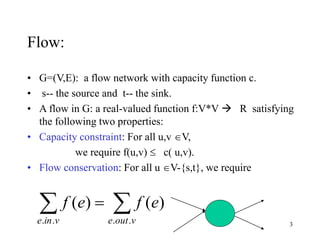
• G=(V,E): a flow network with capacity function c.
• s-- the source and t-- the sink.
• A flow in G: a real-valued function f:V*V  R satisfying
the following two properties:
• Capacity constraint: For all u,v V,
we require f(u,v)  c( u,v).
• Flow conservation: For all u V-{s,t}, we require
 
vine voute
efef
.. ..
)()(
4
Net flow and value of a flow f:
• The quantity f (u,v) is called the net flow from
vertex u to vertex v.
• The value of a flow is defined as
– The total flow from source to any other vertices.
– The same as the total flow from any vertices to
the sink.


Vv
vsff ),(
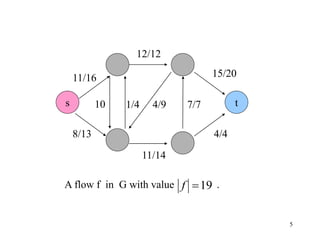
5
s t
11/16
12/12
15/20
10 1/4 4/9 7/7
4/48/13
11/14
A flow f in G with value .19f
6
Maximum-flow problem:
• Given a flow network G with source s and sink t
• Find a flow of maximum value from s to t.
• How to solve it efficiently?
7
The Ford-Fulkerson method
• We call it a “method” rather than an “algorithm” because
it encompasses several implementations with different
running times.
• The Ford-Fulkerson method depends on three important
ideas that transcend the method and are relevant to many
flow algorithms and problems:
– residual networks,
– augmenting paths,
– and cuts.
8
Continue:
• FORD-FULKERSON-METHOD(G,s,t)
• initialize flow f to 0
• while there exists an augmenting path p
• do augment flow f along p
• return f
9
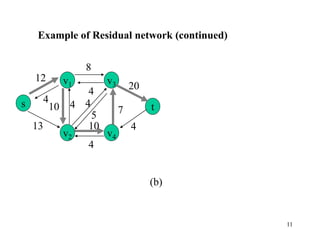
Residual networks:
• Given a flow network and a flow, the residual
network consists of edges that can admit more net
flow.
• G=(V,E) --a flow network with source s and sink t
• f: a flow in G.
• The amount of additional net flow from u to v
before exceeding the capacity c(u,v) is the residual
capacity of (u,v), given by: cf(u,v)=c(u,v)-f(u,v)
in the other direction: cf(v, u)=c(v, u)+f(u, v).
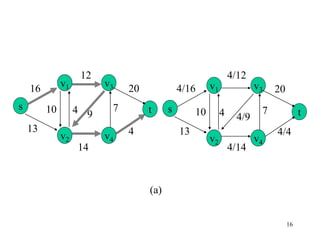
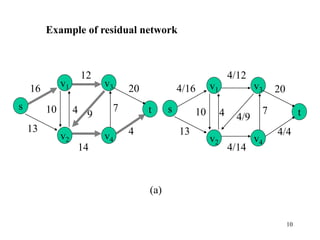
10
s
20
7
9
v2 v4
t
v3v116
13
12
10 4
4
14
4/9
s
v2 v4
t
v3v14/16
13
4/12
10 4
20
4/4
7
4/14
(a)
Example of residual network
11
5
s
v2 v4
t
v3v1
12
13
8
10 4
20
4
7
4
4
4
4
10
(b)
Example of Residual network (continued)
12
Fact 1:
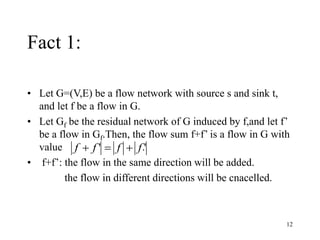
• Let G=(V,E) be a flow network with source s and sink t,
and let f be a flow in G.
• Let Gf be the residual network of G induced by f,and let f’
be a flow in Gf.Then, the flow sum f+f’ is a flow in G with
value .
• f+f’: the flow in the same direction will be added.
the flow in different directions will be cnacelled.
'' ffff 
13
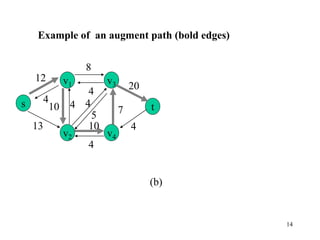
Augmenting paths:
• Given a flow network G=(V,E) and a flow f, an
augmenting path is a simple path from s to t in the residual
network Gf.
• Residual capacity of p : the maximum amount of net flow
that we can ship along the edges of an augmenting path p,
i.e., cf(p)=min{cf(u,v):(u,v) is on p}.
2 3 1
The residual capacity is 1.
14
5
s
v2 v4
t
v3v1
12
13
8
10 4
20
4
7
4
4
4
4
10
(b)
Example of an augment path (bold edges)
15
The basic Ford-Fulkerson
algorithm:
FORD-FULKERSON(G,s,t)
1. for each edge (u,v)E[G]
2. do f[u,v] 0
3. f[v,u] 0
4. while there exists a path p from s to t in the residual network
Gf
5. do cf(p) min{cf(u,v): (u,v) is in p}
6. for each edge (u,v) in p
7. do f[u,v] f[u,v]+cf(p)
8.




16
s
20
7
9
v2 v4
t
v3v116
13
12
10 4
4
14
4/9
s
v2 v4
t
v3v14/16
13
4/12
10 4
20
4/4
7
4/14
(a)
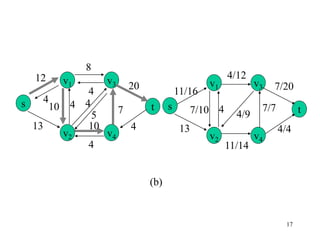
17
5
s
v2 v4
t
v3v1
12
13
8
10 4
20
4
7
4
4
4
4
10
4/9
s
v2 v4
t
v3v1
11/16
13
4/12
7/10 4
7/20
4/4
7/7
11/14
(b)
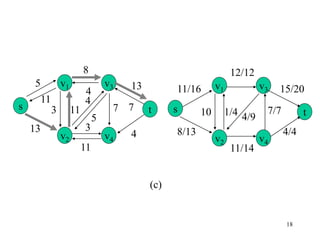
18
5
s
v2 v4
t
v3v15
13
8
3 11
4
7
11
11
4
4
3
13
7
4/9
s
v2 v4
t
v3v111/16
8/13
12/12
10 1/4
15/20
4/4
7/7
11/14
(c)
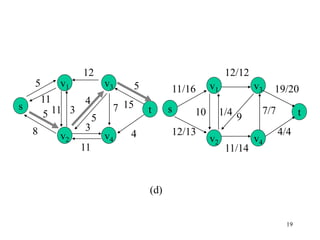
19
5
s
v2 v4
t
v3v15
8
11 3
4
7
11
11
12
4
3
5
15
5 9
s
v2 v4
t
v3v111/16
12/13
12/12
10 1/4
19/20
4/4
7/7
11/14
(d)
20
s
v2 v4
t
v3v15
12
12
11 3
1
4
11
9
3
1
197
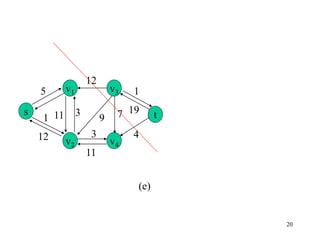
(e)
21
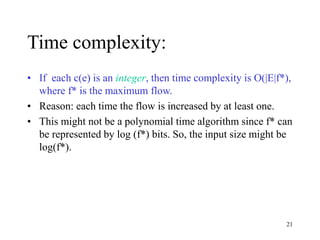
Time complexity:
• If each c(e) is an integer, then time complexity is O(|E|f*),
where f* is the maximum flow.
• Reason: each time the flow is increased by at least one.
• This might not be a polynomial time algorithm since f* can
be represented by log (f*) bits. So, the input size might be
log(f*).

Maximum flow

  • 1.
    Maximum Flow Prepared by Md.Shafiuzzaman Lecturer, Dept. of CSE. JUST
  • 2.
    2 Flow networks: • Aflow network G=(V,E): a directed graph, where each edge (u,v)E has a nonnegative capacity c(u,v)>=0. • If (u,v)E, we assume that c(u,v)=0. • two distinct vertices :a source s and a sink t. s t 16 12 20 10 4 9 7 413 14
  • 3.
    3 Flow: • G=(V,E): aflow network with capacity function c. • s-- the source and t-- the sink. • A flow in G: a real-valued function f:V*V  R satisfying the following two properties: • Capacity constraint: For all u,v V, we require f(u,v)  c( u,v). • Flow conservation: For all u V-{s,t}, we require   vine voute efef .. .. )()(
  • 4.
    4 Net flow andvalue of a flow f: • The quantity f (u,v) is called the net flow from vertex u to vertex v. • The value of a flow is defined as – The total flow from source to any other vertices. – The same as the total flow from any vertices to the sink.   Vv vsff ),(
  • 5.
    5 s t 11/16 12/12 15/20 10 1/44/9 7/7 4/48/13 11/14 A flow f in G with value .19f
  • 6.
    6 Maximum-flow problem: • Givena flow network G with source s and sink t • Find a flow of maximum value from s to t. • How to solve it efficiently?
  • 7.
    7 The Ford-Fulkerson method •We call it a “method” rather than an “algorithm” because it encompasses several implementations with different running times. • The Ford-Fulkerson method depends on three important ideas that transcend the method and are relevant to many flow algorithms and problems: – residual networks, – augmenting paths, – and cuts.
  • 8.
    8 Continue: • FORD-FULKERSON-METHOD(G,s,t) • initializeflow f to 0 • while there exists an augmenting path p • do augment flow f along p • return f
  • 9.
    9 Residual networks: • Givena flow network and a flow, the residual network consists of edges that can admit more net flow. • G=(V,E) --a flow network with source s and sink t • f: a flow in G. • The amount of additional net flow from u to v before exceeding the capacity c(u,v) is the residual capacity of (u,v), given by: cf(u,v)=c(u,v)-f(u,v) in the other direction: cf(v, u)=c(v, u)+f(u, v).
  • 10.
    10 s 20 7 9 v2 v4 t v3v116 13 12 10 4 4 14 4/9 s v2v4 t v3v14/16 13 4/12 10 4 20 4/4 7 4/14 (a) Example of residual network
  • 11.
  • 12.
    12 Fact 1: • LetG=(V,E) be a flow network with source s and sink t, and let f be a flow in G. • Let Gf be the residual network of G induced by f,and let f’ be a flow in Gf.Then, the flow sum f+f’ is a flow in G with value . • f+f’: the flow in the same direction will be added. the flow in different directions will be cnacelled. '' ffff 
  • 13.
    13 Augmenting paths: • Givena flow network G=(V,E) and a flow f, an augmenting path is a simple path from s to t in the residual network Gf. • Residual capacity of p : the maximum amount of net flow that we can ship along the edges of an augmenting path p, i.e., cf(p)=min{cf(u,v):(u,v) is on p}. 2 3 1 The residual capacity is 1.
  • 14.
  • 15.
    15 The basic Ford-Fulkerson algorithm: FORD-FULKERSON(G,s,t) 1.for each edge (u,v)E[G] 2. do f[u,v] 0 3. f[v,u] 0 4. while there exists a path p from s to t in the residual network Gf 5. do cf(p) min{cf(u,v): (u,v) is in p} 6. for each edge (u,v) in p 7. do f[u,v] f[u,v]+cf(p) 8.    
  • 16.
    16 s 20 7 9 v2 v4 t v3v116 13 12 10 4 4 14 4/9 s v2v4 t v3v14/16 13 4/12 10 4 20 4/4 7 4/14 (a)
  • 17.
    17 5 s v2 v4 t v3v1 12 13 8 10 4 20 4 7 4 4 4 4 10 4/9 s v2v4 t v3v1 11/16 13 4/12 7/10 4 7/20 4/4 7/7 11/14 (b)
  • 18.
    18 5 s v2 v4 t v3v15 13 8 3 11 4 7 11 11 4 4 3 13 7 4/9 s v2v4 t v3v111/16 8/13 12/12 10 1/4 15/20 4/4 7/7 11/14 (c)
  • 19.
    19 5 s v2 v4 t v3v15 8 11 3 4 7 11 11 12 4 3 5 15 59 s v2 v4 t v3v111/16 12/13 12/12 10 1/4 19/20 4/4 7/7 11/14 (d)
  • 20.
  • 21.
    21 Time complexity: • Ifeach c(e) is an integer, then time complexity is O(|E|f*), where f* is the maximum flow. • Reason: each time the flow is increased by at least one. • This might not be a polynomial time algorithm since f* can be represented by log (f*) bits. So, the input size might be log(f*).