PRESENTED TO:
MAM MERYAM
DEPARTMENT OF
COMPUTER SCIENCE
GROUP MEMBERS:
IFRA ILYAS (470)
AQSA SHAUKAT (586)
PAZEER ZARA (452)
SAMRA ASLAM (427)
AQSA ANWAR (453)
SHORTEST
PATH
PROBLEM
GRAPH:
 A graph is a representation of a set of objects
where some pairs of objects are connected by links.
 Vertices:
The interconnected objects are represented
by mathematical abstractions called vertices.
 Edges:
The links that connect some pairs of vertices
are called edges.
SHORTEST PATH
PROBLEM :
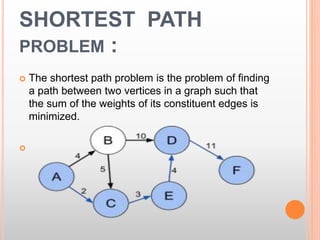
 The shortest path problem is the problem of finding
a path between two vertices in a graph such that
the sum of the weights of its constituent edges is
minimized.

TYPES OF GRAPH:
1. Weighted graph
2. Un-weighted graph
3. Directed graph
4. Un-directed graph
TYPES OF GRAPHS:
 Weighted:
A graph is a
weighted graph if a
number (weight) is
assigned to each edge.
Example:
Such weights might
represent, for example,
costs, lengths or
capacities, etc.
 Un-weighted:
A graph is a un-
weighted graph if a
number(weight) is not
assigned to each edge.
TYPES OF GRAPHS:
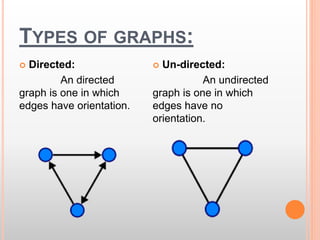
 Directed:
An directed
graph is one in which
edges have orientation.
 Un-directed:
An undirected
graph is one in which
edges have no
orientation.
SHORTEST PATH PROBLEM:
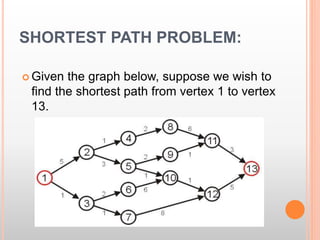
 Given the graph below, suppose we wish to
find the shortest path from vertex 1 to vertex
13.
EXAMPLE:
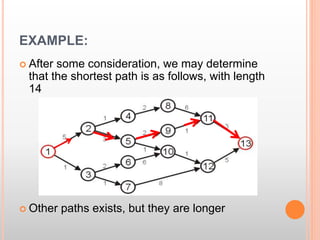
 After some consideration, we may determine
that the shortest path is as follows, with length
14
 Other paths exists, but they are longer
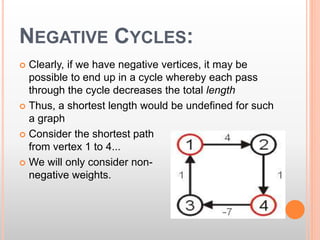
NEGATIVE CYCLES:
 Clearly, if we have negative vertices, it may be
possible to end up in a cycle whereby each pass
through the cycle decreases the total length
 Thus, a shortest length would be undefined for such
a graph
 Consider the shortest path
from vertex 1 to 4...
 We will only consider non-
negative weights.
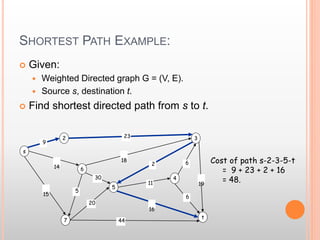
SHORTEST PATH EXAMPLE:
 Given:
 Weighted Directed graph G = (V, E).
 Source s, destination t.
 Find shortest directed path from s to t.
s
3
t
2
6
7
4
5
23
18
2
9
14
15
5
30
20
44
16
11
6
19
6
Cost of path s-2-3-5-t
= 9 + 23 + 2 + 16
= 48.
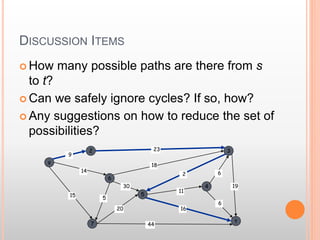
DISCUSSION ITEMS
 How many possible paths are there from s
to t?
 Can we safely ignore cycles? If so, how?
 Any suggestions on how to reduce the set of
possibilities?
s
3
t
2
6
7
4
5
23
18
2
9
14
15
5
30
20
44
16
11
6
19
6
KEY OBSERVATION:
 A key observation is that if the shortest path contains
the node v, then:
 It will only contain v once, as any cycles will only add to the
length.
 The path from s to v must be the shortest path to v from s.
 The path from v to t must be the shortest path to t from v.
DIJKSTRA’S ALGORITHM:
 Works when all of the weights are positive.
 Provides the shortest paths from a source to
all other vertices in the graph.
 Can be terminated early once the shortest
path to t is found if desired.
EXAMPLE:
 Consider the graph:
 the distances are appropriately initialized
 all vertices are marked as being unvisited
EXAMPLE:
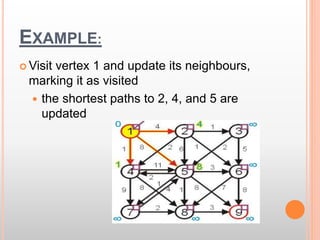
 Visit vertex 1 and update its neighbours,
marking it as visited
 the shortest paths to 2, 4, and 5 are
updated
EXAMPLE:
 The next vertex we visit is vertex 4
 vertex 5 1 + 11 ≥ 8 don’t update
 vertex 7 1 + 9 < ∞ update
 vertex 8 1 + 8 < ∞ update
EXAMPLE:
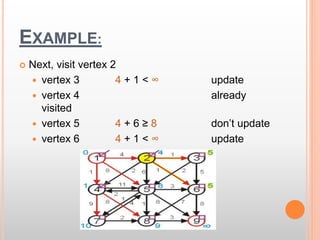
 Next, visit vertex 2
 vertex 3 4 + 1 < ∞ update
 vertex 4 already
visited
 vertex 5 4 + 6 ≥ 8 don’t update
 vertex 6 4 + 1 < ∞ update
EXAMPLE:
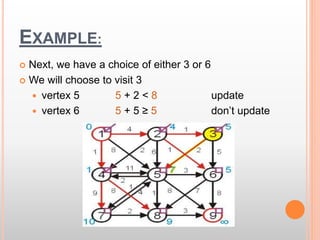
 Next, we have a choice of either 3 or 6
 We will choose to visit 3
 vertex 5 5 + 2 < 8 update
 vertex 6 5 + 5 ≥ 5 don’t update
EXAMPLE:
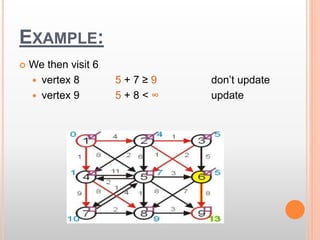
 We then visit 6
 vertex 8 5 + 7 ≥ 9 don’t update
 vertex 9 5 + 8 < ∞ update
EXAMPLE:
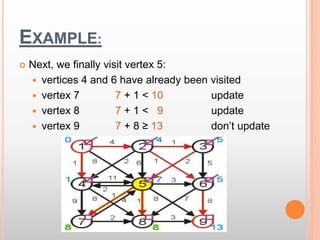
 Next, we finally visit vertex 5:
 vertices 4 and 6 have already been visited
 vertex 7 7 + 1 < 10 update
 vertex 8 7 + 1 < 9 update
 vertex 9 7 + 8 ≥ 13 don’t update
EXAMPLE:
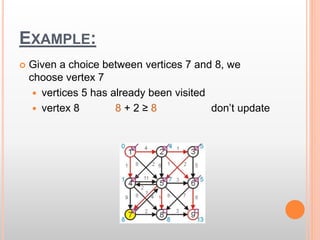
 Given a choice between vertices 7 and 8, we
choose vertex 7
 vertices 5 has already been visited
 vertex 8 8 + 2 ≥ 8 don’t update
EXAMPLE:
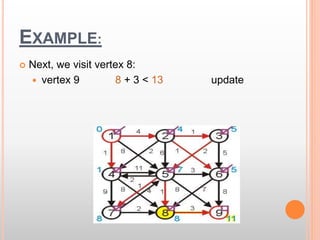
 Next, we visit vertex 8:
 vertex 9 8 + 3 < 13 update
EXAMPLE:
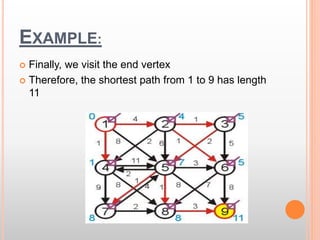
 Finally, we visit the end vertex
 Therefore, the shortest path from 1 to 9 has length
11
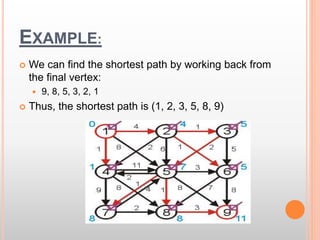
EXAMPLE:
 We can find the shortest path by working back from
the final vertex:
 9, 8, 5, 3, 2, 1
 Thus, the shortest path is (1, 2, 3, 5, 8, 9)
Shortest path problem

Shortest path problem

  • 2.
  • 3.
    GROUP MEMBERS: IFRA ILYAS(470) AQSA SHAUKAT (586) PAZEER ZARA (452) SAMRA ASLAM (427) AQSA ANWAR (453)
  • 4.
  • 5.
    GRAPH:  A graphis a representation of a set of objects where some pairs of objects are connected by links.  Vertices: The interconnected objects are represented by mathematical abstractions called vertices.  Edges: The links that connect some pairs of vertices are called edges.
  • 6.
    SHORTEST PATH PROBLEM : The shortest path problem is the problem of finding a path between two vertices in a graph such that the sum of the weights of its constituent edges is minimized. 
  • 7.
    TYPES OF GRAPH: 1.Weighted graph 2. Un-weighted graph 3. Directed graph 4. Un-directed graph
  • 8.
    TYPES OF GRAPHS: Weighted: A graph is a weighted graph if a number (weight) is assigned to each edge. Example: Such weights might represent, for example, costs, lengths or capacities, etc.  Un-weighted: A graph is a un- weighted graph if a number(weight) is not assigned to each edge.
  • 9.
    TYPES OF GRAPHS: Directed: An directed graph is one in which edges have orientation.  Un-directed: An undirected graph is one in which edges have no orientation.
  • 10.
    SHORTEST PATH PROBLEM: Given the graph below, suppose we wish to find the shortest path from vertex 1 to vertex 13.
  • 11.
    EXAMPLE:  After someconsideration, we may determine that the shortest path is as follows, with length 14  Other paths exists, but they are longer
  • 12.
    NEGATIVE CYCLES:  Clearly,if we have negative vertices, it may be possible to end up in a cycle whereby each pass through the cycle decreases the total length  Thus, a shortest length would be undefined for such a graph  Consider the shortest path from vertex 1 to 4...  We will only consider non- negative weights.
  • 13.
    SHORTEST PATH EXAMPLE: Given:  Weighted Directed graph G = (V, E).  Source s, destination t.  Find shortest directed path from s to t. s 3 t 2 6 7 4 5 23 18 2 9 14 15 5 30 20 44 16 11 6 19 6 Cost of path s-2-3-5-t = 9 + 23 + 2 + 16 = 48.
  • 14.
    DISCUSSION ITEMS  Howmany possible paths are there from s to t?  Can we safely ignore cycles? If so, how?  Any suggestions on how to reduce the set of possibilities? s 3 t 2 6 7 4 5 23 18 2 9 14 15 5 30 20 44 16 11 6 19 6
  • 15.
    KEY OBSERVATION:  Akey observation is that if the shortest path contains the node v, then:  It will only contain v once, as any cycles will only add to the length.  The path from s to v must be the shortest path to v from s.  The path from v to t must be the shortest path to t from v.
  • 16.
    DIJKSTRA’S ALGORITHM:  Workswhen all of the weights are positive.  Provides the shortest paths from a source to all other vertices in the graph.  Can be terminated early once the shortest path to t is found if desired.
  • 17.
    EXAMPLE:  Consider thegraph:  the distances are appropriately initialized  all vertices are marked as being unvisited
  • 18.
    EXAMPLE:  Visit vertex1 and update its neighbours, marking it as visited  the shortest paths to 2, 4, and 5 are updated
  • 19.
    EXAMPLE:  The nextvertex we visit is vertex 4  vertex 5 1 + 11 ≥ 8 don’t update  vertex 7 1 + 9 < ∞ update  vertex 8 1 + 8 < ∞ update
  • 20.
    EXAMPLE:  Next, visitvertex 2  vertex 3 4 + 1 < ∞ update  vertex 4 already visited  vertex 5 4 + 6 ≥ 8 don’t update  vertex 6 4 + 1 < ∞ update
  • 21.
    EXAMPLE:  Next, wehave a choice of either 3 or 6  We will choose to visit 3  vertex 5 5 + 2 < 8 update  vertex 6 5 + 5 ≥ 5 don’t update
  • 22.
    EXAMPLE:  We thenvisit 6  vertex 8 5 + 7 ≥ 9 don’t update  vertex 9 5 + 8 < ∞ update
  • 23.
    EXAMPLE:  Next, wefinally visit vertex 5:  vertices 4 and 6 have already been visited  vertex 7 7 + 1 < 10 update  vertex 8 7 + 1 < 9 update  vertex 9 7 + 8 ≥ 13 don’t update
  • 24.
    EXAMPLE:  Given achoice between vertices 7 and 8, we choose vertex 7  vertices 5 has already been visited  vertex 8 8 + 2 ≥ 8 don’t update
  • 25.
    EXAMPLE:  Next, wevisit vertex 8:  vertex 9 8 + 3 < 13 update
  • 26.
    EXAMPLE:  Finally, wevisit the end vertex  Therefore, the shortest path from 1 to 9 has length 11
  • 27.
    EXAMPLE:  We canfind the shortest path by working back from the final vertex:  9, 8, 5, 3, 2, 1  Thus, the shortest path is (1, 2, 3, 5, 8, 9)