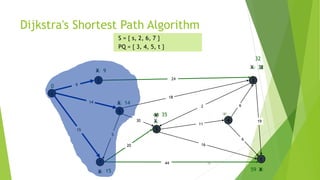
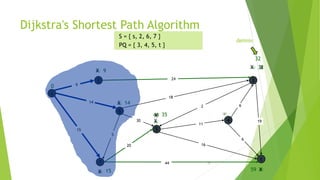
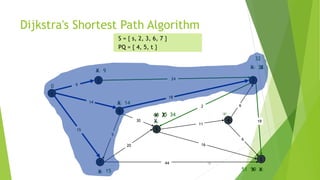
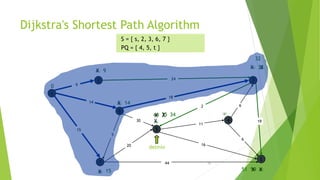
SCHOOL MANAGEMENT SYSTEM
Submited BY:
Faisal Patel 254
Parth Bharuch 257
Dhavan Shah 160
Introduction
 Our project is about
Introduction Contd.
 Greedy algorithms use problem solving methods based on actions to see if there’s
a better long term strategy.
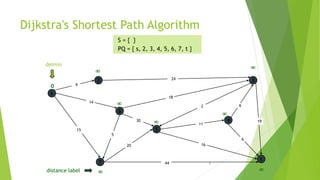
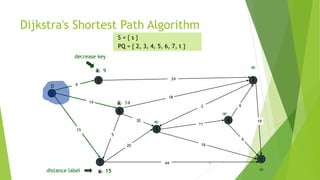
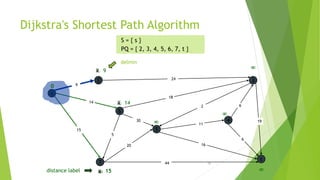
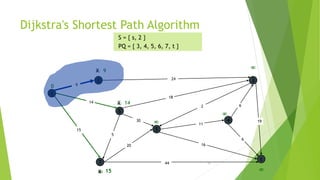
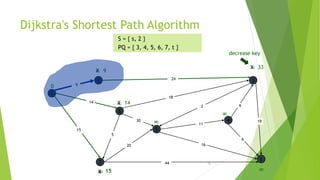
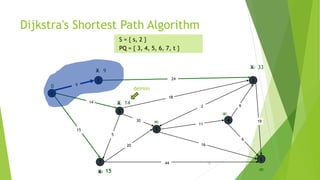
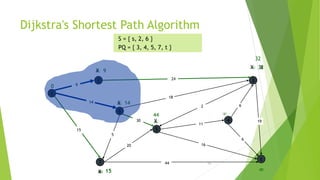
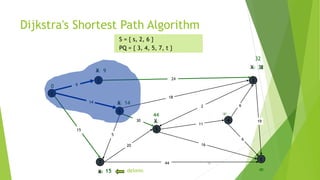
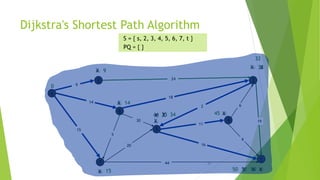
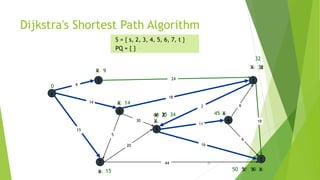
 Dijkstra’s algorithm uses the greedy approach to solve the single source shortest
problem. It repeatedly selects from the unselected vertices, vertex v nearest to
source s and declares the distance to be the actual shortest distance from s to v.
 The edges of v are then checked to see if their destination can be reached by v
followed by the relevant outgoing edges.
 For a given source node in the graph, the algorithm finds the shortest path
between that node and every other.
 It can also be used for finding the shortest paths from a single node to a single
destination node by stopping the algorithm once the shortest path to the
destination node has been determined.
How It Works??
 Before going into details of the pseudo-code of the algorithm it is important
to know how the algorithm works.
 Dijkstra’s algorithm works by solving the sub-problem k, which computes the
shortest path from the source to vertices among the k closest vertices to the
source.
 For the dijkstra’s algorithm to work it should be directed- weighted graph and
the edges should be non-negative.
 If the edges are negative then the actual shortest path cannot be obtained.
More Detailed Knowledge
 At the kth round, there will be a set called Frontier of k vertices that will
consist of the vertices closest to the source and the vertices that lie outside
frontier are computed and put into New Frontier.
 The shortest distance obtained is maintained in sDist[w].
 It holds the estimate of the distance from s to w.
 Dijkstra’s algorithm finds the next closest vertex by maintaining the New
Frontier vertices in a priority-min queue.
6
Dijkstra's Shortest Path Algorithm
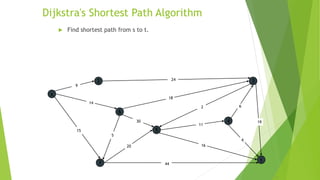
 Find shortest path from s to t.
s
3
t
2
6
7
4
5
24
18
2
9
14
15
5
30
20
44
16
11
6
19
6
7
Dijkstra's Shortest Path Algorithm
s
3
t
2
6
7
4
5
24
18
2
9
14
15
5
30
20
44
16
11
6
19
6







0
distance label
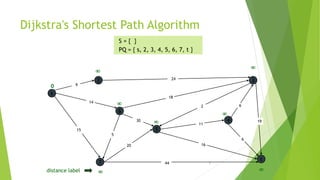
S = { }
PQ = { s, 2, 3, 4, 5, 6, 7, t }
8
Dijkstra's Shortest Path Algorithm
s
3
t
2
6
7
4
5
24
18
2
9
14
15
5
30
20
44
16
11
6
19
6







0
distance label
S = { }
PQ = { s, 2, 3, 4, 5, 6, 7, t }
delmin
9
Dijkstra's Shortest Path Algorithm
s
3
t
2
6
7
4
5
24
18
2
9
14
15
5
30
20
44
16
11
6
19
6
15
9



14

0
distance label
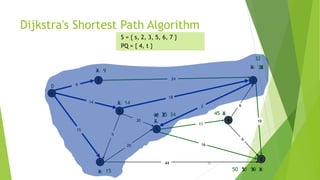
S = { s }
PQ = { 2, 3, 4, 5, 6, 7, t }
decrease key
X

X
X
10
Dijkstra's Shortest Path Algorithm
s
3
t
2
6
7
4
5
24
18
2
9
14
15
5
30
20
44
16
11
6
19
6
15
9



14

0
distance label
S = { s }
PQ = { 2, 3, 4, 5, 6, 7, t }
X

X
X
delmin
11
Dijkstra's Shortest Path Algorithm
s
3
t
2
6
7
4
5
24
18
2
9
14
15
5
30
20
44
16
11
6
19
6
15
9



14

0
S = { s, 2 }
PQ = { 3, 4, 5, 6, 7, t }
X

X
X
12
Dijkstra's Shortest Path Algorithm
s
3
t
2
6
7
4
5
24
18
2
9
14
15
5
30
20
44
16
11
6
19
6
15
9



14

0
S = { s, 2 }
PQ = { 3, 4, 5, 6, 7, t }
X

X
X
decrease key
X 33
13
Dijkstra's Shortest Path Algorithm
s
3
t
2
6
7
4
5
24
18
2
9
14
15
5
30
20
44
16
11
6
19
6
15
9



14

0
S = { s, 2 }
PQ = { 3, 4, 5, 6, 7, t }
X

X
X
X 33
delmin
14
Dijkstra's Shortest Path Algorithm
s
3
t
2
6
7
4
5
24
18
2
9
14
15
5
30
20
44
16
11
6
19
6
15
9



14

0
S = { s, 2, 6 }
PQ = { 3, 4, 5, 7, t }
X

X
X
X 33
44
X
X
32
15
Dijkstra's Shortest Path Algorithm
s
3
t
2
6
7
4
5
24
18
2
9
14
15
5
30
20
44
16
11
6
19
6
15
9


14

0
S = { s, 2, 6 }
PQ = { 3, 4, 5, 7, t }
X

X
X
44
X
delmin
X 33X
32
16
Dijkstra's Shortest Path Algorithm
s
3
t
2
6
7
4
5
18
2
9
14
15
5
30
20
44
16
11
6
19
6
15
9


14

0
S = { s, 2, 6, 7 }
PQ = { 3, 4, 5, t }
X

X
X
44
X
35X
59 X
24
X 33X
32
17
Dijkstra's Shortest Path Algorithm
s
3
t
2
6
7
4
5
24
18
2
9
14
15
5
30
20
44
16
11
6
19
6
15
9


14

0
S = { s, 2, 6, 7 }
PQ = { 3, 4, 5, t }
X

X
X
44
X
35X
59 X
delmin
X 33X
32
18
Dijkstra's Shortest Path Algorithm
s
3
t
2
6
7
4
5
24
18
2
9
14
15
5
30
20
44
16
11
6
19
6
15
9


14

0
S = { s, 2, 3, 6, 7 }
PQ = { 4, 5, t }
X

X
X
44
X
35X
59 XX51
X 34
X 33X
32
19
Dijkstra's Shortest Path Algorithm
s
3
t
2
6
7
4
5
18
2
9
14
15
5
30
20
44
16
11
6
19
6
15
9


14

0
S = { s, 2, 3, 6, 7 }
PQ = { 4, 5, t }
X

X
X
44
X
35X
59 XX51
X 34
delmin
X 33X
32
24
20
Dijkstra's Shortest Path Algorithm
s
3
t
2
6
7
4
5
18
2
9
14
15
5
30
20
44
16
11
6
19
6
15
9


14

0
S = { s, 2, 3, 5, 6, 7 }
PQ = { 4, t }
X

X
X
44
X
35X
59 XX51
X 34
24
X50
X45
X 33X
32
21
Dijkstra's Shortest Path Algorithm
s
3
t
2
6
7
4
5
18
2
9
14
15
5
30
20
44
16
11
6
19
6
15
9


14

0
S = { s, 2, 3, 5, 6, 7 }
PQ = { 4, t }
X

X
X
44
X
35X
59 XX51
X 34
24
X50
X45
delmin
X 33X
32
22
Dijkstra's Shortest Path Algorithm
s
3
t
2
6
7
4
5
18
2
9
14
15
5
30
20
44
16
11
6
19
6
15
9


14

0
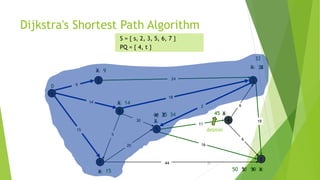
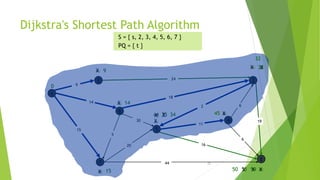
S = { s, 2, 3, 4, 5, 6, 7 }
PQ = { t }
X

X
X
44
X
35X
59 XX51
X 34
24
X50
X45
X 33X
32
23
Dijkstra's Shortest Path Algorithm
s
3
t
2
6
7
4
5
18
2
9
14
15
5
30
20
44
16
11
6
19
6
15
9


14

0
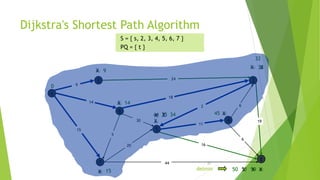
S = { s, 2, 3, 4, 5, 6, 7 }
PQ = { t }
X

X
X
44
X
35X
59 XX51
X 34
X50
X45
delmin
X 33X
32
24
24
Dijkstra's Shortest Path Algorithm
s
3
t
2
6
7
4
5
24
18
2
9
14
15
5
30
20
44
16
11
6
19
6
15
9


14

0
S = { s, 2, 3, 4, 5, 6, 7, t }
PQ = { }
X

X
X
44
X
35X
59 XX51
X 34
X50
X45
X 33X
32
25
Dijkstra's Shortest Path Algorithm
s
3
t
2
6
7
4
5
24
18
2
9
14
15
5
30
20
44
16
11
6
19
6
15
9


14

0
S = { s, 2, 3, 4, 5, 6, 7, t }
PQ = { }
X

X
X
44
X
35X
59 XX51
X 34
X50
X45
X 33X
32
ALgorithm
function Dijkstra(Graph, source):
dist[source] ← 0 // Distance from source to source
prev[source] ← undefined // Previous node in optimal path initialization
for each vertex v in Graph: // Initialization
if v ≠ source // Where v has not yet been removed from Q (unvisited nodes)
dist[v] ← infinity // Unknown distance function from source to v
prev[v] ← undefined // Previous node in optimal path from source
end if
add v to Q // All nodes initially in Q (unvisited nodes)
end for
while Q is not empty:
u ← vertex in Q with min dist[u] // Source node in first case
remove u from Q
for each neighbor v of u: // where v is still in Q.
alt ← dist[u] + length(u, v)
if alt < dist[v]: // A shorter path to v has been found
dist[v] ← alt
prev[v] ← u
end if
end for
end while
return dist[], prev[]
end function
EFFICIENCY
 The complexity efficiency can be expressed in terms of Big-O Notation.
Big-O gives another way of talking about the way input affects the
algorithm’s running time. It gives an upper bound of the running time.
 In Dijkstra’s algorithm, the efficiency varies depending on |V| and |E|
updates for priority queues that were used.
 If a Fibonacci heap was used then the complexity is O( | E | + | V | log |
V | ) , which is the best bound.
DIS-ADVANTAGES
 The major disadvantage of the algorithm is the fact that it does a blind
search there by consuming a lot of time waste of necessary resources.
 Another disadvantage is that it cannot handle negative edges. This leads to
acyclic graphs and most often cannot obtain the right shortest path
APPLICATIONS
 Traffic information systems use Dijkstra’s algorithm in order to track the
source and destinations from a given particular source and destination .
 OSPF- Open Shortest Path First, used in Internet routing.
 It uses a link-state in the individual areas that make up the hierarchy.
 The computation is based on Dijkstra's algorithm which is used to calculate
the shortest path tree inside each area of the network.

Dijkstra’s algorithm

  • 1.
    SCHOOL MANAGEMENT SYSTEM SubmitedBY: Faisal Patel 254 Parth Bharuch 257 Dhavan Shah 160
  • 2.
  • 3.
    Introduction Contd.  Greedyalgorithms use problem solving methods based on actions to see if there’s a better long term strategy.  Dijkstra’s algorithm uses the greedy approach to solve the single source shortest problem. It repeatedly selects from the unselected vertices, vertex v nearest to source s and declares the distance to be the actual shortest distance from s to v.  The edges of v are then checked to see if their destination can be reached by v followed by the relevant outgoing edges.  For a given source node in the graph, the algorithm finds the shortest path between that node and every other.  It can also be used for finding the shortest paths from a single node to a single destination node by stopping the algorithm once the shortest path to the destination node has been determined.
  • 4.
    How It Works?? Before going into details of the pseudo-code of the algorithm it is important to know how the algorithm works.  Dijkstra’s algorithm works by solving the sub-problem k, which computes the shortest path from the source to vertices among the k closest vertices to the source.  For the dijkstra’s algorithm to work it should be directed- weighted graph and the edges should be non-negative.  If the edges are negative then the actual shortest path cannot be obtained.
  • 5.
    More Detailed Knowledge At the kth round, there will be a set called Frontier of k vertices that will consist of the vertices closest to the source and the vertices that lie outside frontier are computed and put into New Frontier.  The shortest distance obtained is maintained in sDist[w].  It holds the estimate of the distance from s to w.  Dijkstra’s algorithm finds the next closest vertex by maintaining the New Frontier vertices in a priority-min queue.
  • 6.
    6 Dijkstra's Shortest PathAlgorithm  Find shortest path from s to t. s 3 t 2 6 7 4 5 24 18 2 9 14 15 5 30 20 44 16 11 6 19 6
  • 7.
    7 Dijkstra's Shortest PathAlgorithm s 3 t 2 6 7 4 5 24 18 2 9 14 15 5 30 20 44 16 11 6 19 6        0 distance label S = { } PQ = { s, 2, 3, 4, 5, 6, 7, t }
  • 8.
    8 Dijkstra's Shortest PathAlgorithm s 3 t 2 6 7 4 5 24 18 2 9 14 15 5 30 20 44 16 11 6 19 6        0 distance label S = { } PQ = { s, 2, 3, 4, 5, 6, 7, t } delmin
  • 9.
    9 Dijkstra's Shortest PathAlgorithm s 3 t 2 6 7 4 5 24 18 2 9 14 15 5 30 20 44 16 11 6 19 6 15 9    14  0 distance label S = { s } PQ = { 2, 3, 4, 5, 6, 7, t } decrease key X  X X
  • 10.
    10 Dijkstra's Shortest PathAlgorithm s 3 t 2 6 7 4 5 24 18 2 9 14 15 5 30 20 44 16 11 6 19 6 15 9    14  0 distance label S = { s } PQ = { 2, 3, 4, 5, 6, 7, t } X  X X delmin
  • 11.
    11 Dijkstra's Shortest PathAlgorithm s 3 t 2 6 7 4 5 24 18 2 9 14 15 5 30 20 44 16 11 6 19 6 15 9    14  0 S = { s, 2 } PQ = { 3, 4, 5, 6, 7, t } X  X X
  • 12.
    12 Dijkstra's Shortest PathAlgorithm s 3 t 2 6 7 4 5 24 18 2 9 14 15 5 30 20 44 16 11 6 19 6 15 9    14  0 S = { s, 2 } PQ = { 3, 4, 5, 6, 7, t } X  X X decrease key X 33
  • 13.
    13 Dijkstra's Shortest PathAlgorithm s 3 t 2 6 7 4 5 24 18 2 9 14 15 5 30 20 44 16 11 6 19 6 15 9    14  0 S = { s, 2 } PQ = { 3, 4, 5, 6, 7, t } X  X X X 33 delmin
  • 14.
    14 Dijkstra's Shortest PathAlgorithm s 3 t 2 6 7 4 5 24 18 2 9 14 15 5 30 20 44 16 11 6 19 6 15 9    14  0 S = { s, 2, 6 } PQ = { 3, 4, 5, 7, t } X  X X X 33 44 X X 32
  • 15.
    15 Dijkstra's Shortest PathAlgorithm s 3 t 2 6 7 4 5 24 18 2 9 14 15 5 30 20 44 16 11 6 19 6 15 9   14  0 S = { s, 2, 6 } PQ = { 3, 4, 5, 7, t } X  X X 44 X delmin X 33X 32
  • 16.
    16 Dijkstra's Shortest PathAlgorithm s 3 t 2 6 7 4 5 18 2 9 14 15 5 30 20 44 16 11 6 19 6 15 9   14  0 S = { s, 2, 6, 7 } PQ = { 3, 4, 5, t } X  X X 44 X 35X 59 X 24 X 33X 32
  • 17.
    17 Dijkstra's Shortest PathAlgorithm s 3 t 2 6 7 4 5 24 18 2 9 14 15 5 30 20 44 16 11 6 19 6 15 9   14  0 S = { s, 2, 6, 7 } PQ = { 3, 4, 5, t } X  X X 44 X 35X 59 X delmin X 33X 32
  • 18.
    18 Dijkstra's Shortest PathAlgorithm s 3 t 2 6 7 4 5 24 18 2 9 14 15 5 30 20 44 16 11 6 19 6 15 9   14  0 S = { s, 2, 3, 6, 7 } PQ = { 4, 5, t } X  X X 44 X 35X 59 XX51 X 34 X 33X 32
  • 19.
    19 Dijkstra's Shortest PathAlgorithm s 3 t 2 6 7 4 5 18 2 9 14 15 5 30 20 44 16 11 6 19 6 15 9   14  0 S = { s, 2, 3, 6, 7 } PQ = { 4, 5, t } X  X X 44 X 35X 59 XX51 X 34 delmin X 33X 32 24
  • 20.
    20 Dijkstra's Shortest PathAlgorithm s 3 t 2 6 7 4 5 18 2 9 14 15 5 30 20 44 16 11 6 19 6 15 9   14  0 S = { s, 2, 3, 5, 6, 7 } PQ = { 4, t } X  X X 44 X 35X 59 XX51 X 34 24 X50 X45 X 33X 32
  • 21.
    21 Dijkstra's Shortest PathAlgorithm s 3 t 2 6 7 4 5 18 2 9 14 15 5 30 20 44 16 11 6 19 6 15 9   14  0 S = { s, 2, 3, 5, 6, 7 } PQ = { 4, t } X  X X 44 X 35X 59 XX51 X 34 24 X50 X45 delmin X 33X 32
  • 22.
    22 Dijkstra's Shortest PathAlgorithm s 3 t 2 6 7 4 5 18 2 9 14 15 5 30 20 44 16 11 6 19 6 15 9   14  0 S = { s, 2, 3, 4, 5, 6, 7 } PQ = { t } X  X X 44 X 35X 59 XX51 X 34 24 X50 X45 X 33X 32
  • 23.
    23 Dijkstra's Shortest PathAlgorithm s 3 t 2 6 7 4 5 18 2 9 14 15 5 30 20 44 16 11 6 19 6 15 9   14  0 S = { s, 2, 3, 4, 5, 6, 7 } PQ = { t } X  X X 44 X 35X 59 XX51 X 34 X50 X45 delmin X 33X 32 24
  • 24.
    24 Dijkstra's Shortest PathAlgorithm s 3 t 2 6 7 4 5 24 18 2 9 14 15 5 30 20 44 16 11 6 19 6 15 9   14  0 S = { s, 2, 3, 4, 5, 6, 7, t } PQ = { } X  X X 44 X 35X 59 XX51 X 34 X50 X45 X 33X 32
  • 25.
    25 Dijkstra's Shortest PathAlgorithm s 3 t 2 6 7 4 5 24 18 2 9 14 15 5 30 20 44 16 11 6 19 6 15 9   14  0 S = { s, 2, 3, 4, 5, 6, 7, t } PQ = { } X  X X 44 X 35X 59 XX51 X 34 X50 X45 X 33X 32
  • 26.
    ALgorithm function Dijkstra(Graph, source): dist[source]← 0 // Distance from source to source prev[source] ← undefined // Previous node in optimal path initialization for each vertex v in Graph: // Initialization if v ≠ source // Where v has not yet been removed from Q (unvisited nodes) dist[v] ← infinity // Unknown distance function from source to v prev[v] ← undefined // Previous node in optimal path from source end if add v to Q // All nodes initially in Q (unvisited nodes) end for
  • 27.
    while Q isnot empty: u ← vertex in Q with min dist[u] // Source node in first case remove u from Q for each neighbor v of u: // where v is still in Q. alt ← dist[u] + length(u, v) if alt < dist[v]: // A shorter path to v has been found dist[v] ← alt prev[v] ← u end if end for end while return dist[], prev[] end function
  • 28.
    EFFICIENCY  The complexityefficiency can be expressed in terms of Big-O Notation. Big-O gives another way of talking about the way input affects the algorithm’s running time. It gives an upper bound of the running time.  In Dijkstra’s algorithm, the efficiency varies depending on |V| and |E| updates for priority queues that were used.  If a Fibonacci heap was used then the complexity is O( | E | + | V | log | V | ) , which is the best bound.
  • 29.
    DIS-ADVANTAGES  The majordisadvantage of the algorithm is the fact that it does a blind search there by consuming a lot of time waste of necessary resources.  Another disadvantage is that it cannot handle negative edges. This leads to acyclic graphs and most often cannot obtain the right shortest path
  • 30.
    APPLICATIONS  Traffic informationsystems use Dijkstra’s algorithm in order to track the source and destinations from a given particular source and destination .  OSPF- Open Shortest Path First, used in Internet routing.  It uses a link-state in the individual areas that make up the hierarchy.  The computation is based on Dijkstra's algorithm which is used to calculate the shortest path tree inside each area of the network.