1
Dynamic Programming
6.8 Shortest Paths
WARNING:
Watch for ambiguous use of “shortest”
in the sense of least weight/cost, and
in the sense of fewest edges.
3
Shortest paths
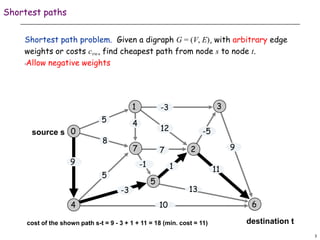
Shortest path problem. Given a digraph G = (V, E), with arbitrary edge
weights or costs cvw, find cheapest path from node s to node t.
•Allow negative weights
7
1 3
source s
-1
8
5
7
5 4
-3
-5
12
10
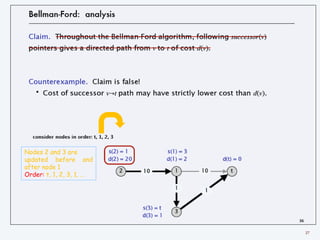
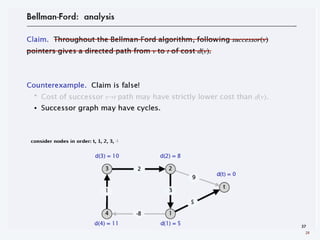
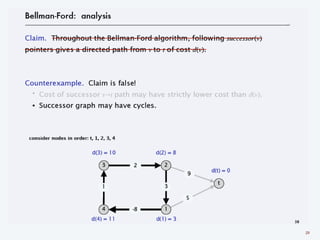
13
9
cost of the shown path s-t = 9 - 3 + 1 + 11 = 18 (min. cost = 11) destination t
0
4
5
2
6
9
-3
1 11
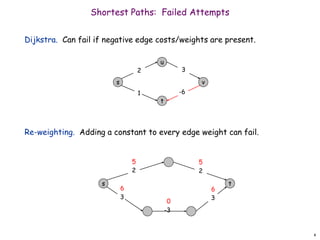
Dijkstra. Can fail if negative edge costs/weights are present.
Re-weighting. Adding a constant to every edge weight can fail.
4
Shortest Paths: Failed Attempts
s t
2 2
-3
3
3
u
t
s v
2
1
3
-6
5 5
6
6
0
5
Negative cycles
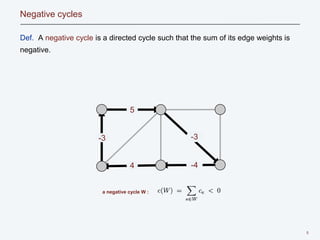
Def. A negative cycle is a directed cycle such that the sum of its edge weights is
negative.
-3
5
-3
-4
4
a negative cycle W :
6
Shortest paths and negative cycles
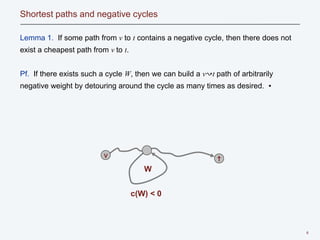
Lemma 1. If some path from v to t contains a negative cycle, then there does not
exist a cheapest path from v to t.
Pf. If there exists such a cycle W, then we can build a v↝t path of arbitrarily
negative weight by detouring around the cycle as many times as desired. ▪
W
c(W) < 0
v t
7
Shortest paths and negative cycles
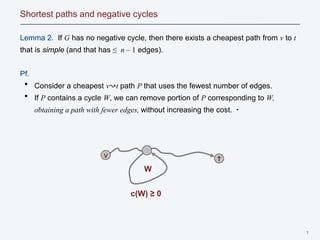
Lemma 2. If G has no negative cycle, then there exists a cheapest path from v to t
that is simple (and that has ≤ n – 1 edges).
Pf.
・ Consider a cheapest v↝t path P that uses the fewest number of edges.
・ If P contains a cycle W, we can remove portion of P corresponding to W,
obtaining a path with fewer edges, without increasing the cost. ▪
W
c(W) ≥ 0
v t
8
Shortest path and negative cycle problems
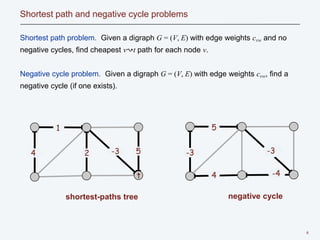
Shortest path problem. Given a digraph G = (V, E) with edge weights cvw and no
negative cycles, find cheapest v↝t path for each node v.
Negative cycle problem. Given a digraph G = (V, E) with edge weights cvw, find a
negative cycle (if one exists).
-3
5
-3
-4
4
negative cycle
4
t
1
-3
shortest-paths tree
5
2
9
Shortest paths: dynamic programming
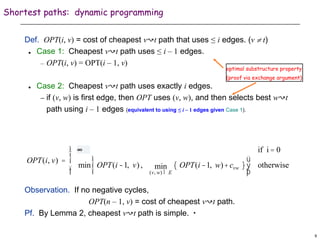
Def. OPT(i, v) = cost of cheapest v↝t path that uses ≤ i edges. (v  t)
 Case 1: Cheapest v↝t path uses ≤ i – 1 edges.
– OPT(i, v) = OPT(i – 1, v)
 Case 2: Cheapest v↝t path uses exactly i edges.
– if (v, w) is first edge, then OPT uses (v, w), and then selects best w↝t
path using i – 1 edges (equivalent to using ≤ i – 1 edges given Case 1).
Observation. If no negative cycles,
OPT(n – 1, v) = cost of cheapest v↝t path.
Pf. By Lemma 2, cheapest v↝t path is simple. ▪
OPT(i, v) =
0 if i = 0
min OPT(i -1, v) ,
(v, w) Î E
min OPT(i -1, w)+cvw
{ }
ì
í
î
ü
ý
þ
otherwise
ì
í
ï
î
ï
∞
optimal substructure property
(proof via exchange argument)
10
Shortest Paths: Implementation
Analysis. (mn) time, (n2) space.
Shortest-Path(G =(V,E,c), t) {
foreach node v  V
M[0, v]  
M[0, t]  0
for i = 1 to n-1
foreach node v  V
M[i, v]  M[i-1, v]
foreach edge (v, w)  E
M[i, v]  min {M[i, v], cvw + M[i-1, w]}
}
Proof of Correctness : A Sketch
Induction Hypothesis: A cheapest path of length k from any
node to node t can be discovered in at most k steps.
Basis Case: k = 0. (t -> t) , k = 1 (single edges v->t).
Induction Step: To construct the cheapest path of length k
from some s (s->v1->*->t), use an edge (s->v1) and the
cheapest path of length k-1 (v1->*->t), discovered using at
most k-1 steps [Ind. Hyp.]. Note that the second foreach-
loop of the nested-loops is run for each edge.
11
…
t
s v1 v2
vk-1
12
Shortest paths: implementation
Theorem 1. Given a digraph G = (V, E) with no negative cycles, the
dynamic programming algorithm computes the cost of the cheapest
v↝t path for each node v in Θ(mn) time and Θ(n2) space.
Pf.
 Table requires Θ(n2) space.
 Each iteration i takes Θ(m) time since we examine each edge
once, and the number of iterations is n. ▪
Finding the shortest paths.
 Approach 1: Maintain a successor(i, v) that points to next node on
cheapest v↝t path using at most i edges.
 Approach 2: Compute optimal costs M[i, v] and consider only
edges with M[i, v] = M[i – 1, w] + cvw.
13
Shortest paths: practical improvements
Space optimization. Maintain two 1D arrays (instead of
2D array).
 M(v) = cost of cheapest v↝t path that we have found
so far.
 successor(v) = next node on a v↝t path.
Performance optimization. If M(w) was not updated in
iteration i – 1, then no reason to consider edges entering
w in iteration i.
14
Bellman-Ford: Efficient Implementation
Bellman-Ford(G=(V,E,c), s, t) {
foreach node v  V {
M[v]  
successor[v]  
}
M[t] = 0
for i = 1 to n-1 {
foreach node w  V {
if (M[w] was updated in previous iteration) {
foreach edge (v, w)  E {
if (M[v] > M[w] + cvw) {
M[v]  M[w] + cvw
successor[v]  w
}
}
}
}
If no M[w] value changed in iteration i, stop.
}
}
CSE 780 Algorithms
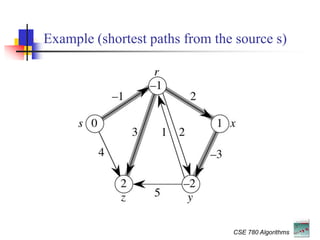
Example (shortest paths from the source s)
- 16
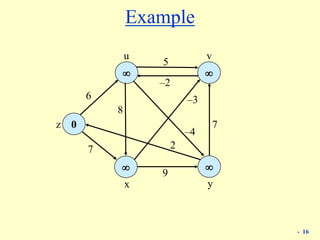
Example
0




z
u v
x y
6
5
–3
9
7
7
8
–2
–4
2
17
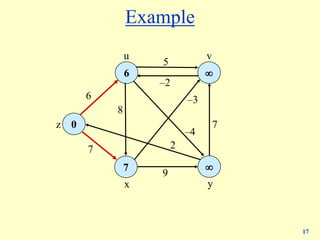
Example
0

7

6
z
u v
x y
6
5
–3
9
7
7
8
–2
–4
2
18
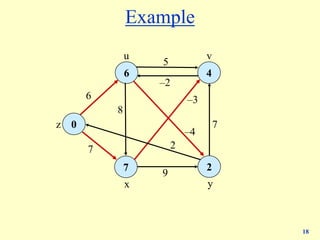
Example
0
2
7
4
6
z
u v
x y
6
5
–3
9
7
7
8
–2
–4
2
19
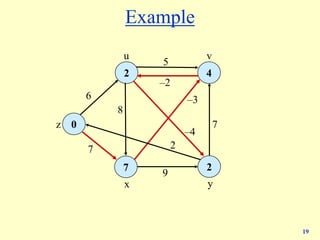
Example
0
2
7
4
2
z
u v
x y
6
5
–3
9
7
7
8
–2
–4
2
- 20
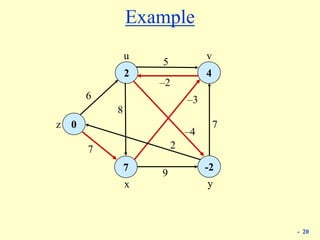
Example
0
-2
7
4
2
z
u v
x y
6
5
–3
9
7
7
8
–2
–4
2
CSE 780 Algorithms
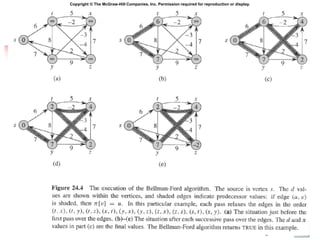
Copyright © The McGraw-Hill Companies, Inc. Permission required for reproduction or display.
Bellman-Ford returns a compact representation
of the set of shortest paths from source s (resp.
to destination t) to (resp. from) all other vertices
in the graph reachable from s (resp. to t). This
is contained in the predecessor (resp. successor)
subgraph.
If Bellman-Ford has not converged after |V| - 1
iterations, then there cannot be a shortest path
tree, and there must be a negative weight cycle.
s - 22
- 23
Another Look
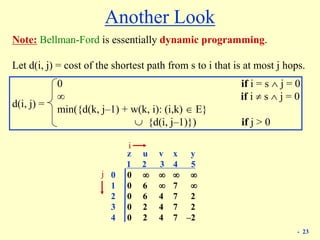
Note: Bellman-Ford is essentially dynamic programming.
Let d(i, j) = cost of the shortest path from s to i that is at most j hops.
d(i, j) =
0 if i = s  j = 0
 if i  s  j = 0
min({d(k, j–1) + w(k, i): (i,k)  E}
 {d(i, j–1)}) if j > 0
z u v x y
1 2 3 4 5
0 0    
1 0 6  7 
2 0 6 4 7 2
3 0 2 4 7 2
4 0 2 4 7 –2
j
i
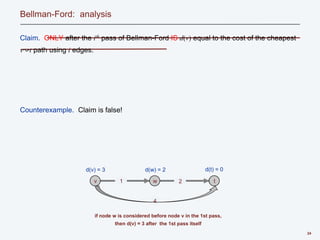
Claim. ONLY after the ith pass of Bellman-Ford IS d(v) equal to the cost of the cheapest
v↝t path using i edges.
Counterexample. Claim is false!
1
24
Bellman-Ford: analysis
v t
2
d(t) = 0
d(w) = 2
if node w is considered before node v in the 1st pass,
then d(v) = 3 after the 1st pass itself
d(v) = 3
4
w
25
Bellman-Ford: analysis
Lemma 3. Throughout Bellman-Ford algorithm, d(v) is the cost of some v↝t path;
after the ith pass, d(v) is no larger than the cost of the cheapest v↝t path using ≤ i
edges.
Pf. [by induction on i]
・ Assume true after ith pass.
・ Let P be any v↝t path (trivially includes the cheapest) with i + 1 edges.
・ Let (v, w) be first edge on path and let P' be subpath from w to t.
・ By inductive hypothesis, d(w) ≤ c(P') since P' is a w↝t path with i edges.
・ After considering v in pass i+1:
Theorem 2. Given a digraph with no negative cycles, Bellman-Ford computes the
costs of the cheapest v↝t paths in O(mn) time and Θ(n) extra space.
Pf. Lemmas 2 + 3. ▪
can be substantially
faster in practice
d(v) ≤ cvw + d(w)
≤ cvw + c(P')
= c(P) ▪
26
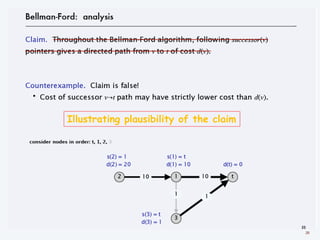
Illustrating plausibility of the claim
27
Nodes 2 and 3 are
updated before and
after node 1
Order: t, 1, 2, 3, 1, …
28
29
30
Bellman-Ford: finding the shortest path
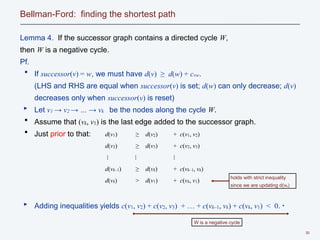
Lemma 4. If the successor graph contains a directed cycle W,
then W is a negative cycle.
Pf.
・ If successor(v) = w, we must have d(v) ≥ d(w) + cvw.
(LHS and RHS are equal when successor(v) is set; d(w) can only decrease; d(v)
decreases only when successor(v) is reset)
‣ Let v1 → v2 → … → vk be the nodes along the cycle W.
・ Assume that (vk, v1) is the last edge added to the successor graph.
・ Just prior to that:
‣ Adding inequalities yields c(v1, v2) + c(v2, v3) + … + c(vk–1, vk) + c(vk, v1) < 0. ▪
d(v1) ≥ d(v2) + c(v1, v2)
d(v2) ≥ d(v3) + c(v2, v3)
⋮ ⋮ ⋮
d(vk–1) ≥ d(vk) + c(vk–1, vk)
d(vk) > d(v1) + c(vk, v1)
W is a negative cycle
holds with strict inequality
since we are updating d(vk)
31
Bellman-Ford: finding the shortest path
Theorem 3. Given a digraph with no negative cycles, Bellman-Ford finds the
cheapest s↝t paths in O(mn) time and Θ(n) extra space.
Pf.
・ The successor graph cannot have a negative cycle. [Lemma 4]
・ Thus, following the successor pointers from s yields a directed path to t.
・ Let s = v1 → v2 → … → vk = t be the nodes along this path P.
・ Upon termination, if successor(v) = w, we must have d(v) = d(w) + cvw.
(LHS and RHS are equal when successor(v) is set; d(·) did not change)
・ Thus,
・
Adding equations yields d(s) = d(t) + c(v1, v2) + c(v2, v3) + … + c(vk–1, vk). ▪
d(v1) = d(v2) + c(v1, v2)
d(v2) = d(v3) + c(v2, v3)
⋮ ⋮ ⋮
d(vk–1) = d(vk) + c(vk–1, vk)
cost of path P
min cost
of any s↝t path
(Theorem 2)
0
since algorithm
terminated
Push Pull Alternatives
Current implementation of Bellman-Ford algorithm is pull-
based, where each node polls its neighbors M[…] for
changes.
The efficiency of the algorithm can be improved by
resorting to push-based alternative, where a node
triggers its neighbors when its M[…] changes.
Despite asynchronous updates, the algorithm converges.
32
6.9 Distance Vector Protocol
34
Distance Vector Protocol
Communication network.
 Nodes  routers.
 Edges  direct communication link.
 Cost of edge  delay on link.
Dijkstra's algorithm. Requires global information about the network.
Bellman-Ford. Uses only local information from the neighboring nodes.
Synchronization. We don't expect routers to run in lockstep. The
order in which each foreach loop executes in not important. Moreover,
algorithm still converges even if the updates are asynchronous.
In practice, properties such as locality, compositionality, modularity,
and asynchronous nature are very important.
naturally nonnegative, but Bellman-Ford used anyway!
35
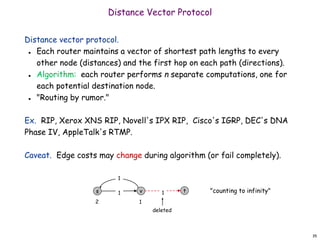
Distance Vector Protocol
Distance vector protocol.
 Each router maintains a vector of shortest path lengths to every
other node (distances) and the first hop on each path (directions).
 Algorithm: each router performs n separate computations, one for
each potential destination node.
 "Routing by rumor."
Ex. RIP, Xerox XNS RIP, Novell's IPX RIP, Cisco's IGRP, DEC's DNA
Phase IV, AppleTalk's RTMP.
Caveat. Edge costs may change during algorithm (or fail completely).
t
v 1
s 1
1
deleted
"counting to infinity"
2 1
36
Path Vector Protocols
Link state routing.
 Each router also stores the entire path.
 Based on Dijkstra's algorithm.
 Avoids "counting-to-infinity" problem and
related difficulties. (see textbook)
 Requires significantly more storage.
Ex. Border Gateway Protocol (BGP), Open
Shortest Path First (OSPF).
not just the distance and first hop
6.10 Negative Cycles in a Graph
38
Detecting Negative Cycles
Lemma. If OPT(n,v) = OPT(n-1,v) for all v, then no negative cycles.
Pf. Bellman-Ford algorithm.
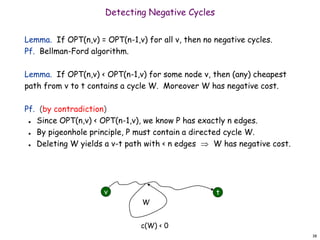
Lemma. If OPT(n,v) < OPT(n-1,v) for some node v, then (any) cheapest
path from v to t contains a cycle W. Moreover W has negative cost.
Pf. (by contradiction)
 Since OPT(n,v) < OPT(n-1,v), we know P has exactly n edges.
 By pigeonhole principle, P must contain a directed cycle W.
 Deleting W yields a v-t path with < n edges  W has negative cost.
v t
W
c(W) < 0
39
Detecting Negative Cycles
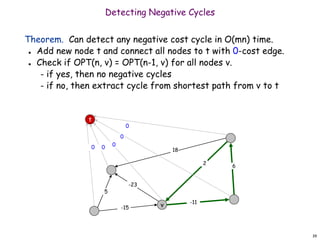
Theorem. Can detect any negative cost cycle in O(mn) time.
 Add new node t and connect all nodes to t with 0-cost edge.
 Check if OPT(n, v) = OPT(n-1, v) for all nodes v.
– if yes, then no negative cycles
– if no, then extract cycle from shortest path from v to t
v
18
2
5
-23
-15
-11
6
t
0
0
0
0
0

bellman-ford Theorem.ppt

  • 1.
  • 2.
    6.8 Shortest Paths WARNING: Watchfor ambiguous use of “shortest” in the sense of least weight/cost, and in the sense of fewest edges.
  • 3.
    3 Shortest paths Shortest pathproblem. Given a digraph G = (V, E), with arbitrary edge weights or costs cvw, find cheapest path from node s to node t. •Allow negative weights 7 1 3 source s -1 8 5 7 5 4 -3 -5 12 10 13 9 cost of the shown path s-t = 9 - 3 + 1 + 11 = 18 (min. cost = 11) destination t 0 4 5 2 6 9 -3 1 11
  • 4.
    Dijkstra. Can failif negative edge costs/weights are present. Re-weighting. Adding a constant to every edge weight can fail. 4 Shortest Paths: Failed Attempts s t 2 2 -3 3 3 u t s v 2 1 3 -6 5 5 6 6 0
  • 5.
    5 Negative cycles Def. Anegative cycle is a directed cycle such that the sum of its edge weights is negative. -3 5 -3 -4 4 a negative cycle W :
  • 6.
    6 Shortest paths andnegative cycles Lemma 1. If some path from v to t contains a negative cycle, then there does not exist a cheapest path from v to t. Pf. If there exists such a cycle W, then we can build a v↝t path of arbitrarily negative weight by detouring around the cycle as many times as desired. ▪ W c(W) < 0 v t
  • 7.
    7 Shortest paths andnegative cycles Lemma 2. If G has no negative cycle, then there exists a cheapest path from v to t that is simple (and that has ≤ n – 1 edges). Pf. ・ Consider a cheapest v↝t path P that uses the fewest number of edges. ・ If P contains a cycle W, we can remove portion of P corresponding to W, obtaining a path with fewer edges, without increasing the cost. ▪ W c(W) ≥ 0 v t
  • 8.
    8 Shortest path andnegative cycle problems Shortest path problem. Given a digraph G = (V, E) with edge weights cvw and no negative cycles, find cheapest v↝t path for each node v. Negative cycle problem. Given a digraph G = (V, E) with edge weights cvw, find a negative cycle (if one exists). -3 5 -3 -4 4 negative cycle 4 t 1 -3 shortest-paths tree 5 2
  • 9.
    9 Shortest paths: dynamicprogramming Def. OPT(i, v) = cost of cheapest v↝t path that uses ≤ i edges. (v  t)  Case 1: Cheapest v↝t path uses ≤ i – 1 edges. – OPT(i, v) = OPT(i – 1, v)  Case 2: Cheapest v↝t path uses exactly i edges. – if (v, w) is first edge, then OPT uses (v, w), and then selects best w↝t path using i – 1 edges (equivalent to using ≤ i – 1 edges given Case 1). Observation. If no negative cycles, OPT(n – 1, v) = cost of cheapest v↝t path. Pf. By Lemma 2, cheapest v↝t path is simple. ▪ OPT(i, v) = 0 if i = 0 min OPT(i -1, v) , (v, w) Î E min OPT(i -1, w)+cvw { } ì í î ü ý þ otherwise ì í ï î ï ∞ optimal substructure property (proof via exchange argument)
  • 10.
    10 Shortest Paths: Implementation Analysis.(mn) time, (n2) space. Shortest-Path(G =(V,E,c), t) { foreach node v  V M[0, v]   M[0, t]  0 for i = 1 to n-1 foreach node v  V M[i, v]  M[i-1, v] foreach edge (v, w)  E M[i, v]  min {M[i, v], cvw + M[i-1, w]} }
  • 11.
    Proof of Correctness: A Sketch Induction Hypothesis: A cheapest path of length k from any node to node t can be discovered in at most k steps. Basis Case: k = 0. (t -> t) , k = 1 (single edges v->t). Induction Step: To construct the cheapest path of length k from some s (s->v1->*->t), use an edge (s->v1) and the cheapest path of length k-1 (v1->*->t), discovered using at most k-1 steps [Ind. Hyp.]. Note that the second foreach- loop of the nested-loops is run for each edge. 11 … t s v1 v2 vk-1
  • 12.
    12 Shortest paths: implementation Theorem1. Given a digraph G = (V, E) with no negative cycles, the dynamic programming algorithm computes the cost of the cheapest v↝t path for each node v in Θ(mn) time and Θ(n2) space. Pf.  Table requires Θ(n2) space.  Each iteration i takes Θ(m) time since we examine each edge once, and the number of iterations is n. ▪ Finding the shortest paths.  Approach 1: Maintain a successor(i, v) that points to next node on cheapest v↝t path using at most i edges.  Approach 2: Compute optimal costs M[i, v] and consider only edges with M[i, v] = M[i – 1, w] + cvw.
  • 13.
    13 Shortest paths: practicalimprovements Space optimization. Maintain two 1D arrays (instead of 2D array).  M(v) = cost of cheapest v↝t path that we have found so far.  successor(v) = next node on a v↝t path. Performance optimization. If M(w) was not updated in iteration i – 1, then no reason to consider edges entering w in iteration i.
  • 14.
    14 Bellman-Ford: Efficient Implementation Bellman-Ford(G=(V,E,c),s, t) { foreach node v  V { M[v]   successor[v]   } M[t] = 0 for i = 1 to n-1 { foreach node w  V { if (M[w] was updated in previous iteration) { foreach edge (v, w)  E { if (M[v] > M[w] + cvw) { M[v]  M[w] + cvw successor[v]  w } } } } If no M[w] value changed in iteration i, stop. } }
  • 15.
    CSE 780 Algorithms Example(shortest paths from the source s)
  • 16.
    - 16 Example 0     z u v xy 6 5 –3 9 7 7 8 –2 –4 2
  • 17.
  • 18.
  • 19.
  • 20.
    - 20 Example 0 -2 7 4 2 z u v xy 6 5 –3 9 7 7 8 –2 –4 2
  • 21.
    CSE 780 Algorithms Copyright© The McGraw-Hill Companies, Inc. Permission required for reproduction or display.
  • 22.
    Bellman-Ford returns acompact representation of the set of shortest paths from source s (resp. to destination t) to (resp. from) all other vertices in the graph reachable from s (resp. to t). This is contained in the predecessor (resp. successor) subgraph. If Bellman-Ford has not converged after |V| - 1 iterations, then there cannot be a shortest path tree, and there must be a negative weight cycle. s - 22
  • 23.
    - 23 Another Look Note:Bellman-Ford is essentially dynamic programming. Let d(i, j) = cost of the shortest path from s to i that is at most j hops. d(i, j) = 0 if i = s  j = 0  if i  s  j = 0 min({d(k, j–1) + w(k, i): (i,k)  E}  {d(i, j–1)}) if j > 0 z u v x y 1 2 3 4 5 0 0     1 0 6  7  2 0 6 4 7 2 3 0 2 4 7 2 4 0 2 4 7 –2 j i
  • 24.
    Claim. ONLY afterthe ith pass of Bellman-Ford IS d(v) equal to the cost of the cheapest v↝t path using i edges. Counterexample. Claim is false! 1 24 Bellman-Ford: analysis v t 2 d(t) = 0 d(w) = 2 if node w is considered before node v in the 1st pass, then d(v) = 3 after the 1st pass itself d(v) = 3 4 w
  • 25.
    25 Bellman-Ford: analysis Lemma 3.Throughout Bellman-Ford algorithm, d(v) is the cost of some v↝t path; after the ith pass, d(v) is no larger than the cost of the cheapest v↝t path using ≤ i edges. Pf. [by induction on i] ・ Assume true after ith pass. ・ Let P be any v↝t path (trivially includes the cheapest) with i + 1 edges. ・ Let (v, w) be first edge on path and let P' be subpath from w to t. ・ By inductive hypothesis, d(w) ≤ c(P') since P' is a w↝t path with i edges. ・ After considering v in pass i+1: Theorem 2. Given a digraph with no negative cycles, Bellman-Ford computes the costs of the cheapest v↝t paths in O(mn) time and Θ(n) extra space. Pf. Lemmas 2 + 3. ▪ can be substantially faster in practice d(v) ≤ cvw + d(w) ≤ cvw + c(P') = c(P) ▪
  • 26.
  • 27.
    27 Nodes 2 and3 are updated before and after node 1 Order: t, 1, 2, 3, 1, …
  • 28.
  • 29.
  • 30.
    30 Bellman-Ford: finding theshortest path Lemma 4. If the successor graph contains a directed cycle W, then W is a negative cycle. Pf. ・ If successor(v) = w, we must have d(v) ≥ d(w) + cvw. (LHS and RHS are equal when successor(v) is set; d(w) can only decrease; d(v) decreases only when successor(v) is reset) ‣ Let v1 → v2 → … → vk be the nodes along the cycle W. ・ Assume that (vk, v1) is the last edge added to the successor graph. ・ Just prior to that: ‣ Adding inequalities yields c(v1, v2) + c(v2, v3) + … + c(vk–1, vk) + c(vk, v1) < 0. ▪ d(v1) ≥ d(v2) + c(v1, v2) d(v2) ≥ d(v3) + c(v2, v3) ⋮ ⋮ ⋮ d(vk–1) ≥ d(vk) + c(vk–1, vk) d(vk) > d(v1) + c(vk, v1) W is a negative cycle holds with strict inequality since we are updating d(vk)
  • 31.
    31 Bellman-Ford: finding theshortest path Theorem 3. Given a digraph with no negative cycles, Bellman-Ford finds the cheapest s↝t paths in O(mn) time and Θ(n) extra space. Pf. ・ The successor graph cannot have a negative cycle. [Lemma 4] ・ Thus, following the successor pointers from s yields a directed path to t. ・ Let s = v1 → v2 → … → vk = t be the nodes along this path P. ・ Upon termination, if successor(v) = w, we must have d(v) = d(w) + cvw. (LHS and RHS are equal when successor(v) is set; d(·) did not change) ・ Thus, ・ Adding equations yields d(s) = d(t) + c(v1, v2) + c(v2, v3) + … + c(vk–1, vk). ▪ d(v1) = d(v2) + c(v1, v2) d(v2) = d(v3) + c(v2, v3) ⋮ ⋮ ⋮ d(vk–1) = d(vk) + c(vk–1, vk) cost of path P min cost of any s↝t path (Theorem 2) 0 since algorithm terminated
  • 32.
    Push Pull Alternatives Currentimplementation of Bellman-Ford algorithm is pull- based, where each node polls its neighbors M[…] for changes. The efficiency of the algorithm can be improved by resorting to push-based alternative, where a node triggers its neighbors when its M[…] changes. Despite asynchronous updates, the algorithm converges. 32
  • 33.
  • 34.
    34 Distance Vector Protocol Communicationnetwork.  Nodes  routers.  Edges  direct communication link.  Cost of edge  delay on link. Dijkstra's algorithm. Requires global information about the network. Bellman-Ford. Uses only local information from the neighboring nodes. Synchronization. We don't expect routers to run in lockstep. The order in which each foreach loop executes in not important. Moreover, algorithm still converges even if the updates are asynchronous. In practice, properties such as locality, compositionality, modularity, and asynchronous nature are very important. naturally nonnegative, but Bellman-Ford used anyway!
  • 35.
    35 Distance Vector Protocol Distancevector protocol.  Each router maintains a vector of shortest path lengths to every other node (distances) and the first hop on each path (directions).  Algorithm: each router performs n separate computations, one for each potential destination node.  "Routing by rumor." Ex. RIP, Xerox XNS RIP, Novell's IPX RIP, Cisco's IGRP, DEC's DNA Phase IV, AppleTalk's RTMP. Caveat. Edge costs may change during algorithm (or fail completely). t v 1 s 1 1 deleted "counting to infinity" 2 1
  • 36.
    36 Path Vector Protocols Linkstate routing.  Each router also stores the entire path.  Based on Dijkstra's algorithm.  Avoids "counting-to-infinity" problem and related difficulties. (see textbook)  Requires significantly more storage. Ex. Border Gateway Protocol (BGP), Open Shortest Path First (OSPF). not just the distance and first hop
  • 37.
  • 38.
    38 Detecting Negative Cycles Lemma.If OPT(n,v) = OPT(n-1,v) for all v, then no negative cycles. Pf. Bellman-Ford algorithm. Lemma. If OPT(n,v) < OPT(n-1,v) for some node v, then (any) cheapest path from v to t contains a cycle W. Moreover W has negative cost. Pf. (by contradiction)  Since OPT(n,v) < OPT(n-1,v), we know P has exactly n edges.  By pigeonhole principle, P must contain a directed cycle W.  Deleting W yields a v-t path with < n edges  W has negative cost. v t W c(W) < 0
  • 39.
    39 Detecting Negative Cycles Theorem.Can detect any negative cost cycle in O(mn) time.  Add new node t and connect all nodes to t with 0-cost edge.  Check if OPT(n, v) = OPT(n-1, v) for all nodes v. – if yes, then no negative cycles – if no, then extract cycle from shortest path from v to t v 18 2 5 -23 -15 -11 6 t 0 0 0 0 0

Editor's Notes

  • #4 Ex. Nodes represent agents in a financial setting and c_vw is cost of transaction in which we buy from agent v and sell immediately to agent w.
  • #5 One can form cheaper paths using more expensive sub-paths, so nodes can be added non-monotonically w.r.t the length of their paths. This is contrary to Dijsktra’s approach. E.g., one can have S->direct->T be cheaper than S->direct->U but with S->U->V->T, where V-Direct->T is very small, S->*->T cost can be smaller. (2) Adding constant to every edge does not work because different path lengths will introduce different cost increments to the paths, modifying the original problem and path relationships. Only weight transformations that preserve path weights are admissible.
  • #6 ‘Does a solution always exist?’ need to be explored before developing an efficient algorithm. Well-founded problem definition requires absence of Negative cycles.
  • #7 Requirement for a solution to always exist: Absence of negative cycles.
  • #8 Algorithmic Implication: Explore paths of length (n-1) to get cheapest paths. CONTRAPOSITIVE: If path of length n or greater is cheaper, then a negative cycle exists. STRENTHENING: If G has no negative cycle from v to t, then there exists a cheapest path from v to t that is simple (and that has ≤ n – 1 edges).
  • #9 Paths to target t (rather than paths from source s). Negative cycle on a path to t vs any negative cycle in the entire graph.
  • #10 **** Exception: if i = 0, then OPT(i, t) =0 and forall v =/= t: OPT(i,v) = infinity -------------------- PATH(v,t) = edge(v-w) ++ PATH(w,t) ------------------- Should not Case 2 be: Cheapest v↝t path uses exactly i edges. if (v, w) is first edge, then OPT uses (v, w), and then selects best w↝t path that uses i – 1 edges **** [[even if we build using <= i – 1 edges, only the i-edges will generate new paths, we write it as <= i – 1, to enable recursion]]
  • #11 ------------------------------------------------------------------------------------------------ Initially path length = 0 ------------ i ranges over path lengths M[0,t] = 0 -- there is a path of length 0 from t to t Construct paths backward from t – suffix is the optimal substructure Path(v,t) = edge(v,w) + Path(w,t) ------------ m = number of edges n = number of nodes ================================================================= Brilliant algorithm : simple and elegant => clear only with proof of correctness ****Proof of correctness: Cheapest path of length k or less is discovered in the k^th iteration or earlier.**** ================================================================== Cannot combine the two foreach loops as shown M[i, v]  min {M[i-1, v], cvw + M[i-1, w]} because we need to take minimum over all edges incident on v. That is, earlier choice may get overwritten incorrectly. If it were correct, it would have converged slower also. =================================== Erasing the first index of M requires proof of convergence, however. =================================== Parallel processing – amenable to distributed implementation – locality property Update till convergence
  • #12 If cheapest paths of length k-1 have been discovered in at most k-1 steps (here: v1->*->t), then the cheapest paths of length k (here: s->v1->*->t) can be constructed from them by considering all possible ways of extending them. ================= [at most] is [equal] if we perform the inner second foreach-loop in parallel. [at most] is [at most] if we perform the inner second foreach-loop sequentially. In other words, cheapest paths can be discovered earlier as clarified using “successor”-links example later. -----------------------------
  • #13 n = number of nodes m = number of edges (Table space - max path length (number of iterations) x number of nodes)) Time = O[number of nodes (outer for-loop) * number of edges (inner foreach-loop)] Time can be improved further if we consider edges that are incident only on nodes whose distance/cost/weight changed in the last pass ------------------------------------------------------------------------------------- RECALL two variants: (i) Determine cheapest cost (ii) Determine cheapest path
  • #15 Push-Based-Shortest-Path(G=(V,E,c), s, t) The time complexity is O(n*m) [outer for-loop -> number of nodes, inner foreach-loop - amortized -> number of edges] while space complexity is O(n) [number of nodes]. --------------------- See ‘Proof of Correctness : A Sketch’ slide --------------------- If we replace the outer-loop with a while-loop that stops when M[…] stabilizes, Then for termination can we show that M[v] and M[w] will not monotonically diminish without limit! => Is this the situation when there is a negative cycle or count-to-infinity? ----------------------
  • #16 xxx
  • #17 Initialization
  • #18 Paths of length 1 from t
  • #19 Paths of lengths 1 and 2 from t
  • #20 Paths of length <= 3 from t
  • #21 Paths of length <= 4 from t (Maximal/cheapest tree paths unless there are negative cycles)
  • #22 source-based algorithm (as opposed to destination based)
  • #25 Note that weights of both v and w will be updated due to t’s update. w before v gives cheapest path of length 2 for v in pass 1. However, v before w requires requires pass 2. Note two sorts of comparisons in the forthcoming slides: d(v) in relation to costs of various paths from v to t d(v) in relation to d(w), the current path cost associating with neighboring node
  • #26 [wayne] separate out first part of lemma from second? M[] = d() ------------------------ d(v) can have the value of the global/optimal shortest path even after the first iteration if the graph is a directed chain and the nodes are considered in the order of their path length from t (or s)! ----------------------------------------------------------------------- d(v) <= c(v,w) + d(w) is justified by the fact that there can be other choices for w and we consider ALL the *incoming from source* / *outgoing to destination* edges (equality holds for the cheapest path)
  • #27 The cost of the “successor”-path may be lower than what d(v) contains Based on the order in which the nodes are considered. But this discrepancy will be set right in subsequent iterations.
  • #28 Note: could prove that successor(v) traces a path of cost at most d(v), assuming no negative cycles. In fact, d(v) can be higher than c_vw + d(w) if d(w) got updated subsequent to updating d(v). ----------- Full order of visits: t, 1, 2, 3, 1, …
  • #30 In this case, it has a negative cycle because of which the direct path from 1 to t of cost 5 is more costly than the path 1-4-3-2-t.
  • #31 Note: tracing successor[v] to t need not be a path whose length equals M[v] - it may be a shorter path! (even if no negative cycles) ------------------------------------- The first sentence deals with the situation before the conditional-then is executed.
  • #36 in some protocols, length = hop count since each node determines is values based on its neighbors, protocol sometimes facetiously reffered to as routing by rumor route invalidation timer: v flags path to t as invalid if v doesn't hear from t for a while RIP fix for counting to infinity: maintain max hop count = 16
  • #37 each router stores whole network topology “counting to infinity” problem occurs when the network is disconnected and the algorithm wastefully tries to discover a path, something analogous to “cycles in garbage”. Deletion of an edge may trigger a node to seek alternate path by updating its distance from its neighbor. This change may make the neighbor update its distance. The infinite regress of this pair of updates can happen when there is no other path.
  • #39 By deleting the cycle, the cost went up. So the cycle must be negative. ------------------------ A negative cycle can be detected in an earlier iteration too! Since OPT(n,v) < OPT(n-1,v), we know P has exactly n edges. => WHY?
  • #40 Why add a new node? We want to prove result for negative cycles in a graph as opposed to negative cycles on a path to a specific destination t. ------------------ W.r.t. modified graph: If there is a negative cycle on a path to t (in the new graph), then we know it must contain nodes other than t because t has no outgoing edges. If there is no negative cycle on a path to t (in the new graph), then there is no cycle in the original graph because adding t does not alter cycles. EQUIVALENTLY, the CONTRAPOSITIVE is: If there is a negative cycle in the original graph then we can find a negative cycle on a path to t (in the new graph) from some node v.
  • #42  Undirected. O(mn + n2 log n) Reduce to weighted non-bipartite matching. Beyond the scope of this course.