FORD FULKERSON
ALGORITHM
Adarsh V R
ME Scholar, UVCE
K R Circle, Bangalore
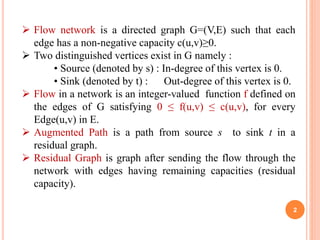
 Flow network is a directed graph G=(V,E) such that each
edge has a non-negative capacity c(u,v)≥0.
 Two distinguished vertices exist in G namely :
• Source (denoted by s) : In-degree of this vertex is 0.
• Sink (denoted by t) : Out-degree of this vertex is 0.
 Flow in a network is an integer-valued function f defined on
the edges of G satisfying 0 ≤ f(u,v) ≤ c(u,v), for every
Edge(u,v) in E.
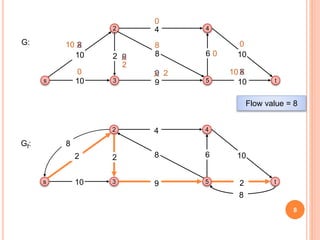
 Augmented Path is a path from source s to sink t in a
residual graph.
 Residual Graph is graph after sending the flow through the
network with edges having remaining capacities (residual
capacity).
2
• FORD-FULKERSON(G,s,t)
• for each edge (u,v)  E[G]
• do f[u,v] 0
• f[v,u] 0
• while there exists a path p from s to t in the residual
network Gf
• do cf(p) min{cf(u,v): (u,v) is in p}
• for each edge (u,v) in p
• do f[u,v] f[u,v]+cf(p) 3




Ford Fulkerson Algorithm
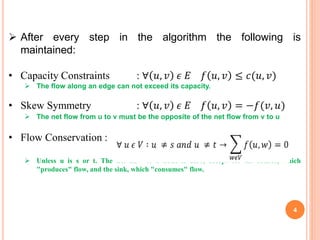
 After every step in the algorithm the following is
maintained:
• Capacity Constraints : ∀ 𝑢, 𝑣 𝜖 𝐸 𝑓 𝑢, 𝑣 ≤ 𝑐(𝑢, 𝑣)
 The flow along an edge can not exceed its capacity.
• Skew Symmetry : ∀ 𝑢, 𝑣 𝜖 𝐸 𝑓 𝑢, 𝑣 = −𝑓(𝑣, 𝑢)
 The net flow from u to v must be the opposite of the net flow from v to u
• Flow Conservation :
 Unless u is s or t. The net flow to a node is zero, except for the source, which
"produces" flow, and the sink, which "consumes" flow.
4
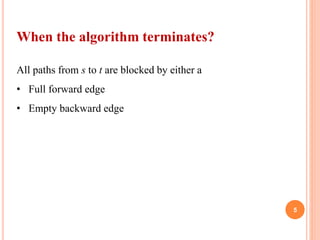
When the algorithm terminates?
All paths from s to t are blocked by either a
• Full forward edge
• Empty backward edge
5
EXAMPLE:
s
2
3
4
5 t10
10
9
8
4
10
1062
0
0
0
0 0 0
0
0
G:
Flow value = 0
0
flow
capacity
6
s
2
3
4
5 t10
10
9
8
4
10
1062
0
0
0
0 0 0
0
0
G:
s
2
3
4
5 t10 9
4
1062
Gf:
10 8
10
8 8
8
X X
X
0
Flow value = 0
capacity
residual capacity
flow
7
s
2
3
4
5 t10
10
9
8
4
10
1062
8
0
0
0 0 8
8
0 0
G:
s
2
3
4
5 t10
4
106
Gf:
8
8
8
9
22
2
10
2
10
X
X
X2X
Flow value = 8
8
0
s
2
3
4
5 t10
10
9
8
4
10
1062
10
0
0
0 2 10
8
2
G:
s
2
3
4
5 t
4
2
Gf:
10
810
2
10 7
106
X
6
6
6
X
X
8X
Flow value = 10
9
s
2
3
4
5 t10
10
9
8
4
10
1062
10
0
6
6 8 10
8
2
G:
s
2
3
4
5 t1
6
Gf:
10
810
8
6
6
6
4
4
4
2
X
8
2
8
X
X
0
X
Flow value = 16
10
s
2
3
4
5 t10
10
9
8
4
10
1062
10
2
8
8 8 10
8
0
G:
s
2
3
4
5 t
62
Gf:
10
10
8
6
8
8
2
2 1
2
8 2
X
9
7 9
X
X
9X
X 3
Flow value = 18
11
s
2
3
4
5 t10
10
9
8
4
10
1062
10
3
9
9 9 10
7
0
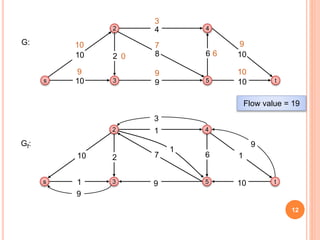
G:
s
2
3
4
5 t1 9
1
162
Gf:
10
710
6
9
9
3
1
Flow value = 19
12
s
2
3
4
5 t10
10
9
8
4
10
1062
10
3
9
9 9 10
7
0
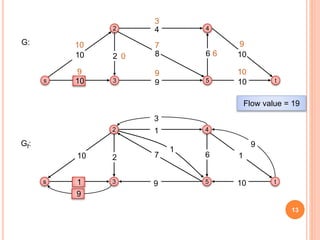
G:
s
2
3
4
5 t1 9
1
162
Gf:
10
710
6
9
9
3
1
Flow value = 19
13
14

Ford Fulkerson Algorithm

  • 1.
    FORD FULKERSON ALGORITHM Adarsh VR ME Scholar, UVCE K R Circle, Bangalore
  • 2.
     Flow networkis a directed graph G=(V,E) such that each edge has a non-negative capacity c(u,v)≥0.  Two distinguished vertices exist in G namely : • Source (denoted by s) : In-degree of this vertex is 0. • Sink (denoted by t) : Out-degree of this vertex is 0.  Flow in a network is an integer-valued function f defined on the edges of G satisfying 0 ≤ f(u,v) ≤ c(u,v), for every Edge(u,v) in E.  Augmented Path is a path from source s to sink t in a residual graph.  Residual Graph is graph after sending the flow through the network with edges having remaining capacities (residual capacity). 2
  • 3.
    • FORD-FULKERSON(G,s,t) • foreach edge (u,v)  E[G] • do f[u,v] 0 • f[v,u] 0 • while there exists a path p from s to t in the residual network Gf • do cf(p) min{cf(u,v): (u,v) is in p} • for each edge (u,v) in p • do f[u,v] f[u,v]+cf(p) 3     Ford Fulkerson Algorithm
  • 4.
     After everystep in the algorithm the following is maintained: • Capacity Constraints : ∀ 𝑢, 𝑣 𝜖 𝐸 𝑓 𝑢, 𝑣 ≤ 𝑐(𝑢, 𝑣)  The flow along an edge can not exceed its capacity. • Skew Symmetry : ∀ 𝑢, 𝑣 𝜖 𝐸 𝑓 𝑢, 𝑣 = −𝑓(𝑣, 𝑢)  The net flow from u to v must be the opposite of the net flow from v to u • Flow Conservation :  Unless u is s or t. The net flow to a node is zero, except for the source, which "produces" flow, and the sink, which "consumes" flow. 4
  • 5.
    When the algorithmterminates? All paths from s to t are blocked by either a • Full forward edge • Empty backward edge 5
  • 6.
    EXAMPLE: s 2 3 4 5 t10 10 9 8 4 10 1062 0 0 0 0 00 0 0 G: Flow value = 0 0 flow capacity 6
  • 7.
    s 2 3 4 5 t10 10 9 8 4 10 1062 0 0 0 0 00 0 0 G: s 2 3 4 5 t10 9 4 1062 Gf: 10 8 10 8 8 8 X X X 0 Flow value = 0 capacity residual capacity flow 7
  • 8.
    s 2 3 4 5 t10 10 9 8 4 10 1062 8 0 0 0 08 8 0 0 G: s 2 3 4 5 t10 4 106 Gf: 8 8 8 9 22 2 10 2 10 X X X2X Flow value = 8 8
  • 9.
    0 s 2 3 4 5 t10 10 9 8 4 10 1062 10 0 0 0 210 8 2 G: s 2 3 4 5 t 4 2 Gf: 10 810 2 10 7 106 X 6 6 6 X X 8X Flow value = 10 9
  • 10.
    s 2 3 4 5 t10 10 9 8 4 10 1062 10 0 6 6 810 8 2 G: s 2 3 4 5 t1 6 Gf: 10 810 8 6 6 6 4 4 4 2 X 8 2 8 X X 0 X Flow value = 16 10
  • 11.
    s 2 3 4 5 t10 10 9 8 4 10 1062 10 2 8 8 810 8 0 G: s 2 3 4 5 t 62 Gf: 10 10 8 6 8 8 2 2 1 2 8 2 X 9 7 9 X X 9X X 3 Flow value = 18 11
  • 12.
    s 2 3 4 5 t10 10 9 8 4 10 1062 10 3 9 9 910 7 0 G: s 2 3 4 5 t1 9 1 162 Gf: 10 710 6 9 9 3 1 Flow value = 19 12
  • 13.
    s 2 3 4 5 t10 10 9 8 4 10 1062 10 3 9 9 910 7 0 G: s 2 3 4 5 t1 9 1 162 Gf: 10 710 6 9 9 3 1 Flow value = 19 13
  • 14.