Dijkstra Algorithm: Finding shortest paths in
order
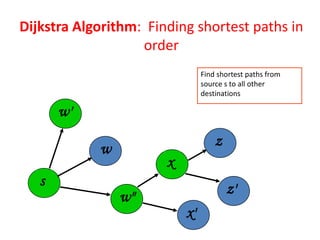
Find shortest paths from
source s to all other
destinations

w'
z

w
s

x
w"

z'

x'
Djikstra's algorithm
(named after its
discover, E.W. Dijkstra)
solves the problem of
finding the shortest
path from a point in a
graph (the source) to a
destination.
• Suppose we want to find a shortest path from
a given node a to other nodes in a network
(one-to-all shortest path problem)
• It finds the shortest path from a given node a
to all other nodes in the network
• Node a is called a starting node or an initial
node
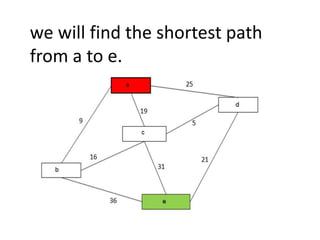
we will find the shortest path
from a to e.
Dijkstra's algorithm keeps two sets of vertices:

Set P : The set of vertices whose shortest paths from the
source have already been determined and
Set T : The remaining vertices.
So here initially
P = {} i.e. Empty
T = {a,b,c,d,f}
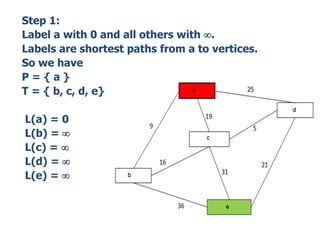
Step 1:
Label a with 0 and all others with .
Labels are shortest paths from a to vertices.
So we have
P={a}
T = { b, c, d, e}
L(a) = 0
L(b) = 
L(c) = 
L(d) = 
L(e) = 
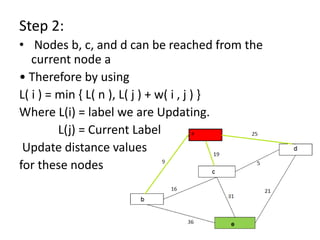
Step 2:
• Nodes b, c, and d can be reached from the
current node a
• Therefore by using
L( i ) = min { L( n ), L( j ) + w( i , j ) }
Where L(i) = label we are Updating.
L(j) = Current Label
Update distance values
for these nodes
So we get
L ( b ) = min { L( b ) , L( a ) + W ( a , b ) }
= min {  , 0 + 9 }
= min { , 9 }
Selecting the minimum we get
L (b) = 9
Smilarly calculating for L(c) and L(d) we get
L(c) = min { , 19}
= 19
L(d) = min { , 25}
= 25
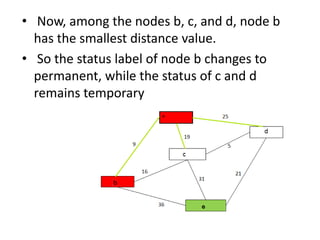
• Now, among the nodes b, c, and d, node b
has the smallest distance value.
• So the status label of node b changes to
permanent, while the status of c and d
remains temporary
Step 3:
• P = { a, b}
• T = { c, d, e}
• Node b becomes the current node Operation

• Nodes c, and e can be reached from the current node b.
So, updating values for c, d, e
We get
• L (c)= min { 19 , 9+16 }
= min { 19 , 25}
= 19
• Similarly ( e ) = 45
• Now label c has the smallest value. Therefore it changes
to permanent.
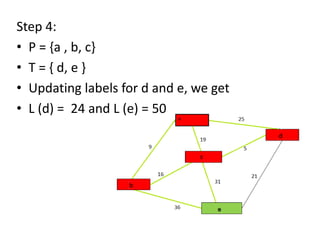
Step 4:
• P = {a , b, c}
• T = { d, e }
• Updating labels for d and e, we get
• L (d) = 24 and L (e) = 50
•
•
•
•

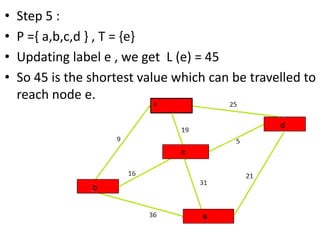
Step 5 :
P ={ a,b,c,d } , T = {e}
Updating label e , we get L (e) = 45
So 45 is the shortest value which can be travelled to
reach node e.
Applications
Telephone Network
The vertices represents switching station, the
edges represents the transmission line, and the
weight of edges represents the BW.

Flight Agenda
To determine the earliest arrival time for the
destination given an origin airport and start
time.
Dijkstra's algorithm

Dijkstra's algorithm

  • 1.
    Dijkstra Algorithm: Findingshortest paths in order Find shortest paths from source s to all other destinations w' z w s x w" z' x'
  • 2.
    Djikstra's algorithm (named afterits discover, E.W. Dijkstra) solves the problem of finding the shortest path from a point in a graph (the source) to a destination.
  • 3.
    • Suppose wewant to find a shortest path from a given node a to other nodes in a network (one-to-all shortest path problem) • It finds the shortest path from a given node a to all other nodes in the network • Node a is called a starting node or an initial node
  • 4.
    we will findthe shortest path from a to e.
  • 5.
    Dijkstra's algorithm keepstwo sets of vertices: Set P : The set of vertices whose shortest paths from the source have already been determined and Set T : The remaining vertices.
  • 6.
    So here initially P= {} i.e. Empty T = {a,b,c,d,f}
  • 7.
    Step 1: Label awith 0 and all others with . Labels are shortest paths from a to vertices. So we have P={a} T = { b, c, d, e} L(a) = 0 L(b) =  L(c) =  L(d) =  L(e) = 
  • 8.
    Step 2: • Nodesb, c, and d can be reached from the current node a • Therefore by using L( i ) = min { L( n ), L( j ) + w( i , j ) } Where L(i) = label we are Updating. L(j) = Current Label Update distance values for these nodes
  • 9.
    So we get L( b ) = min { L( b ) , L( a ) + W ( a , b ) } = min {  , 0 + 9 } = min { , 9 } Selecting the minimum we get L (b) = 9 Smilarly calculating for L(c) and L(d) we get L(c) = min { , 19} = 19 L(d) = min { , 25} = 25
  • 10.
    • Now, amongthe nodes b, c, and d, node b has the smallest distance value. • So the status label of node b changes to permanent, while the status of c and d remains temporary
  • 11.
    Step 3: • P= { a, b} • T = { c, d, e} • Node b becomes the current node Operation • Nodes c, and e can be reached from the current node b. So, updating values for c, d, e We get • L (c)= min { 19 , 9+16 } = min { 19 , 25} = 19 • Similarly ( e ) = 45 • Now label c has the smallest value. Therefore it changes to permanent.
  • 12.
    Step 4: • P= {a , b, c} • T = { d, e } • Updating labels for d and e, we get • L (d) = 24 and L (e) = 50
  • 13.
    • • • • Step 5 : P={ a,b,c,d } , T = {e} Updating label e , we get L (e) = 45 So 45 is the shortest value which can be travelled to reach node e.
  • 14.
    Applications Telephone Network The verticesrepresents switching station, the edges represents the transmission line, and the weight of edges represents the BW. Flight Agenda To determine the earliest arrival time for the destination given an origin airport and start time.