WELCOME
TO My
SESSION
Presented By:
MD. Saidur Rahman Kohinoor
DIU Student
E-mail: saidur95@gmail.com
Social Network: www.fb.com/kohinoor11
Presentation Topic:
Floyd Warshall’s
Algorithm
Floyd Warshall Algorithm - what?
An example of dynamic programming
An algorithm for finding shortest paths in
a weighted graph with positive or negative
edge weights
no negative cycles
find the lengths of the shortest paths
between all pairs of vertices
History and naming - how?
 Bernard Roy in 1959
Robert Floyd in 1962
Stephen Warshall in 1962
Peter Ingerman in 1962
The algorithm is also known as
History and naming - how?
The Floyd's algorithm
 the Roy–Warshall algorithm
 the Roy–Floyd algorithm, or
 the WFI algorithm
The Floyd's algorithm
 the Roy–Warshall algorithm
 the Roy–Floyd algorithm, or
 the WFI algorithm
Shortest paths – mean?
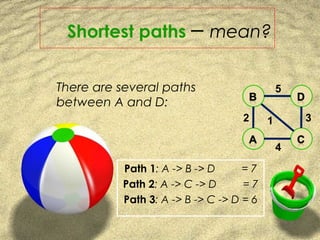
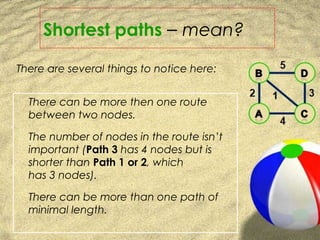
Path 1: A -> B -> D = 7
Path 2: A -> C -> D = 7
Path 3: A -> B -> C -> D = 6
There are several paths
between A and D:
5
4
312
There are several things to notice here:
There can be more then one route
between two nodes.
The number of nodes in the route isn’t
important (Path 3 has 4 nodes but is
shorter than Path 1 or 2, which
has 3 nodes).
There can be more than one path of
minimal length.
Shortest paths – mean?
Floyd Warshall Algorithm- programs
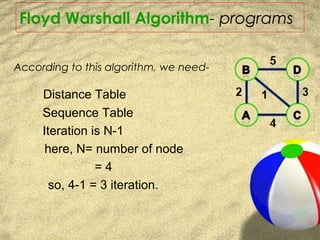
Distance Table
Sequence Table
Iteration is N-1
here, N= number of node
= 4
so, 4-1 = 3 iteration.
According to this algorithm, we need-
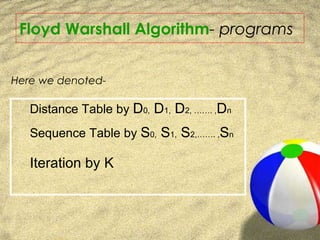
Distance Table by D0, D1, D2, ……. ,Dn
Sequence Table by S0, S1, S2,……. ,Sn
Iteration by K
Here we denoted-
Floyd Warshall Algorithm- programs
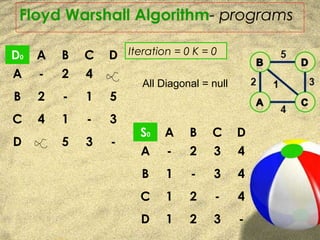
D0 A B C D
A - 2 4
B 2 - 1 5
C 4 1 - 3
D 5 3 -
S0 A B C D
A - 2 3 4
B 1 - 3 4
C 1 2 - 4
D 1 2 3 -
Iteration = 0 K = 0
All Diagonal = null
Floyd Warshall Algorithm- programs
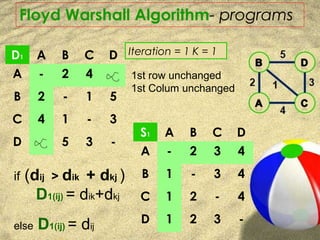
D1 A B C D
A - 2 4
B 2 - 1 5
C 4 1 - 3
D 5 3 -
S1 A B C D
A - 2 3 4
B 1 - 3 4
C 1 2 - 4
D 1 2 3 -
1st row unchanged
1st Colum unchanged
Iteration = 1 K = 1
if (dij > dik + dkj )
D1(ij) = dik+dkj
else D1(ij) = dij
Floyd Warshall Algorithm- programs
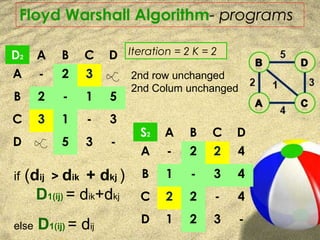
D2 A B C D
A - 2 3
B 2 - 1 5
C 3 1 - 3
D 5 3 -
S2 A B C D
A - 2 2 4
B 1 - 3 4
C 2 2 - 4
D 1 2 3 -
Iteration = 2 K = 2
2nd row unchanged
2nd Colum unchanged
if (dij > dik + dkj )
D1(ij) = dik+dkj
else D1(ij) = dij
Floyd Warshall Algorithm- programs
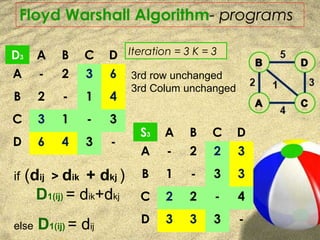
D3 A B C D
A - 2 3 6
B 2 - 1 4
C 3 1 - 3
D 6 4 3 -
S3 A B C D
A - 2 2 3
B 1 - 3 3
C 2 2 - 4
D 3 3 3 -
Iteration = 3 K = 3
3rd row unchanged
3rd Colum unchanged
if (dij > dik + dkj )
D1(ij) = dik+dkj
else D1(ij) = dij
Floyd Warshall Algorithm- programs
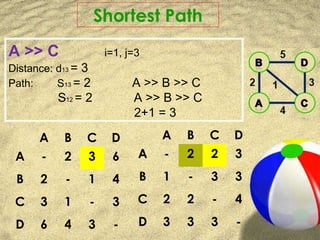
Shortest Path
A B C D
A - 2 3 6
B 2 - 1 4
C 3 1 - 3
D 6 4 3 -
A B C D
A - 2 2 3
B 1 - 3 3
C 2 2 - 4
D 3 3 3 -
A >> C i=1, j=3
Distance: d13 = 3
Path: S13 = 2 A >> B >> C
S12 = 2 A >> B >> C
2+1 = 3
A B C D
A - 2 3 6
B 2 - 1 4
C 3 1 - 3
D 6 4 3 -
A B C D
A - 2 2 3
B 1 - 3 3
C 2 2 - 4
D 3 3 3 -
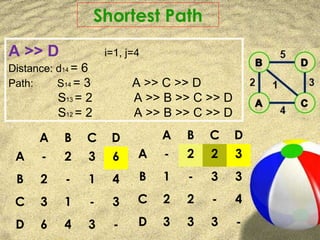
A >> D i=1, j=4
Distance: d14 = 6
Path: S14 = 3 A >> C >> D
S13 = 2 A >> B >> C >> D
S12 = 2 A >> B >> C >> D
Shortest Path
 The running time is O(n3
).
 The space
requirements
are O(n2
)
16
Time and Space Requirements
Shortest paths in directed graphs
Transitive closure of directed
graphs.
Inversion of real matrices
Optimal routing.
Maximum bandwidth paths
Computing canonical form of
difference bound matrices
Applications and generalizations
My Complete Code
C Programming
http://pastebin.com/s3vBx3KD
References
https://en.wikipedia.org/wiki/Floyd
%E2%80%93Warshall_algorithm
https://compprog.wordpress.com/200
7/11/15/all-sources-shortest-path-the-
floyd-warshall-algorithm/
Thanks to All

Floyd Warshall Algorithm

  • 1.
    WELCOME TO My SESSION Presented By: MD.Saidur Rahman Kohinoor DIU Student E-mail: saidur95@gmail.com Social Network: www.fb.com/kohinoor11
  • 2.
  • 3.
    Floyd Warshall Algorithm- what? An example of dynamic programming An algorithm for finding shortest paths in a weighted graph with positive or negative edge weights no negative cycles find the lengths of the shortest paths between all pairs of vertices
  • 4.
    History and naming- how?  Bernard Roy in 1959 Robert Floyd in 1962 Stephen Warshall in 1962 Peter Ingerman in 1962
  • 5.
    The algorithm isalso known as History and naming - how? The Floyd's algorithm  the Roy–Warshall algorithm  the Roy–Floyd algorithm, or  the WFI algorithm The Floyd's algorithm  the Roy–Warshall algorithm  the Roy–Floyd algorithm, or  the WFI algorithm
  • 6.
    Shortest paths –mean? Path 1: A -> B -> D = 7 Path 2: A -> C -> D = 7 Path 3: A -> B -> C -> D = 6 There are several paths between A and D: 5 4 312
  • 7.
    There are severalthings to notice here: There can be more then one route between two nodes. The number of nodes in the route isn’t important (Path 3 has 4 nodes but is shorter than Path 1 or 2, which has 3 nodes). There can be more than one path of minimal length. Shortest paths – mean?
  • 8.
    Floyd Warshall Algorithm-programs Distance Table Sequence Table Iteration is N-1 here, N= number of node = 4 so, 4-1 = 3 iteration. According to this algorithm, we need-
  • 9.
    Distance Table byD0, D1, D2, ……. ,Dn Sequence Table by S0, S1, S2,……. ,Sn Iteration by K Here we denoted- Floyd Warshall Algorithm- programs
  • 10.
    D0 A BC D A - 2 4 B 2 - 1 5 C 4 1 - 3 D 5 3 - S0 A B C D A - 2 3 4 B 1 - 3 4 C 1 2 - 4 D 1 2 3 - Iteration = 0 K = 0 All Diagonal = null Floyd Warshall Algorithm- programs
  • 11.
    D1 A BC D A - 2 4 B 2 - 1 5 C 4 1 - 3 D 5 3 - S1 A B C D A - 2 3 4 B 1 - 3 4 C 1 2 - 4 D 1 2 3 - 1st row unchanged 1st Colum unchanged Iteration = 1 K = 1 if (dij > dik + dkj ) D1(ij) = dik+dkj else D1(ij) = dij Floyd Warshall Algorithm- programs
  • 12.
    D2 A BC D A - 2 3 B 2 - 1 5 C 3 1 - 3 D 5 3 - S2 A B C D A - 2 2 4 B 1 - 3 4 C 2 2 - 4 D 1 2 3 - Iteration = 2 K = 2 2nd row unchanged 2nd Colum unchanged if (dij > dik + dkj ) D1(ij) = dik+dkj else D1(ij) = dij Floyd Warshall Algorithm- programs
  • 13.
    D3 A BC D A - 2 3 6 B 2 - 1 4 C 3 1 - 3 D 6 4 3 - S3 A B C D A - 2 2 3 B 1 - 3 3 C 2 2 - 4 D 3 3 3 - Iteration = 3 K = 3 3rd row unchanged 3rd Colum unchanged if (dij > dik + dkj ) D1(ij) = dik+dkj else D1(ij) = dij Floyd Warshall Algorithm- programs
  • 14.
    Shortest Path A BC D A - 2 3 6 B 2 - 1 4 C 3 1 - 3 D 6 4 3 - A B C D A - 2 2 3 B 1 - 3 3 C 2 2 - 4 D 3 3 3 - A >> C i=1, j=3 Distance: d13 = 3 Path: S13 = 2 A >> B >> C S12 = 2 A >> B >> C 2+1 = 3
  • 15.
    A B CD A - 2 3 6 B 2 - 1 4 C 3 1 - 3 D 6 4 3 - A B C D A - 2 2 3 B 1 - 3 3 C 2 2 - 4 D 3 3 3 - A >> D i=1, j=4 Distance: d14 = 6 Path: S14 = 3 A >> C >> D S13 = 2 A >> B >> C >> D S12 = 2 A >> B >> C >> D Shortest Path
  • 16.
     The runningtime is O(n3 ).  The space requirements are O(n2 ) 16 Time and Space Requirements
  • 17.
    Shortest paths indirected graphs Transitive closure of directed graphs. Inversion of real matrices Optimal routing. Maximum bandwidth paths Computing canonical form of difference bound matrices Applications and generalizations
  • 18.
    My Complete Code CProgramming http://pastebin.com/s3vBx3KD
  • 19.
  • 20.

Editor's Notes

  • #4 The Floyd–Warshall algorithm is an example of dynamic programming. In computer science, the Floyd–Warshall algorithm is an algorithm for finding shortest paths in a weighted graph with positive or negative edge weights (but with no negative cycles). A single execution of the algorithm will find the lengths of the shortest paths between all pairs of vertices, though it does not return details of the paths themselves.
  • #5 The Floyd–Warshall algorithm was published by Bernard Roy in 1959. Later it recognized form by Robert Floyd in 1962 and also by Stephen Warshall in 1962 for finding the transitive closure of a graph. The modern formulation of the algorithm as three nested for-loops was first described by Peter Ingerman, in 1962.
  • #6 The algorithm is also known as Floyd's algorithm, the Roy–Warshall algorithm, the Roy–Floyd algorithm, or the WFI algorithm.
  • #7 The shortest path between two nodes of a graph is a sequence of connected nodes so that the sum of the edges that inter-connect them is minimal.
  • #17 the space requirements are high. One can reduce the space from O(n3) to O(n2) by using a single array d. Let n be |V|, the number of vertices. To find all n2 of shortestPath(i,j,k) (for all i and j) from those of shortestPath(i,j,k−1) requires 2n2 operations. Since we begin with shortestPath(i,j,0) = edgeCost(i,j) and compute the sequence of n matrices shortestPath(i,j,1), shortestPath(i,j,2), …, shortestPath(i,j,n), the total number of operations used is n · 2n2 = 2n3. Therefore, the complexity of the algorithm is Θ(n3).
  • #18 The Floyd–Warshall algorithm can be used to solve the following problems, among others: In mathematics, the transitive closure of a binary relation R on a set X is the transitive relation R+ on set X such that R+ contains R and R+ is minimal