S.SRIKRISHNAN
II year
CSE Department
SSNCE
1
The shortest distance between two points is under construction. – Noelie Altito
FLOYD’ ALGORITHM DESIGN
 Introduction
 Problem statement
 Solution
◦ Greedy Method (Dijkstra’s Algorithm)
◦ Dynamic Programming Method
 Applications
2
 A non-linear data structure
 Set of vertices and edges
 Classification
◦ Undirected graph
◦ Directed graph (digraph)
 Basic terminologies
◦ Path
◦ Cycle
◦ Degree
3
 Representation
◦ Incidence Matrix
◦ Adjacency Matrix
◦ Adjacency List
◦ Path Matrix
 Traversals
◦ Depth first (Stack ADT)
◦ Breadth first (Queue ADT)
4
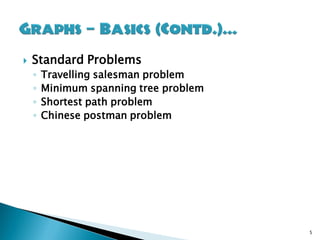
 Standard Problems
◦ Travelling salesman problem
◦ Minimum spanning tree problem
◦ Shortest path problem
◦ Chinese postman problem
5
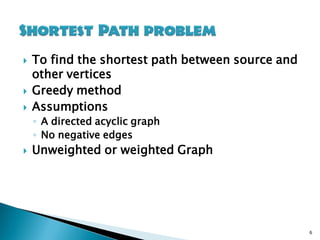
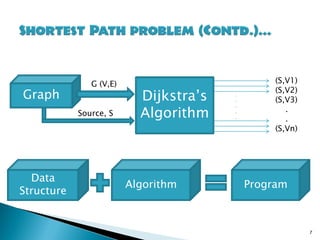
 To find the shortest path between source and
other vertices
 Greedy method
 Assumptions
◦ A directed acyclic graph
◦ No negative edges
 Unweighted or weighted Graph
6
7
Graph
Source, S
G (V,E) (S,V1)
(S,V2)
(S,V3)
.
.
(S,Vn)
Algorithm
Data
Structure
Program
Dijkstra’s
Algorithm
.
.
.
.
.
8
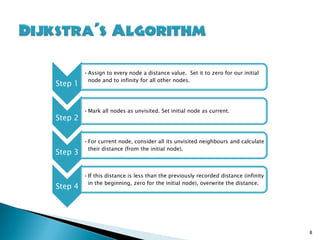
Step 1
•Assign to every node a distance value. Set it to zero for our initial
node and to infinity for all other nodes.
Step 2
•Mark all nodes as unvisited. Set initial node as current.
Step 3
•For current node, consider all its unvisited neighbours and calculate
their distance (from the initial node).
Step 4
•If this distance is less than the previously recorded distance (infinity
in the beginning, zero for the initial node), overwrite the distance.
9
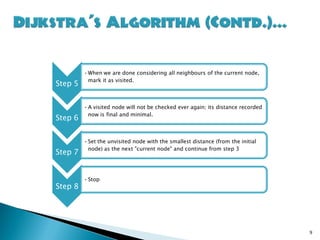
Step 5
•When we are done considering all neighbours of the current node,
mark it as visited.
Step 6
•A visited node will not be checked ever again; its distance recorded
now is final and minimal.
Step 7
•Set the unvisited node with the smallest distance (from the initial
node) as the next "current node" and continue from step 3
Step 8
•Stop
Pseudo code
1. function Dijkstra (Graph, source):
2. for each vertex v in Graph: // Initializations
3. dist[v] := infinity // Unknown distance function from source to v
4. previous[v] := undefined // Previous node in optimal path from source
5. dist[source] := 0 // Distance from source to
source
6. Q := the set of all nodes in Graph // All nodes in the graph are unoptimized -
thus are in Q
7. while Q is not empty: // The main loop
8. u := vertex in Q with smallest dist[]
9. if dist[u] = infinity:
10. break // all remaining vertices are inaccessible from source
11. remove u from Q
12. for each neighbor v of u: // where v has not yet been removed from Q
13. alt := dist[u] + dist_between(u, v)
14. if alt < dist[v]: // Relax (u,v,a)
15. dist[v] := alt
16. previous[v] := u
17. return dist[]
Running time: O((n+|E|)log n)
10
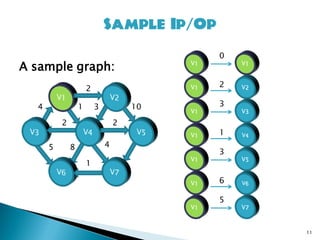
A sample graph:
2
4
103
2
2
4 1
1
85
0
2
3
1
3
6
5
Sample Ip/Op
11
Result and Scope of DA
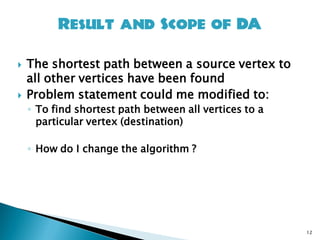
 The shortest path between a source vertex to
all other vertices have been found
 Problem statement could me modified to:
◦ To find shortest path between all vertices to a
particular vertex (destination)
◦ How do I change the algorithm ?
12
Problem Extensions
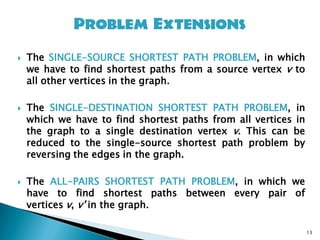
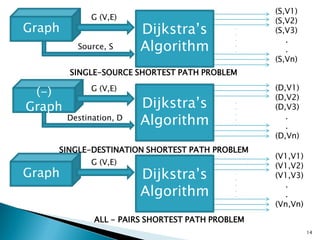
 The SINGLE-SOURCE SHORTEST PATH PROBLEM, in which
we have to find shortest paths from a source vertex v to
all other vertices in the graph.
 The SINGLE-DESTINATION SHORTEST PATH PROBLEM, in
which we have to find shortest paths from all vertices in
the graph to a single destination vertex v. This can be
reduced to the single-source shortest path problem by
reversing the edges in the graph.
 The ALL-PAIRS SHORTEST PATH PROBLEM, in which we
have to find shortest paths between every pair of
vertices v, v' in the graph.
13
Graph
Source, S
G (V,E)
Dijkstra’s
Algorithm
.
.
.
.
.
(S,V1)
(S,V2)
(S,V3)
.
.
(S,Vn)
(-)
Graph
Destination, D
G (V,E)
Dijkstra’s
Algorithm
.
.
.
.
.
(D,V1)
(D,V2)
(D,V3)
.
.
(D,Vn)
SINGLE-SOURCE SHORTEST PATH PROBLEM
SINGLE-DESTINATION SHORTEST PATH PROBLEM
Graph
G (V,E)
Dijkstra’s
Algorithm
.
.
.
.
.
(V1,V1)
(V1,V2)
(V1,V3)
.
.
(Vn,Vn)
ALL - PAIRS SHORTEST PATH PROBLEM
14
All Pairs Shortest Path problem
 The all-pairs shortest path algorithm is to determine
a matrix A such that A(i, j) is the length of the
shortest path between i and j.
 Input given as a matrix form
 Output is an nXn matrix D = [dij] where dij is the
shortest path from vertex i to j.
Wij =
0, if i=j
W(i, j), if (i,j) ε E
∞, if (i,j) ε E
15
Solution 1
 If there are no negative cost edges apply
Dijkstra’s algorithm to each vertex (as the
source) of the digraph.
 Disadvantage
 Running time increases to O(n(n+|E|)log n)
 Therefore we go for Dynamic Programming
16
17
Dynamic Programming
 An algorithm design method that can be used
when the solution to the problem can be viewed
as a result of a sequence of decisions.
 Best examples:
 Ordering matrix multiplication
 Optimal binary search trees
 All pairs-shortest path
18
Solution 2
 To find the shortest path from i to j (i!=j)
 Assume some intermediate vertex k (or no
vertices also)
 The shortest path from i to j is the shortest
path from [(i,k) + (k,j) or i to j ] which ever is
shorter.
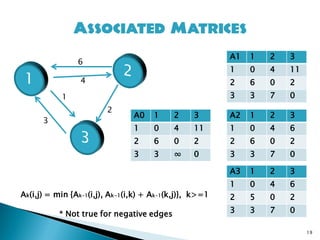
 We use associated matrices and its powers to
calculate the shortest path from i to k and also
k to j.
 Matrix obtained in O(n.n.n)
19
Associated Matrices
1
6
3
4
2
A0 1 2 3
1 0 4 11
2 6 0 2
3 3 ∞ 0
A1 1 2 3
1 0 4 11
2 6 0 2
3 3 7 0
A2 1 2 3
1 0 4 6
2 6 0 2
3 3 7 0
A3 1 2 3
1 0 4 6
2 5 0 2
3 3 7 0
Ak(i,j) = min {Ak-1(i,j), Ak-1(i,k) + Ak-1(k,j)}, k>=1
* Not true for negative edges
20
Pseudo Code
1. algorithm allpairs (cost, A, n):
2. //cost[1:n, 1:n] is the cost adjacency matrix of a graph with n
vertices
3. //A[i,j] is the cost of a shortest path from vertex i toj .
4. //cost[i,i] = 0 for 1<=i<=n.
5. {
6. for(i=0;i<n;i++)
7. for(j=0;j<n;j++)
8. A[i][j]=cost[i][j] //copy cost into A
9. for(k=0;k<n;k++)
10. for(i=0;i<n;i++)
11. for(j=0;j<n;j++)
12. A[i,j] = min { A[i,j] , A[i,k] + A[k,j] };
13. }
21
Applications
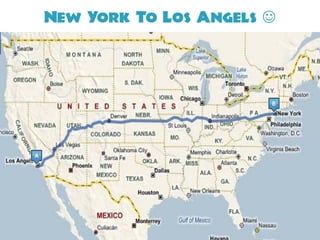
 To automatically find directions between
physical locations
 Vehicle Routing and scheduling
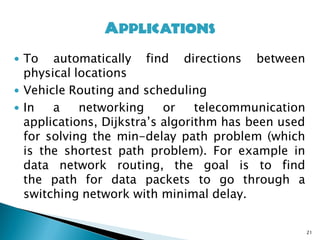
 In a networking or telecommunication
applications, Dijkstra’s algorithm has been used
for solving the min-delay path problem (which
is the shortest path problem). For example in
data network routing, the goal is to find
the path for data packets to go through a
switching network with minimal delay.
22
New York To Los Angels 
23
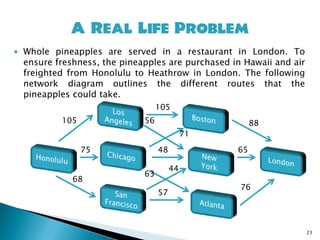
A Real Life Problem
 Whole pineapples are served in a restaurant in London. To
ensure freshness, the pineapples are purchased in Hawaii and air
freighted from Honolulu to Heathrow in London. The following
network diagram outlines the different routes that the
pineapples could take.
105
68
57
76
65
88
105
4875
44
63
56
71
24
References
 Data Structures and Algorithm Analysis in C,
Second Edition, M.A. Weiss
 Fundamentals of Computer Algorithms, Second
Edition, Ellis Horowitz, Sartaj Sahni,
Sanguthevar Rajasekaran
 Introduction to Design and Analysis of
Algorithms, Fifth Edition, Anany Levitin
25
All pairs shortest path algorithm

All pairs shortest path algorithm

  • 1.
    S.SRIKRISHNAN II year CSE Department SSNCE 1 Theshortest distance between two points is under construction. – Noelie Altito FLOYD’ ALGORITHM DESIGN
  • 2.
     Introduction  Problemstatement  Solution ◦ Greedy Method (Dijkstra’s Algorithm) ◦ Dynamic Programming Method  Applications 2
  • 3.
     A non-lineardata structure  Set of vertices and edges  Classification ◦ Undirected graph ◦ Directed graph (digraph)  Basic terminologies ◦ Path ◦ Cycle ◦ Degree 3
  • 4.
     Representation ◦ IncidenceMatrix ◦ Adjacency Matrix ◦ Adjacency List ◦ Path Matrix  Traversals ◦ Depth first (Stack ADT) ◦ Breadth first (Queue ADT) 4
  • 5.
     Standard Problems ◦Travelling salesman problem ◦ Minimum spanning tree problem ◦ Shortest path problem ◦ Chinese postman problem 5
  • 6.
     To findthe shortest path between source and other vertices  Greedy method  Assumptions ◦ A directed acyclic graph ◦ No negative edges  Unweighted or weighted Graph 6
  • 7.
    7 Graph Source, S G (V,E)(S,V1) (S,V2) (S,V3) . . (S,Vn) Algorithm Data Structure Program Dijkstra’s Algorithm . . . . .
  • 8.
    8 Step 1 •Assign toevery node a distance value. Set it to zero for our initial node and to infinity for all other nodes. Step 2 •Mark all nodes as unvisited. Set initial node as current. Step 3 •For current node, consider all its unvisited neighbours and calculate their distance (from the initial node). Step 4 •If this distance is less than the previously recorded distance (infinity in the beginning, zero for the initial node), overwrite the distance.
  • 9.
    9 Step 5 •When weare done considering all neighbours of the current node, mark it as visited. Step 6 •A visited node will not be checked ever again; its distance recorded now is final and minimal. Step 7 •Set the unvisited node with the smallest distance (from the initial node) as the next "current node" and continue from step 3 Step 8 •Stop
  • 10.
    Pseudo code 1. functionDijkstra (Graph, source): 2. for each vertex v in Graph: // Initializations 3. dist[v] := infinity // Unknown distance function from source to v 4. previous[v] := undefined // Previous node in optimal path from source 5. dist[source] := 0 // Distance from source to source 6. Q := the set of all nodes in Graph // All nodes in the graph are unoptimized - thus are in Q 7. while Q is not empty: // The main loop 8. u := vertex in Q with smallest dist[] 9. if dist[u] = infinity: 10. break // all remaining vertices are inaccessible from source 11. remove u from Q 12. for each neighbor v of u: // where v has not yet been removed from Q 13. alt := dist[u] + dist_between(u, v) 14. if alt < dist[v]: // Relax (u,v,a) 15. dist[v] := alt 16. previous[v] := u 17. return dist[] Running time: O((n+|E|)log n) 10
  • 11.
    A sample graph: 2 4 103 2 2 41 1 85 0 2 3 1 3 6 5 Sample Ip/Op 11
  • 12.
    Result and Scopeof DA  The shortest path between a source vertex to all other vertices have been found  Problem statement could me modified to: ◦ To find shortest path between all vertices to a particular vertex (destination) ◦ How do I change the algorithm ? 12
  • 13.
    Problem Extensions  TheSINGLE-SOURCE SHORTEST PATH PROBLEM, in which we have to find shortest paths from a source vertex v to all other vertices in the graph.  The SINGLE-DESTINATION SHORTEST PATH PROBLEM, in which we have to find shortest paths from all vertices in the graph to a single destination vertex v. This can be reduced to the single-source shortest path problem by reversing the edges in the graph.  The ALL-PAIRS SHORTEST PATH PROBLEM, in which we have to find shortest paths between every pair of vertices v, v' in the graph. 13
  • 14.
    Graph Source, S G (V,E) Dijkstra’s Algorithm . . . . . (S,V1) (S,V2) (S,V3) . . (S,Vn) (-) Graph Destination,D G (V,E) Dijkstra’s Algorithm . . . . . (D,V1) (D,V2) (D,V3) . . (D,Vn) SINGLE-SOURCE SHORTEST PATH PROBLEM SINGLE-DESTINATION SHORTEST PATH PROBLEM Graph G (V,E) Dijkstra’s Algorithm . . . . . (V1,V1) (V1,V2) (V1,V3) . . (Vn,Vn) ALL - PAIRS SHORTEST PATH PROBLEM 14
  • 15.
    All Pairs ShortestPath problem  The all-pairs shortest path algorithm is to determine a matrix A such that A(i, j) is the length of the shortest path between i and j.  Input given as a matrix form  Output is an nXn matrix D = [dij] where dij is the shortest path from vertex i to j. Wij = 0, if i=j W(i, j), if (i,j) ε E ∞, if (i,j) ε E 15
  • 16.
    Solution 1  Ifthere are no negative cost edges apply Dijkstra’s algorithm to each vertex (as the source) of the digraph.  Disadvantage  Running time increases to O(n(n+|E|)log n)  Therefore we go for Dynamic Programming 16
  • 17.
    17 Dynamic Programming  Analgorithm design method that can be used when the solution to the problem can be viewed as a result of a sequence of decisions.  Best examples:  Ordering matrix multiplication  Optimal binary search trees  All pairs-shortest path
  • 18.
    18 Solution 2  Tofind the shortest path from i to j (i!=j)  Assume some intermediate vertex k (or no vertices also)  The shortest path from i to j is the shortest path from [(i,k) + (k,j) or i to j ] which ever is shorter.  We use associated matrices and its powers to calculate the shortest path from i to k and also k to j.  Matrix obtained in O(n.n.n)
  • 19.
    19 Associated Matrices 1 6 3 4 2 A0 12 3 1 0 4 11 2 6 0 2 3 3 ∞ 0 A1 1 2 3 1 0 4 11 2 6 0 2 3 3 7 0 A2 1 2 3 1 0 4 6 2 6 0 2 3 3 7 0 A3 1 2 3 1 0 4 6 2 5 0 2 3 3 7 0 Ak(i,j) = min {Ak-1(i,j), Ak-1(i,k) + Ak-1(k,j)}, k>=1 * Not true for negative edges
  • 20.
    20 Pseudo Code 1. algorithmallpairs (cost, A, n): 2. //cost[1:n, 1:n] is the cost adjacency matrix of a graph with n vertices 3. //A[i,j] is the cost of a shortest path from vertex i toj . 4. //cost[i,i] = 0 for 1<=i<=n. 5. { 6. for(i=0;i<n;i++) 7. for(j=0;j<n;j++) 8. A[i][j]=cost[i][j] //copy cost into A 9. for(k=0;k<n;k++) 10. for(i=0;i<n;i++) 11. for(j=0;j<n;j++) 12. A[i,j] = min { A[i,j] , A[i,k] + A[k,j] }; 13. }
  • 21.
    21 Applications  To automaticallyfind directions between physical locations  Vehicle Routing and scheduling  In a networking or telecommunication applications, Dijkstra’s algorithm has been used for solving the min-delay path problem (which is the shortest path problem). For example in data network routing, the goal is to find the path for data packets to go through a switching network with minimal delay.
  • 22.
    22 New York ToLos Angels 
  • 23.
    23 A Real LifeProblem  Whole pineapples are served in a restaurant in London. To ensure freshness, the pineapples are purchased in Hawaii and air freighted from Honolulu to Heathrow in London. The following network diagram outlines the different routes that the pineapples could take. 105 68 57 76 65 88 105 4875 44 63 56 71
  • 24.
    24 References  Data Structuresand Algorithm Analysis in C, Second Edition, M.A. Weiss  Fundamentals of Computer Algorithms, Second Edition, Ellis Horowitz, Sartaj Sahni, Sanguthevar Rajasekaran  Introduction to Design and Analysis of Algorithms, Fifth Edition, Anany Levitin
  • 25.