
Dijkstra’s Algorithm
P r e s e n t a t i o n b y,
S u b i d B i s w a s
M A I L : s u b i d b i s w a s 2 0 6 1 @ g m a i l . c o m
CS492- Design & Ananlysis of Algorithm Lab
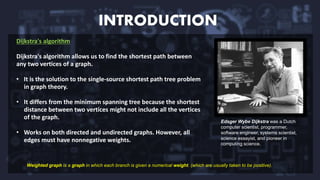
Dijkstra's algorithm
Dijkstra's algorithm allows us to find the shortest path between
any two vertices of a graph.
• It is the solution to the single-source shortest path tree problem
in graph theory.
• It differs from the minimum spanning tree because the shortest
distance between two vertices might not include all the vertices
of the graph.
• Works on both directed and undirected graphs. However, all
edges must have nonnegative weights.
Weighted graph is a graph in which each branch is given a numerical weight. (which are usually taken to be positive).
Edsger Wybe Dijkstra was a Dutch
computer scientist, programmer,
software engineer, systems scientist,
science essayist, and pioneer in
computing science.
INTRODUCTION
Approach: Greedy (To find the single source shortest path)
• Input: Weighted graph G={E,V} and source vertex v∈V, such that all edge weights are nonnegative.
• Output: Lengths of shortest paths (or the shortest paths themselves) from a given source to all other vertices.
HOW IT WORKS?
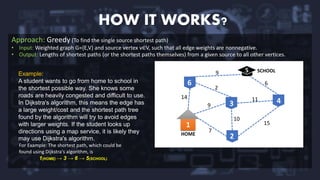
Example:
A student wants to go from home to school in
the shortest possible way. She knows some
roads are heavily congested and difficult to use.
In Dijkstra's algorithm, this means the edge has
a large weight/cost and the shortest path tree
found by the algorithm will try to avoid edges
with larger weights. If the student looks up
directions using a map service, it is likely they
may use Dijkstra's algorithm.
For Example: The shortest path, which could be
found using Dijkstra's algorithm, is
1(HOME) → 3 → 6 → 5(SCHOOL)
HOME
2
3 4
6
SCHOOL
7
14
9
10
15
11
6
9
2
1
5
IMPLEMENTATION
1 2 3
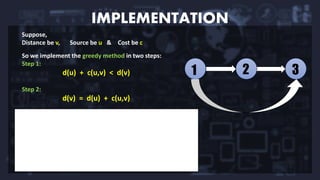
Suppose,
Distance be v, Source be u & Cost be c
So we implement the greedy method in two steps:
Step 1:
d(u) + c(u,v) < d(v)
Step 2:
d(v) = d(u) + c(u,v)
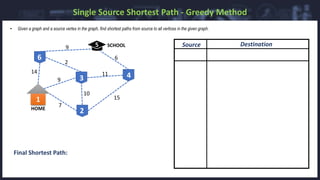
Single Source Shortest Path - Greedy Method
• Given a graph and a source vertex in the graph, find shortest paths from source to all vertices in the given graph.
Final Shortest Path:
HOME
2
3 4
6
SCHOOL
7
14
9
10
15
11
6
9
2
1
5 Source Destination
PSEUDO CODE:
function dijkstra(G, S)
for each vertex V in G
distance[V] <- infinite
previous[V] <- NULL
If V != S, add V to Priority Queue Q
distance[S] <- 0
while Q IS NOT EMPTY
U <- Extract MIN from Q
for each unvisited neighbour V of U
tempDistance <- distance[U] + edge_weight(U, V)
if tempDistance < distance[V]
distance[V] <- tempDistance
previous[V] <- U
return distance[], previous[]
1
2
3
4
5
10
20
30
40
50
60
S
PSEUDO CODE:
Dijkstra(Graph, Source)
Create Vertex Set Q
for each vertex V in graph
distance[V] = infinite
previous[V] = NULL
If V not equal S,
add V to Priority Queue Q
distance[S] = 0
while Q IS NOT EMPTY
U = Extract - min [Q]
for each neighbour V of U
relax(U, V)
TIME COMPLEXITY
1
2
3
4
5
10
20
30
40
50
60
S
PSEUDO CODE: (From previous slide)
Dijkstra(Graph, Source)
Create Vertex Set Q
for each vertex V in graph
distance[V] = infinite
previous[V] = NULL
If V not equal S,
add V to Priority Queue Q
distance[S] = 0
while Q IS NOT EMPTY
U = Extract - min [Q]
for each neighbour V of U
relax(U, V)
TIME COMPLEXITY
Time Complexity:
It is the computational
complexity that
describes the amount of
computer time it takes to
run an algorithm.
Pseudocode:
It is the plain language
description of the steps
in an algorithm or
another system.
Space complexity:
It is the amount of
memory used by the
algorithm (including the
input values to the
algorithm) to execute
and produce the result
Dijkstra's Algorithm Complexity:
• Time Complexity: O(E Log V)
where, E is the number of edges and V is the number
of vertices.
• Space Complexity: O(V)
10
20
30
50
1. It is used in Google Maps
2. It is used in finding Shortest Path on
geographical Maps.
3. To find locations of Map which refers to
vertices of graph. Distance between
the location refers to edges.
4. It is used in IP routing to find Open
shortest Path First.
5. It is used in the telephone network.
ADVANTAGES & DISADVANTAGES:
1. The major disadvantage of
the algorithm is the fact that it does
a blind search there by consuming a
lot of time waste of necessary
resources
2. It cannot handle negative edges.
3. This leads to acyclic graphs and most
often cannot obtain the right
shortest path.
4. Time consuming because it
expands in every direction
Advantages: Disadvantages:
APPLICATIONS:
Dijkstra’s Algorithm has several real-world use cases, some of which are as follows:
Digital Mapping Services in Google Maps:
Dijkstra’s Algorithm is used to find the minimum distance between two locations along the path.
Social Networking Applications:
The standard Dijkstra algorithm can be applied using the shortest path between users measured
through handshakes or connections among them.
IP routing to find Open shortest Path First: Open Shortest Path First (OSPF) :
The algorithm provides the shortest cost path from the source router to other routers in the
network.
Robotic Path:
Robot/drone moves in the ordered direction by following the shortest path to keep delivering
the package in a minimum amount of time.
THANK YOU!
P r e s e n t a t i o n b y,
S u b i d B i s w a s

Dijkstra's algorithm presentation

  • 1.
    Dijkstra’s Algorithm P re s e n t a t i o n b y, S u b i d B i s w a s M A I L : s u b i d b i s w a s 2 0 6 1 @ g m a i l . c o m CS492- Design & Ananlysis of Algorithm Lab
  • 2.
    Dijkstra's algorithm Dijkstra's algorithmallows us to find the shortest path between any two vertices of a graph. • It is the solution to the single-source shortest path tree problem in graph theory. • It differs from the minimum spanning tree because the shortest distance between two vertices might not include all the vertices of the graph. • Works on both directed and undirected graphs. However, all edges must have nonnegative weights. Weighted graph is a graph in which each branch is given a numerical weight. (which are usually taken to be positive). Edsger Wybe Dijkstra was a Dutch computer scientist, programmer, software engineer, systems scientist, science essayist, and pioneer in computing science. INTRODUCTION
  • 3.
    Approach: Greedy (Tofind the single source shortest path) • Input: Weighted graph G={E,V} and source vertex v∈V, such that all edge weights are nonnegative. • Output: Lengths of shortest paths (or the shortest paths themselves) from a given source to all other vertices. HOW IT WORKS? Example: A student wants to go from home to school in the shortest possible way. She knows some roads are heavily congested and difficult to use. In Dijkstra's algorithm, this means the edge has a large weight/cost and the shortest path tree found by the algorithm will try to avoid edges with larger weights. If the student looks up directions using a map service, it is likely they may use Dijkstra's algorithm. For Example: The shortest path, which could be found using Dijkstra's algorithm, is 1(HOME) → 3 → 6 → 5(SCHOOL) HOME 2 3 4 6 SCHOOL 7 14 9 10 15 11 6 9 2 1 5
  • 4.
    IMPLEMENTATION 1 2 3 Suppose, Distancebe v, Source be u & Cost be c So we implement the greedy method in two steps: Step 1: d(u) + c(u,v) < d(v) Step 2: d(v) = d(u) + c(u,v)
  • 5.
    Single Source ShortestPath - Greedy Method • Given a graph and a source vertex in the graph, find shortest paths from source to all vertices in the given graph. Final Shortest Path: HOME 2 3 4 6 SCHOOL 7 14 9 10 15 11 6 9 2 1 5 Source Destination
  • 6.
    PSEUDO CODE: function dijkstra(G,S) for each vertex V in G distance[V] <- infinite previous[V] <- NULL If V != S, add V to Priority Queue Q distance[S] <- 0 while Q IS NOT EMPTY U <- Extract MIN from Q for each unvisited neighbour V of U tempDistance <- distance[U] + edge_weight(U, V) if tempDistance < distance[V] distance[V] <- tempDistance previous[V] <- U return distance[], previous[] 1 2 3 4 5 10 20 30 40 50 60 S PSEUDO CODE: Dijkstra(Graph, Source) Create Vertex Set Q for each vertex V in graph distance[V] = infinite previous[V] = NULL If V not equal S, add V to Priority Queue Q distance[S] = 0 while Q IS NOT EMPTY U = Extract - min [Q] for each neighbour V of U relax(U, V)
  • 7.
    TIME COMPLEXITY 1 2 3 4 5 10 20 30 40 50 60 S PSEUDO CODE:(From previous slide) Dijkstra(Graph, Source) Create Vertex Set Q for each vertex V in graph distance[V] = infinite previous[V] = NULL If V not equal S, add V to Priority Queue Q distance[S] = 0 while Q IS NOT EMPTY U = Extract - min [Q] for each neighbour V of U relax(U, V) TIME COMPLEXITY Time Complexity: It is the computational complexity that describes the amount of computer time it takes to run an algorithm. Pseudocode: It is the plain language description of the steps in an algorithm or another system. Space complexity: It is the amount of memory used by the algorithm (including the input values to the algorithm) to execute and produce the result Dijkstra's Algorithm Complexity: • Time Complexity: O(E Log V) where, E is the number of edges and V is the number of vertices. • Space Complexity: O(V) 10 20 30 50
  • 8.
    1. It isused in Google Maps 2. It is used in finding Shortest Path on geographical Maps. 3. To find locations of Map which refers to vertices of graph. Distance between the location refers to edges. 4. It is used in IP routing to find Open shortest Path First. 5. It is used in the telephone network. ADVANTAGES & DISADVANTAGES: 1. The major disadvantage of the algorithm is the fact that it does a blind search there by consuming a lot of time waste of necessary resources 2. It cannot handle negative edges. 3. This leads to acyclic graphs and most often cannot obtain the right shortest path. 4. Time consuming because it expands in every direction Advantages: Disadvantages:
  • 9.
    APPLICATIONS: Dijkstra’s Algorithm hasseveral real-world use cases, some of which are as follows: Digital Mapping Services in Google Maps: Dijkstra’s Algorithm is used to find the minimum distance between two locations along the path. Social Networking Applications: The standard Dijkstra algorithm can be applied using the shortest path between users measured through handshakes or connections among them. IP routing to find Open shortest Path First: Open Shortest Path First (OSPF) : The algorithm provides the shortest cost path from the source router to other routers in the network. Robotic Path: Robot/drone moves in the ordered direction by following the shortest path to keep delivering the package in a minimum amount of time.
  • 10.
    THANK YOU! P re s e n t a t i o n b y, S u b i d B i s w a s