Saga Valsalan
www.SagaValsalan.blogspot.in
www.YouTube.com/SagaValsalan
www.Facebook.com/SagaValsalan
Minimum SpanningTrees (MST)
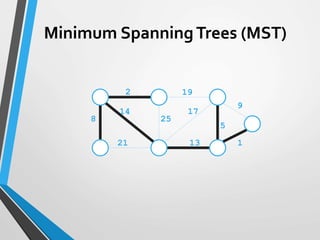
• A minimum spanning tree (MST) or minimum weight
spanning tree is a spanning tree of a connected, undirected
graph.
• It connects all the vertices together with the minimal total
weighting for its edges.
• MST is a tree ,because it is acyclic
• Any undirected graph has a minimum spanning forest, which
is a union of minimum spanning trees for its connected
components.
• If a graph has N vertices then the spanning tree will have N-1
edges
Minimum SpanningTrees (MST)
2 19
9
1
5
13
17
25
14
8
21
Prims Algorithm
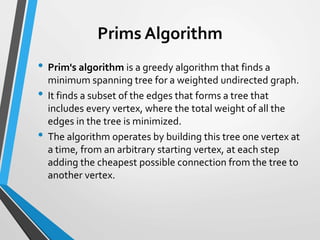
• Prim's algorithm is a greedy algorithm that finds a
minimum spanning tree for a weighted undirected graph.
• It finds a subset of the edges that forms a tree that
includes every vertex, where the total weight of all the
edges in the tree is minimized.
• The algorithm operates by building this tree one vertex at
a time, from an arbitrary starting vertex, at each step
adding the cheapest possible connection from the tree to
another vertex.
Prims Algorithm
Procedure:
• Initialize the min priority queue Q to contain all the
vertices.
• Set the key of each vertex to ∞ and root’s key is set to
zero
• Set the parent of root to NIL
• If weight of vertex is less than key value of the vertex,
connect the graph.
• Repeat the process till all vertex are used.
MST-Prim(G, w, r)
Q = V[G];
for each u  Q
key[u] = ;
key[r] = 0;
p[r] = NULL;
while (Q not empty)
u = ExtractMin(Q);
for each v  Adj[u]
if (v  Q and w(u,v) < key[v])
p[v] = u;
key[v] = w(u,v);
Initialize the min priority queue Q to contain
all the vertices.
Set the key of each vertex to ∞
Set the parent of root to NIL
Root’s key is set to 0
Until queue become null set
Input– Graph, Weight, Root
Set the parent of ‘v’ as ‘u’
Set the key of v = weight of edge
connecting uv
Prims Algorithm
MST-Prim(G, w, r)
Q = V[G];
for each u  Q
key[u] = ;
key[r] = 0;
p[r] = NULL;
while (Q not empty)
u = ExtractMin(Q);
for each v  Adj[u]
if (v  Q and w(u,v) < key[v])
p[v] = u;
key[v] = w(u,v);
14
10
3
6 4
5
2
9
15
8
Run on example graph
Prims Algorithm
  
  


14
10
3
6 4
5
2
9
15
8
Run on example graph
MST-Prim(G, w, r)
Q = V[G];
for each u  Q
key[u] = ;
key[r] = 0;
p[r] = NULL;
while (Q not empty)
u = ExtractMin(Q);
for each v  Adj[u]
if (v  Q and w(u,v) < key[v])
p[v] = u;
key[v] = w(u,v);
Prims Algorithm
  
0  


14
10
3
6 4
5
2
9
15
8
Pick a start vertex r
r
MST-Prim(G, w, r)
Q = V[G];
for each u  Q
key[u] = ;
key[r] = 0;
p[r] = NULL;
while (Q not empty)
u = ExtractMin(Q);
for each v  Adj[u]
if (v  Q and w(u,v) < key[v])
p[v] = u;
key[v] = w(u,v);
Prims Algorithm
  
0  


14
10
3
6 4
5
2
9
15
8
Black vertices have been removed from Q
u
Prims Algorithm
MST-Prim(G, w, r)
Q = V[G];
for each u  Q
key[u] = ;
key[r] = 0;
p[r] = NULL;
while (Q not empty)
u = ExtractMin(Q);
for each v  Adj[u]
if (v  Q and w(u,v) < key[v])
p[v] = u;
key[v] = w(u,v);
  
0  
3

14
10
3
6 4
5
2
9
15
8
Black arrows indicate parent pointers
u
Prims Algorithm
MST-Prim(G, w, r)
Q = V[G];
for each u  Q
key[u] = ;
key[r] = 0;
p[r] = NULL;
while (Q not empty)
u = ExtractMin(Q);
for each v  Adj[u]
if (v  Q and w(u,v) < key[v])
p[v] = u;
key[v] = w(u,v);
14  
0  
3

14
10
3
6 4
5
2
9
15
8
u
Prims Algorithm
MST-Prim(G, w, r)
Q = V[G];
for each u  Q
key[u] = ;
key[r] = 0;
p[r] = NULL;
while (Q not empty)
u = ExtractMin(Q);
for each v  Adj[u]
if (v  Q and w(u,v) < key[v])
p[v] = u;
key[v] = w(u,v);
14  
0  
3

14
10
3
6 4
5
2
9
15
8
u
MST-Prim(G, w, r)
Q = V[G];
for each u  Q
key[u] = ;
key[r] = 0;
p[r] = NULL;
while (Q not empty)
u = ExtractMin(Q);
for each v  Adj[u]
if (v  Q and w(u,v) < key[v])
p[v] = u;
key[v] = w(u,v);
Prims Algorithm
14  
0 8 
3

14
10
3
6 4
5
2
9
15
8
u
MST-Prim(G, w, r)
Q = V[G];
for each u  Q
key[u] = ;
key[r] = 0;
p[r] = NULL;
while (Q not empty)
u = ExtractMin(Q);
for each v  Adj[u]
if (v  Q and w(u,v) < key[v])
p[v] = u;
key[v] = w(u,v);
Prims Algorithm
10  
0 8 
3

14
10
3
6 4
5
2
9
15
8
u
MST-Prim(G, w, r)
Q = V[G];
for each u  Q
key[u] = ;
key[r] = 0;
p[r] = NULL;
while (Q not empty)
u = ExtractMin(Q);
for each v  Adj[u]
if (v  Q and w(u,v) < key[v])
p[v] = u;
key[v] = w(u,v);
Prims Algorithm
10  
0 8 
3

14
10
3
6 4
5
2
9
15
8
u
MST-Prim(G, w, r)
Q = V[G];
for each u  Q
key[u] = ;
key[r] = 0;
p[r] = NULL;
while (Q not empty)
u = ExtractMin(Q);
for each v  Adj[u]
if (v  Q and w(u,v) < key[v])
p[v] = u;
key[v] = w(u,v);
Prims Algorithm
10 2 
0 8 
3

14
10
3
6 4
5
2
9
15
8
u
MST-Prim(G, w, r)
Q = V[G];
for each u  Q
key[u] = ;
key[r] = 0;
p[r] = NULL;
while (Q not empty)
u = ExtractMin(Q);
for each v  Adj[u]
if (v  Q and w(u,v) < key[v])
p[v] = u;
key[v] = w(u,v);
Prims Algorithm
10 2 
0 8 15
3

14
10
3
6 4
5
2
9
15
8
u
MST-Prim(G, w, r)
Q = V[G];
for each u  Q
key[u] = ;
key[r] = 0;
p[r] = NULL;
while (Q not empty)
u = ExtractMin(Q);
for each v  Adj[u]
if (v  Q and w(u,v) < key[v])
p[v] = u;
key[v] = w(u,v);
Prims Algorithm
10 2 
0 8 15
3

14
10
3
6 4
5
2
9
15
8
u
MST-Prim(G, w, r)
Q = V[G];
for each u  Q
key[u] = ;
key[r] = 0;
p[r] = NULL;
while (Q not empty)
u = ExtractMin(Q);
for each v  Adj[u]
if (v  Q and w(u,v) < key[v])
p[v] = u;
key[v] = w(u,v);
Prims Algorithm
10 2 9
0 8 15
3

14
10
3
6 4
5
2
9
15
8
u
MST-Prim(G, w, r)
Q = V[G];
for each u  Q
key[u] = ;
key[r] = 0;
p[r] = NULL;
while (Q not empty)
u = ExtractMin(Q);
for each v  Adj[u]
if (v  Q and w(u,v) < key[v])
p[v] = u;
key[v] = w(u,v);
Prims Algorithm
10 2 9
0 8 15
3
4
14
10
3
6 4
5
2
9
15
8
u
MST-Prim(G, w, r)
Q = V[G];
for each u  Q
key[u] = ;
key[r] = 0;
p[r] = NULL;
while (Q not empty)
u = ExtractMin(Q);
for each v  Adj[u]
if (v  Q and w(u,v) < key[v])
p[v] = u;
key[v] = w(u,v);
Prims Algorithm
5 2 9
0 8 15
3
4
14
10
3
6 4
5
2
9
15
8
u
MST-Prim(G, w, r)
Q = V[G];
for each u  Q
key[u] = ;
key[r] = 0;
p[r] = NULL;
while (Q not empty)
u = ExtractMin(Q);
for each v  Adj[u]
if (v  Q and w(u,v) < key[v])
p[v] = u;
key[v] = w(u,v);
Prims Algorithm
5 2 9
0 8 15
3
4
14
10
3
6 4
5
2
9
15
8
u
MST-Prim(G, w, r)
Q = V[G];
for each u  Q
key[u] = ;
key[r] = 0;
p[r] = NULL;
while (Q not empty)
u = ExtractMin(Q);
for each v  Adj[u]
if (v  Q and w(u,v) < key[v])
p[v] = u;
key[v] = w(u,v);
Prims Algorithm
5 2 9
0 8 15
3
4
14
10
3
6 4
5
2
9
15
8
u
MST-Prim(G, w, r)
Q = V[G];
for each u  Q
key[u] = ;
key[r] = 0;
p[r] = NULL;
while (Q not empty)
u = ExtractMin(Q);
for each v  Adj[u]
if (v  Q and w(u,v) < key[v])
p[v] = u;
key[v] = w(u,v);
Prims Algorithm
5 2 9
0 8 15
3
4
14
10
3
6 4
5
2
9
15
8
u
MST-Prim(G, w, r)
Q = V[G];
for each u  Q
key[u] = ;
key[r] = 0;
p[r] = NULL;
while (Q not empty)
u = ExtractMin(Q);
for each v  Adj[u]
if (v  Q and w(u,v) < key[v])
p[v] = u;
key[v] = w(u,v);
Prims Algorithm
5 2 9
0 8 15
3
4
14
10
3
6 4
5
2
9
15
8
u
MST-Prim(G, w, r)
Q = V[G];
for each u  Q
key[u] = ;
key[r] = 0;
p[r] = NULL;
while (Q not empty)
u = ExtractMin(Q);
for each v  Adj[u]
if (v  Q and w(u,v) < key[v])
p[v] = u;
key[v] = w(u,v);
Prims Algorithm
MST-Prim(G, w, r)
Q = V[G];
for each u  Q
key[u] = ;
key[r] = 0;
p[r] = NULL;
while (Q not empty)
u = ExtractMin(Q);
for each v  Adj[u]
if (v  Q and w(u,v) < key[v])
p[v] = u;
key[v] = w(u,v);
5 2 9
0 8 15
3
4
3
4
5
2
9
15
8
Prims Algorithm
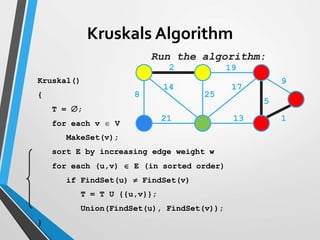
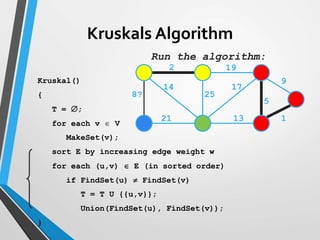
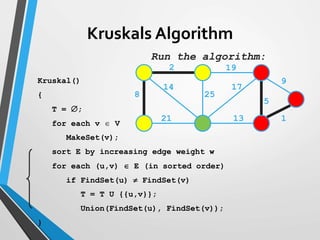
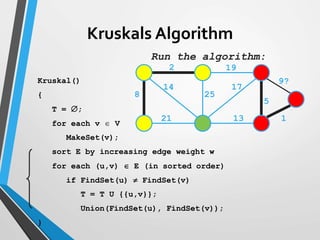
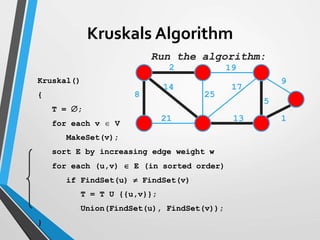
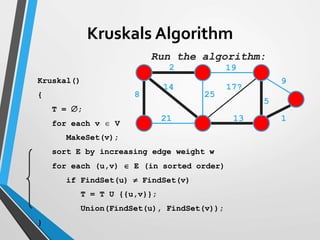
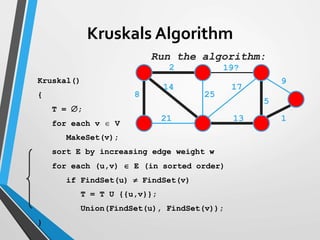
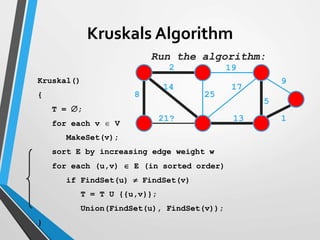
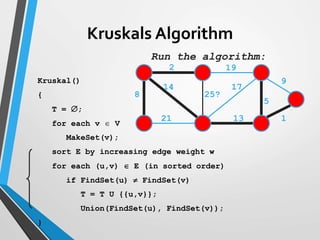
Kruskals Algorithm
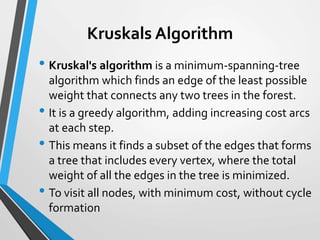
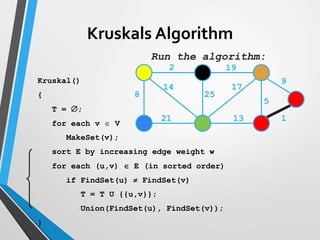
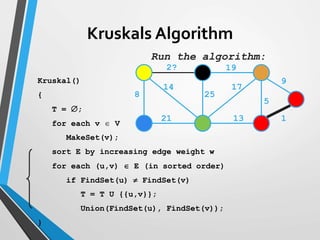
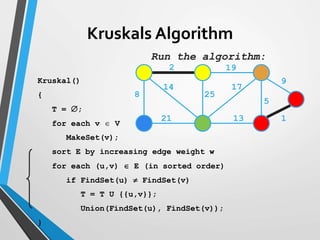
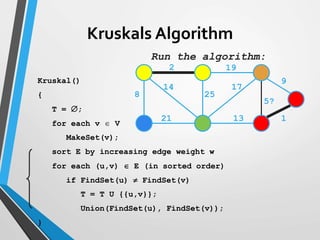
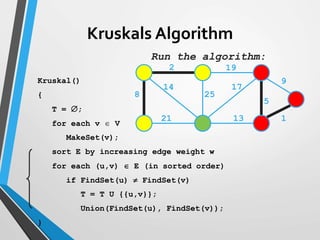
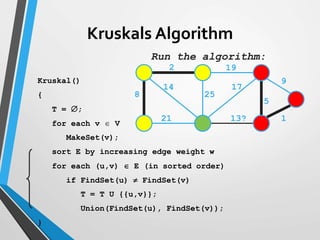
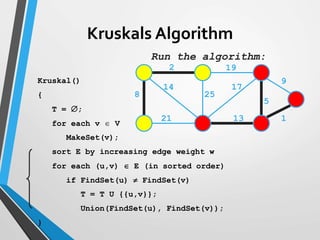
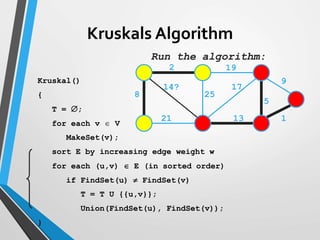
• Kruskal's algorithm is a minimum-spanning-tree
algorithm which finds an edge of the least possible
weight that connects any two trees in the forest.
• It is a greedy algorithm, adding increasing cost arcs
at each step.
• This means it finds a subset of the edges that forms
a tree that includes every vertex, where the total
weight of all the edges in the tree is minimized.
• To visit all nodes, with minimum cost, without cycle
formation
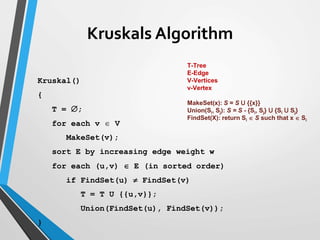
Kruskal()
{
T = ;
for each v  V
MakeSet(v);
sort E by increasing edge weight w
for each (u,v)  E (in sorted order)
if FindSet(u)  FindSet(v)
T = T U {{u,v}};
Union(FindSet(u), FindSet(v));
}
Kruskals Algorithm
T-Tree
E-Edge
V-Vertices
v-Vertex
MakeSet(x): S = S U {{x}}
Union(Si, Sj): S = S - {Si, Sj} U {Si U Sj}
FindSet(X): return Si  S such that x  Si
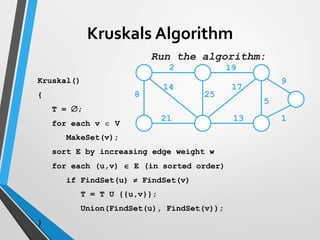
2 19
9
1
5
13
17
25
14
8
21
Run the algorithm:
Kruskal()
{
T = ;
for each v  V
MakeSet(v);
sort E by increasing edge weight w
for each (u,v)  E (in sorted order)
if FindSet(u)  FindSet(v)
T = T U {{u,v}};
Union(FindSet(u), FindSet(v));
}
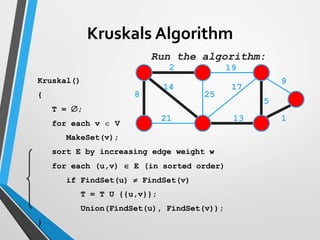
Kruskals Algorithm
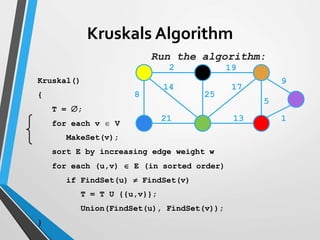
2 19
9
1
5
13
17
25
14
8
21
Run the algorithm:
Kruskal()
{
T = ;
for each v  V
MakeSet(v);
sort E by increasing edge weight w
for each (u,v)  E (in sorted order)
if FindSet(u)  FindSet(v)
T = T U {{u,v}};
Union(FindSet(u), FindSet(v));
}
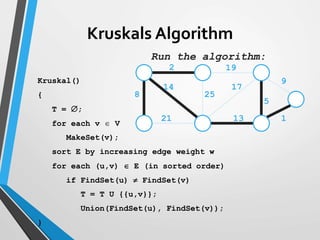
Kruskals Algorithm
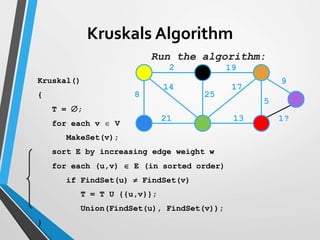
2 19
9
1?
5
13
17
25
14
8
21
Run the algorithm:
Kruskal()
{
T = ;
for each v  V
MakeSet(v);
sort E by increasing edge weight w
for each (u,v)  E (in sorted order)
if FindSet(u)  FindSet(v)
T = T U {{u,v}};
Union(FindSet(u), FindSet(v));
}
Kruskals Algorithm
2 19
9
1
5
13
17
25
14
8
21
Run the algorithm:
Kruskal()
{
T = ;
for each v  V
MakeSet(v);
sort E by increasing edge weight w
for each (u,v)  E (in sorted order)
if FindSet(u)  FindSet(v)
T = T U {{u,v}};
Union(FindSet(u), FindSet(v));
}
Kruskals Algorithm
2? 19
9
1
5
13
17
25
14
8
21
Run the algorithm:
Kruskal()
{
T = ;
for each v  V
MakeSet(v);
sort E by increasing edge weight w
for each (u,v)  E (in sorted order)
if FindSet(u)  FindSet(v)
T = T U {{u,v}};
Union(FindSet(u), FindSet(v));
}
Kruskals Algorithm
2 19
9
1
5
13
17
25
14
8
21
Run the algorithm:
Kruskal()
{
T = ;
for each v  V
MakeSet(v);
sort E by increasing edge weight w
for each (u,v)  E (in sorted order)
if FindSet(u)  FindSet(v)
T = T U {{u,v}};
Union(FindSet(u), FindSet(v));
}
Kruskals Algorithm
2 19
9
1
5?
13
17
25
14
8
21
Run the algorithm:
Kruskal()
{
T = ;
for each v  V
MakeSet(v);
sort E by increasing edge weight w
for each (u,v)  E (in sorted order)
if FindSet(u)  FindSet(v)
T = T U {{u,v}};
Union(FindSet(u), FindSet(v));
}
Kruskals Algorithm
2 19
9
1
5
13
17
25
14
8
21
Run the algorithm:
Kruskal()
{
T = ;
for each v  V
MakeSet(v);
sort E by increasing edge weight w
for each (u,v)  E (in sorted order)
if FindSet(u)  FindSet(v)
T = T U {{u,v}};
Union(FindSet(u), FindSet(v));
}
Kruskals Algorithm
2 19
9
1
5
13
17
25
14
8?
21
Run the algorithm:
Kruskal()
{
T = ;
for each v  V
MakeSet(v);
sort E by increasing edge weight w
for each (u,v)  E (in sorted order)
if FindSet(u)  FindSet(v)
T = T U {{u,v}};
Union(FindSet(u), FindSet(v));
}
Kruskals Algorithm
2 19
9
1
5
13
17
25
14
8
21
Run the algorithm:
Kruskal()
{
T = ;
for each v  V
MakeSet(v);
sort E by increasing edge weight w
for each (u,v)  E (in sorted order)
if FindSet(u)  FindSet(v)
T = T U {{u,v}};
Union(FindSet(u), FindSet(v));
}
Kruskals Algorithm
2 19
9?
1
5
13
17
25
14
8
21
Run the algorithm:
Kruskal()
{
T = ;
for each v  V
MakeSet(v);
sort E by increasing edge weight w
for each (u,v)  E (in sorted order)
if FindSet(u)  FindSet(v)
T = T U {{u,v}};
Union(FindSet(u), FindSet(v));
}
Kruskals Algorithm
2 19
9
1
5
13
17
25
14
8
21
Run the algorithm:
Kruskal()
{
T = ;
for each v  V
MakeSet(v);
sort E by increasing edge weight w
for each (u,v)  E (in sorted order)
if FindSet(u)  FindSet(v)
T = T U {{u,v}};
Union(FindSet(u), FindSet(v));
}
Kruskals Algorithm
2 19
9
1
5
13?
17
25
14
8
21
Run the algorithm:
Kruskal()
{
T = ;
for each v  V
MakeSet(v);
sort E by increasing edge weight w
for each (u,v)  E (in sorted order)
if FindSet(u)  FindSet(v)
T = T U {{u,v}};
Union(FindSet(u), FindSet(v));
}
Kruskals Algorithm
Kruskal()
{
T = ;
for each v  V
MakeSet(v);
sort E by increasing edge weight w
for each (u,v)  E (in sorted order)
if FindSet(u)  FindSet(v)
T = T U {{u,v}};
Union(FindSet(u), FindSet(v));
}
2 19
9
1
5
13
17
25
14
8
21
Run the algorithm:
Kruskals Algorithm
Kruskal()
{
T = ;
for each v  V
MakeSet(v);
sort E by increasing edge weight w
for each (u,v)  E (in sorted order)
if FindSet(u)  FindSet(v)
T = T U {{u,v}};
Union(FindSet(u), FindSet(v));
}
2 19
9
1
5
13
17
25
14?
8
21
Run the algorithm:
Kruskals Algorithm
Kruskal()
{
T = ;
for each v  V
MakeSet(v);
sort E by increasing edge weight w
for each (u,v)  E (in sorted order)
if FindSet(u)  FindSet(v)
T = T U {{u,v}};
Union(FindSet(u), FindSet(v));
}
2 19
9
1
5
13
17
25
14
8
21
Run the algorithm:
Kruskals Algorithm
Kruskal()
{
T = ;
for each v  V
MakeSet(v);
sort E by increasing edge weight w
for each (u,v)  E (in sorted order)
if FindSet(u)  FindSet(v)
T = T U {{u,v}};
Union(FindSet(u), FindSet(v));
}
2 19
9
1
5
13
17?
25
14
8
21
Run the algorithm:
Kruskals Algorithm
Kruskal()
{
T = ;
for each v  V
MakeSet(v);
sort E by increasing edge weight w
for each (u,v)  E (in sorted order)
if FindSet(u)  FindSet(v)
T = T U {{u,v}};
Union(FindSet(u), FindSet(v));
}
2 19?
9
1
5
13
17
25
14
8
21
Run the algorithm:
Kruskals Algorithm
Kruskal()
{
T = ;
for each v  V
MakeSet(v);
sort E by increasing edge weight w
for each (u,v)  E (in sorted order)
if FindSet(u)  FindSet(v)
T = T U {{u,v}};
Union(FindSet(u), FindSet(v));
}
2 19
9
1
5
13
17
25
14
8
21?
Run the algorithm:
Kruskals Algorithm
Kruskal()
{
T = ;
for each v  V
MakeSet(v);
sort E by increasing edge weight w
for each (u,v)  E (in sorted order)
if FindSet(u)  FindSet(v)
T = T U {{u,v}};
Union(FindSet(u), FindSet(v));
}
2 19
9
1
5
13
17
25?
14
8
21
Run the algorithm:
Kruskals Algorithm
Kruskal()
{
T = ;
for each v  V
MakeSet(v);
sort E by increasing edge weight w
for each (u,v)  E (in sorted order)
if FindSet(u)  FindSet(v)
T = T U {{u,v}};
Union(FindSet(u), FindSet(v));
}
2 19
9
1
5
13
17
25
14
8
21
Run the algorithm:
Kruskals Algorithm
Kruskal()
{
T = ;
for each v  V
MakeSet(v);
sort E by increasing edge weight w
for each (u,v)  E (in sorted order)
if FindSet(u)  FindSet(v)
T = T U {{u,v}};
Union(FindSet(u), FindSet(v));
}
2 19
9
1
5
13
17
25
14
8
21
Run the algorithm:
Kruskals Algorithm
ThankYou

Prims and kruskal algorithms

  • 1.
  • 2.
    Minimum SpanningTrees (MST) •A minimum spanning tree (MST) or minimum weight spanning tree is a spanning tree of a connected, undirected graph. • It connects all the vertices together with the minimal total weighting for its edges. • MST is a tree ,because it is acyclic • Any undirected graph has a minimum spanning forest, which is a union of minimum spanning trees for its connected components. • If a graph has N vertices then the spanning tree will have N-1 edges Minimum SpanningTrees (MST)
  • 3.
    Minimum SpanningTrees (MST) 219 9 1 5 13 17 25 14 8 21
  • 4.
    Prims Algorithm • Prim'salgorithm is a greedy algorithm that finds a minimum spanning tree for a weighted undirected graph. • It finds a subset of the edges that forms a tree that includes every vertex, where the total weight of all the edges in the tree is minimized. • The algorithm operates by building this tree one vertex at a time, from an arbitrary starting vertex, at each step adding the cheapest possible connection from the tree to another vertex.
  • 5.
    Prims Algorithm Procedure: • Initializethe min priority queue Q to contain all the vertices. • Set the key of each vertex to ∞ and root’s key is set to zero • Set the parent of root to NIL • If weight of vertex is less than key value of the vertex, connect the graph. • Repeat the process till all vertex are used.
  • 6.
    MST-Prim(G, w, r) Q= V[G]; for each u  Q key[u] = ; key[r] = 0; p[r] = NULL; while (Q not empty) u = ExtractMin(Q); for each v  Adj[u] if (v  Q and w(u,v) < key[v]) p[v] = u; key[v] = w(u,v); Initialize the min priority queue Q to contain all the vertices. Set the key of each vertex to ∞ Set the parent of root to NIL Root’s key is set to 0 Until queue become null set Input– Graph, Weight, Root Set the parent of ‘v’ as ‘u’ Set the key of v = weight of edge connecting uv Prims Algorithm
  • 7.
    MST-Prim(G, w, r) Q= V[G]; for each u  Q key[u] = ; key[r] = 0; p[r] = NULL; while (Q not empty) u = ExtractMin(Q); for each v  Adj[u] if (v  Q and w(u,v) < key[v]) p[v] = u; key[v] = w(u,v); 14 10 3 6 4 5 2 9 15 8 Run on example graph Prims Algorithm
  • 8.
           14 10 3 6 4 5 2 9 15 8 Run on example graph MST-Prim(G, w, r) Q = V[G]; for each u  Q key[u] = ; key[r] = 0; p[r] = NULL; while (Q not empty) u = ExtractMin(Q); for each v  Adj[u] if (v  Q and w(u,v) < key[v]) p[v] = u; key[v] = w(u,v); Prims Algorithm
  • 9.
       0    14 10 3 6 4 5 2 9 15 8 Pick a start vertex r r MST-Prim(G, w, r) Q = V[G]; for each u  Q key[u] = ; key[r] = 0; p[r] = NULL; while (Q not empty) u = ExtractMin(Q); for each v  Adj[u] if (v  Q and w(u,v) < key[v]) p[v] = u; key[v] = w(u,v); Prims Algorithm
  • 10.
       0    14 10 3 6 4 5 2 9 15 8 Black vertices have been removed from Q u Prims Algorithm MST-Prim(G, w, r) Q = V[G]; for each u  Q key[u] = ; key[r] = 0; p[r] = NULL; while (Q not empty) u = ExtractMin(Q); for each v  Adj[u] if (v  Q and w(u,v) < key[v]) p[v] = u; key[v] = w(u,v);
  • 11.
       0  3  14 10 3 6 4 5 2 9 15 8 Black arrows indicate parent pointers u Prims Algorithm MST-Prim(G, w, r) Q = V[G]; for each u  Q key[u] = ; key[r] = 0; p[r] = NULL; while (Q not empty) u = ExtractMin(Q); for each v  Adj[u] if (v  Q and w(u,v) < key[v]) p[v] = u; key[v] = w(u,v);
  • 12.
    14   0  3  14 10 3 6 4 5 2 9 15 8 u Prims Algorithm MST-Prim(G, w, r) Q = V[G]; for each u  Q key[u] = ; key[r] = 0; p[r] = NULL; while (Q not empty) u = ExtractMin(Q); for each v  Adj[u] if (v  Q and w(u,v) < key[v]) p[v] = u; key[v] = w(u,v);
  • 13.
    14   0  3  14 10 3 6 4 5 2 9 15 8 u MST-Prim(G, w, r) Q = V[G]; for each u  Q key[u] = ; key[r] = 0; p[r] = NULL; while (Q not empty) u = ExtractMin(Q); for each v  Adj[u] if (v  Q and w(u,v) < key[v]) p[v] = u; key[v] = w(u,v); Prims Algorithm
  • 14.
    14   08  3  14 10 3 6 4 5 2 9 15 8 u MST-Prim(G, w, r) Q = V[G]; for each u  Q key[u] = ; key[r] = 0; p[r] = NULL; while (Q not empty) u = ExtractMin(Q); for each v  Adj[u] if (v  Q and w(u,v) < key[v]) p[v] = u; key[v] = w(u,v); Prims Algorithm
  • 15.
    10   08  3  14 10 3 6 4 5 2 9 15 8 u MST-Prim(G, w, r) Q = V[G]; for each u  Q key[u] = ; key[r] = 0; p[r] = NULL; while (Q not empty) u = ExtractMin(Q); for each v  Adj[u] if (v  Q and w(u,v) < key[v]) p[v] = u; key[v] = w(u,v); Prims Algorithm
  • 16.
    10   08  3  14 10 3 6 4 5 2 9 15 8 u MST-Prim(G, w, r) Q = V[G]; for each u  Q key[u] = ; key[r] = 0; p[r] = NULL; while (Q not empty) u = ExtractMin(Q); for each v  Adj[u] if (v  Q and w(u,v) < key[v]) p[v] = u; key[v] = w(u,v); Prims Algorithm
  • 17.
    10 2  08  3  14 10 3 6 4 5 2 9 15 8 u MST-Prim(G, w, r) Q = V[G]; for each u  Q key[u] = ; key[r] = 0; p[r] = NULL; while (Q not empty) u = ExtractMin(Q); for each v  Adj[u] if (v  Q and w(u,v) < key[v]) p[v] = u; key[v] = w(u,v); Prims Algorithm
  • 18.
    10 2  08 15 3  14 10 3 6 4 5 2 9 15 8 u MST-Prim(G, w, r) Q = V[G]; for each u  Q key[u] = ; key[r] = 0; p[r] = NULL; while (Q not empty) u = ExtractMin(Q); for each v  Adj[u] if (v  Q and w(u,v) < key[v]) p[v] = u; key[v] = w(u,v); Prims Algorithm
  • 19.
    10 2  08 15 3  14 10 3 6 4 5 2 9 15 8 u MST-Prim(G, w, r) Q = V[G]; for each u  Q key[u] = ; key[r] = 0; p[r] = NULL; while (Q not empty) u = ExtractMin(Q); for each v  Adj[u] if (v  Q and w(u,v) < key[v]) p[v] = u; key[v] = w(u,v); Prims Algorithm
  • 20.
    10 2 9 08 15 3  14 10 3 6 4 5 2 9 15 8 u MST-Prim(G, w, r) Q = V[G]; for each u  Q key[u] = ; key[r] = 0; p[r] = NULL; while (Q not empty) u = ExtractMin(Q); for each v  Adj[u] if (v  Q and w(u,v) < key[v]) p[v] = u; key[v] = w(u,v); Prims Algorithm
  • 21.
    10 2 9 08 15 3 4 14 10 3 6 4 5 2 9 15 8 u MST-Prim(G, w, r) Q = V[G]; for each u  Q key[u] = ; key[r] = 0; p[r] = NULL; while (Q not empty) u = ExtractMin(Q); for each v  Adj[u] if (v  Q and w(u,v) < key[v]) p[v] = u; key[v] = w(u,v); Prims Algorithm
  • 22.
    5 2 9 08 15 3 4 14 10 3 6 4 5 2 9 15 8 u MST-Prim(G, w, r) Q = V[G]; for each u  Q key[u] = ; key[r] = 0; p[r] = NULL; while (Q not empty) u = ExtractMin(Q); for each v  Adj[u] if (v  Q and w(u,v) < key[v]) p[v] = u; key[v] = w(u,v); Prims Algorithm
  • 23.
    5 2 9 08 15 3 4 14 10 3 6 4 5 2 9 15 8 u MST-Prim(G, w, r) Q = V[G]; for each u  Q key[u] = ; key[r] = 0; p[r] = NULL; while (Q not empty) u = ExtractMin(Q); for each v  Adj[u] if (v  Q and w(u,v) < key[v]) p[v] = u; key[v] = w(u,v); Prims Algorithm
  • 24.
    5 2 9 08 15 3 4 14 10 3 6 4 5 2 9 15 8 u MST-Prim(G, w, r) Q = V[G]; for each u  Q key[u] = ; key[r] = 0; p[r] = NULL; while (Q not empty) u = ExtractMin(Q); for each v  Adj[u] if (v  Q and w(u,v) < key[v]) p[v] = u; key[v] = w(u,v); Prims Algorithm
  • 25.
    5 2 9 08 15 3 4 14 10 3 6 4 5 2 9 15 8 u MST-Prim(G, w, r) Q = V[G]; for each u  Q key[u] = ; key[r] = 0; p[r] = NULL; while (Q not empty) u = ExtractMin(Q); for each v  Adj[u] if (v  Q and w(u,v) < key[v]) p[v] = u; key[v] = w(u,v); Prims Algorithm
  • 26.
    5 2 9 08 15 3 4 14 10 3 6 4 5 2 9 15 8 u MST-Prim(G, w, r) Q = V[G]; for each u  Q key[u] = ; key[r] = 0; p[r] = NULL; while (Q not empty) u = ExtractMin(Q); for each v  Adj[u] if (v  Q and w(u,v) < key[v]) p[v] = u; key[v] = w(u,v); Prims Algorithm
  • 27.
    MST-Prim(G, w, r) Q= V[G]; for each u  Q key[u] = ; key[r] = 0; p[r] = NULL; while (Q not empty) u = ExtractMin(Q); for each v  Adj[u] if (v  Q and w(u,v) < key[v]) p[v] = u; key[v] = w(u,v); 5 2 9 0 8 15 3 4 3 4 5 2 9 15 8 Prims Algorithm
  • 28.
    Kruskals Algorithm • Kruskal'salgorithm is a minimum-spanning-tree algorithm which finds an edge of the least possible weight that connects any two trees in the forest. • It is a greedy algorithm, adding increasing cost arcs at each step. • This means it finds a subset of the edges that forms a tree that includes every vertex, where the total weight of all the edges in the tree is minimized. • To visit all nodes, with minimum cost, without cycle formation
  • 29.
    Kruskal() { T = ; foreach v  V MakeSet(v); sort E by increasing edge weight w for each (u,v)  E (in sorted order) if FindSet(u)  FindSet(v) T = T U {{u,v}}; Union(FindSet(u), FindSet(v)); } Kruskals Algorithm T-Tree E-Edge V-Vertices v-Vertex MakeSet(x): S = S U {{x}} Union(Si, Sj): S = S - {Si, Sj} U {Si U Sj} FindSet(X): return Si  S such that x  Si
  • 30.
    2 19 9 1 5 13 17 25 14 8 21 Run thealgorithm: Kruskal() { T = ; for each v  V MakeSet(v); sort E by increasing edge weight w for each (u,v)  E (in sorted order) if FindSet(u)  FindSet(v) T = T U {{u,v}}; Union(FindSet(u), FindSet(v)); } Kruskals Algorithm
  • 31.
    2 19 9 1 5 13 17 25 14 8 21 Run thealgorithm: Kruskal() { T = ; for each v  V MakeSet(v); sort E by increasing edge weight w for each (u,v)  E (in sorted order) if FindSet(u)  FindSet(v) T = T U {{u,v}}; Union(FindSet(u), FindSet(v)); } Kruskals Algorithm
  • 32.
    2 19 9 1? 5 13 17 25 14 8 21 Run thealgorithm: Kruskal() { T = ; for each v  V MakeSet(v); sort E by increasing edge weight w for each (u,v)  E (in sorted order) if FindSet(u)  FindSet(v) T = T U {{u,v}}; Union(FindSet(u), FindSet(v)); } Kruskals Algorithm
  • 33.
    2 19 9 1 5 13 17 25 14 8 21 Run thealgorithm: Kruskal() { T = ; for each v  V MakeSet(v); sort E by increasing edge weight w for each (u,v)  E (in sorted order) if FindSet(u)  FindSet(v) T = T U {{u,v}}; Union(FindSet(u), FindSet(v)); } Kruskals Algorithm
  • 34.
    2? 19 9 1 5 13 17 25 14 8 21 Run thealgorithm: Kruskal() { T = ; for each v  V MakeSet(v); sort E by increasing edge weight w for each (u,v)  E (in sorted order) if FindSet(u)  FindSet(v) T = T U {{u,v}}; Union(FindSet(u), FindSet(v)); } Kruskals Algorithm
  • 35.
    2 19 9 1 5 13 17 25 14 8 21 Run thealgorithm: Kruskal() { T = ; for each v  V MakeSet(v); sort E by increasing edge weight w for each (u,v)  E (in sorted order) if FindSet(u)  FindSet(v) T = T U {{u,v}}; Union(FindSet(u), FindSet(v)); } Kruskals Algorithm
  • 36.
    2 19 9 1 5? 13 17 25 14 8 21 Run thealgorithm: Kruskal() { T = ; for each v  V MakeSet(v); sort E by increasing edge weight w for each (u,v)  E (in sorted order) if FindSet(u)  FindSet(v) T = T U {{u,v}}; Union(FindSet(u), FindSet(v)); } Kruskals Algorithm
  • 37.
    2 19 9 1 5 13 17 25 14 8 21 Run thealgorithm: Kruskal() { T = ; for each v  V MakeSet(v); sort E by increasing edge weight w for each (u,v)  E (in sorted order) if FindSet(u)  FindSet(v) T = T U {{u,v}}; Union(FindSet(u), FindSet(v)); } Kruskals Algorithm
  • 38.
    2 19 9 1 5 13 17 25 14 8? 21 Run thealgorithm: Kruskal() { T = ; for each v  V MakeSet(v); sort E by increasing edge weight w for each (u,v)  E (in sorted order) if FindSet(u)  FindSet(v) T = T U {{u,v}}; Union(FindSet(u), FindSet(v)); } Kruskals Algorithm
  • 39.
    2 19 9 1 5 13 17 25 14 8 21 Run thealgorithm: Kruskal() { T = ; for each v  V MakeSet(v); sort E by increasing edge weight w for each (u,v)  E (in sorted order) if FindSet(u)  FindSet(v) T = T U {{u,v}}; Union(FindSet(u), FindSet(v)); } Kruskals Algorithm
  • 40.
    2 19 9? 1 5 13 17 25 14 8 21 Run thealgorithm: Kruskal() { T = ; for each v  V MakeSet(v); sort E by increasing edge weight w for each (u,v)  E (in sorted order) if FindSet(u)  FindSet(v) T = T U {{u,v}}; Union(FindSet(u), FindSet(v)); } Kruskals Algorithm
  • 41.
    2 19 9 1 5 13 17 25 14 8 21 Run thealgorithm: Kruskal() { T = ; for each v  V MakeSet(v); sort E by increasing edge weight w for each (u,v)  E (in sorted order) if FindSet(u)  FindSet(v) T = T U {{u,v}}; Union(FindSet(u), FindSet(v)); } Kruskals Algorithm
  • 42.
    2 19 9 1 5 13? 17 25 14 8 21 Run thealgorithm: Kruskal() { T = ; for each v  V MakeSet(v); sort E by increasing edge weight w for each (u,v)  E (in sorted order) if FindSet(u)  FindSet(v) T = T U {{u,v}}; Union(FindSet(u), FindSet(v)); } Kruskals Algorithm
  • 43.
    Kruskal() { T = ; foreach v  V MakeSet(v); sort E by increasing edge weight w for each (u,v)  E (in sorted order) if FindSet(u)  FindSet(v) T = T U {{u,v}}; Union(FindSet(u), FindSet(v)); } 2 19 9 1 5 13 17 25 14 8 21 Run the algorithm: Kruskals Algorithm
  • 44.
    Kruskal() { T = ; foreach v  V MakeSet(v); sort E by increasing edge weight w for each (u,v)  E (in sorted order) if FindSet(u)  FindSet(v) T = T U {{u,v}}; Union(FindSet(u), FindSet(v)); } 2 19 9 1 5 13 17 25 14? 8 21 Run the algorithm: Kruskals Algorithm
  • 45.
    Kruskal() { T = ; foreach v  V MakeSet(v); sort E by increasing edge weight w for each (u,v)  E (in sorted order) if FindSet(u)  FindSet(v) T = T U {{u,v}}; Union(FindSet(u), FindSet(v)); } 2 19 9 1 5 13 17 25 14 8 21 Run the algorithm: Kruskals Algorithm
  • 46.
    Kruskal() { T = ; foreach v  V MakeSet(v); sort E by increasing edge weight w for each (u,v)  E (in sorted order) if FindSet(u)  FindSet(v) T = T U {{u,v}}; Union(FindSet(u), FindSet(v)); } 2 19 9 1 5 13 17? 25 14 8 21 Run the algorithm: Kruskals Algorithm
  • 47.
    Kruskal() { T = ; foreach v  V MakeSet(v); sort E by increasing edge weight w for each (u,v)  E (in sorted order) if FindSet(u)  FindSet(v) T = T U {{u,v}}; Union(FindSet(u), FindSet(v)); } 2 19? 9 1 5 13 17 25 14 8 21 Run the algorithm: Kruskals Algorithm
  • 48.
    Kruskal() { T = ; foreach v  V MakeSet(v); sort E by increasing edge weight w for each (u,v)  E (in sorted order) if FindSet(u)  FindSet(v) T = T U {{u,v}}; Union(FindSet(u), FindSet(v)); } 2 19 9 1 5 13 17 25 14 8 21? Run the algorithm: Kruskals Algorithm
  • 49.
    Kruskal() { T = ; foreach v  V MakeSet(v); sort E by increasing edge weight w for each (u,v)  E (in sorted order) if FindSet(u)  FindSet(v) T = T U {{u,v}}; Union(FindSet(u), FindSet(v)); } 2 19 9 1 5 13 17 25? 14 8 21 Run the algorithm: Kruskals Algorithm
  • 50.
    Kruskal() { T = ; foreach v  V MakeSet(v); sort E by increasing edge weight w for each (u,v)  E (in sorted order) if FindSet(u)  FindSet(v) T = T U {{u,v}}; Union(FindSet(u), FindSet(v)); } 2 19 9 1 5 13 17 25 14 8 21 Run the algorithm: Kruskals Algorithm
  • 51.
    Kruskal() { T = ; foreach v  V MakeSet(v); sort E by increasing edge weight w for each (u,v)  E (in sorted order) if FindSet(u)  FindSet(v) T = T U {{u,v}}; Union(FindSet(u), FindSet(v)); } 2 19 9 1 5 13 17 25 14 8 21 Run the algorithm: Kruskals Algorithm
  • 52.