The document discusses the Bellman-Ford algorithm, which computes shortest paths from a single source vertex to all other vertices in a weighted graph. It can handle graphs with negative edge weights, and can detect negative cycles. The algorithm maintains distance estimates from the source for each vertex, updating the estimates by relaxing edges until it converges or detects a negative cycle. Examples are provided to illustrate running the algorithm on graphs and finding shortest paths.
The algorithmis named after two of its developers, Richard
Bellman and Lester Ford, Jr., who published it in 1958 and 1956,
respectively; however, Edward F. Moore also published the same
algorithm in 1957, and for this reason it is also sometimes called
the Bellman–Ford–Moore algorithm.
The Bellman–Ford algorithm is an algorithm that computes
shortest paths from a single source vertex to all of the other
vertices in a weighted graph . It is slower than Dijkstra's
algorithm for the same problem, but more versatile, as it is
capable of handling graphs in which some of the edge weights
are negative numbers.
4.
Negative edgeweights are found in various applications of
graphs, hence the usefulness of this algorithm. If a graph contains
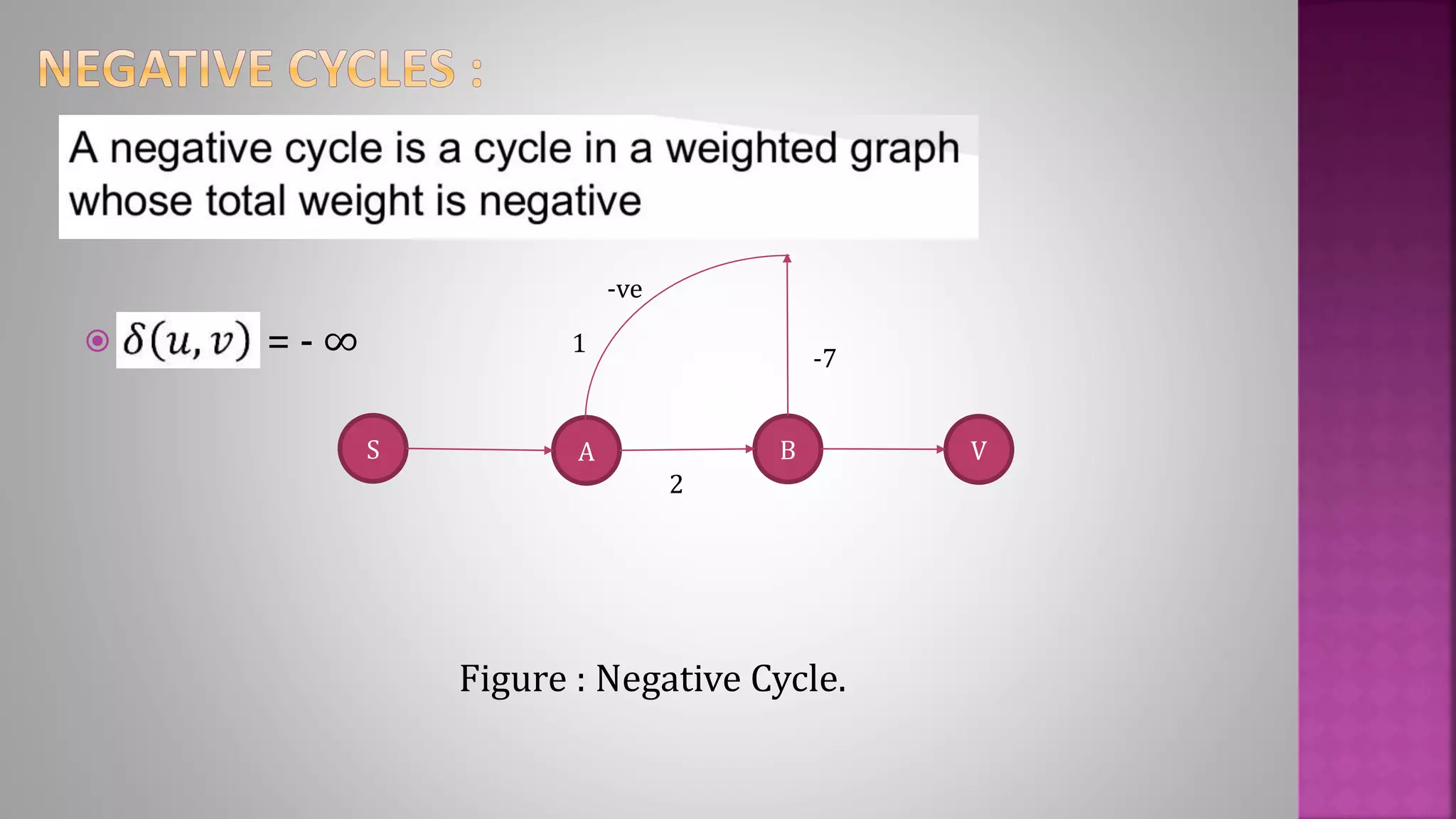
a "negative cycle" (i.e. a cycle whose edges sum to a negative
value) that is reachable from the source, then there is no
cheapest path: any path can be made cheaper by one more walk
around the negative cycle. In such a case, the Bellman–Ford
algorithm can detect negative cycles and report their existence.
5.
Shortest pathnetwork
Directed graph
Source s , Destination t
cost( v-u) cost of using edge from v to u
Shortest path problem
Find shortest directed path from s to t
Cost of path = sum of arc cost in path
6.
Networks (Routing).
Robot Navigation.
Urban Traffic Planning.
Telemarketer operator scheduling.
Routing of Communication messages.
Optimal truck routing through given traffic congestion
pattern.
OSPF routing protocol for IP.
7.
Given graph(directed or undirected) G = (V,E) with
weight function w : E R and a vertex s V,
find for all vertices v V the minimum possible weight for
path from s to v.
There are two algorithms:
1- Dijkstra’s Algorithm.
2- Bellman-Ford algorithm.
8.
Maintain d[v]for each v V
d[v] is called shortest-path weight estimate
INITIALIZE (G, s)
for each v V do
d[v] ← ∞
π[v] ← NIL
d[s] ← 0
9.
Dijkstra's Algorithmfails when there is negative edge
Solution is Bellman Ford Algorithm which can work on negative edges
s-x-y-v
10.
BELMAN-FORD( G, s)
INITIALIZE SINGLE-SOURCE ( G, s )
for i ←1 to |V|-1 do
for each edge (u, v) G.E do
RELAX( u, v )
for each edge ( u, v ) E do
if d[v] > d[u]+w(u,v) then
return FALSE
return TRUE
computaion
check
11.
RELAX(u ,v)
if d[v] > d[u]+w(u,v) then
d[v] = d[u]+w(u,v)
π[v] = [u]
5
2
2
9
5 7
Relax(u,v)
5
2
2
6
5 6
If has achieved the
condition
If not has achieved
the condition
12.
s a bt
0 0 ∞ ∞ ∞
1 0
2 0
3 0
s
a
b
t
5
-2
4
6
-9
∞
∞
∞
0
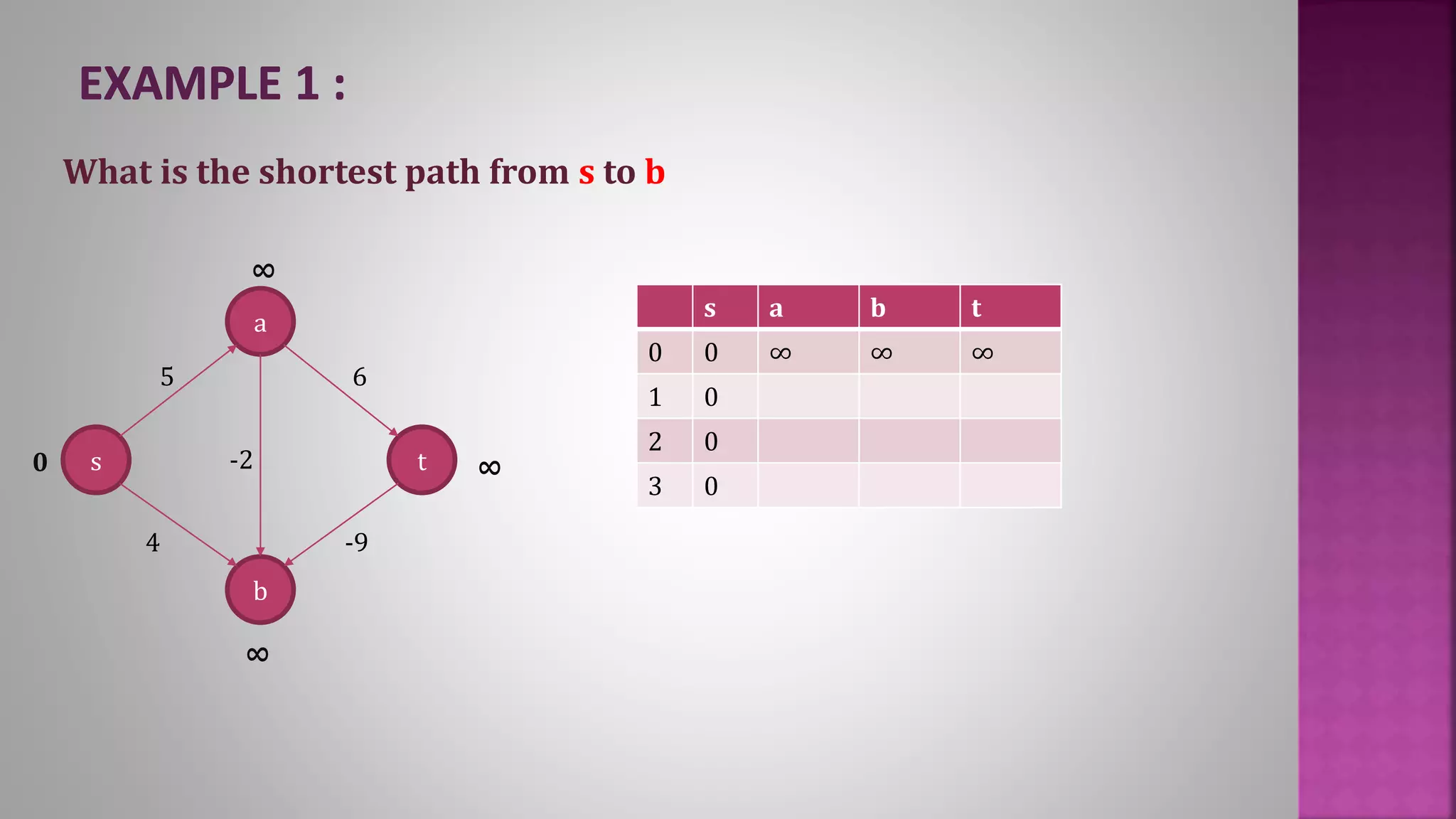
What is the shortest path from s to b
13.
s a bt
0 0 ∞ ∞ ∞
1 0 5 4 ∞
2 0
3 0
s
a
b
t
5
-2
4
6
-9
5
4
∞0
14.
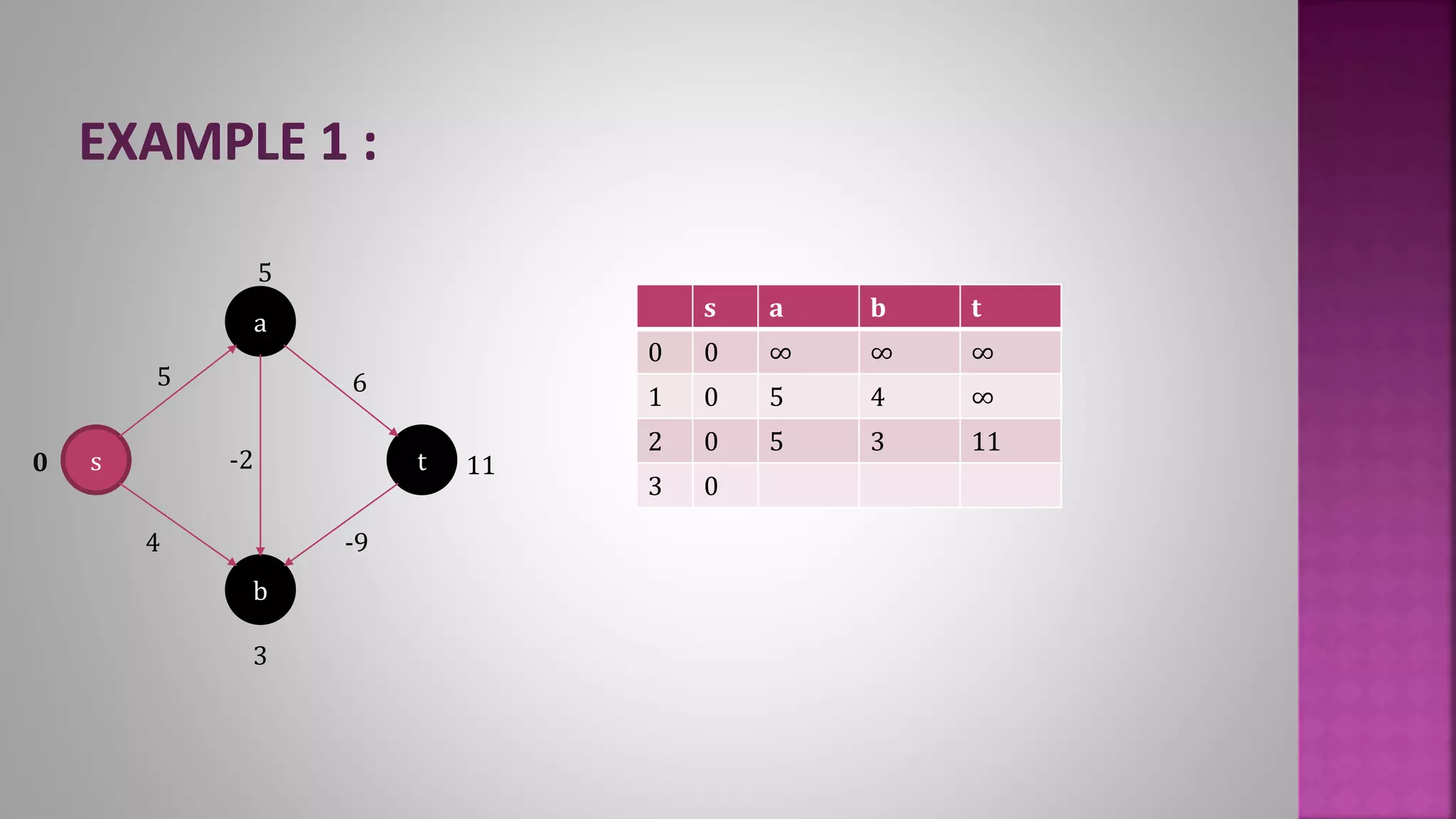
s a bt
0 0 ∞ ∞ ∞
1 0 5 4 ∞
2 0 5 3 11
3 0
s
a
b
t
5
-2
4
6
-9
3
11
5
0
15.
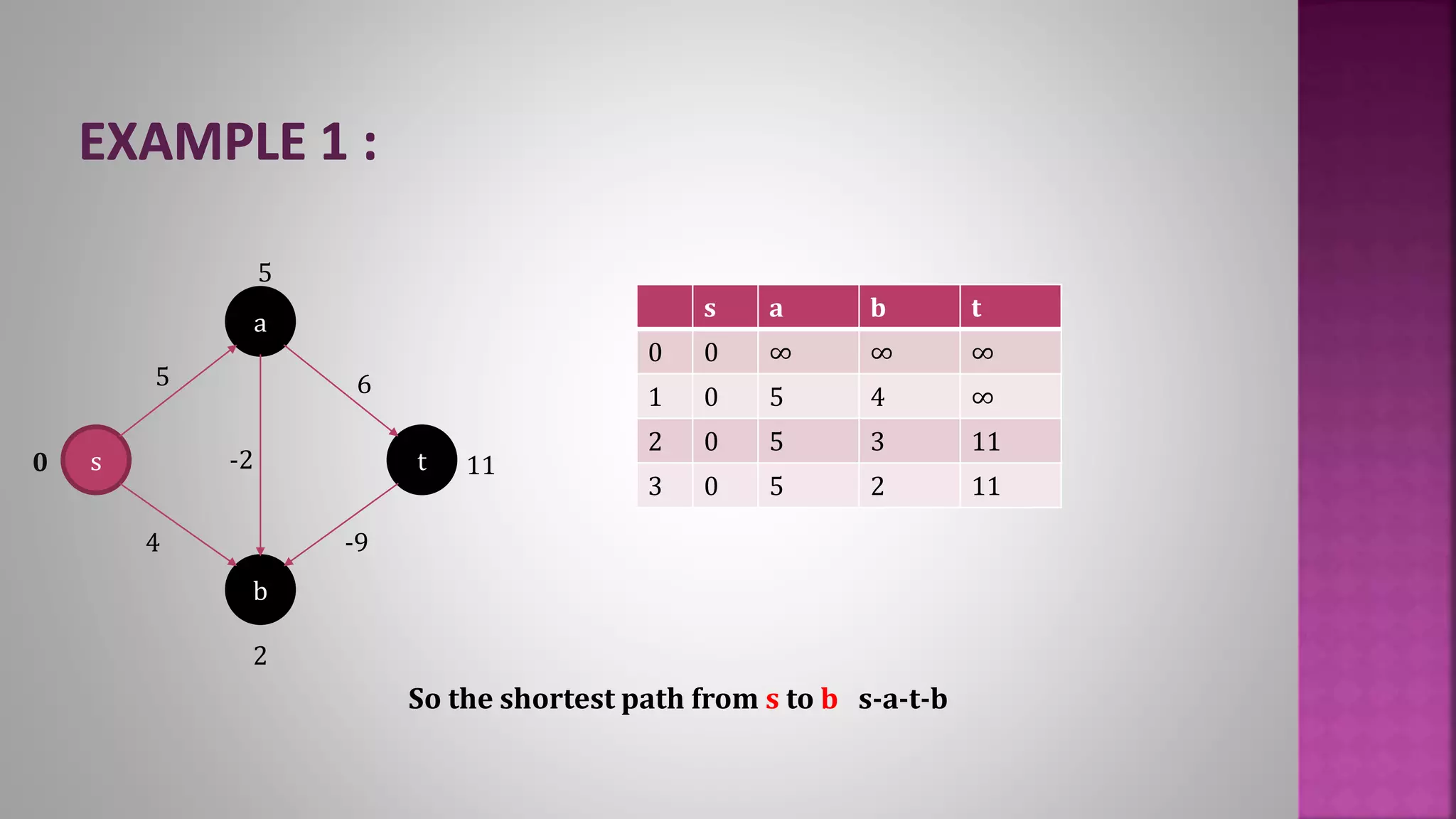
s a bt
0 0 ∞ ∞ ∞
1 0 5 4 ∞
2 0 5 3 11
3 0 5 2 11
s
a
b
t
5
-2
4
6
-9
2
11
5
0
So the shortest path from s to b s-a-t-b
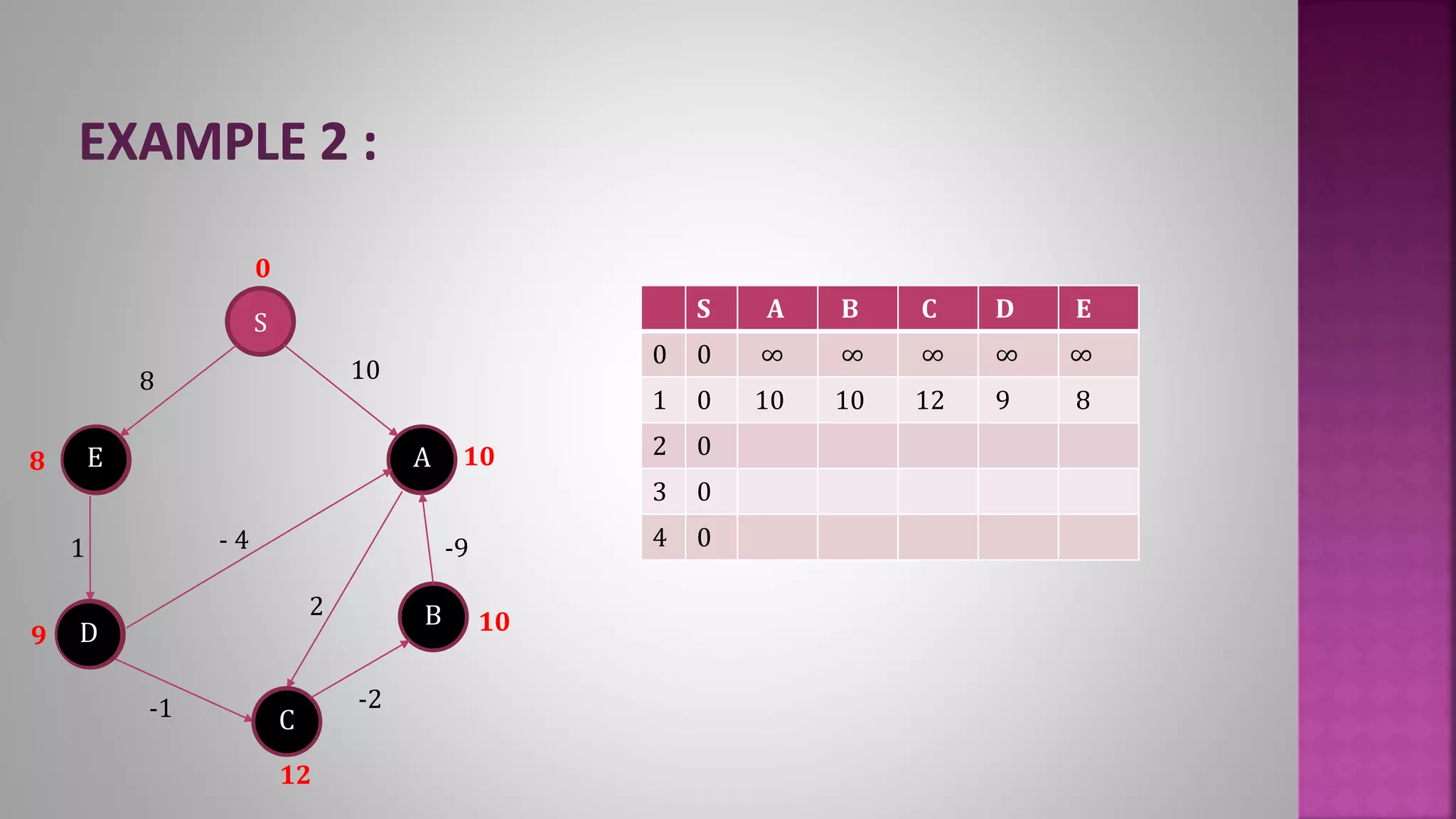
16.
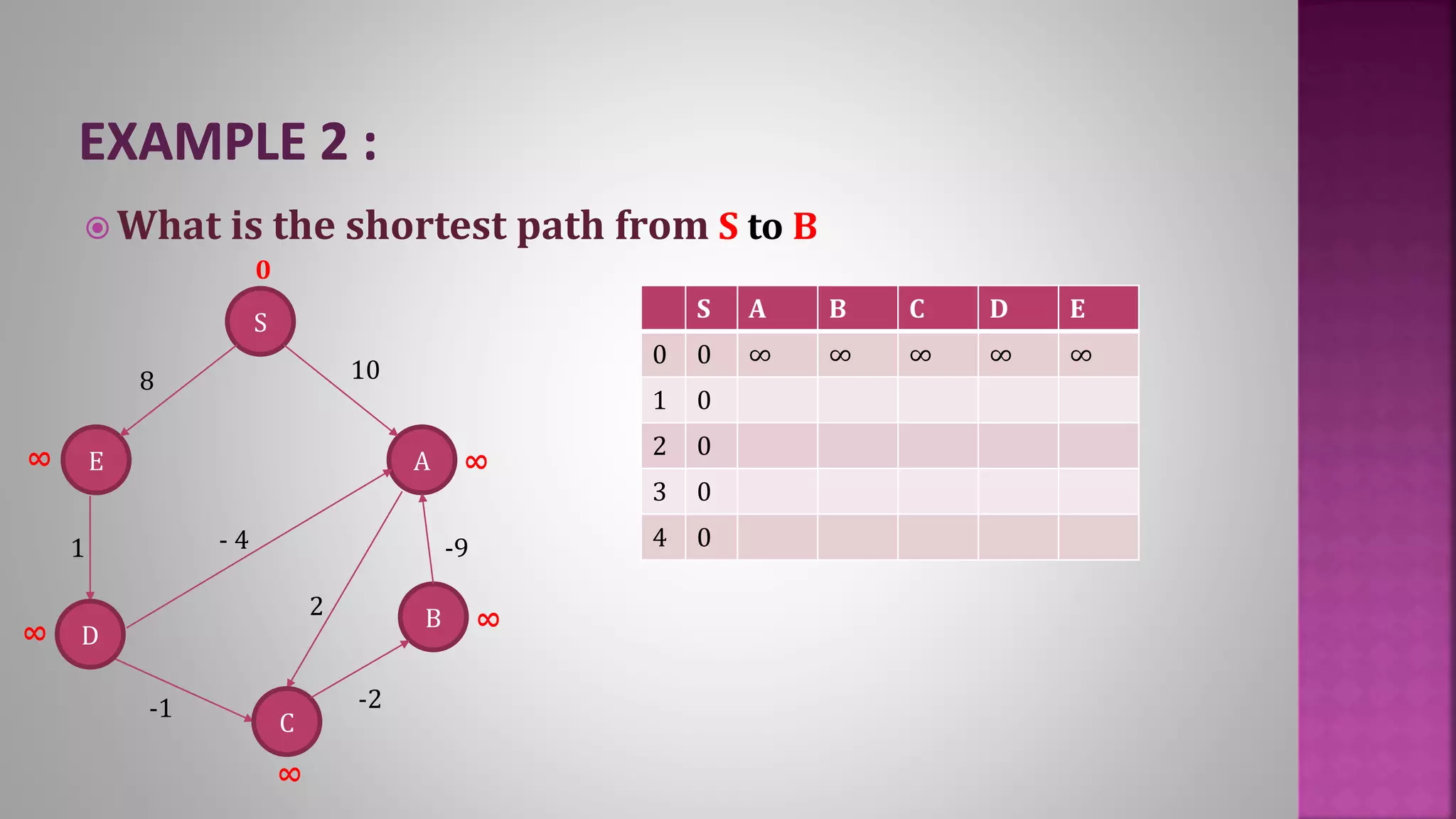
S A BC D E
0 0 ∞ ∞ ∞ ∞ ∞
1 0
2 0
3 0
4 0
E
S
B
A
8
1 - 4
10
-9
C
D
2
-2-1
What is the shortest path from S to B
0
∞
∞
∞
∞
∞
17.
S A BC D E
0 0 ∞ ∞ ∞ ∞ ∞
1 0 10 10 12 9 8
2 0
3 0
4 0
E
S
8
1 - 4
10
-9
C
D
2
-2-1
AE
B
C
D
0
8
9
12
10
10
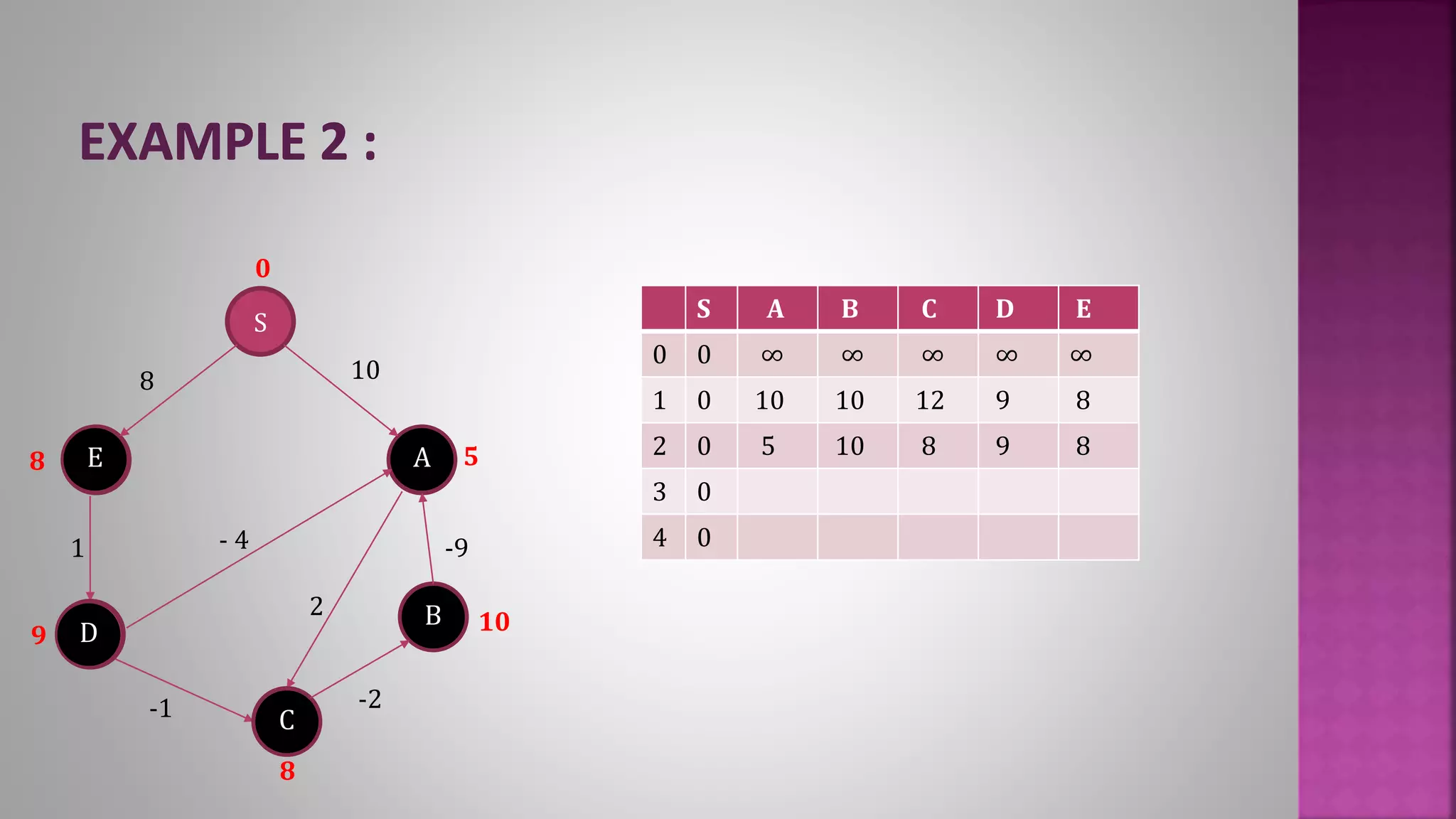
18.
S A BC D E
0 0 ∞ ∞ ∞ ∞ ∞
1 0 10 10 12 9 8
2 0 5 10 8 9 8
3 0
4 0
E
S
8
1 - 4
10
-9
C
D
2
-2-1
AE
B
C
D
0
9
10
58
8
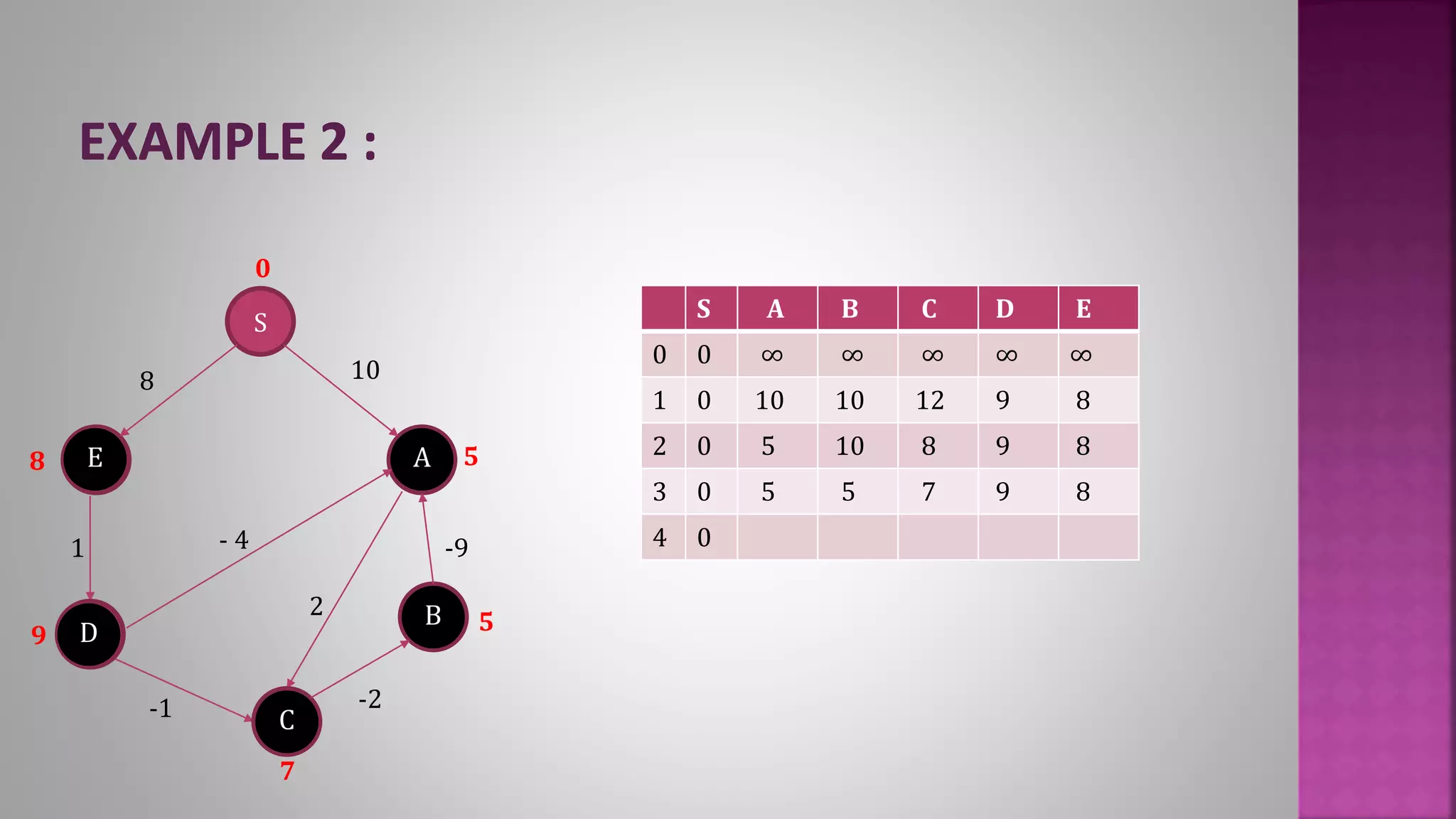
19.
S A BC D E
0 0 ∞ ∞ ∞ ∞ ∞
1 0 10 10 12 9 8
2 0 5 10 8 9 8
3 0 5 5 7 9 8
4 0
E
S
8
1 - 4
10
-9
C
D
2
-2-1
AE
B
C
D
0
9
5
58
7
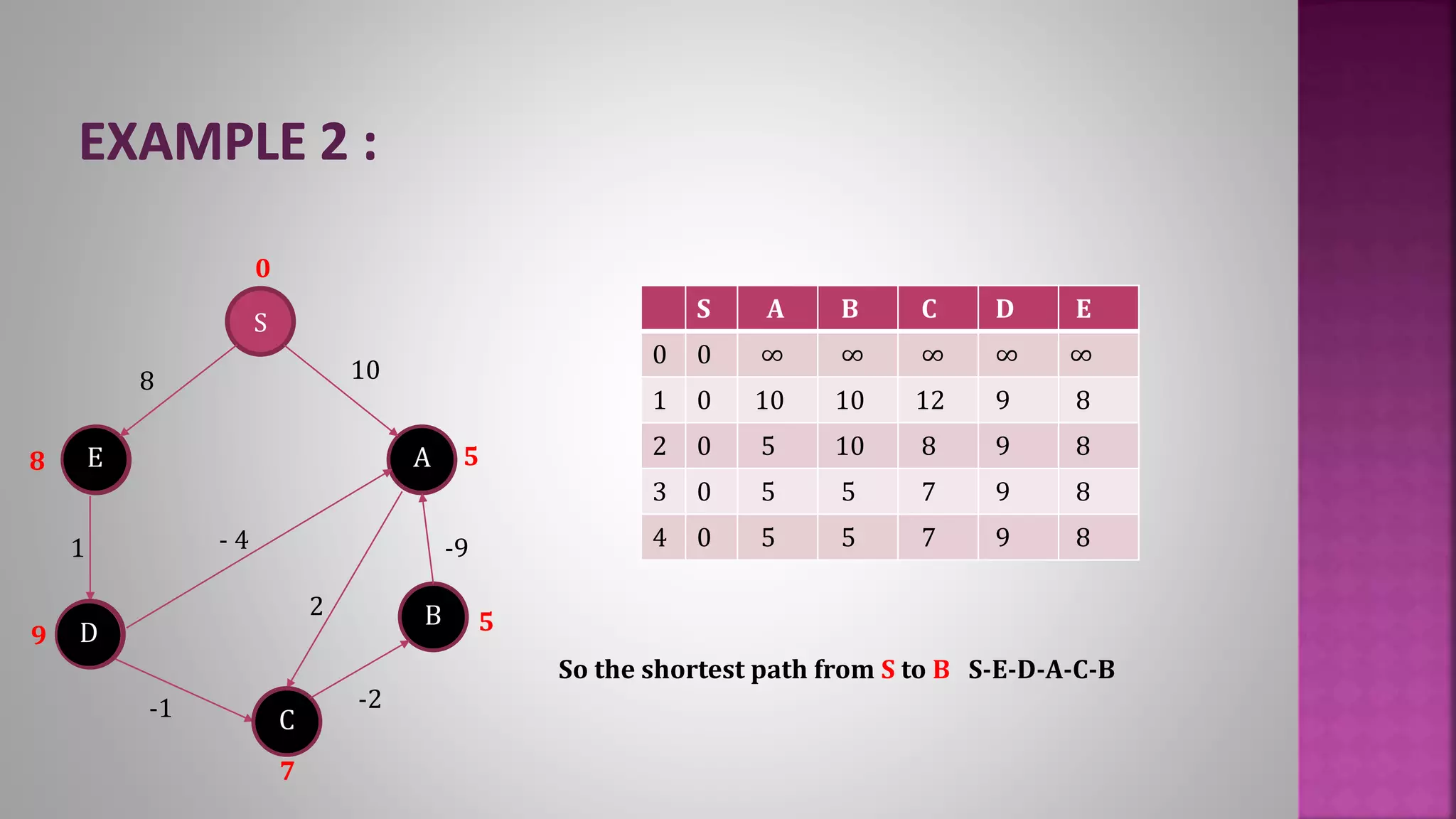
20.
S A BC D E
0 0 ∞ ∞ ∞ ∞ ∞
1 0 10 10 12 9 8
2 0 5 10 8 9 8
3 0 5 5 7 9 8
4 0 5 5 7 9 8
E
S
8
1 - 4
10
-9
C
D
2
-2-1
AE
B
C
D
0
9
5
58
7
So the shortest path from S to B S-E-D-A-C-B
21.
S A BC D
0 0 ∞ ∞ ∞ ∞
1 0
2 0
3 0
A
S
D
B
4
-5
3
6
1
C
2
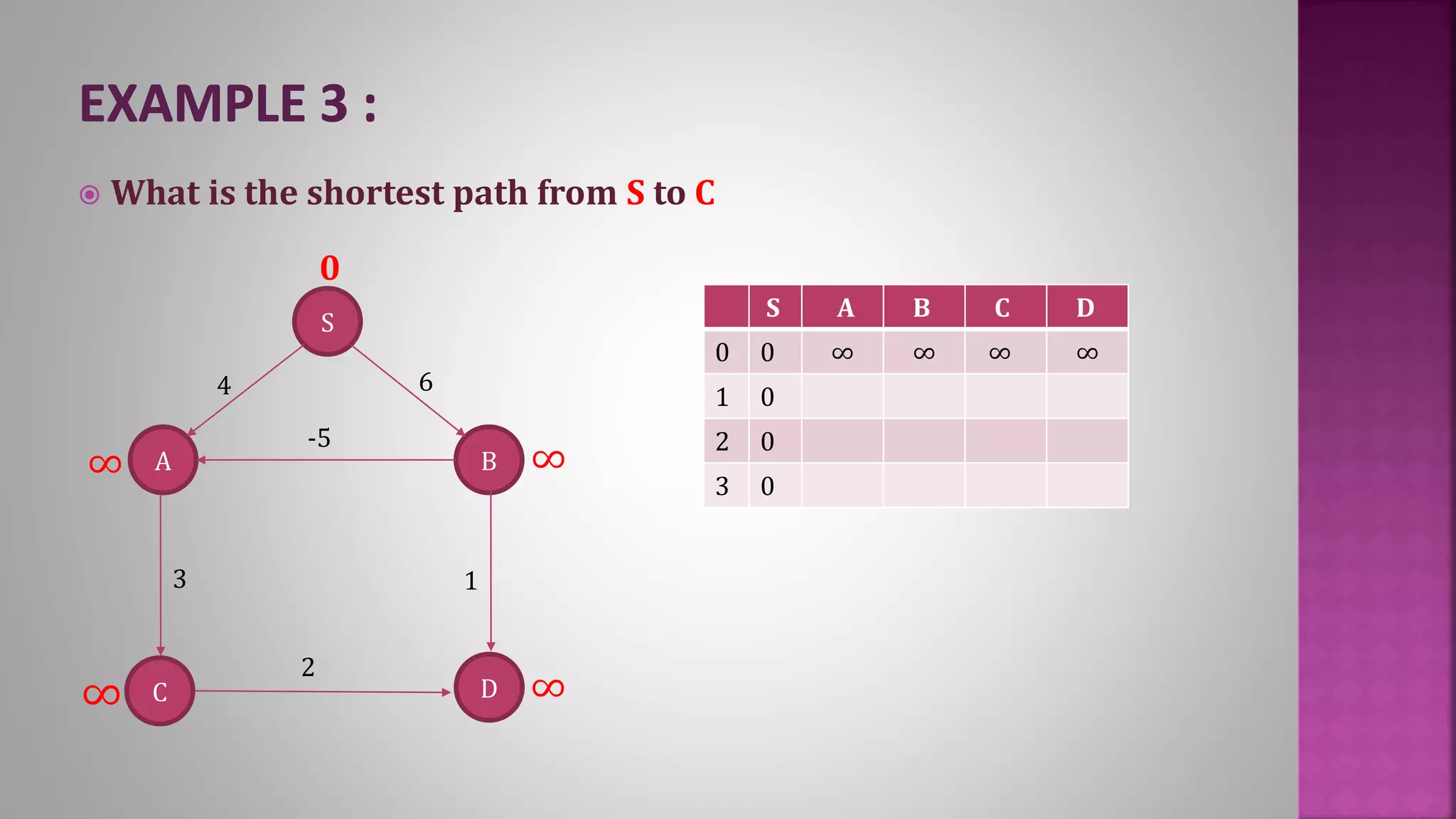
What is the shortest path from S to C
0
∞∞
∞ ∞
22.
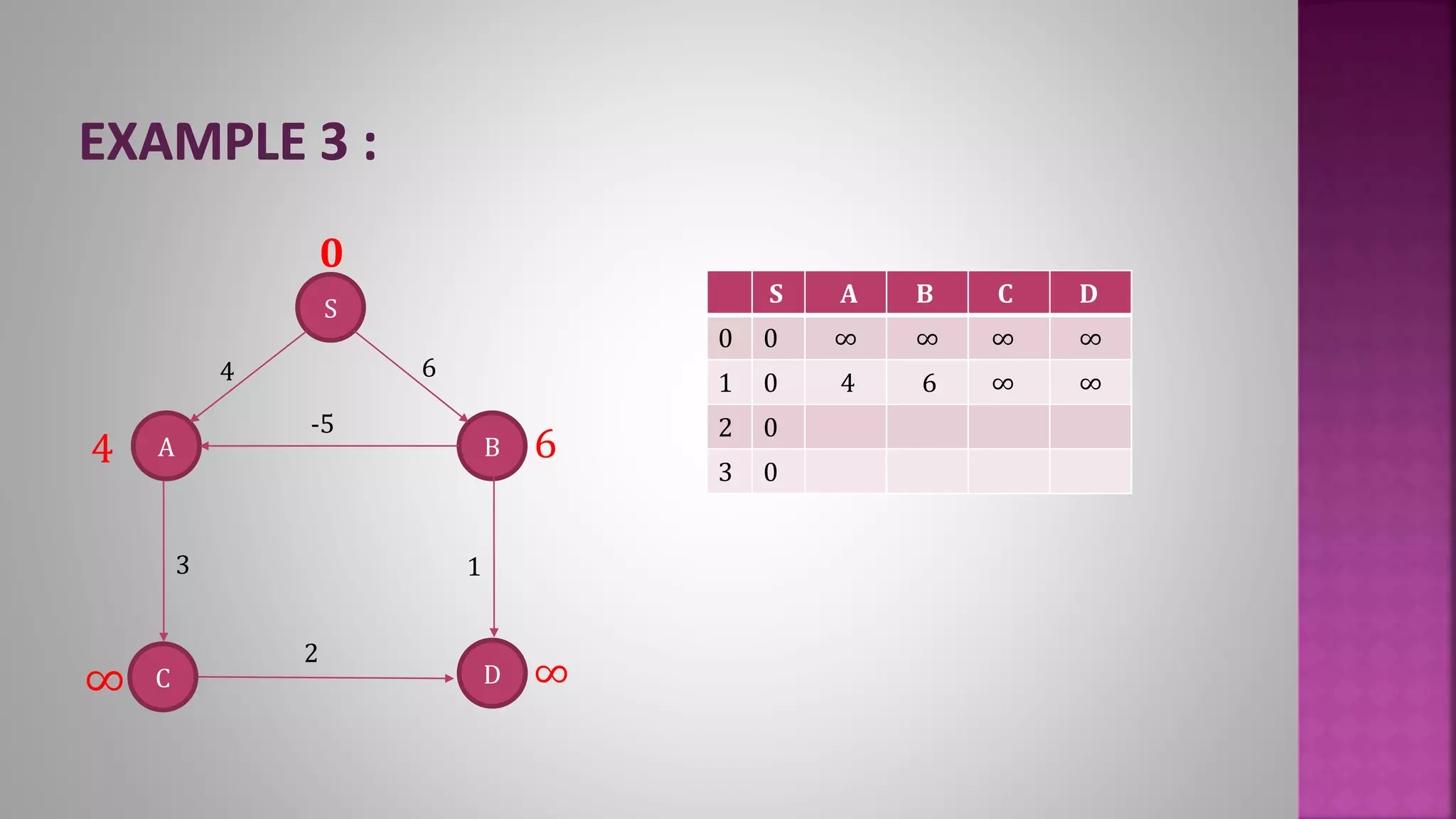
S A BC D
0 0 ∞ ∞ ∞ ∞
1 0 4 6 ∞ ∞
2 0
3 0
A
S
D
B
4
-5
3
6
1
C
2
64
∞ ∞
0
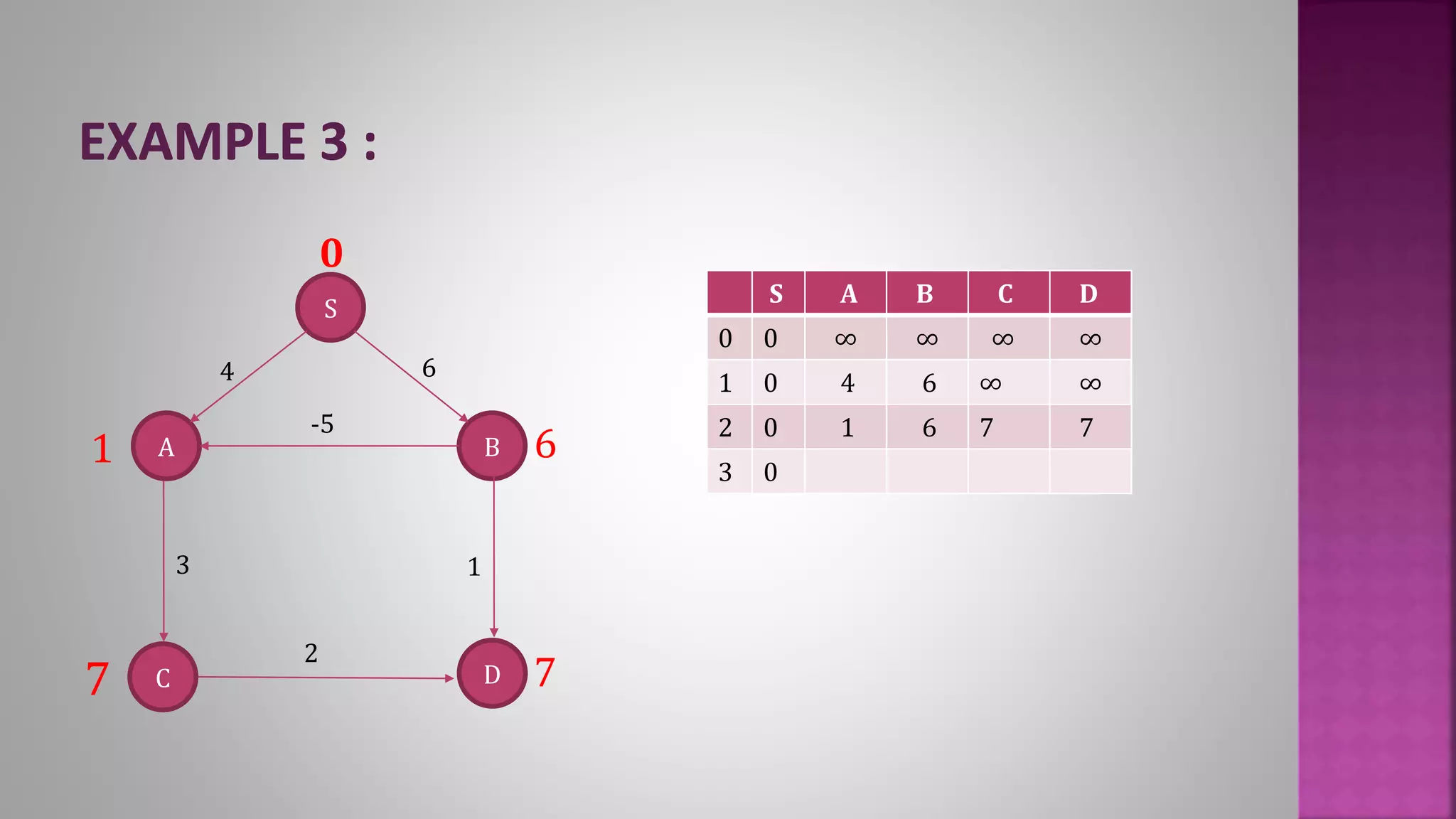
23.
S A BC D
0 0 ∞ ∞ ∞ ∞
1 0 4 6 ∞ ∞
2 0 1 6 7 7
3 0
A
S
D
B
4
-5
3
6
1
C
2
61
7 7
0
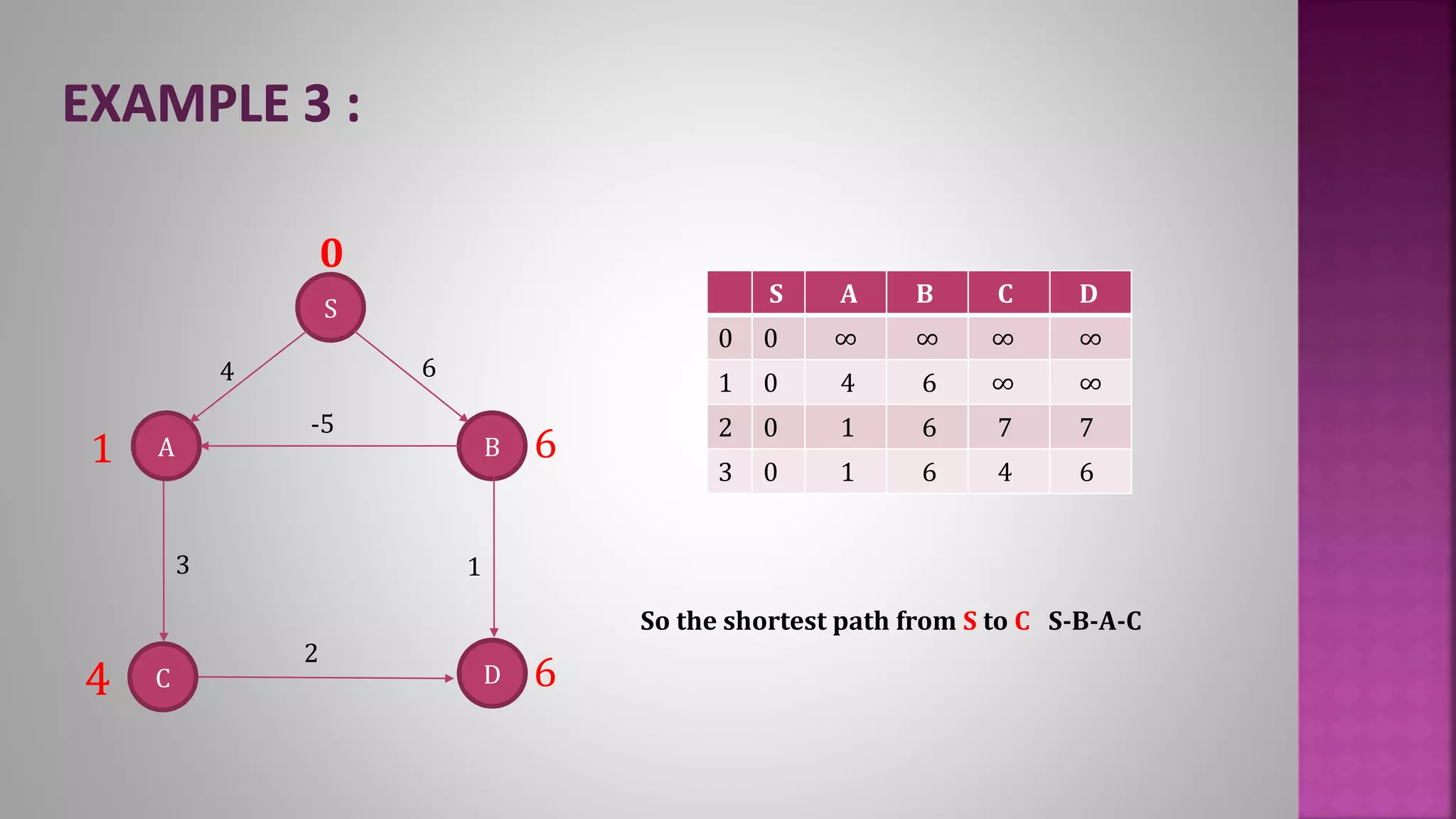
24.
S A BC D
0 0 ∞ ∞ ∞ ∞
1 0 4 6 ∞ ∞
2 0 1 6 7 7
3 0 1 6 4 6
A
S
D
B
4
-5
3
6
1
C
2
61
4 6
0
So the shortest path from S to C S-B-A-C


![ Maintain d[v] for each v V
d[v] is called shortest-path weight estimate
INITIALIZE (G, s)
for each v V do
d[v] ← ∞
π[v] ← NIL
d[s] ← 0](https://image.slidesharecdn.com/bellmanford-151227235400/75/Bellmanford-montaser-hamza-iraq-8-2048.jpg)

![BELMAN-FORD( G, s )
INITIALIZE SINGLE-SOURCE ( G, s )
for i ←1 to |V|-1 do
for each edge (u, v) G.E do
RELAX( u, v )
for each edge ( u, v ) E do
if d[v] > d[u]+w(u,v) then
return FALSE
return TRUE
computaion
check](https://image.slidesharecdn.com/bellmanford-151227235400/75/Bellmanford-montaser-hamza-iraq-10-2048.jpg)
![ RELAX(u ,v)
if d[v] > d[u]+w(u,v) then
d[v] = d[u]+w(u,v)
π[v] = [u]
5
2
2
9
5 7
Relax(u,v)
5
2
2
6
5 6
If has achieved the
condition
If not has achieved
the condition](https://image.slidesharecdn.com/bellmanford-151227235400/75/Bellmanford-montaser-hamza-iraq-11-2048.jpg)





![Depth first search [dfs]](https://cdn.slidesharecdn.com/ss_thumbnails/depthfirstsearchdfs-190926145304-thumbnail.jpg?width=640&height=640&fit=bounds)


![Vibe Coding vs. Spec-Driven Development [Free Meetup]](https://cdn.slidesharecdn.com/ss_thumbnails/vibecodingvsspecdrivendevelopment-251209105622-43f455e7-thumbnail.jpg?width=640&height=640&fit=bounds)


