This document discusses formulating the research problem in research methodology. It defines a research problem as a perceived gap between what is and what should be. The key points covered include:
- Identifying sources of research problems such as people, problems, programs, and phenomena.
- Considering factors like relevance, expertise, and ethics when selecting a research problem.
- Outlining the steps to formulate a research problem such as identifying the broad field and raising questions.
- The importance of formulating clear research objectives and operational definitions to focus the study.
KNOWLEDGE FOR THEBENEFIT OF HUMANITYKNOWLEDGE FOR THE BENEFIT OF HUMANITY
RESEARCH METHODOLOGY (HFS4343)
FORMULATING THE
RESEARCH PROBLEM
Dr.Dr. MohdMohd RazifRazif ShahrilShahril
School of Nutrition & DieteticsSchool of Nutrition & Dietetics
Faculty of Health SciencesFaculty of Health Sciences
UniversitiUniversiti SultanSultan ZainalZainal AbidinAbidin
1
2.
S C HO O L O F N U T R I T I O N A N D D I E T E T I C S • U N I V E R S I T I S U L T A N Z A I N A L A B I D I N
Topic Learning Outcomes
At the end of this lecture, students should be able to;
• identify importance of formulating a research problem
• list sources of research problems
• explain the considerations in selecting a research
problem
• describe steps in formulating a research problem
• demonstrate how to formulate research objectives
• define operational definitions
2
3.
S C HO O L O F N U T R I T I O N A N D D I E T E T I C S • U N I V E R S I T I S U L T A N Z A I N A L A B I D I N
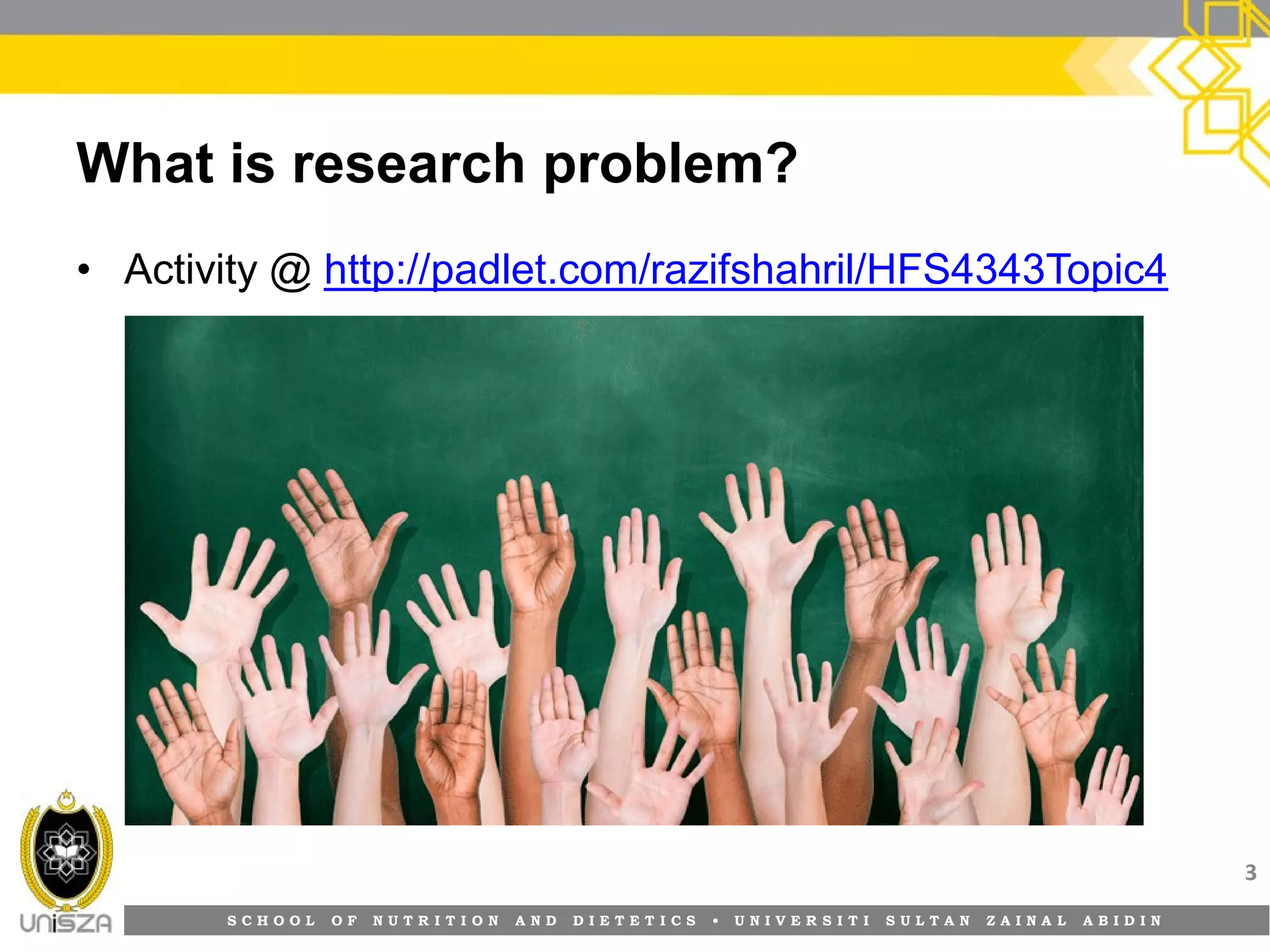
What is research problem?
• Activity @ http://padlet.com/razifshahril/HFS4343Topic4
3
4.
S C HO O L O F N U T R I T I O N A N D D I E T E T I C S • U N I V E R S I T I S U L T A N Z A I N A L A B I D I N
What is research problem?
• Any question that you want answered and any
assumption or assertion that you want to challenge or
investigate.
• However;
– not all questions can be transformed into research
problems.
– the process of formulating them in a meaningful way
is not at all an easy task.
– it requires considerable knowledge of both the subject
area and research methodology.
4
5.
S C HO O L O F N U T R I T I O N A N D D I E T E T I C S • U N I V E R S I T I S U L T A N Z A I N A L A B I D I N
What is research problem? (cont.)
• A research problem is a perceived gap between what is
and what should be.
• Research problem arise from;
– Evolution of theories.
– Peers and supervisors etc.
– Published research (literature review).
– Day-to-day experience
5
6.
S C HO O L O F N U T R I T I O N A N D D I E T E T I C S • U N I V E R S I T I S U L T A N Z A I N A L A B I D I N
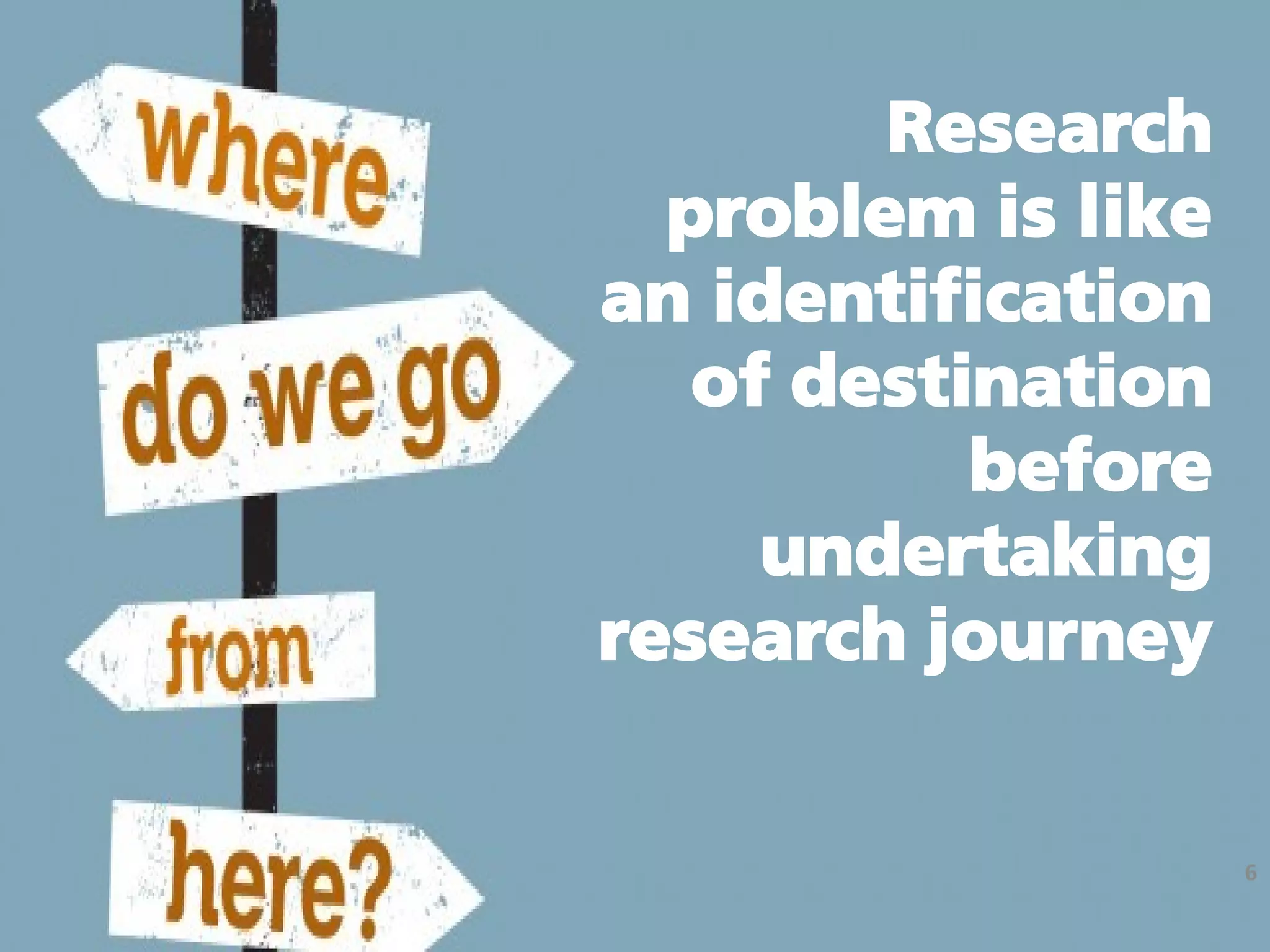
ResearchResearch
problem is likeproblem is like
an identificationan identification
of destinationof destination
beforebefore
undertakingundertaking
research journeyresearch journey
6
7.
S C HO O L O F N U T R I T I O N A N D D I E T E T I C S • U N I V E R S I T I S U L T A N Z A I N A L A B I D I N
Clear research problem would
result in clear and economical
research plan.
7
8.
S C HO O L O F N U T R I T I O N A N D D I E T E T I C S • U N I V E R S I T I S U L T A N Z A I N A L A B I D I N
RESEARCH PROBLEM IS THE
FOUNDATION OF THE RESEARCH
STUDY
8
9.
S C HO O L O F N U T R I T I O N A N D D I E T E T I C S • U N I V E R S I T I S U L T A N Z A I N A L A B I D I N
9
WHAT IT IS THAT YOUWHAT IT IS THAT YOU WANT TO FINDWANT TO FIND
OUTOUT ABOUTABOUT AND NOT WHAT YOUAND NOT WHAT YOU
THINK YOU MUST FINDTHINK YOU MUST FIND
10.
S C HO O L O F N U T R I T I O N A N D D I E T E T I C S • U N I V E R S I T I S U L T A N Z A I N A L A B I D I N
The way we formulate the research
problem determines every step that
follows;
• type of study design that can be used
• type of sampling strategy that can be employed
• research instrument that can be used or developed
• type of analysis that can be undertaken
10
11.
S C HO O L O F N U T R I T I O N A N D D I E T E T I C S • U N I V E R S I T I S U L T A N Z A I N A L A B I D I N
11
12.
S C HO O L O F N U T R I T I O N A N D D I E T E T I C S • U N I V E R S I T I S U L T A N Z A I N A L A B I D I N
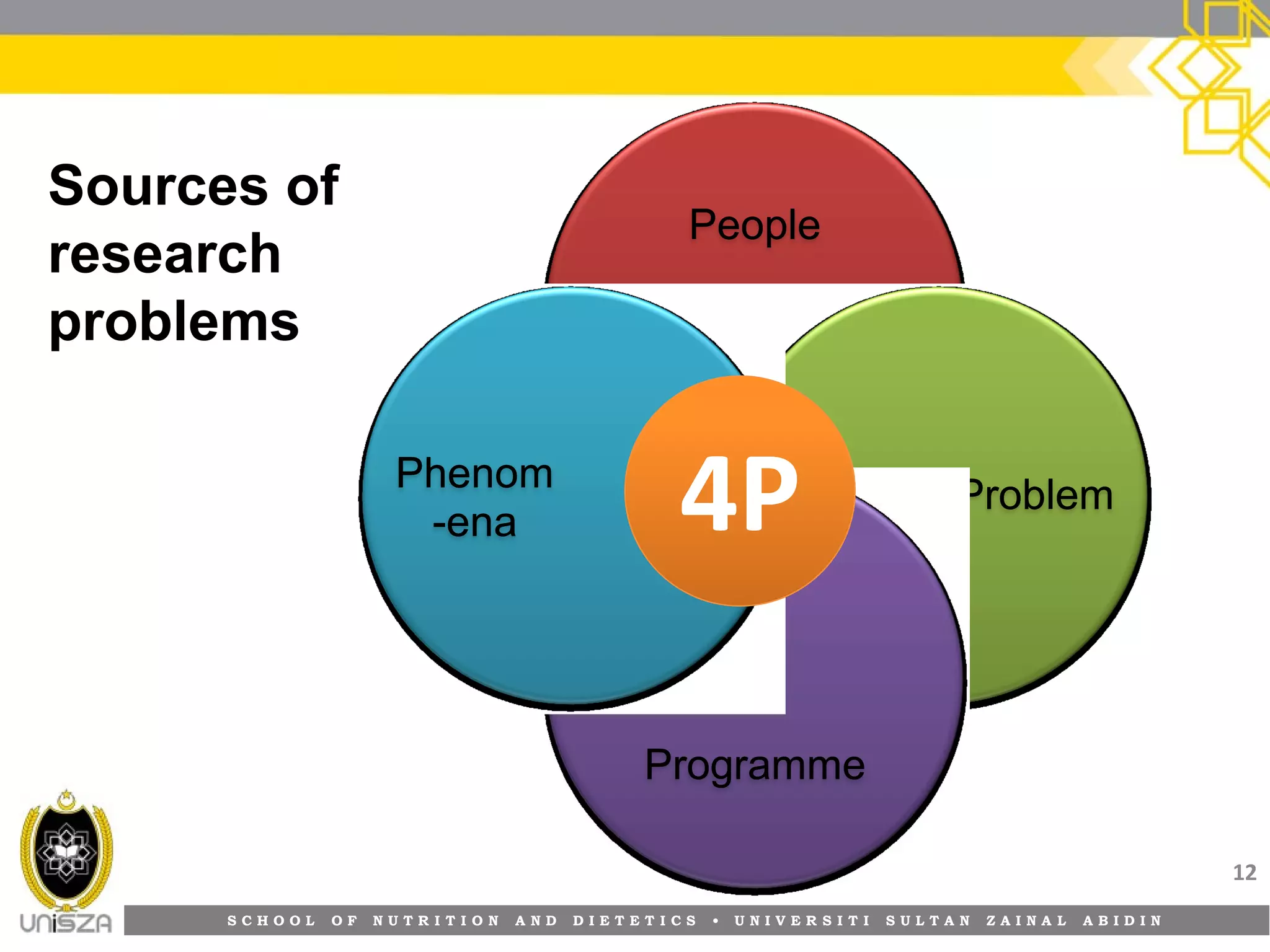
Sources of
research
problems
12
PeoplePeople
ProblemProblem
ProgrammeProgramme
PhenomPhenom
--enaena 4P4P4P4P
13.
S C HO O L O F N U T R I T I O N A N D D I E T E T I C S • U N I V E R S I T I S U L T A N Z A I N A L A B I D I N
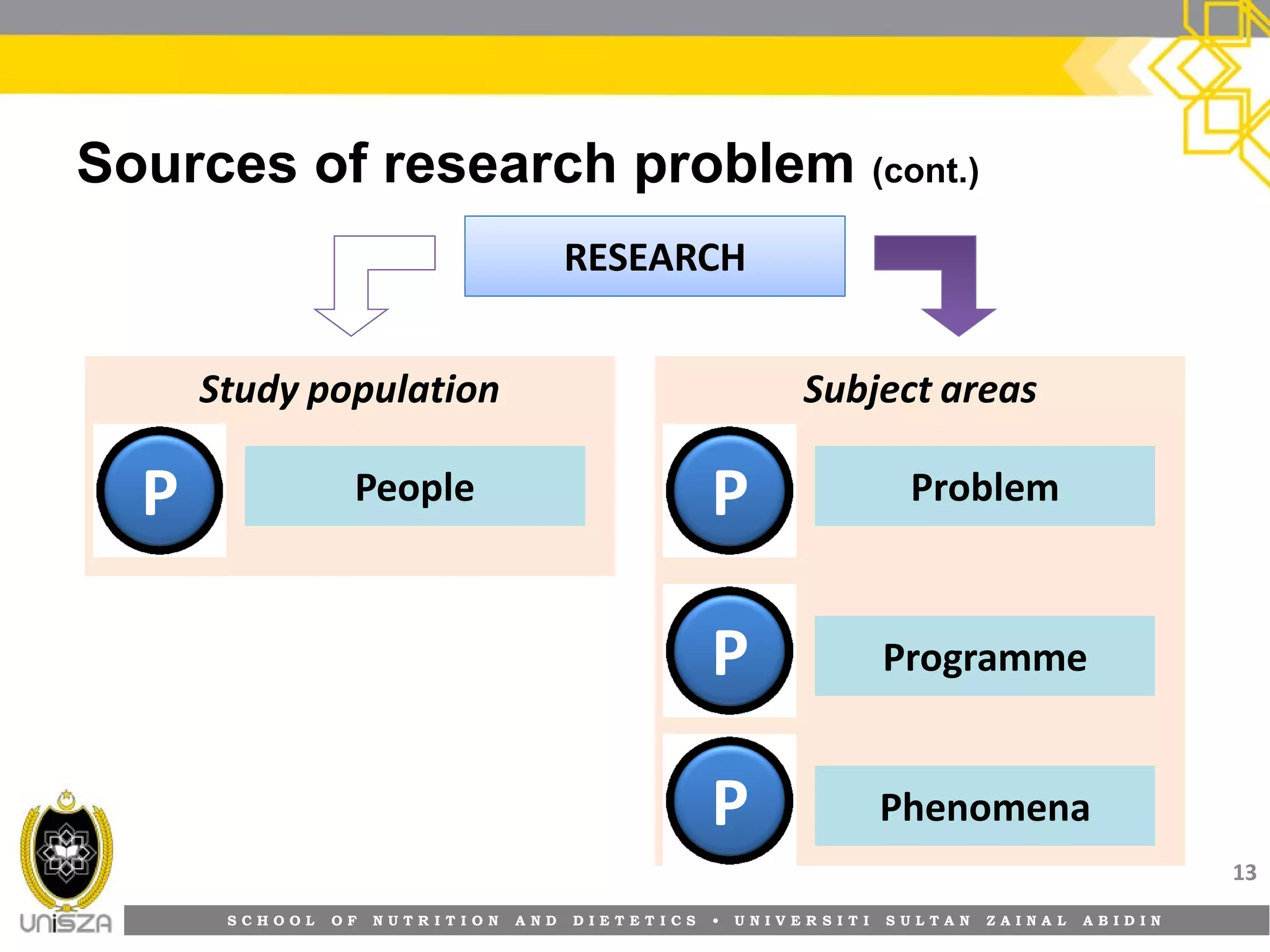
Subject areasStudy population
Sources of research problem (cont.)
13
RESEARCH
P P
P
P
People Problem
Programme
Phenomena
14.
S C HO O L O F N U T R I T I O N A N D D I E T E T I C S • U N I V E R S I T I S U L T A N Z A I N A L A B I D I N
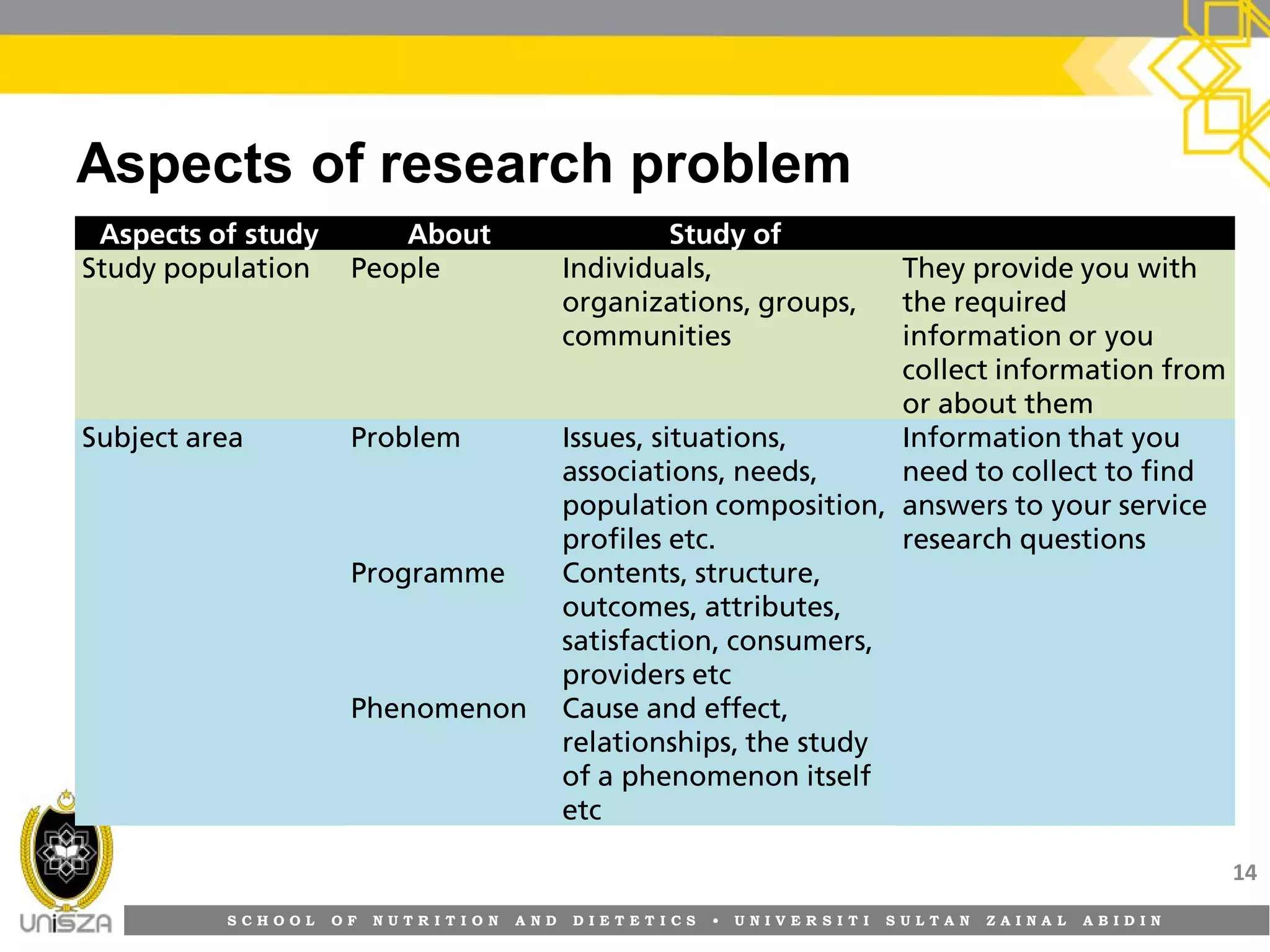
Aspects of research problem
14
Aspects of study About Study of
Study population People Individuals,
organizations, groups,
communities
They provide you with
the required
information or you
collect information from
or about them
Subject area Problem Issues, situations,
associations, needs,
population composition,
profiles etc.
Information that you
need to collect to find
answers to your service
research questions
Programme Contents, structure,
outcomes, attributes,
satisfaction, consumers,
providers etc
Phenomenon Cause and effect,
relationships, the study
of a phenomenon itself
etc
15.
S C HO O L O F N U T R I T I O N A N D D I E T E T I C S • U N I V E R S I T I S U L T A N Z A I N A L A B I D I N
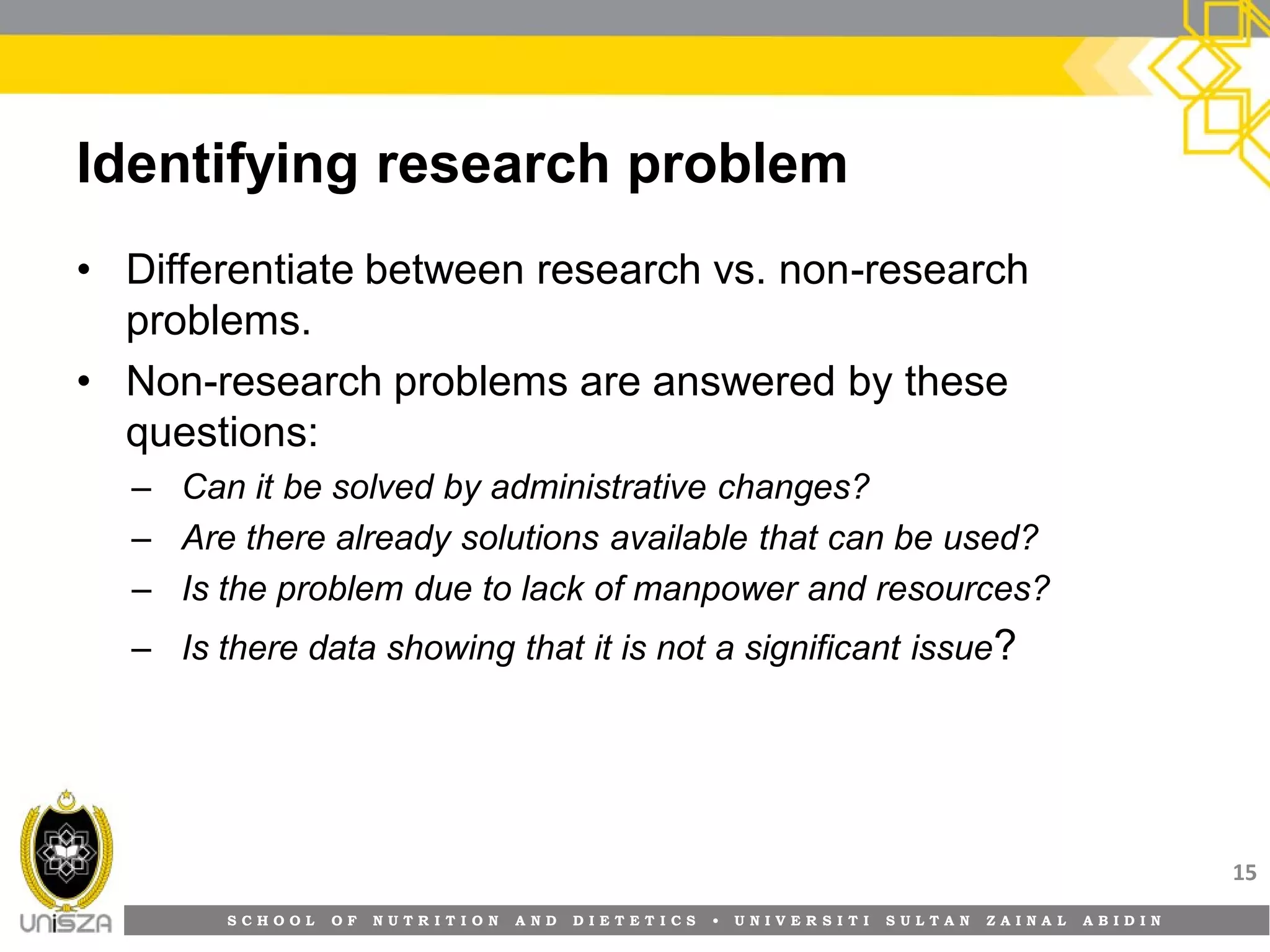
Identifying research problem
• Differentiate between research vs. non-research
problems.
• Non-research problems are answered by these
questions:
– Can it be solved by administrative changes?
– Are there already solutions available that can be used?
– Is the problem due to lack of manpower and resources?
– Is there data showing that it is not a significant issue?
15
16.
S C HO O L O F N U T R I T I O N A N D D I E T E T I C S • U N I V E R S I T I S U L T A N Z A I N A L A B I D I N
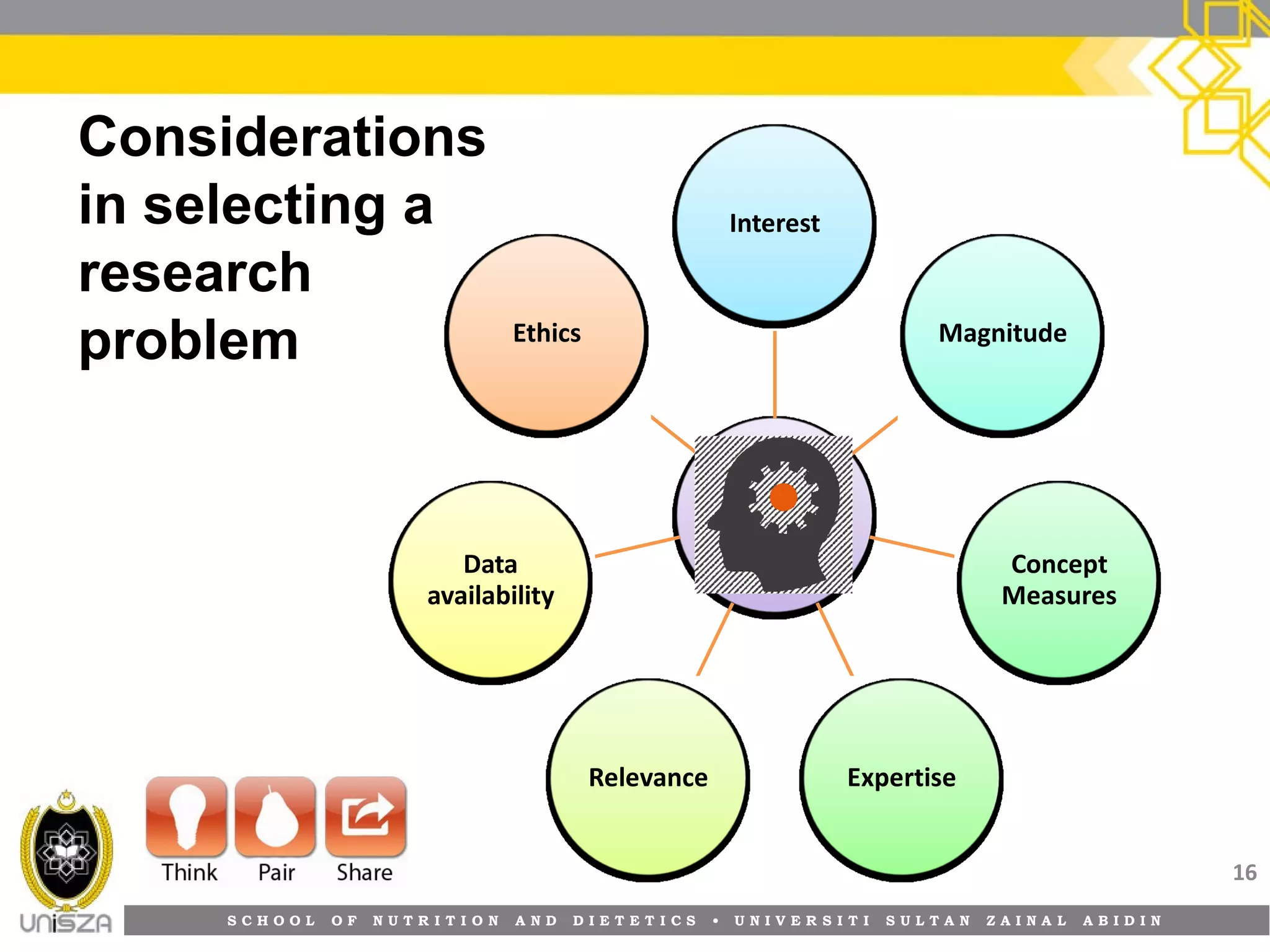
Considerations
in selecting a
research
problem
16
Interest
Magnitude
Concept
Measures
ExpertiseRelevance
Data
availability
Ethics
17.
S C HO O L O F N U T R I T I O N A N D D I E T E T I C S • U N I V E R S I T I S U L T A N Z A I N A L A B I D I N
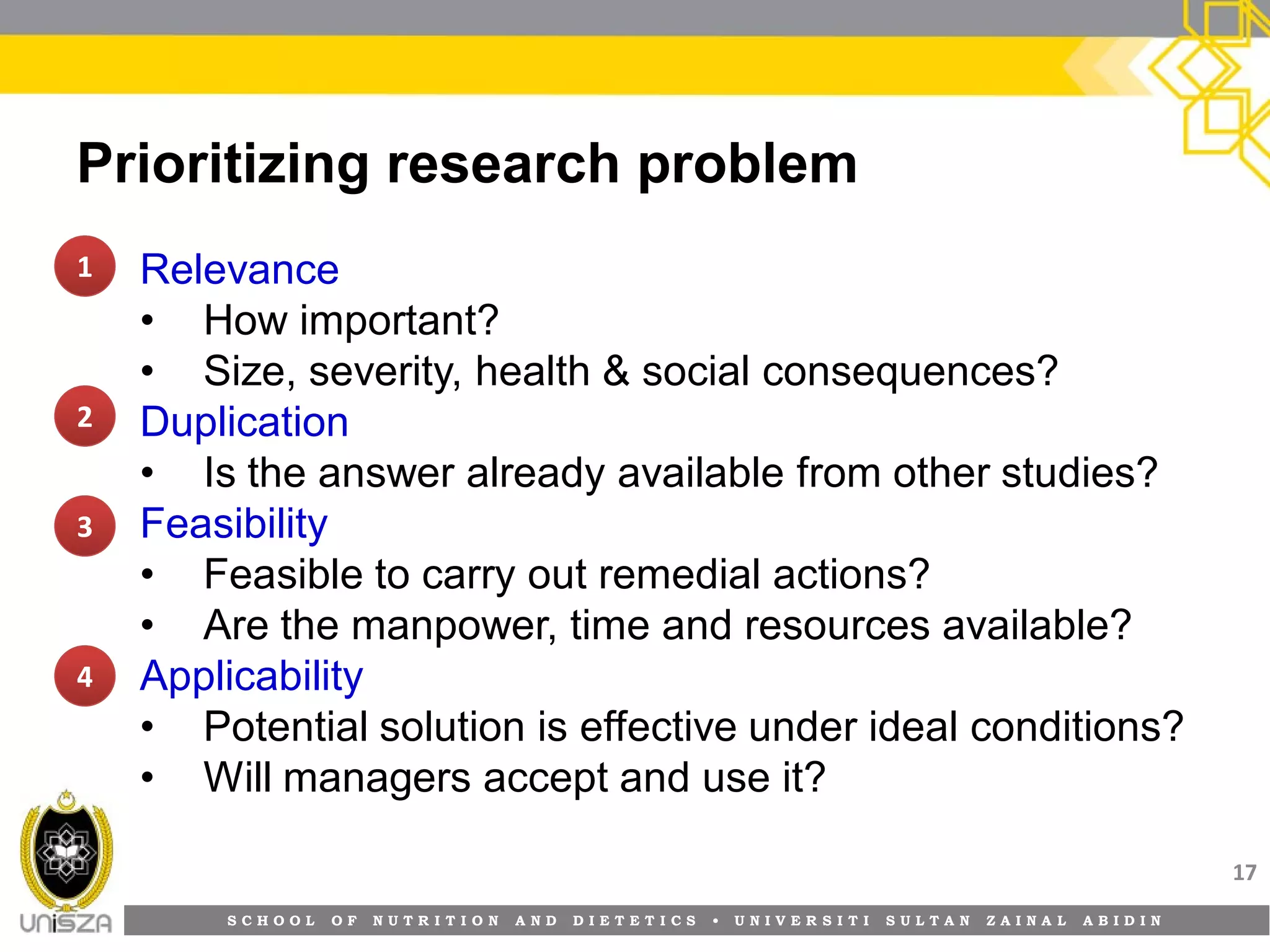
Prioritizing research problem
• Relevance
• How important?
• Size, severity, health & social consequences?
• Duplication
• Is the answer already available from other studies?
• Feasibility
• Feasible to carry out remedial actions?
• Are the manpower, time and resources available?
• Applicability
• Potential solution is effective under ideal conditions?
• Will managers accept and use it?
17
1111
2222
3333
4444
18.
S C HO O L O F N U T R I T I O N A N D D I E T E T I C S • U N I V E R S I T I S U L T A N Z A I N A L A B I D I N
Prioritizing research problem (cont.)
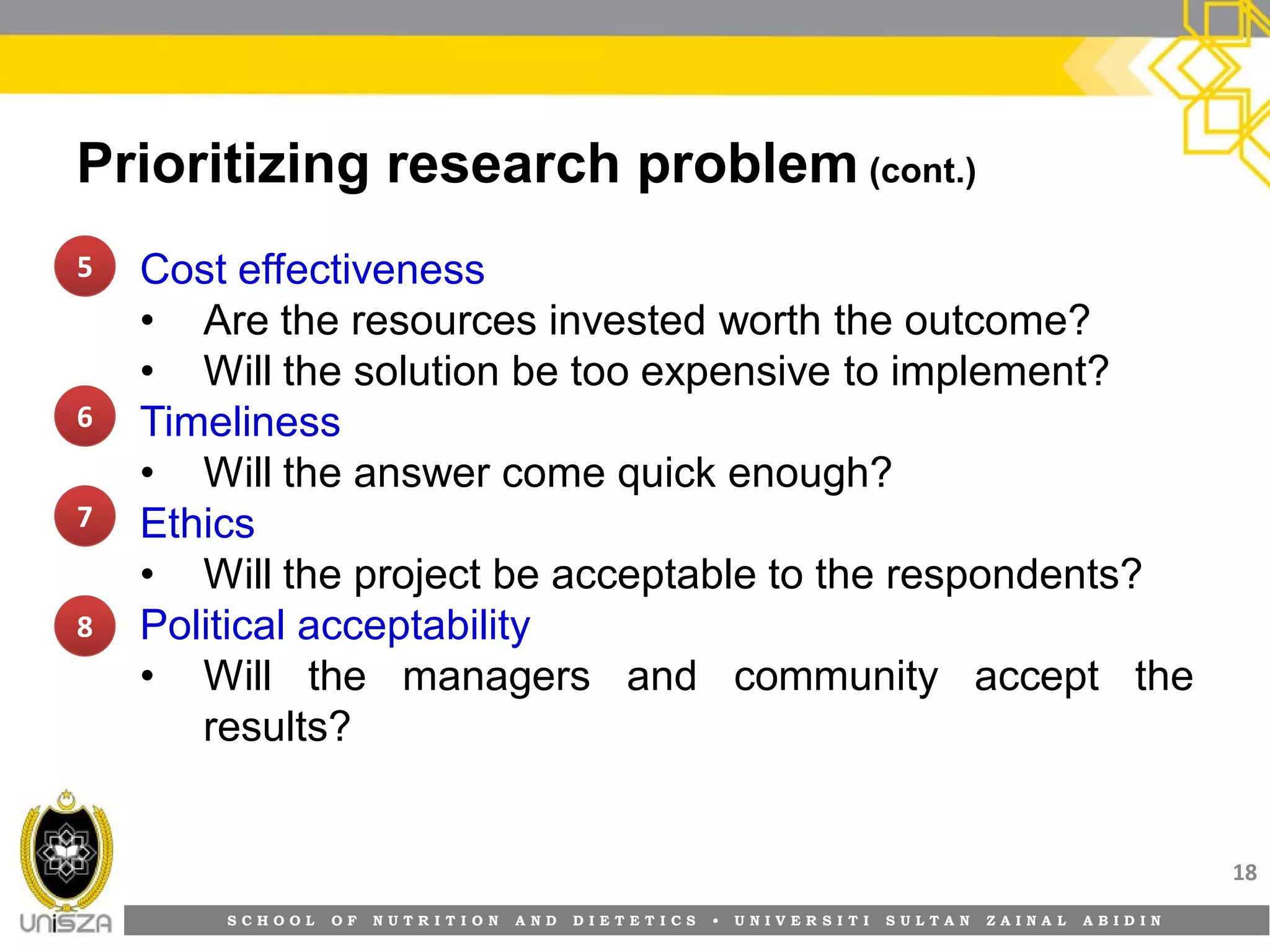
• Cost effectiveness
• Are the resources invested worth the outcome?
• Will the solution be too expensive to implement?
• Timeliness
• Will the answer come quick enough?
• Ethics
• Will the project be acceptable to the respondents?
• Political acceptability
• Will the managers and community accept the
results?
18
5555
6666
7777
8888
19.
S C HO O L O F N U T R I T I O N A N D D I E T E T I C S • U N I V E R S I T I S U L T A N Z A I N A L A B I D I N
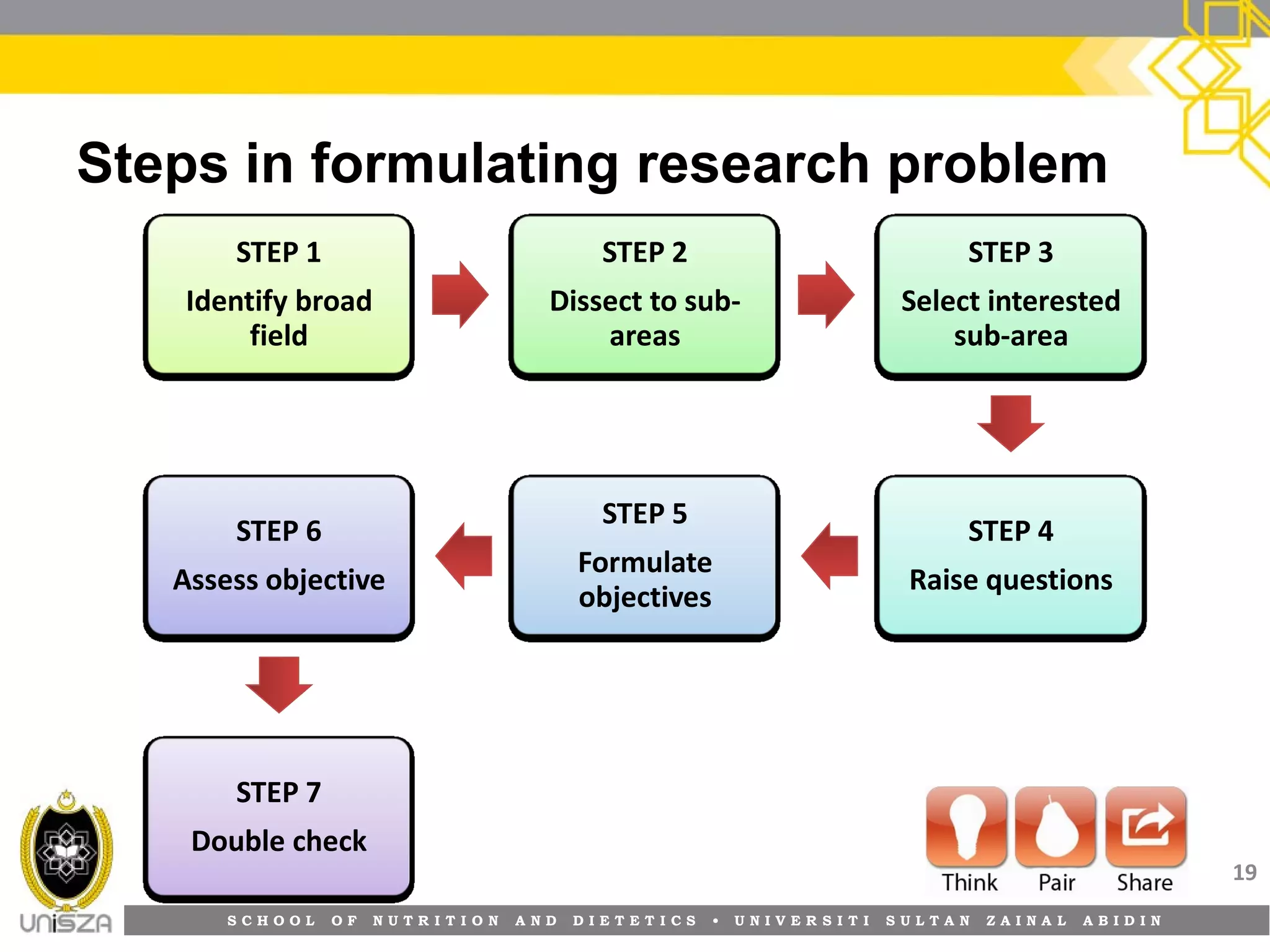
Steps in formulating research problem
19
STEP 1
Identify broad
field
STEP 2
Dissect to sub-
areas
STEP 3
Select interested
sub-area
STEP 4
Raise questions
STEP 5
Formulate
objectives
STEP 6
Assess objective
STEP 7
Double check
20.
S C HO O L O F N U T R I T I O N A N D D I E T E T I C S • U N I V E R S I T I S U L T A N Z A I N A L A B I D I N
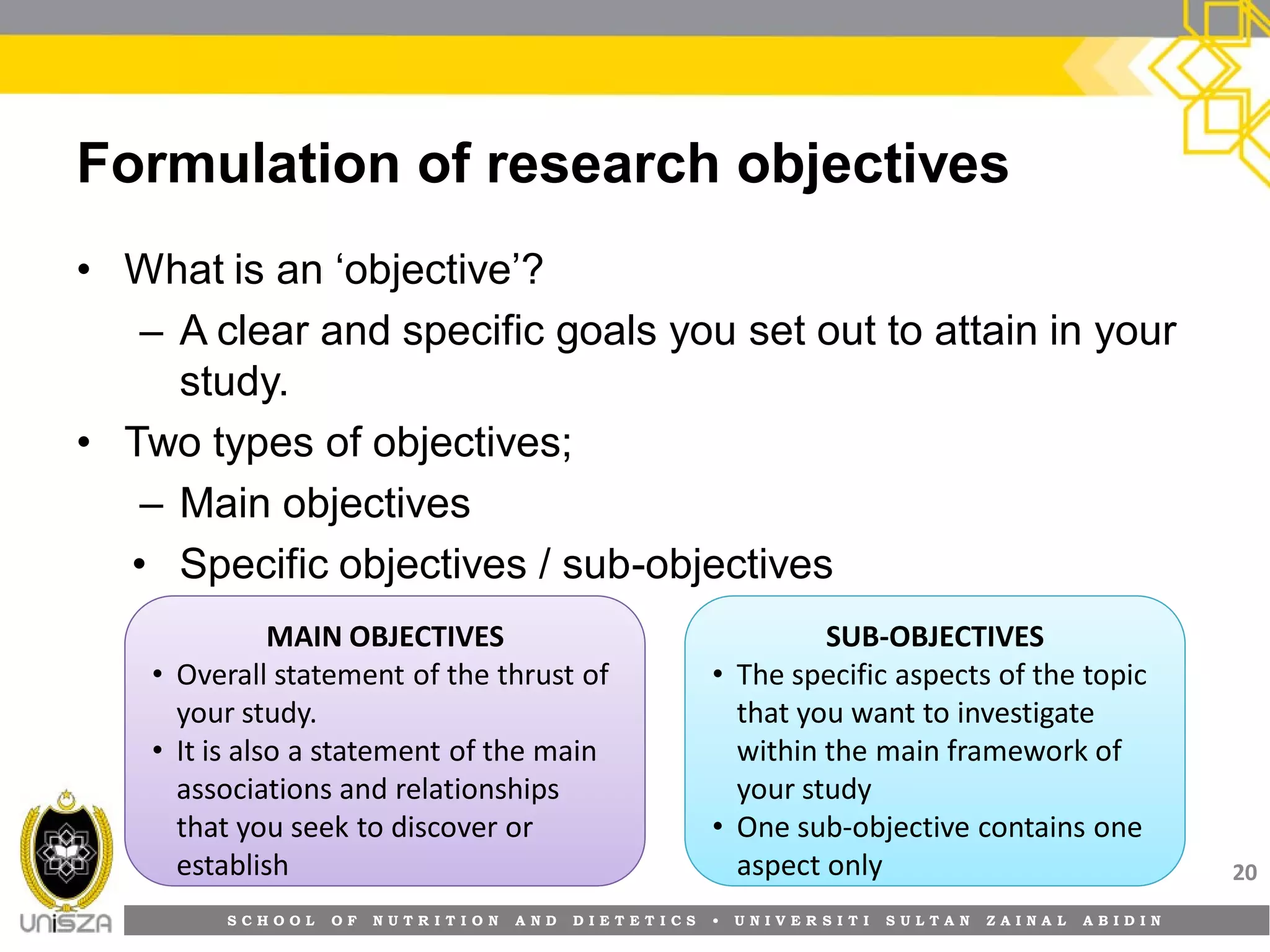
Formulation of research objectives
• What is an ‘objective’?
– A clear and specific goals you set out to attain in your
study.
• Two types of objectives;
– Main objectives
• Specific objectives / sub-objectives
20
MAIN OBJECTIVES
• Overall statement of the thrust of
your study.
• It is also a statement of the main
associations and relationships
that you seek to discover or
establish
SUB-OBJECTIVES
• The specific aspects of the topic
that you want to investigate
within the main framework of
your study
• One sub-objective contains one
aspect only
21.
S C HO O L O F N U T R I T I O N A N D D I E T E T I C S • U N I V E R S I T I S U L T A N Z A I N A L A B I D I N
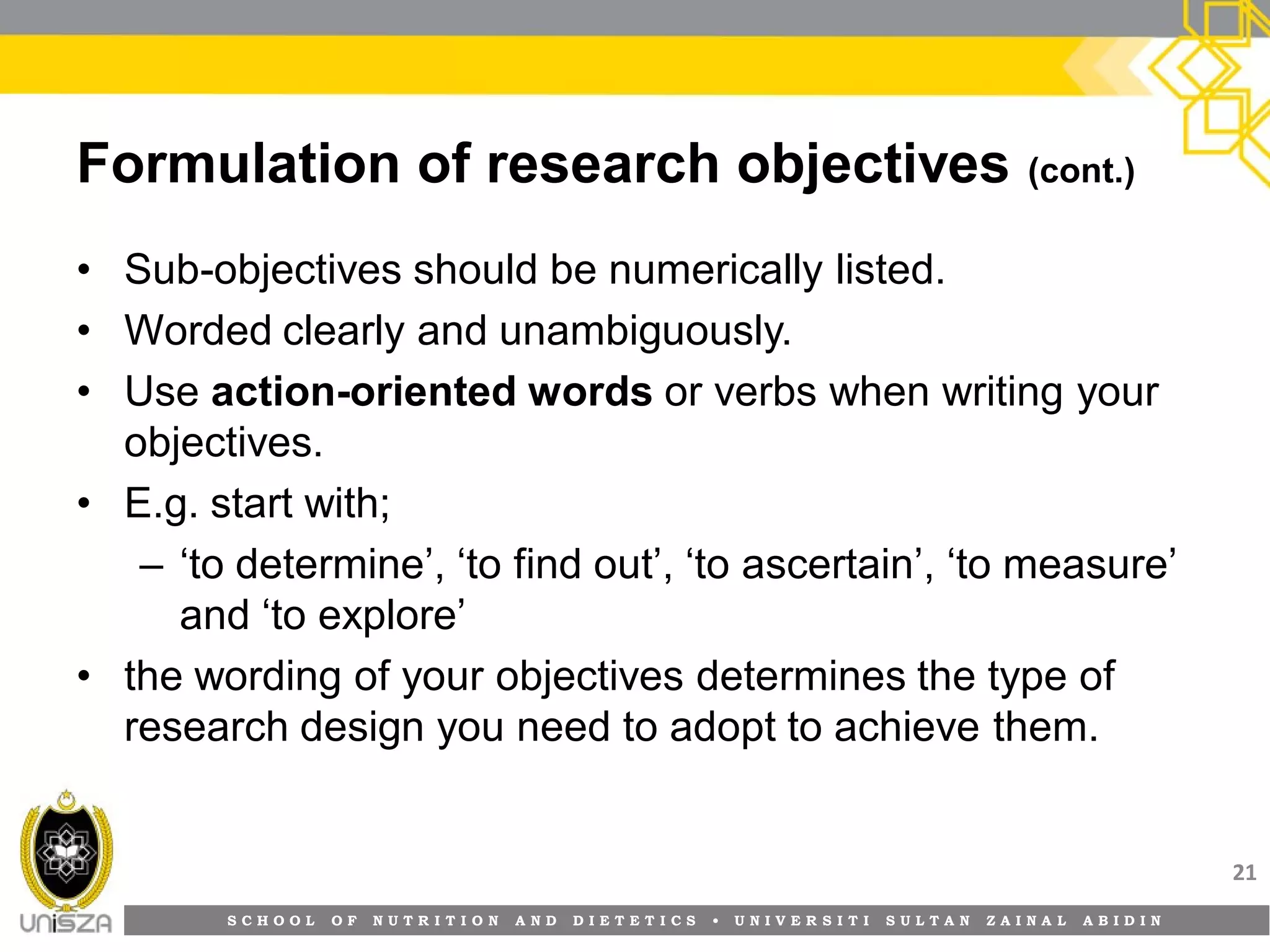
Formulation of research objectives (cont.)
• Sub-objectives should be numerically listed.
• Worded clearly and unambiguously.
• Use action-oriented words or verbs when writing your
objectives.
• E.g. start with;
– ‘to determine’, ‘to find out’, ‘to ascertain’, ‘to measure’
and ‘to explore’
• the wording of your objectives determines the type of
research design you need to adopt to achieve them.
21
22.
S C HO O L O F N U T R I T I O N A N D D I E T E T I C S • U N I V E R S I T I S U L T A N Z A I N A L A B I D I N
Functions of research objectives
• Focus the study (narrowing it down to essentials).
• Avoid the collection of data which are not strictly
necessary for understanding and solving the problem
you have identified.
• Organize the study in clearly defined parts or phases.
22
23.
S C HO O L O F N U T R I T I O N A N D D I E T E T I C S • U N I V E R S I T I S U L T A N Z A I N A L A B I D I N
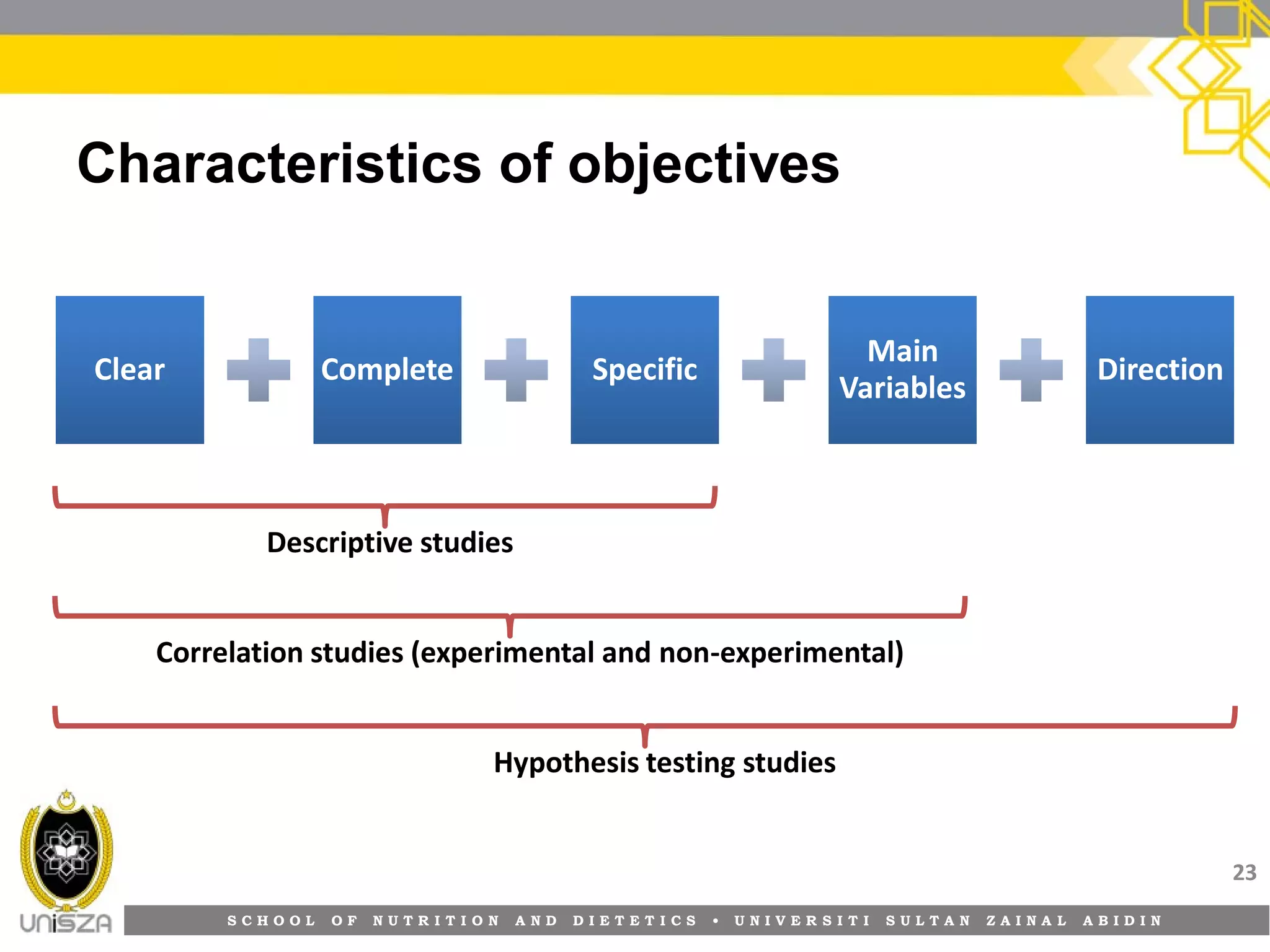
Characteristics of objectives
23
ClearClear CompleteComplete SpecificSpecific
Main
Variables
Main
Variables
DirectionDirection
Descriptive studies
Correlation studies (experimental and non-experimental)
Hypothesis testing studies
24.
S C HO O L O F N U T R I T I O N A N D D I E T E T I C S • U N I V E R S I T I S U L T A N Z A I N A L A B I D I N
Establishing operational definition
• Working definitions or operational definitions are
pre-defined concepts that you plan to use either in your
research problem and/or in identifying the study
population in a measurable form.
• Used only for the purpose of your study and could be
quite different to legal definitions, or those used by
others.
• Working definitions will inform your readers what exactly
you mean by the concepts that you have used in your
study to avoid ambiguity and confusion.
24